
Last Updated on October 5, 2026
By Florian Smeritschnig, former McKinsey Senior Consultant · Updated October 5, 2026
The BCG Pymetrics test is a roughly 25-minute online assessment of 12 short mini-games (now a Harver product) that measure cognitive and behavioral traits like risk tolerance, attention, and memory, not business knowledge.
In 2026, BCG still uses it in some offices, but it is office-dependent and is increasingly being replaced by the BCG Cognitive Test. Get the wrong information and you either prep for a screen you will never see or walk in cold to one you will. I evaluated candidates at McKinsey and have coached 700+ people into MBB, so this guide gives you the current format, what each game tests, and how to actually prepare.
Key Takeaways
- The BCG Pymetrics test is 12 neuroscience-based mini-games, about 25 minutes total, taken from home. It measures traits, not business skills, so there are no “right” answers to memorize.
- Pymetrics the company no longer exists as a standalone brand. It was acquired by Harver in 2022, so newer materials may call this the “Harver” or “pymetrics by Harver” assessment.
- It is not a hard pass/fail filter. BCG reads your results alongside your resume and other screens, and describes Pymetrics as an inclusion tool.
- Whether you face it depends on your office, role, and year. Many offices now run the BCG Cognitive Test or the Online Case (Casey) instead. Confirm with your recruiter.
- You cannot “cram” a trait test, but you can remove the friction of unfamiliarity and lean into the tendencies that fit the consultant profile.
Is BCG Still Using the Pymetrics Test in 2026?
Sometimes, and it depends on your office. In 2026, BCG still deploys the Pymetrics games in parts of its recruiting funnel, usually as an early screen after the resume, but it is no longer BCG’s default online assessment everywhere. Many offices in Europe and Asia now run the harder, proctored BCG Cognitive Test or lean on the Online Case chatbot, Casey, instead. This is the single fact most guides on this topic get wrong, because they were written years ago and never revisited.
Two things changed since this test first appeared, and both matter for how you prepare.
First, Pymetrics is now Harver. The company that built these games was acquired by Harver in August 2022, and the standalone “pymetrics” product was folded into Harver’s assessment suite. The games themselves are largely the same, but the “pymetrics.com” you may have read about no longer runs as an independent site. If a recruiter or a newer prep page calls this the “Harver assessment,” they are talking about the same thing.
Second, BCG’s screening is consolidating. Over the last few years BCG has spread its early assessments across several formats: the Pymetrics games, the Online Case (Casey), the one-way video interview, the Consulting Career Assessment (CCA), and the newer Cognitive Test. BCG’s own interview-process page lists only human interview stages, which tells you these online screens are office-specific add-ons rather than one global step. The direction of travel is toward the Cognitive Test, which is harder to game and gives BCG a cleaner aptitude signal.
The practical takeaway is simple. Do not assume you will face Pymetrics because a blog said so in 2021. Ask your recruiter which online assessment your office uses this cycle, then prepare for that specific screen. If you want the full map of every firm’s tests, we keep it in our guide to consulting assessment tests. Click here for an overview of all BCG online assessments.
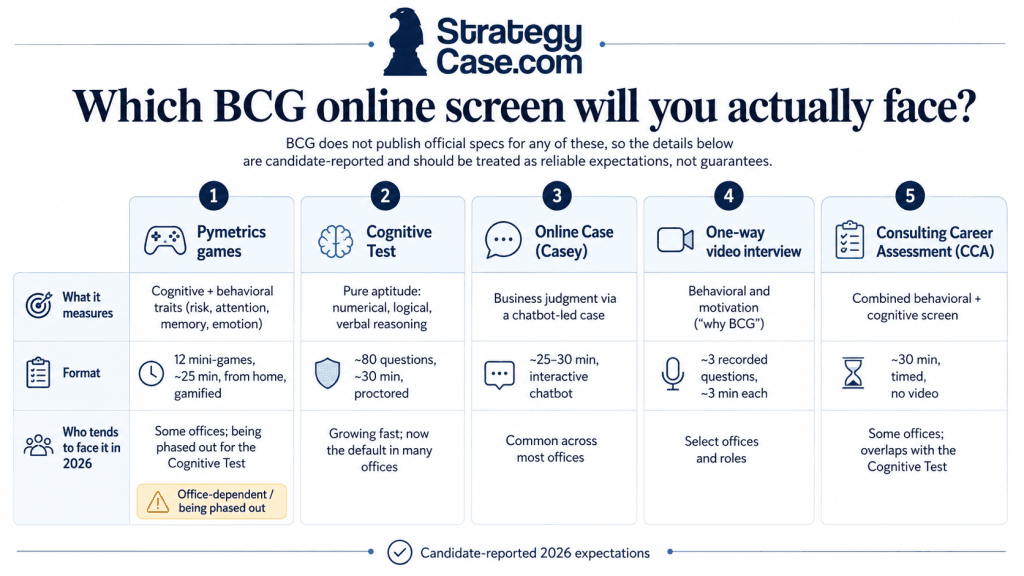
Which BCG online screen will you actually face?
BCG does not publish official specs for any of these, so the details below are candidate-reported and should be treated as reliable expectations, not guarantees.
| BCG screen | What it measures | Format (candidate-reported) | Who tends to face it in 2026 |
|---|---|---|---|
| Pymetrics games (this guide) | Cognitive + behavioral traits (risk, attention, memory, emotion) | 12 mini-games, ~25 min, from home, gamified | Some offices; being phased out for the Cognitive Test |
| Cognitive Test | Pure aptitude: numerical, logical, verbal reasoning | 80 questions, ~30 min, proctored | Growing fast; now the default in many offices |
| Online Case (Casey) | Business judgment via a chatbot-led case | ~25-30 min, interactive chatbot | Common across most offices |
| One-way video interview | Behavioral and motivation (“why BCG”) | ~3 recorded questions, ~3 min each | Select offices and roles |
| Consulting Career Assessment (CCA) | Combined behavioral + cognitive screen | ~30 min, timed, no video | Some offices; overlaps with the Cognitive Test |
What Is the BCG Pymetrics Test?
The BCG Pymetrics test is an online, game-based assessment that BCG uses early in recruiting to measure a candidate’s cognitive and behavioral traits. You play 12 short mini-games (about 25 minutes total) from your own device, and an algorithm scores your play against the profile of successful BCGers. It tests how you think and decide, not what you know about business.
That last point is what makes it different from BCG’s other screens. The Online Case and the Cognitive Test (to some degree) reward business acumen and quantitative skill. Pymetrics deliberately does not. It was built to capture the “softer” signals a resume cannot show, things like how you handle risk under time pressure, whether you plan before you act, and how you read other people. BCG’s stated aim was to widen the funnel to candidates whose resumes alone might not have cleared the bar.
Here is the honest version of why firms adopted this format. It lets BCG screen far more candidates cheaply (the algorithm scores you automatically, and you play from home), it surfaces traits a resume hides, and the gamified, math-light design reduces some of the background advantage that business and engineering students hold on traditional tests. Whether it fully removes bias is a claim the vendor makes, not one you should take at face value, but the intent is clear.
The traits BCG is looking at
The 12 games feed roughly 90 underlying data points, which Pymetrics (now Harver) groups into nine broad dimensions. There is no single “correct” profile, but certain tendencies show up more often in strong consultants than in the general pool. This table is our read from coaching candidates through these screens, not an official BCG key, so treat it as informed guidance.
| Dimension | What it captures | Tendency that fits the consultant profile |
|---|---|---|
| Attention | How steadily you focus and filter distraction | Consistent, methodical pace over erratic bursts |
| Focus | How you handle task-switching and multitasking | Adapts quickly without dropping threads |
| Learning | How fast you adjust to new rules and feedback | Updates behavior fast after errors |
| Decision-making | Logic versus gut | Leans on evidence and data over pure instinct |
| Risk tolerance | How you act under uncertainty | Balanced, neither reckless nor frozen |
| Fairness | How you judge and respond to unfair situations | Notices unfairness, values equitable splits |
| Effort | Big-picture versus detail | An 80/20 bias toward high-value effort |
| Emotion | How you read and manage emotions | Perceptive about others’ motivations |
| Generosity | Self-interest versus the team | Willing to put the team first |
The reason to know these is not to fake them. It is to stop yourself from playing against your own interests, for example, rushing every game to look “fast” when steadiness is what several games reward.
The 12 BCG Pymetrics Games (and What Each One Measures)
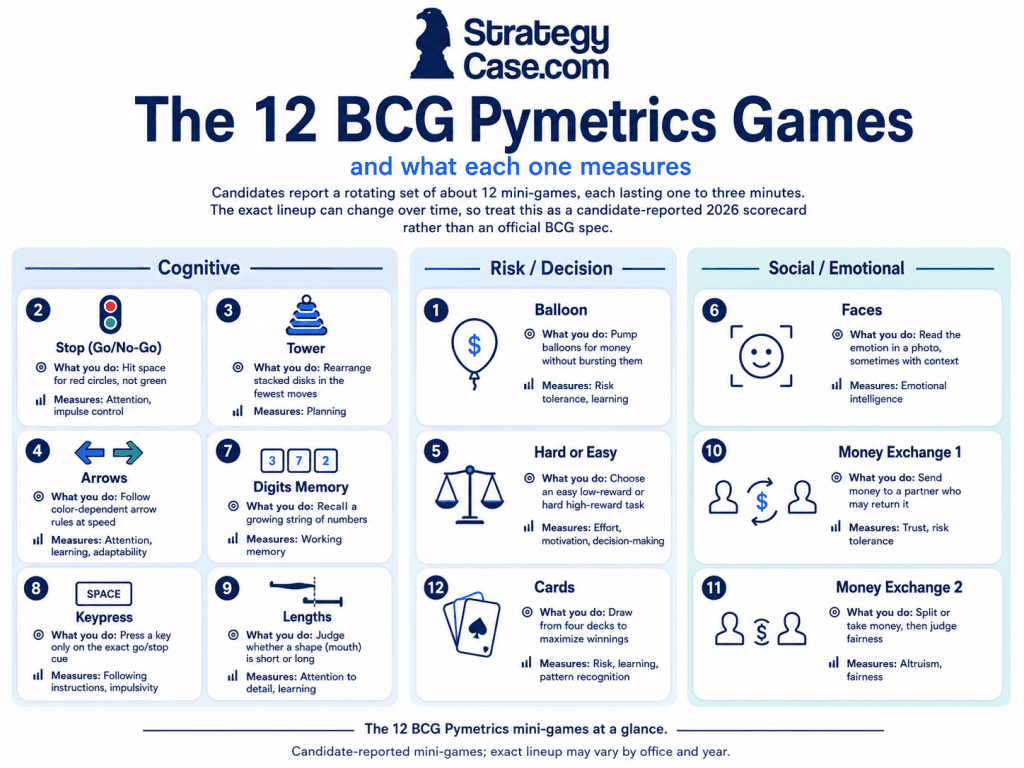
Candidates report a rotating set of about 12 mini-games, each lasting one to three minutes. The exact lineup can change, because firms adjust these games over time specifically to stop candidates from trading answers online. Start with the summary, then read the detail on each.
| # | Game | What you do | Primary traits measured |
|---|---|---|---|
| 1 | Balloon | Pump balloons for money without bursting them | Risk tolerance, learning |
| 2 | Stop (Go/No-Go) | Hit space for red circles, not green | Attention, impulse control |
| 3 | Tower | Rearrange stacked disks in the fewest moves | Planning |
| 4 | Arrows | Follow color-dependent arrow rules at speed | Attention, learning, adaptability |
| 5 | Hard or Easy | Choose an easy low-reward or hard high-reward task | Effort, motivation, decision-making |
| 6 | Faces | Read the emotion in a photo, sometimes with context | Emotional intelligence |
| 7 | Digits Memory | Recall a growing string of numbers | Working memory |
| 8 | Keypress | Press a key only on the exact go/stop cue | Following instructions, impulsivity |
| 9 | Lengths | Judge whether a shape (mouth) is short or long | Attention to detail, learning |
| 10 | Money Exchange 1 | Send money to a partner who may return it | Trust, risk tolerance |
| 11 | Money Exchange 2 | Split or take money, then judge fairness | Altruism, fairness |
| 12 | Cards | Draw from four decks to maximize winnings | Risk, learning, pattern recognition |
1. Balloon. You pump balloons to earn money and bank your winnings before they burst. Different colors burst at different points, so the game rewards spotting the pattern and adjusting. It reads your risk tolerance and how fast you learn from each pop.
2. Stop (Go/No-Go). Press the spacebar for red circles and hold back on green ones as they flash by. After a run of reds, the hard part is suppressing the reflex when a green appears. It measures attention and impulse control under time pressure.
3. Tower. A version of the Tower of Hanoi puzzle: rearrange colored disks to match a target in as few moves as possible. The game tracks both your move count and how long you pause before your first move, so thinking before acting is the point. It reads planning.
4. Arrows. Respond to the middle arrow for blue or black sets, and to the outer arrows for red sets, across roughly 135 rounds in three minutes. It stresses attention, learning the rules, and adaptability when the rule flips.
5. Hard or Easy. Choose between an easy task with a high success chance and low reward, or a hard task with a bigger payout but a lower and uncertain chance of winning. It reads effort allocation, motivation, and decision-making under probability.
6. Faces. Identify the emotion a person’s expression conveys, sometimes with a short text that agrees or conflicts with the face. It is a straight measure of emotional intelligence and how you weigh conflicting cues.
7. Digits Memory. Memorize and retype a digit string that grows by one number each round. Saying the digits out loud as they appear genuinely helps recall. It measures working memory under load.
8. Keypress. Press a key as many times as you can, but only between the exact “go” and “stop” cues. The real test is not speed, it is following instructions precisely and controlling impulsivity by not jumping the gun.
9. Lengths. Decide whether a feature (a mouth, or a mustache in the tutorial) is short or long, with rewards appearing only sometimes for correct answers. The tiny differences make it a test of attention to detail and learning from an unreliable reward.
10. Money Exchange 1 (Trust). You start with $10 and can send any amount to a partner; whatever you send triples, and they decide how much to return. Your willingness to send signals trust, and living with their response signals risk tolerance.
11. Money Exchange 2 (Altruism). You and a partner start even, but you get extra money and decide how to split or take, then judge the fairness of the outcome. It reads altruism and fairness when you hold the power.
12. Cards. Draw from four decks that each gain or lose money on hidden patterns, and finish with as much as possible. It rewards spotting which decks pay off, so it measures risk, learning, and pattern recognition.
A quick note on the old Lemonade Stand game. BCG’s original beta used a strategy game where you ran a lemonade stand across five business scenarios, mapped to BCG’s five approaches to strategy (Classical, Adaptive, Visionary, Shaping, and Renewal). It is not part of the current test. I mention it only because a few outdated guides still describe it as if it were live, and it could resurface.
You cannot pause a game once it starts, but you can take a short break between games. Read every instruction slowly, because a single misread can flip your intended answer.
How to Prepare for the BCG Pymetrics Test
Here is the truth most prep sites will not tell you, because they are selling a “Pymetrics course”: you cannot study your way to a specific score on a trait-based test the way you can for the Online Case or the Cognitive Test. There is no answer key. What you can do is remove the two things that quietly cost candidates points: unfamiliarity with the mechanics, and playing against the traits the games actually reward.
The goal is not a memorized solution. It is walking in calm, familiar with the format, and deliberate about how you play.
1. Get familiar with the game mechanics. The biggest edge is not being surprised. A few minutes a day on brain-training apps (Lumosity, Elevate, Peak, or the classic Dr. Kawashima’s Brain Training) primes you for the reaction-speed, memory, and pattern games so you lose no points to a slow start. You are building comfort, not a score.
2. Know the consultant-leaning tendencies, then play like yourself. Use the nine-dimension table above as a guide, not a mask. Aim for a steady, methodical pace, decide from evidence rather than pure gut, keep risk balanced, and show you can put the team first in the money-exchange games. Do not overcorrect into a caricature; the algorithm reads consistency across games, and a faked profile tends to contradict itself.
3. Read every instruction carefully. Small negligence, like reacting to the wrong color or starting before the cue, is the most common own-goal. Never rush the interface. If BCG offers a tutorial or demo, use it to strategize each game.
4. Set up the day properly. The test is short but intense, especially if you are not used to gaming under pressure. Take it well-rested, in a quiet room, with a stable connection, and with a bit of caffeine if that helps you focus. Treat it like a timed exam, not a casual app.
5. Expect variation and stay flexible. Everything here is accurate at the time of writing, but some games may be swapped for new ones, and each candidate gets a uniquely generated scenario. Do not try to replicate someone else’s results from a forum. Focus on the process and the traits you want to show.
What Happens After the BCG Pymetrics Test?
Because you take it from home, your results are scored automatically the moment you finish and sent straight to BCG. You will usually see a personal trait profile of your own, similar to the feedback screen Pymetrics shows candidates.

Your score is then read alongside the rest of your application, above all your resume and any other screens. This is the part candidates most often misunderstand: Pymetrics is not a standalone gate. In BCG’s own candidate guidance, the firm describes the games as “just one of several components” of evaluation, states results are “never used as a filter to eliminate candidates,” and frames Pymetrics as an inclusion tool for finding people with the traits of successful BCGers across different backgrounds.
Take that at face value: a middling game session will not sink a strong application on its own, and a great one will not rescue a weak resume.
From there, based on the full picture, you either advance to interviews or drop out of the process. Candidates we have coached typically hear back within one to two weeks, though this varies by office and cycle.
BCG Pymetrics Test: FAQ
Is the BCG Pymetrics test hard?
Not in the way a case or a math test is hard. There is nothing to solve and no business knowledge required. The difficulty is staying calm and consistent across 12 fast games under a ticking clock, especially the reaction and memory ones. Most candidates who struggle do so because the format surprised them, which a little familiarity fixes.
Can you fail the BCG Pymetrics test?
There is no published pass/fail score, and BCG says the games are never used as a filter to cut candidates on their own. Your profile is weighed with your resume and other screens. So you cannot “fail” it in isolation, but a result that clashes badly with the consultant profile, on top of a borderline application, will not help you.
How long is the BCG Pymetrics test?
About 25 minutes of play, with 12 mini-games of one to three minutes each. Add a few minutes for setup and instructions. You cannot pause mid-game, but you can breathe between games.
Can you practice for the BCG Pymetrics test?
You can prepare, but not by memorizing answers, because there are none. Practice the game mechanics with brain-training apps so nothing is unfamiliar, learn which tendencies fit the consultant profile, and take the test rested and focused. That is the honest ceiling on preparation for a trait-based assessment.
Does BCG still use Pymetrics in 2026?
In some offices, yes, but it is no longer BCG’s universal online screen. Many offices now use the BCG Cognitive Test or the Online Case (Casey) instead, and the Pymetrics product itself is now part of Harver after a 2022 acquisition. Confirm your specific screen with your recruiter.
What is the difference between the Pymetrics test and the BCG Cognitive Test?
Pymetrics measures behavioral and cognitive traits through games and has no right answers. The BCG Cognitive Test is a proctored aptitude test of numerical, logical, and verbal reasoning with correct answers and a score. They test different things, and BCG is shifting toward the Cognitive Test in many offices.
Related Guides
- The BCG Cognitive Test: the newer, harder aptitude screen that is replacing Pymetrics in many offices.
- The BCG Online Case (Casey): the chatbot-led case that tests business judgment.
- The BCG One-Way Video Interview: the recorded behavioral screen used in select offices.
- The BCG Consulting Career Assessment (CCA): the combined behavioral and cognitive screen.
- Consulting Assessment Tests: The Full Map: every firm’s online screen in one place.
The Bottom Line on the BCG Pymetrics Test
The BCG Pymetrics test is a short, game-based trait assessment, not a knowledge test, and in 2026 it is only one of several online screens BCG might send you, often no longer the default. Three things will serve you better than any memorized “solution”:
- Confirm the screen. Ask your recruiter whether your office uses Pymetrics, the Cognitive Test, Casey, or the CCA this cycle, and prepare for the right one.
- Remove the friction. Get familiar with the game mechanics so nothing surprises you, and play to the consultant-leaning tendencies without faking a profile.
- Keep it in perspective. Pymetrics is an inclusion tool read alongside your resume, not a gate that decides your candidacy by itself.
If you want to prepare for BCG’s online screens with insider structure instead of guesswork, the BCG Online Case Guide walks through every assessment with practice built from real test-takers, and you can also book one-on-one coaching with Florian for targeted feedback. Whichever screen your office throws at you, the candidates who prepare deliberately are the ones who move on to the interviews.
About the Author: Florian Smeritschnig is the founder of StrategyCase.com and a former McKinsey Senior Consultant who spent five years at the firm. He has delivered 2,200+ mock interviews and coaching sessions and coached 700+ candidates into McKinsey, BCG, Bain, and other top firms.

3 Responses
I just took the pymetrics test and got the most unique characteristics for learning concentration and attention. I am a little bit worried because I got ADD and probably that means nothing good. Is there an approach interpreting the direction? Otherwise, I will find out in the following week.
Hi Linus, the Pymetrics never is the sole decision criterion and is always looked at in combination with other things such as the resume, other tests, or the interviews. Don’t worry! All the best, Florian
[…] View Details […]