
Last Updated on October 5, 2026
By Florian Smeritschnig, former McKinsey Senior Consultant · Updated October 2026
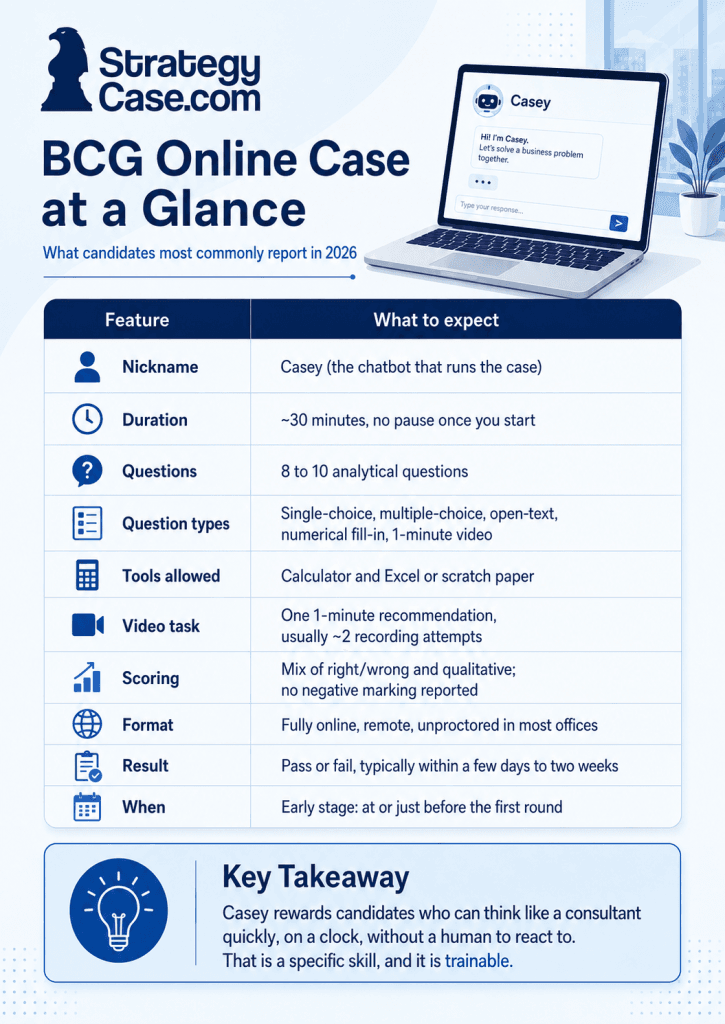
The BCG Online Case is a 30-minute, chatbot-led case interview, nicknamed Casey, that you take remotely early in BCG’s process. You answer 8 to 10 questions (multiple choice, open text, a numerical fill-in, and a 1-minute video recommendation), you can use a calculator and Excel, and you get a pass or fail result within a few days.
One honest caveat: BCG publishes no official specs, so the numbers here come from candidate reports and my own coaching. I evaluated candidates at McKinsey and have coached 700+ into MBB, so this guide covers exactly what Casey tests and how to beat it.
Key Takeaways
- The BCG Online Case is a 30-minute online case run by a chatbot called Casey, taken remotely, usually at or just before the first interview round.
- Expect 8 to 10 questions: single-choice, multiple-choice, open-text, a numerical fill-in, and a 1-minute video recommendation at the end.
- You can use a calculator and Excel, and candidates report no penalty for wrong multiple-choice answers, so never leave one blank.
- It tests real case skills (structuring, chart reading, math, and synthesis), not the pure aptitude the BCG Cognitive Test measures. They are different assessments.
- BCG does not publish official specs. Confirm with your recruiter which assessment your office uses before you spend hours preparing for the wrong one.
BCG Online Case at a Glance
Here is the format most candidates report in 2026. Treat the exact figures as candidate-reported approximations, not BCG-published fact.
What the BCG Online Case Is (and Why It’s Called Casey)
The BCG Online Case is Boston Consulting Group’s digital case interview. Instead of sitting across from an interviewer, you work a single business case with a chatbot named Casey that feeds you prompts, exhibits, and questions one screen at a time.
BCG rolled Casey out around 2020, starting in its Asian offices, then extended it to Europe and North America. By 2023, most BCG offices used some version of it. It replaced an older, static “BCG Online Case” (sometimes called the Potential Test) that ran closer to 45 minutes with about 23 questions and no video.
The purpose is straightforward. Casey lets BCG test whether you can actually solve a case, at scale, before it commits expensive partner and principal time to a live interview. It does two jobs at once: filter the applicant pool efficiently, and standardize how candidates are compared, since everyone faces the same case under the same clock.
One point that trips people up: the Online Case is a case, not an aptitude quiz. Where your office also uses the BCG Cognitive Test, that numerical-and-logical screen usually comes first, and Casey sits later as the case-skills check. The next section untangles which is which.
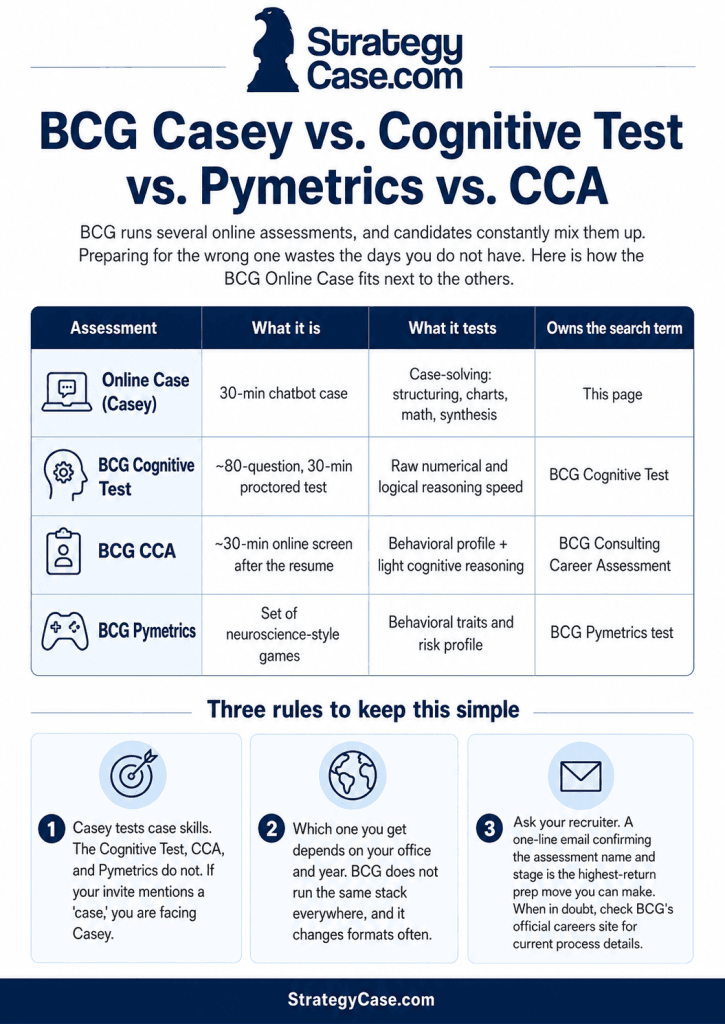
BCG Casey vs. Cognitive Test vs. Pymetrics vs. CCA
BCG runs several online assessments, and candidates constantly mix them up. Preparing for the wrong one wastes the days you do not have. Here is how the BCG Online Case fits next to the others. Click here for an overview of all BCG online assessments.
| Assessment | What it is | What it tests |
|---|---|---|
| Online Case (Casey) | 30-min chatbot case | Case-solving: structuring, charts, math, synthesis |
| BCG Cognitive Test | 80-question, 30-min proctored test | Raw numerical and logical reasoning speed |
| BCG CCA | ~30-min online screen after the resume | Behavioral profile + light cognitive reasoning |
| BCG Pymetrics | Set of neuroscience-style games | Behavioral traits and risk profile |
Three rules keep this simple:
- Casey tests case skills. The Cognitive Test, CCA, and Pymetrics do not. If your invite mentions a “case,” you are facing Casey.
- Which one you get depends on your office and year. BCG does not run the same stack everywhere, and it changes formats often.
- Ask your recruiter. A one-line email confirming the assessment name and stage is the highest-return prep move you can make. When in doubt, check BCG’s official careers site for current process details.
What the Casey Chatbot Actually Tests
Casey scores the same core competencies a live BCG interviewer would, just through a screen. Six show up again and again in candidate reports and in my coaching.
- Idea generation and creativity. Open questions reward candidates who can produce several distinct, relevant ideas, not one obvious answer.
- Business sense and intuition. You need a feel for how businesses make and lose money so your answers stay grounded in reality.
- Analytical rigor and logic. Casey checks whether your reasoning holds together and whether your conclusions actually follow from the data on screen.
- Mental math and comfort with numbers. You get a calculator, but you still need to set up the right calculation fast and sanity-check the output.
- Top-down communication. The pyramid principle matters even to a bot: lead with the answer, then support it. The open-text and video answers are graded partly on structure.
- Maturity. Steady, professional responses under time pressure, without panic or filler.

These are the same skills that decide a real BCG case interview. Casey is a preview of the round that follows, which is why treating it as a throwaway “online test” is a mistake.
The Four Themes Every Question Draws On
Across those competencies, Casey questions cluster into four themes. Drill these four and you have covered most of the test:
- Structuring: breaking a broad problem into clean, MECE buckets.
- Chart interpretation: reading exhibits and pulling the one insight that matters.
- Case math: percentages, growth rates, breakeven, and simple profit calculations, done at speed.
- Synthesis: turning your analysis into a clear recommendation, which is exactly what the video task demands.
The 5 Question Types You’ll Face
Casey mixes formats to test both your answers and your thinking. Knowing the five types in advance removes the “wait, what is this asking?” hesitation that eats your clock.
- Single-choice questions. Pick the one best answer from a list. Usually a calculation result or a logic conclusion.
- Multiple-choice questions. Select every correct option. Partial guesses hurt here, so reason through each choice rather than pattern-matching.
- Open-format questions. Type a short free-text answer. Casey grades your thought process, so structure the response and label your logic.
- Fill-in questions. Enter a specific number or complete a statement. This is where your math setup and calculator discipline pay off.
- Video recommendation. Record a 1-minute spoken recommendation, typically with about two attempts. You synthesize the case into a clear, answer-first message.
Because candidates report no negative marking on the choice questions, answer every single one. A reasoned guess is worth more than a blank, and a blank is a guaranteed zero.
How to Prepare for the BCG Online Case
There is no shortcut, but there is a right order. Preparation splits into two moves: understand the format, then drill the four themes until they are automatic under a clock.
Step 1: Learn the format cold
Half the pressure of Casey is uncertainty. Remove it. Reread the “At a Glance” table above until the flow feels familiar, so on test day your attention goes to the case, not the interface.
Step 2: Drill the four case skills
This is where the score is won. Spread short, focused sessions across the days you have:
- Structuring: practice building issue trees and frameworks from scratch, not memorized templates. Casey rewards original structure.
- Charts: train chart and exhibit interpretation so you extract the key data point in seconds.
- Math: rebuild speed and accuracy with targeted case interview math drills. Casey math is harder than most free practice tests, so overtrain it.
- Synthesis and communication: rehearse 60-second, answer-first recommendations out loud until they are tight.
Step 3: Simulate the real thing
Reading about Casey is not the same as sitting it. The closest practice is a timed, chatbot-style simulation that mirrors the question types and the clock. StrategyCase built BCG Online Case practice simulations for exactly this, so you can rehearse the format under pressure before it counts. If you only do one active-prep thing, make it a full timed run-through.
Candidates who want a broader benchmark can also try the McKinsey Solve assessment, which stresses a similar mix of speed, data, and judgment in a different wrapper.
Test-Day Tactics and Common Mistakes
Preparation gets you to the starting line. These habits protect your score once the clock is running.
Set up your environment. Use a stable connection, a working webcam for the video, and a quiet room. Have a calculator, scratch paper, and water within reach before you click start.
Adopt a finisher’s mindset. With roughly 30 minutes for 8 to 10 questions, you cannot afford to stall. Set a rough time budget per question and move on when it is spent. A good-enough answer submitted beats a perfect answer you never reach.
Read each prompt fully. The most common own-goal is answering the question you assumed instead of the one on screen. Slow down for two seconds to parse exactly what Casey wants.
The pitfalls that sink otherwise-strong candidates are predictable:
- Time pressure. People freeze on one hard question and lose three easy ones. Guard the clock.
- Underestimating the math. Casey math runs harder than typical free practice. If you only “kind of” prepared, this is where you crack.
- Format surprise. Meeting the open-text or video task for the first time on test day costs you composure. Rehearse both.
- Rattled by wrong answers. Since there is no confirmed penalty for a wrong choice, do not let a shaky question bleed into the next one. Reset and keep moving.
Frequently Asked Questions About the BCG Online Case
What is the BCG Online Case?
The BCG Online Case is a 30-minute digital case interview run by a chatbot named Casey. You solve one business case through 8 to 10 questions (multiple choice, open text, a numerical fill-in, and a 1-minute video recommendation) and receive a pass or fail result within a few days. BCG uses it early in the process to test case-solving skills at scale.
Is the BCG Online Case hard?
It is challenging mainly because of the clock and the isolation. The individual questions are fair, but 8 to 10 of them in 30 minutes, with harder-than-expected math and no interviewer to guide you, punishes anyone who has not practiced under time pressure. Candidates who drill structuring, charts, math, and synthesis beforehand find it manageable.
What is the difference between the BCG Online Case and the BCG Cognitive Test?
They are two different assessments. The Online Case (Casey) is a case interview that tests structuring, data reading, math, and synthesis. The BCG Cognitive Test is a faster, proctored numerical-and-logical aptitude screen with roughly 80 questions. Where an office uses both, the Cognitive Test usually comes first.
Can you use a calculator on the BCG Online Case?
Yes. Candidates report you can use a calculator and Excel or scratch paper during Casey. The challenge is not access to a calculator but setting up the right calculation quickly and checking that your answer makes business sense.
What happens if you fail the BCG Online Case?
A fail typically ends that application cycle, and you usually cannot advance without passing. BCG generally allows you to reapply after a waiting period, so review BCG’s reapplication timeline and use the gap to close the specific gaps that cost you.
How do you prepare for the Casey video recommendation?
Treat the 1-minute video like a mini synthesis. Lead with your recommendation in the first sentence, give two or three supporting reasons, and close with a next step or risk. Use your ~2 attempts: rehearse a structure, not a script, so you sound clear and composed rather than memorized.
The Bottom Line
The BCG Online Case is not a hoop to jump through, it is a preview of how BCG will judge you in every round that follows. Casey tests whether you can structure a problem, read a chart, run the math, and land a clear recommendation, all at speed and on your own. Those are the exact skills that separate offers from rejections, so the work you put in now pays off twice.
Learn the format so nothing surprises you, drill the four case skills until they are automatic, and rehearse at least one full timed simulation before you sit the real thing. When you are ready to practice under real conditions, work through the StrategyCase BCG Online Case practice simulations, or get targeted feedback with 1-on-1 coaching. Prepare the right way, and Casey becomes the easiest yes on your path to a BCG offer.
Related Guides
- BCG Cognitive Test: 80 Questions in 30 Minutes: the aptitude screen candidates most often confuse with Casey.
- BCG Consulting Career Assessment (CCA): the behavioral-plus-cognitive screen some offices send after the resume.
- BCG Pymetrics Test: the neuroscience-style games in BCG’s assessment stack.
- The BCG Case Interview: the live rounds Casey is preparing you for.
About the Author: Florian Smeritschnig is the founder of StrategyCase.com and a former McKinsey Senior Consultant who spent five years at the firm. He has delivered 2,200+ mock interviews and coaching sessions and coached 700+ candidates into McKinsey, BCG, Bain, and other top firms.
The format details in this guide reflect current candidate reports plus what he sees across that coaching pipeline, because BCG itself publishes no official Casey specifications.
