
Updated July 2026 by Florian Smeritschnig, former McKinsey Senior Consultant
You can grind through 50 practice cases and still walk into your McKinsey interview with no idea whether you’re ready. That’s the trap. Volume without feedback just cements the same mistakes, case after case.
A case interview feedback sheet fixes that. It’s a scorecard that rates your performance across the seven dimensions consulting firms actually grade on the same Insufficient-to-Distinctive scale McKinsey uses. Score every mock against it and your weak spots stop hiding.
I spent five years at McKinsey and evaluated candidates. Then I started coaching candidates for MBB interviews and published The 1%: Conquer Your Consulting Case Interview. Below is exactly how firms score you, the feedback sheet from the book I also give my coaching clients, and how to turn feedback into offers instead of motion.
Key Takeaways
- Consulting firms score case interviews on seven dimensions: Problem-solving, analytics, quantitative, creativity, communication, maturity and presence, business sense
- McKinsey rates each on a five-point scale from Insufficient to Distinctive. You need spikes (several “very good” and “distinctive” marks), not a flat row of “good.”
- Avoiding the bottom two ratings is not enough. Offers go to candidates who are clearly distinctive in at least a couple of dimensions.
- A feedback sheet only works if you score every practice case honestly and track the pattern over weeks, not once.
- Firms rarely give detailed feedback after real interviews, so building your own feedback loop is on you.
How Are Case Interviews Actually Scored?
Interviewers do not decide with their gut. After every case, the interviewer fills out a structured evaluation form, and those scores get debated in a committee where nobody in the room watched you perform. Your rating on paper is the only version of you that gets discussed.
Consulting firms grade each dimension on a five-point scale. The labels matter, because they tell you where the bar sits. Interviewers also add a written commentary on their overall impression, highlighting positive, negative, as well as neutral observations
| Rating | What it means | Impact on your candidacy |
|---|---|---|
| Insufficient (1) | Serious gaps: no real structure, math errors, lost the thread | Automatic reject |
| Adequate (2) | Below the bar: generic approach, needed heavy prompting | Reject in almost every case |
| Good (3) | Solid and correct, but nothing an interviewer remembers | Borderline; rarely enough on its own |
| Very Good (4) | Clearly above the bar: sharp, independent, well-communicated | Offer territory |
| Distinctive (5) | Top few percent: insight and poise the interviewer quotes in the debrief | Strong offer signal |
Here is the part most candidates get wrong. They aim to be “good” everywhere and assume a clean row of threes gets them through. It does not.
Firms look for performance spikes. A candidate who is Distinctive in structure and math but only Good on presence usually beats the candidate who is a flat Good across the board. The spike is what an interviewer remembers and defends in committee. Uniform competence is forgettable, and forgettable loses.
This is not a McKinsey quirk. BCG’s own case interview guidance tells candidates that what matters most is “how you approach the problem and the quality of your reasoning,” and McKinsey’s careers page says it wants to see how you “structure tough, ambiguous business challenges, identify important issues, deal with all the implications of facts and data, formulate conclusions and recommendations, and articulate your thoughts.”
Different words, same dimensions. Understanding how consulting case interviews really work starts with knowing you are being graded on all seven at once.
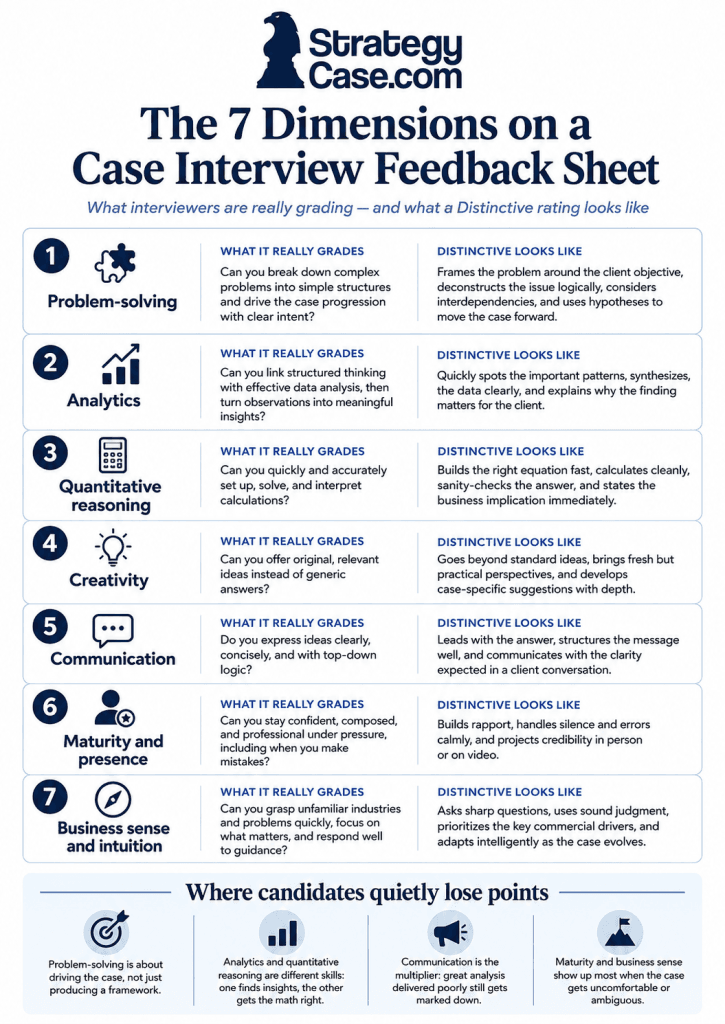
The 7 Dimensions on a Case Interview Feedback Sheet
Every credible case interview feedback sheet evaluates some version of the same seven dimensions. The wording varies by firm, but the underlying skills are remarkably consistent. Here is what each dimension is really testing and what a Distinctive rating looks like in the room.
| Dimension | What the interviewer is really grading | What “Distinctive” looks like |
|---|---|---|
| Problem-solving | Whether you can break a complex problem into a simple, logical structure and drive the case forward with clear intent | You frame the problem around the client’s objective, identify the key issues and interdependencies, and use hypotheses to actively steer the analysis |
| Analytics | Whether you can extract meaning from data, connect it to your structure, and turn observations into insights | You quickly identify the important patterns, synthesize them into a clear message, and explain why they matter for the client |
| Quantitative reasoning | Whether you can set up, solve, and interpret calculations quickly and accurately | You build the right equation immediately, calculate cleanly, sanity-check the result, and state the business implication without being prompted |
| Creativity | Whether you can generate original, relevant ideas rather than defaulting to generic case answers | You develop case-specific ideas, explore non-obvious angles, and add perspectives the interviewer has not had to lead you toward |
| Communication | Whether you can express your thinking clearly, concisely, and in a top-down way | You lead with the answer, structure your reasoning, and communicate with the clarity expected in a client discussion |
| Maturity and presence | Whether you remain confident, composed, credible, and professional under pressure | You build rapport naturally, handle silence and mistakes without unraveling, and come across as someone a client would trust |
| Business sense and intuition | Whether you can quickly understand an unfamiliar business problem, prioritize what matters, and exercise sound judgment | You ask sharp questions, focus on the key commercial drivers, form sensible hypotheses, and adapt quickly when new information or guidance appears |
A few things are worth calling out, because these are where candidates quietly lose points.
Problem-solving is about driving the case, not producing a framework. A tailored three-branch structure is useless if you cannot use it to decide what to analyze next. Strong candidates constantly connect the analysis back to the client’s objective, update their hypotheses, and move the case forward with intent.
Analytics and quantitative reasoning are not the same skill. Quantitative reasoning in a case interview is whether you can correctly calculate that profits will fall by $4.2 million. Analytics is whether you notice the decline is entirely driven by one customer segment, connect that finding to your initial hypothesis, and explain what the client should investigate next. Interviewers grade both.
Creativity does not mean throwing out 15 ideas. Generic brainstorms are easy. The real test is whether you can develop a smaller number of relevant, case-specific ideas with enough depth to be useful. “Increase marketing” is generic. Identifying a specific underserved customer segment, explaining why it is attractive, and proposing a route to reach it shows creativity and insight in case interview brainstorming.
Communication is the multiplier. Brilliant analysis delivered as a rambling stream gets marked down, because a consultant who cannot lead with the answer cannot effectively guide a client discussion. The strongest case candidates communicate top-down throughout the case, not only during the final recommendation.
Maturity and presence become most visible when something goes wrong. Interviewers watch what happens when you make a calculation mistake, misunderstand a chart, receive a challenge, or sit through five seconds of silence. Correcting yourself calmly and moving on can actually demonstrate more maturity than completing a perfectly smooth case.
Business sense is the glue between all seven dimensions. You can have a beautiful structure, flawless math, and polished communication and still struggle if you consistently focus on commercially irrelevant questions. Strong candidates develop an instinct for what matters, ask the questions that change the direction of the analysis, and respond intelligently to guidance without needing the interviewer to solve the case for them.
Download Your Free Case Interview Feedback Sheet
Here is the scorecard I give my StrategyCase coaching clients. Copy it, print it, and fill one out after every single practice case. Rate each dimension from 1 (Insufficient) to 5 (Distinctive), and force yourself to write one line of evidence for the score so you cannot fudge it later.

The sheet is worthless if you use it once. Its value comes from the pattern. Score ten cases over two weeks and the truth jumps out at you: maybe your problem-solving/structuring is consistently a 4 but your communication never clears a 3, or your math spikes on profitability cases and collapses on market sizing.
That pattern is your prep plan. It tells you the one or two dimensions to attack, instead of vaguely “doing more cases.”
How to Get Feedback That Actually Improves Your Case Performance
A scorecard tells you where you stand. Getting better requires feedback, and not all feedback is equal. There are three sources, and each has a ceiling.
Self-review. Record yourself solving a case, watch it back, and score it on the feedback sheet. This is non-negotiable and almost nobody does it, because watching yourself is uncomfortable. It works for the obvious stuff: filler words, slow math, structures that wander. Its ceiling is your own blind spots. You cannot catch the mistake you do not know is a mistake.
Peer practice. Practicing with another candidate is useful for reps and for learning to give a case. The catch is that two candidates tend to reinforce each other’s habits, and neither has evaluated real interviews, so neither can reliably tell a Good from a Distinctive. Peer feedback is better than none, but it plateaus fast.
Expert feedback. Someone who has sat on the other side of the table sees the spike-killers you and your peers cannot. That is the entire value of working with a coach who has evaluated real candidates: honest scoring against the real bar, plus the specific fix for the one dimension holding you back.
The bigger point is the one the prep industry keeps getting wrong. Ten cases you actually score and debrief beat fifty cases you run on autopilot. That is the whole gap between how candidates prepare and what firms test: motion feels like progress, but only feedback creates mastery.
Should You Ask for Feedback After a Real Case Interview?
You can ask, but manage your expectations, because most firms will not give you a real debrief.
Interviewers evaluate a high volume of candidates, and detailed written feedback creates legal and consistency risk for the firm, so the standard policy is a simple yes or no. Some offices and some individual interviewers will volunteer a line (“strong problem-solving, work on your synthesis”), but you cannot count on it, and demanding it works against you.
If you do ask, follow three rules:
- Ask after the decision, never during or immediately after the case. Asking mid-process signals you do not understand how recruiting works. Harvard Business Review’s guidance on asking an interviewer for feedback makes the same point: timing and framing decide whether you get an answer.
- Be specific and brief. “Is there one area I should focus on for next time?” gets a response far more often than “Do you have any feedback?”
- Stay gracious. Recruiters remember candidates who handle a rejection well, and re-applications are common. Burning the bridge costs you a future shot.
The most useful move happens before you ever hear back. The moment you leave the room, reconstruct the case and score yourself on the feedback sheet while it is fresh. Your own honest scorecard, filled out within the hour, is more actionable than anything HR will email you.
If you are a re-applicant to McKinsey, BCG, or Bain, that self-scored record becomes the map for exactly what to fix before round two.
Frequently Asked Questions
Do consulting firms give feedback after a case interview?
Rarely in detail. Most firms give a pass or reject decision only, because high candidate volume plus legal and consistency concerns make written feedback impractical. Some interviewers volunteer a quick pointer, but do not rely on it. Score yourself on a feedback sheet immediately after the interview instead.
How is a case interview scored?
Interviewers rate you on seven dimensions (problem-solving, analytics, quantitative, creativity, communication, maturity and presence, business sense) using a scale that runs from Insufficient to Distinctive. Those scores are then debated in a committee, so your written evaluation is what actually decides the outcome.
What is a good score on a case interview?
Avoiding the bottom two ratings is the minimum, not the goal. Offers go to candidates who score Very Good or Distinctive on at least a couple of dimensions. A flat row of “Good” is usually a reject, because interviewers reward memorable spikes over uniform competence.
How do I get feedback on my case interview practice without a coach?
Record every practice case, watch it back, and score it on a feedback sheet. Pair that with peer practice so you get an outside view. Self-review plus peer feedback covers the obvious errors; an expert is what you add when you have plateaued and cannot see why.
What should be on a case interview feedback form?
The seven graded dimensions, a 1-to-5 rating for each, a line of evidence per score, and an overall impression. A good form forces you to justify each rating so you cannot flatter yourself.
How many distinctive ratings do I need to get an offer?
There is no fixed quota, but as a rule of thumb you want to be genuinely distinctive in at least one or two dimensions and no lower than “good” anywhere. One serious weakness (an Insufficient) can sink an otherwise strong performance, so consistency protects you while spikes get you the offer.
Related Guides
- The McKinsey case interview: firm-specific expectations and how the scoring plays out at McKinsey.
- How to be MECE in a case interview: sharpen the structure dimension interviewers grade first.
- Case interview examples from McKinsey and others: real cases to run and score against your feedback sheet.
- Chart and data interpretation guide: how to deal with exhibits in case interviews.
Score Your Next Ten Cases, Not Your Next Fifty
Feedback is the difference between practicing and improving. The candidates who break into the top 1% are not the ones who do the most cases. They are the ones who score every case honestly, find their weak dimension, and fix it before the real interview.
Download the feedback sheet, score your next ten practice cases, and watch the pattern emerge. Then, if you want a former McKinsey consultant to pressure-test the gaps the sheet exposes, book a 1-on-1 coaching session with Florian and get scored against the real bar before your interviewers do it for you.
The feedback sheet also lives inside The 1%: Case Interview Workbook with 25 realistic practice cases, and the thinking behind it runs through The 1%: Conquer Your Consulting Case Interview. Both were built for exactly this: fewer cases, scored properly, until the skills firms test become second nature.
About the author: Written by Florian Smeritschnig, founder of StrategyCase.com and a former McKinsey Senior Consultant who evaluated candidates at the firm and has since delivered 2,200+ mock interviews and coaching sessions, helping 700+ candidates secure offers at McKinsey, BCG, Bain, and other top firms.

