
By Dr. Florian Smeritschnig, former McKinsey Senior Consultant. Updated September 24, 2026.
People leaving McKinsey, BCG, or Bain go in all different kinds of directions. A 2025 LinkedIn analysis of 1,644 former MBB consultants found the largest groups moved into other consulting and advisory roles (16.6%), financial services (13.7%), and software companies (13.1%). Private equity and venture capital together took 5.1%. Most leavers had spent 2 to 4 years at the firm.
If you’re at an MBB firm and thinking about leaving, or you’ve just been told it’s time, the folklore about consulting exit opportunities won’t help you plan. “MBB opens every door” comes from the loudest exits: megafund PE offers and forum threads. Plan around that and you run the wrong search, at the wrong time, from a weaker position than you need to.
I spent five years at McKinsey, watched colleagues leave at every level, and left myself in 2020. This guide uses sourced data, not forum lore, to show where MBB leavers land, how your firm and your level change the options, and how to run the search while you’re still staffed.
Key Takeaways
- PE is the loudest MBB exit, not the biggest. In the 2025 LinkedIn data, PE and VC employers took 5.1% of MBB leavers. Other consulting roles (16.6%), financial services (13.7%), and software (13.1%) each took more than twice that.
- Your level sets the menu more than your firm does. Director (12.3%), Manager (10%), and VP (8.8%) were common titles.
- Within MBB, your last 18 months of staffing matter more than the logo. Bain’s large private equity practice means more diligence exposure, but at every firm a sector track record is what recruiters read.
- Not every exit is voluntary, and that’s normal. McKinsey’s headcount fell from 45,100 to about 40,000 in 18 months, which it attributed to “normal attrition and performance review firings.” A counseled-out exit doesn’t have to land worse than a voluntary one.
- Start 12 to 18 months before you want to leave. The exits that go well begin with a chosen destination and a steered staffing history, not a resignation letter.
Where MBB Leavers Land: Consulting Exit Opportunities by the Numbers
Consulting exit opportunities, defined: the jobs open to you when you leave a consulting firm. For McKinsey, BCG, and Bain alumni, they span other consulting and advisory roles, strategy and operating jobs in industry, tech, financial services, startups, and investing (PE, growth equity, VC, hedge funds).
Firms don’t publish where their alumni go. The best public dataset I know of is a LinkedIn analysis of 1,644 people who left McKinsey, BCG, or Bain, run by the company Management Consulted between August and November 2025 and reported by Poets&Quants. It covers everyone from analysts to partners.
Where MBB leavers go, by employer industry
| Employer industry (LinkedIn tag) | Share of MBB leavers |
|---|---|
| Business consulting and services | 16.6% |
| Financial services | 13.7% |
| Software development | 13.1% |
| Hardware, electronics, and devices | 7.2% |
| Retail | 5.3% |
| Venture capital and private equity | 5.1% |
| All other industries | ~39% |
What level they start at
| Title at the next employer | Share of MBB leavers |
|---|---|
| Consultant or individual contributor | 31.1% |
| Director | 12.3% |
| Manager | 10.0% |
| Vice President | 8.8% |
| C-suite | 7.7% |
| Founder | 6.3% |
| Partner | 6.1% |
| CEO | 3.8% |
| Advisor | 3.6% |
| President | 1.3% |
Three other findings matter if you’re planning an exit. Most leavers joined private companies (62.8%) rather than public ones (18.7%). Company size split both ways: 37.2% joined companies with $1 billion or more in revenue, while 30.6% joined companies with $25 million or less. And the average tenure before leaving was 2 to 4 years.
Read the data with three caveats. First, LinkedIn tags the employer’s industry, not your job. A Director of Strategy at a bank counts as “financial services,” so corporate strategy roles are spread across every row. Second, it’s a three-month snapshot across all levels, so partner-level exits and analyst exits sit in the same numbers. Third, it doesn’t split results by firm, so no one can tell you from this data that “Bain sends more people to PE.” Firm differences come from how each firm’s work is structured, which I cover below.
The takeaway still holds: the average MBB exit is a strategy, operating, or advisory job at a private company, often at individual-contributor or manager level. That’s a good outcome. It’s also a different search from the one the forums describe.
The Main Consulting Exit Opportunities, Ranked by How Many Leavers Take Them
The order below follows the study’s industry shares where they map to a path. Each path has its own in-depth guide; this section tells you who each one suits and what your MBB years need to show.
1. Another Consulting or Advisory Role
The single largest bucket (16.6%) stays in consulting. That covers boutique and specialist firms, in-house strategy and transformation teams, PE-owned value-creation advisors, senior moves to Tier-2 firms, and independent consulting.
This is also my own exit. I left McKinsey in 2020, founded StrategyCase.com the same year, and I’m still an active consultant and advisor alongside it. Independent work suits people with a sector specialty and a few clients who would hire them directly. It suits people who only want a break from travel much less well.
What to show: a defined specialty (sector or function) and senior client relationships. Expect case interviews again at most firms, often harder than your MBB ones because you’ll be interviewed at a senior level.
2. Tech and Software: BizOps, Strategy, Product
Software (13.1%) plus hardware and devices (7.2%) make tech the biggest industry destination once you combine the two rows. MBB leavers typically join business operations (BizOps), strategy, chief-of-staff, and, less often, product management teams.
What to show: tech client work, comfort with metrics and product data, and something you shipped or ran rather than recommended. Product roles often test product sense, which consulting doesn’t train. The consulting to big tech guide covers level mapping and the interview loops.
3. Financial Services and Public-Markets Investing
Financial services employers took 13.7% of leavers. Most of these are strategy, transformation, and business-unit roles at banks, insurers, payment companies, and asset managers. A smaller group goes into public-markets investing as analysts at long/short or multi-manager funds.
What to show: financial services client work for the corporate roles; for investing, a sector you know deeply and real stock views. Funds hire few consultants and test you with a stock pitch, so this path rewards preparation that starts well before you apply. See consulting to hedge funds.
4. Corporate Strategy and Operating Roles in Industry
Corporate strategy doesn’t appear as its own row because it lives inside every industry: retail (5.3%), healthcare, industrials, consumer goods, and the rest. Director or VP of strategy is a common landing title for manager-level leavers, and many join a company they served as a client.
What to show: a sector you’ve worked in repeatedly, stakeholder management, and a credible story about why you want to own outcomes instead of advising on them. Pay is often flat or lower in cash at first; hours are usually better. The consulting to corporate strategy guide covers levels, pay, and which companies hire most.
5. Startups and Founding
6.3% of leavers started as founders, and the 30.6% who joined companies with $25 million or less in revenue include many early and growth-stage startups. Typical roles are chief of staff, BizOps lead, head of strategy, and general manager of a new business line.
What to show: evidence you can execute with thin resources, plus the financial runway to accept lower cash and uncertain equity. Vet the equity as seriously as a client’s business case; the consulting to startups guide shows how.
6. Private Equity, Growth Equity, and Venture Capital
PE and VC firms took 5.1% of leavers. This is the path with the most forum coverage and the tightest funnel. Megafund PE recruits on a compressed annual cycle through headhunters, tests LBO modeling, and prefers consultants 18 to 30 months into the job. Growth equity leans more on sector theses and less on debt. VC hires the fewest consultants and favors sector depth or operating experience.
What to show: diligence reps, a modeling test you’ve practiced for, and a sector point of view. Start with consulting to private equity, then consulting to growth equity and consulting to venture capital.
Also Common: MBA, Public Sector, and Nonprofits
Pre-MBA consultants often leave for business school and choose their real exit afterward. Government, multilateral, and nonprofit roles pay less but attract consultants with a public or social sector practice history. Neither shows up as a large industry row, but both are normal, respected exits.
McKinsey vs BCG vs Bain Exit Opportunities: What Changes When You Leave
Your firm changes your exit less than your staffing does. A Bain consultant who spent two years on retail strategy and a McKinsey consultant who spent two years on consumer diligence are competing for different jobs, and the McKinsey consultant is the stronger PE candidate. Where the firms do differ is in how their work, alumni infrastructure, and exit pressure are set up.
| McKinsey | BCG | Bain | |
|---|---|---|---|
| Titles at typical exit points | Business Analyst, Associate, Engagement Manager, Associate Partner | Associate, Consultant, Project Leader, Principal | Associate Consultant, Consultant, Manager, Associate Partner |
| Built-in pipeline | Largest firm, so the widest spread of sectors, functions, and public-sector work | Tech build and product work through BCG X | A leading PE advisory practice, so more diligence exposure |
| Alumni infrastructure | Alumni Center with career services and a searchable network | Alumni job board where alumni upload resumes and recruiters post roles | Alumni career center with open roles, directory, and job board |
| Exit pressure in 2024-2026 | Headcount down more than 10% from its 2023 peak; paid “on search” periods offered to some managers | Industry-wide slowdown: slower hiring and delayed start dates | Same industry-wide slowdown |
Leaving McKinsey
McKinsey is the most explicit of the three about up-or-out. You’ll usually hear where you stand at each review, which helps you plan. It has also been the most visible about exits lately. In April 2024, Fortune reported that McKinsey offered some UK managers up to nine months’ pay, with career coaching and no client work, to find their next job. By May 2025, its headcount had fallen from 45,100 to about 40,000.
One lesson from my own exit: the alumni network belongs to the firm, not to you. In 2025, McKinsey removed me from its alumni network for helping hundreds of candidates get into the firm. Treat the network as a relationship you maintain, and leave on terms that keep it open. For practice areas, the alumni network, and McKinsey-specific paths, read the McKinsey exit opportunities guide.
Leaving BCG
BCG’s differentiator for exits is BCG X, its tech build and design unit. If you’ve been staffed on build work, product and tech operating roles can read your experience more easily than a pure strategy CV. BCG also runs an alumni job board where alumni post resumes and recruiters post roles. Check the BCG hierarchy and salary guide for how your title translates, since “Consultant” at BCG is a post-MBA level and can read as junior outside the firm.
Leaving Bain
Bain has the most direct structural pipeline into private equity of the three. Its own site says it works with about 80% of the largest private equity firms in the world and lists 22,000+ due diligence cases. More diligence staffing means more PE-relevant stories when headhunters call. Bain also runs an alumni career center with a directory and open roles for its 25,000+ alumni. One translation issue: Bain’s “Manager” is the Engagement Manager equivalent, and older CVs may still say “Case Team Leader.” The Bain hierarchy and salary guide maps the levels.
Your Level Decides Your Menu
Most MBB leavers overestimate the title they’ll get. The data shows why: 31.1% start as individual contributors. The table maps where you are to where you can realistically land.
| Your level (McKinsey / BCG / Bain) | Typical tenure | Realistic landing titles | Paths that open widest |
|---|---|---|---|
| Business Analyst / Associate / Associate Consultant (pre-MBA) | 2 to 3 years | PE associate, strategy or BizOps associate, chief of staff at a startup, senior associate at a boutique | Megafund and middle-market PE, tech BizOps, startups, MBA |
| Associate / Consultant / Consultant (post-MBA or promoted) | 2 to 3 years | Senior manager of strategy, BizOps lead, PE associate or senior associate, growth equity associate | Corporate strategy, tech, growth equity, startups |
| Engagement Manager / Project Leader / Manager | 2 to 3 years at level | Director of strategy, head of BizOps, general manager of a business line, principal at a boutique | Corporate strategy and operating roles, later-stage startups |
| Associate Partner / Principal / Associate Partner | 2 to 4 years at level | VP or SVP, C-suite at smaller companies, PE operating partner, partner at a smaller firm | Senior operating roles, portfolio company leadership, own practice |
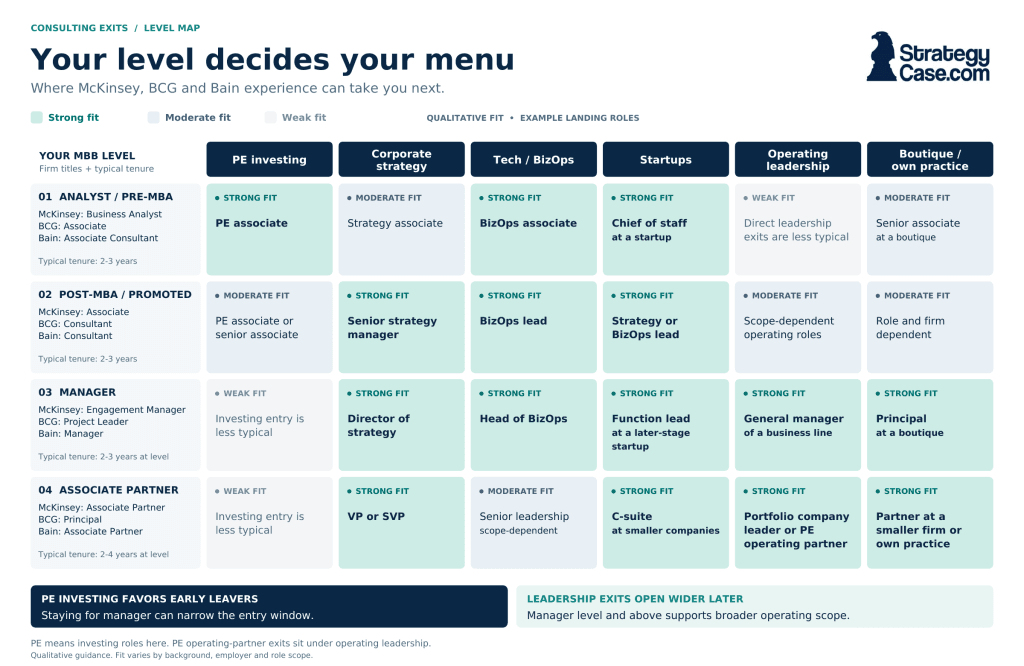
Two timing effects stand out. Megafund PE prefers you early, so staying for the manager promotion can close that door. Corporate leadership roles work the other way, and leaving one promotion too early can cost you a level at the new employer. The when to leave consulting guide covers each window in detail.
Leaving on Your Terms vs Being Counseled Out
MBB firms run on up-or-out: if you’re not progressing toward the next level, the firm eventually tells you to find your next role. With the industry slowdown of 2024 to 2026, more people are hearing that message, and at more senior levels. The consulting job market guide tracks the current state of layoffs and hiring.
If you’re leaving voluntarily, check whether you’re moving toward something or away from something. The exits that hold up come from a pull toward a specific role. The ones driven only by burnout often land in another high-intensity job, and 18 months later the same person is looking again.
If you’ve been counseled out, your transition period is your search. Handle it like this:
- Get the terms in writing. Length of the transition period, pay, bonus eligibility, whether you stay on client work, and how your departure will be described in references.
- Start in week one. A multi-month transition window disappears fast if you spend the first half recovering. Rest, but run the search in parallel.
- Line up two internal references. A partner and an engagement manager who have seen your best work are worth more than the firm name on your CV.
- Build your story around where you’re going. Hiring managers outside consulting know how up-or-out works. A clear reason for the destination matters far more to them than the mechanics of your exit.
Handled this way, a counseled-out exit can land just as well as a voluntary one. The mistake is treating it as a verdict on your ability rather than a signal about fit with one firm’s promotion model.
How to Exit Consulting While You’re Still Staffed
Whether you leave by choice or not, the search runs better from inside the firm. These seven steps apply to every destination.
- Pick the destination before you start the search. Write down the role, the type of employer, and why. If you can’t, you’re not ready to run a search; you’re ready to talk to alumni.
- Steer your last 12 to 18 months of staffing. Ask for diligence and value-creation work if you’re targeting PE, tech clients for tech roles, and repeated work in one sector for corporate strategy. Your staffing history is the evidence recruiters read.
- Build the skill the destination tests. LBO modeling for PE, product sense for tech product roles, a stock pitch for hedge funds, a P&L ownership story for operating roles. None of them comes free with MBB training.
- Work the alumni network early. Aim for 5 to 10 conversations a quarter with alumni who took the path you want. Alumni referrals often matter more than headhunters outside megafund PE.
- Route client offers through your partner. Many leavers join a former client, but engagement contracts sometimes restrict clients from hiring the team. Raise it openly; going around the partner costs you the reference.
- Time the resignation around the money. Check when your bonus pays out, your notice period (often a few weeks in the US, commonly up to three months in much of Europe), and any sign-on or tuition clawbacks. If you’re on a firm-sponsored MBA or PhD, read the return or repayment terms first. I did my PhD on a McKinsey-sponsored educational leave, and those terms shape your timing.
- Tell the firm late and gracefully. Share your plans with partners once you have an offer or are in final rounds, and leave your work in good order. Your former firm will keep supplying references and referrals for the rest of your career.
The Interviews You’ll Face on the Way Out
MBB consultants often assume the brand gets them through the next interview loop. It gets you the interview. Then each destination tests something specific.
| Destination | What they test | Where MBB consultants slip |
|---|---|---|
| Other consulting firms, in-house strategy teams | Case interviews at your level, plus fit | Rusty case math and structuring after years of managing teams instead of solving cases live |
| Private equity | LBO modeling test, paper LBO, case study or investment memo | The modeling test; most consultants haven’t built an LBO under time pressure |
| Corporate strategy | Case-style problem solving, stakeholder and leadership questions | Answering like an advisor instead of an owner of results |
| Big tech | Product sense, analytics, behavioral loops (such as leadership principles) | Product intuition and metrics fluency |
| Hedge funds | Stock pitch, sector depth, modeling | Having no real investment view |
| Startups | Work trials, operating cases, founder conversations | Presenting slides where the founder wants execution |
The case interview comes back more often than MBB leavers expect, because the biggest destination bucket is other consulting and strategy roles. If that’s your path, the case interview guide for experienced hires covers how interviewers raise the bar for senior candidates. StrategyCase’s Case Interview Academy is a quick way to rebuild live case speed if you’ve spent the last few years reviewing other people’s analyses.
Common Mistakes When Leaving MBB
- Leaving in a panic. Burnout exits go to whatever’s available. Fix the staffing or take leave first, then decide.
- Chasing PE because everyone else is. It’s 5.1% of exits for a reason: the funnel is narrow, and the hours often match or exceed consulting.
- Interviewing as a generalist. Every good exit rewards a sector or functional point of view. “I’m interested in healthcare” loses to a specific thesis.
- Expecting a title jump. Most leavers start at manager level. Negotiate on scope and pay, and accept that the title may reset.
- Burning bridges on the way out. Your partners and managers are your references for the next decade. Even a hard exit deserves a clean handover.
Frequently Asked Questions
Where do most people go after leaving McKinsey, BCG, or Bain?
Most go into another consulting or advisory role, financial services, or tech. In a 2025 LinkedIn analysis of 1,644 MBB alumni, those three industries took 16.6%, 13.7%, and 13.1% of leavers. Private equity and venture capital took 5.1%. Corporate strategy roles are spread across all industries, so they’re more common than any single row suggests.
Is it bad to leave MBB after 1 or 2 years?
No. Leaving after 2 years is a standard exit point, especially for pre-MBA consultants heading to PE, business school, or tech. The average tenure in the 2025 data was 2 to 4 years. Leaving before one full year is harder to explain, so have a clear reason tied to where you’re going.
Does consulting still have good exit opportunities in 2026?
Yes, but they’re narrower than the folklore suggests. The MBB brand still gets you interviews across industries. The 2024 to 2026 slowdown means more people are leaving at once, so a chosen destination, sector depth, and early preparation matter more than they did in 2021.
Are exit opportunities better from McKinsey, BCG, or Bain?
They’re broadly similar, and your staffing history matters more than the firm. The main structural difference is private equity: Bain works with about 80% of the largest PE firms, so its consultants tend to see more diligence work. At McKinsey and BCG, the equivalent edge comes from sector depth, client relationships, and, at BCG, tech build experience through BCG X.
Will being counseled out of McKinsey, BCG, or Bain hurt my next job search?
Rarely, if you handle it well. Hiring managers know how up-or-out works and care more about where you’re heading than how you left. Use the transition period to search, secure strong internal references, and build a clear story around your destination.
Do I need an MBA to exit MBB?
Only for some paths. Pre-MBA consultants regularly move into PE, tech, and startups without one. VC and some senior corporate tracks favor an MBA. Do one because your target exit needs it, not because you’re tired of consulting.
Related Guides
- Work-life balance in consulting: what the hours really look like, and when they’re fixable without leaving
- Consulting resume guide: how to rewrite MBB bullets into quantified, destination-specific impact
- Consulting networking: how to run alumni conversations that turn into referrals
- Experienced hires at McKinsey, BCG, and Bain: entry levels if you ever want to return to MBB
- Consulting vs investment banking: how the two tracks compare for finance and investing exits
The Bottom Line on Consulting Exit Opportunities
Consulting exit opportunities from McKinsey, BCG, and Bain are real, but they look different from the forum version. Most leavers move into other consulting roles, industry strategy and operating jobs, financial services, or tech, usually at individual-contributor or manager level, after 2 to 4 years. PE is a narrow path for early leavers with diligence experience. Your level and your last 18 months of staffing shape your options more than your firm’s name does.
So pick the destination first, steer your staffing toward it, build the skill it tests, and leave on terms that keep your references and network intact. If you want the full playbook for thriving inside a top firm and transitioning out of it with your firm’s support, get Consulting Career Secrets. If your next role means case interviews again, 1:1 coaching with me starts with a baseline of where your case skills stand today.
About the author: Dr. Florian Smeritschnig is the founder of StrategyCase.com and a former McKinsey Senior Consultant who evaluated candidates for the firm. Since 2020 he has delivered 2,200+ mock interviews and coaching sessions, and his clients have secured 700+ consulting offers, 340 of them at McKinsey, BCG, and Bain. He is the author of three books on consulting interviews and careers, including The 1%: Conquer Your Consulting Case Interview.
