
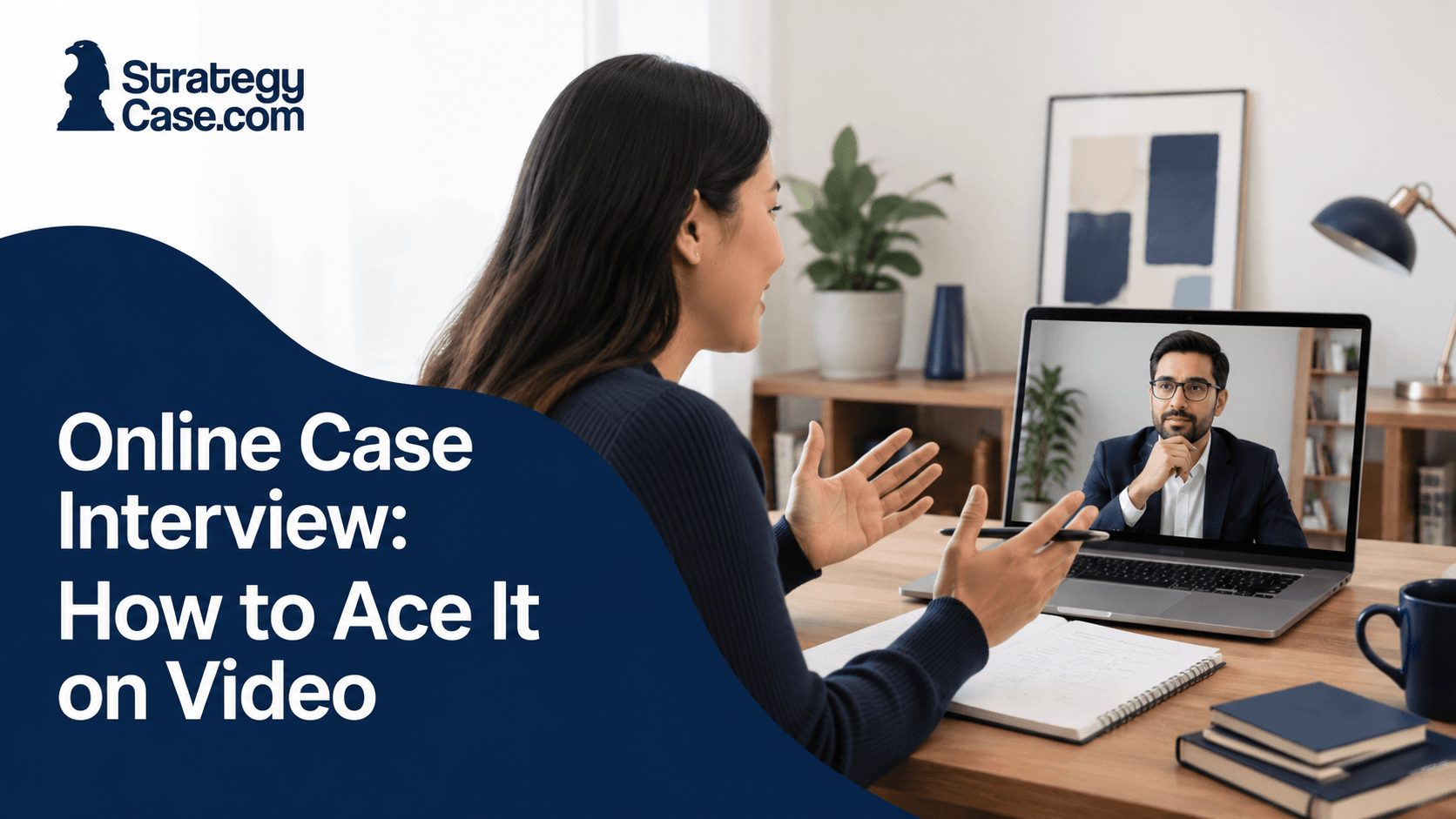
Updated July 2026. By Florian Smeritschnig, former McKinsey Senior Consultant.
An online case interview is a normal consulting case interview run over video, almost always on Zoom, and the firm scores it with the exact same criteria it uses in person: your structure, your math, and how clearly you communicate. What changes is everything around the case. Your setup, screen-sharing, and how you read an interviewer through a webcam.
If you have a virtual case interview coming up, that gap is where offers are won and lost. I spent five years at McKinsey as a Senior Consultant and have since delivered more than 2,200 mock interviews, a growing share of them over video. The candidates who treat the online format as an afterthought are the ones who freeze when the connection stutters or when an exhibit lands on screen.
This guide shows you how the remote format actually differs and how to prepare so the technology fades into the background.
Key Takeaways
- Online case interviews use the same evaluation criteria as in-person rounds: structure, quantitative reasoning, and communication. The format changes your setup, not the standard you are held to.
- Most McKinsey, BCG, Bain, and Big 4 first rounds are still virtual in 2026. Some final rounds have moved back to the office, so confirm your round with your recruiter.
- Your biggest controllable advantage is a tested setup: stable connection, clear audio, good camera framing, and a desk clear of distractions.
- Signpost more on video than you would in person. The interviewer loses most of the visual cues they would pick up sitting across from you.
- Calculators are still banned. Keep paper, pens, and a clean workspace ready for live math.
What is an online case interview? An online case interview is a case interview conducted remotely over a video platform such as Zoom or Microsoft Teams, where a consulting interviewer presents a business problem and assesses how you structure it, work the numbers, and communicate a recommendation. It is scored identically to an in-person case.
Are Consulting Case Interviews Still Online in 2026?
Yes. For most candidates, the first round is still a video case interview. After the pandemic pushed the entire industry onto Zoom, firms kept the virtual format for early rounds because it is faster and cheaper to schedule across offices and time zones. What has shifted is the final round: several offices now bring shortlisted candidates on-site again, partly to sell the firm and partly because senior partners prefer meeting in person.
The honest answer is that it depends on your firm, your office, and your round. Firms publish very little about this, and practices vary by region. The table below reflects what candidates consistently report in 2026. Treat it as a starting point and confirm the specifics with your recruiter.
| Firm | First round | Final round | Notes |
|---|---|---|---|
| McKinsey | Video (Zoom or Teams) | Often on-site | The Solve assessment sits before the interviews; cases are interviewer-led |
| BCG | Video | Mixed by office | The automated Online Case (Casey) or Consulting Career Assessment is a separate step from the human case |
| Bain | Video | Often on-site | Candidate-led, answer-first structure; SOVA or TestGorilla aptitude test is separate |
| Big 4 (Deloitte, PwC, EY, KPMG) | Video | Video or on-site assessment center | Increasingly hybrid, often with group exercises |
The practical takeaway: prepare for a virtual first round no matter which firm you target, and ask your recruiter whether the final round is remote or in the office so you are not surprised.
How an Online Case Interview Is Different From In Person
The case content does not change online. The way you deliver it does. Here are the six differences that actually matter, and what each one means for your preparation.
1. Exhibits arrive on screen, not on paper. In person, the interviewer slides a chart across the table. Online, they share their screen or send a file in the chat. You need to read a chart on a display, sometimes a small one, while still taking notes. Practice interpreting exhibits from a screen, not just from a printout.
2. The interviewer only sees your head and shoulders. When I interviewed candidates in person, I could read a lot before anyone spoke: how they laid out their paper, whether they wrote while thinking, when they hesitated. Over video, most of that disappears. The interviewer is working with a webcam view and a voice. That cuts both ways. A candidate who over-communicates and narrates their thinking looks more in control on camera than they would across a table. A candidate who goes silent to think looks, on a webcam, like they have frozen.
3. Technology can fail. Wi-Fi drops, audio cuts out, a screen-share freezes. None of this happens in a conference room. A visible tech problem does not fail you, but panicking over one can derail your composure for the rest of the case.
4. Your notes live off-camera. Your structure and math sit on paper below the frame or on a second screen. The interviewer cannot glance at your issue tree, so you have to describe it out loud instead of pointing at it.
5. Reading the room is harder. Subtle cues, a raised eyebrow, a lean-in, a glance at the clock, are muted or invisible on a webcam. You get less feedback about whether you are on the right track, so you have to ask more explicitly.
6. Energy has to travel through a screen. Flat delivery reads as disengaged on video far more than it does in person. You need slightly more energy, clearer enunciation, and deliberate eye contact with the camera to come across as present.

What actually changes when your case interview moves to video, and what does not.
How to Set Up Your Space, Tech, and Materials
Setup is the part of the online case interview you fully control, and most candidates under-invest in it. A stable, professional setup will not win you the offer on its own, but a bad one can lose it. Here is the checklist I give every candidate before a video round.
Test Your Tech Before the Day
Run a full rehearsal on the exact platform the firm uses, ideally with a practice partner on a real call.
- Check your internet connection, and use a wired connection or sit close to the router if you can.
- Test your microphone and headphones so your audio is clean. Wired earbuds with a mic usually beat a laptop speaker.
- Confirm your webcam works and that Zoom or Teams has camera and microphone permissions enabled.
- Have a backup ready. Know the dial-in number and keep your phone charged so you can switch to mobile data if your Wi-Fi dies.
- Close every other application so nothing hogs bandwidth or pops up mid-case.
Frame Your Camera and Light Your Face
Raise your laptop so the camera sits at eye level rather than looking up at you. Put your main light source in front of you, a window or a lamp, not behind you, so you are not a silhouette. Aim for a plain, tidy background. A blank wall beats a virtual background, which can glitch when you move or gesture.
Lay Out Paper, Pens, and a Calculator-Free Desk
Calculators are banned in an online case interview, exactly as they are in person. Set out several sheets of blank paper and a couple of working pens within reach but below the camera frame. Keep water nearby. Have your structure paper and a scratch sheet for math clearly separated so you are not shuffling under pressure.
Kill Every Distraction
Silence your phone and put it out of arm’s reach unless it is your backup line. Turn off desktop and browser notifications. Close the door, and if you live with others, tell them you are unavailable for the next hour. One Slack ping or a roommate walking in can break your train of thought at the worst moment.
How to Deliver Structure, Math, and Communication on Camera
Strong candidates get graded on the same three skills online as in person. The delivery is what you adapt.
Signpost More Than You Would In Person
Because the interviewer cannot see your paper, you have to say out loud what you would normally show. Lead with your headline, then walk through your structure top-down using clear labels: “I’d like to look at three areas. First, the market. Second, the company’s costs. Third, the competitive response. Let me start with the market.” This top-down habit is central to good case interview frameworks, and on video it is not optional. Numbered signposts are how the interviewer follows a structure they cannot see.
Handle Exhibits and Screen-Shares Calmly
When an exhibit appears on screen, do not rush. Take ten seconds to read the title, the axes, and the units out loud, then state what the data tells you before you react to it. If the shared screen is small or blurry, it is completely fine to ask the interviewer to zoom in or to confirm a number. That reads as careful, not weak.
Do Case Math Cleanly When They Cannot See Your Paper
The interviewer cannot follow your arithmetic on your notepad, so narrate it. State your approach first (“I’ll estimate the market as population times adoption times price”), then walk through the numbers step by step, calling out each figure. If you make a mistake, catch it out loud and correct it. Clean, spoken case interview math is a bigger differentiator on video than in person, because the interviewer is relying entirely on what you say.
One insider habit worth building: look at the camera, not at your own image, when you deliver a conclusion. Talking to your webcam is the video equivalent of eye contact, and it makes your recommendation land with far more authority.
McKinsey, BCG, and Bain: Online Case Formats Compared
The video wrapper is similar across firms, but the case style underneath is not. Match your preparation to your target firm.
McKinsey runs interviewer-led cases: the interviewer drives the case through a set sequence of questions, and you solve each one as it comes. Online, that means shorter back-and-forth exchanges and exhibits shared on screen at each step. McKinsey also runs the Solve assessment before the interviews, so your first “online” touchpoint is often the game, not a person. See the McKinsey case interview guide for the full format.
Bain and BCG run candidate-led cases (although Bain is experimenting with interviewer-driven formats too): you set the direction, form a hypothesis early, and drive toward a recommendation. Bain in particular rewards Bain’s answer-first approach, stating your best guess up front and then testing it. On video, candidate-led cases put even more weight on your signposting, because you are steering a conversation the interviewer can only hear.
A quick clarification, since the terms overlap. BCG’s “Online Case” often refers to the automated Casey chatbot assessment, which is a separate, machine-scored step. This guide is about the live case interview you do with a human over video. Both can be part of a BCG process, so check which one your invitation is referring to.
Common Online Case Interview Mistakes to Avoid
These are the errors I see most often when candidates move from in-person practice to a real video round.
- Treating setup as optional. Bad lighting, laptop-speaker audio, and an untested connection signal that you did not prepare. Fix these first.
- Going silent to think. A ten-second pause feels natural in a room and looks like a freeze on a webcam. Say “let me take a moment to structure this” before you go quiet.
- Reading exhibits too fast. Screens are smaller than handouts. Slow down, read the labels aloud, and confirm units before you interpret.
- Forgetting the interviewer cannot see your paper. If you do not say it, it did not happen. Narrate your structure and your math.
- Low energy. Flat delivery reads as disengaged on video. Bring slightly more energy than feels natural and talk to the camera.
- Ignoring the fit portion. Most online rounds pair the case with behavioral questions. Prepare your stories with the same care.
Do Not Neglect the Fit Interview Online
Almost every online round pairs the case with a fit interview, the behavioral questions about your leadership, teamwork, and drive. On video, structure matters here too: use a clear framework so your stories do not ramble when you cannot read the interviewer’s reaction. Our fit interview guide walks through how to build answers that hit the competencies each firm scores.
Frequently Asked Questions
Are consulting case interviews still online in 2026?
For most candidates, the first round is still a virtual case interview. Firms kept the video format for early rounds because it is easier to schedule. Some final rounds have moved back on-site, so confirm your specific round with your recruiter.
How is an online case interview different from an in-person one?
The case itself is identical and scored the same way. What changes is delivery: exhibits arrive on screen, your notes are off-camera, technology can fail, and the interviewer reads you through a webcam. You compensate by signposting and narrating more.
What do I need to set up for a virtual case interview?
A stable internet connection (ideally wired), clear audio through a headset, a webcam at eye level, front lighting, a tidy background, blank paper and pens for math, and a distraction-free room. Test everything on the firm’s platform beforehand.
Can I use a calculator or notes in an online case interview?
No calculator. Case math is done by hand, on paper, the same as in person. You can use blank paper for your own notes and structure, but pre-written frameworks or crib sheets are not the point of the exercise and interviewers can usually tell when you are reading from one.
Do McKinsey, BCG, and Bain interview online or in person?
All three run virtual first rounds for most candidates in 2026. Final rounds vary by office, with several bringing candidates on-site. McKinsey cases are interviewer-led; Bain and BCG cases are candidate-led.
How do I show my structure and math to the interviewer over Zoom?
You describe them out loud rather than pointing at your paper. State your structure top-down with numbered buckets, and narrate your math step by step, calling out each number and your approach. Assume the interviewer can only judge what you say, not what you write.
Turn the Online Format Into an Advantage
An online case interview rewards the same fundamentals as any other: a clear structure, clean quantitative reasoning, and confident communication. The difference is that on video, preparation shows up twice, once in how you solve the case and once in how you set up to be seen and heard solving it. Get the setup right, over-communicate your thinking, and match your style to your target firm, and the virtual format stops being a distraction and starts working in your favor.
The fastest way to get comfortable is to practice cases the way you will actually do them: over video, out loud, with someone giving you honest feedback. If you want that feedback from a former McKinsey Senior Consultant, book a 1-on-1 mock case interview with Florian and rehearse the online round before it counts. For the full picture of how cases work end to end, start with our complete guide to case interviews.
Related Guides
- How to Be MECE in a Case Interview
- Case Interview Examples From McKinsey and Others
- The Final-Round Case Interview, Explained
- Market Sizing Cases: A Step-by-Step Guide
About the author: Florian Smeritschnig is a former McKinsey Senior Consultant who spent five years at the firm, evaluated candidates, and has delivered 2,200+ mock interviews and coaching sessions. He founded StrategyCase.com in 2020 and has helped 700+ candidates land offers at McKinsey, BCG, Bain, and other top firms.
