
Last Updated on September 24, 2026
Updated September 24, 2026 | By Dr. Florian Smeritschnig, former McKinsey Senior Consultant
Most consulting jobs in Dubai and the Middle East at top firms never appear on a job board. McKinsey, BCG, Bain, Strategy&, Oliver Wyman, Kearney, and the Big 4 hire graduates, MBAs, and experienced professionals into Dubai, Riyadh, Abu Dhabi, and Doha through their own portals, using the same case and fit interviews as London or New York.
That is the trap in searching “consulting jobs in Dubai”. You get thousands of listings, and most of them are IT, engineering, sales, or recruitment-agency roles that happen to carry the word “consultant”. Apply to those and you end up in a different career from the one you were aiming for.
This guide covers the market you are most likely after: management and strategy consulting in the Gulf. You will see which firms hire, which office to target, what the jobs pay, how localization quotas change the odds for nationals and expats, and how to get through the process. I spent five years at McKinsey, now coaching candidates globally into top firms, and the Gulf-specific parts of this process are where I see strong applicants lose offers they could have won.
Key Takeaways
- Job boards mostly list implementation, IT, and specialist roles. Generalist strategy roles at MBB, Strategy&, and Tier-2 firms run through the firms’ own application portals, campus and MBA recruiting, and referrals.
- The Gulf is still hiring. The GCC consulting market was projected to grow 12% in 2025 to over $8.3 billion, but after PIF ordered spending cuts of at least 20%, firms hire against signed contracts, not forecasts.
- Saudi Arabia requires 40% of roles in covered consulting professions to go to Saudi nationals, and UAE mainland companies with 50+ staff must reach 10% Emiratis in skilled roles by the end of 2026. Nationals gain; expats need a stronger regional reason.
- Reported pay for a “management consultant” in the UAE runs from about AED 7,800 a month to a median of AED 500,000 a year, because those figures describe different jobs. Salaries carry no personal income tax in the UAE or Saudi Arabia.
- The interview bar matches global offices. What the Gulf weighs more heavily is your answer to “why this region, why this office”.
What Counts as a Consulting Job in Dubai?
Definition: A management consulting job in Dubai or the wider Middle East is a client-facing role at an advisory firm (McKinsey, BCG, Bain, Strategy&, Oliver Wyman, Kearney, or a Big 4 consulting arm) that solves strategy, operations, or transformation problems for Gulf governments and companies. Typical entry titles are Business Analyst, Associate, and Consultant.
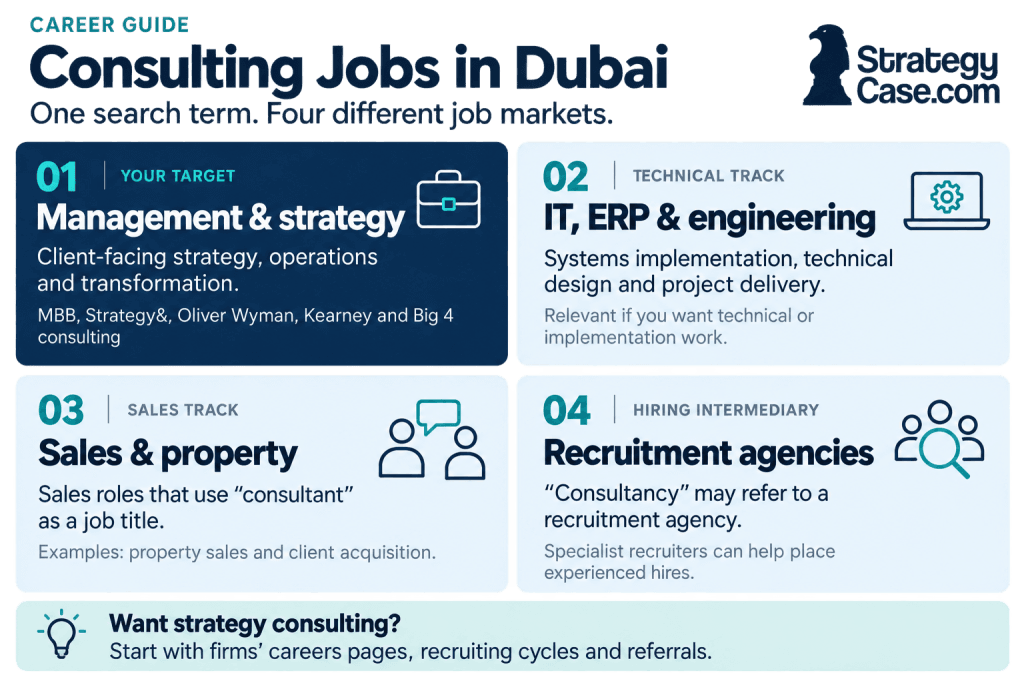
The search term covers far more than that. Type “consulting jobs in Dubai” into Google and the first page is Indeed, LinkedIn, GulfTalent, Bayt, Naukrigulf, Michael Page, and a few firms’ careers pages (checked September 2026). Those listings blend four different job markets:
| What the listing says | What the job usually is | Relevant if you want strategy consulting? |
|---|---|---|
| Management or strategy consultant at an advisory firm | Client-facing problem solving at MBB, Tier-2, or Big 4 firms | Yes: this guide |
| IT, ERP, or engineering consultant | Systems implementation, technical design, project delivery | Only if you want implementation-heavy firms |
| Sales, property, or client consultant | Sales roles that use “consultant” as a job title | No |
| “Consultancy” | In Gulf usage, often a recruitment agency | No, though specialist recruiters do place experienced hires |
The numbers show how thin the strategy slice is. In September 2026, Naukrigulf listed 441 management consulting vacancies in the UAE but only 36 in strategy consulting.
So if you want a generalist consulting role at McKinsey, BCG, Bain, or Strategy&, stop scrolling job boards. Those firms fill Gulf roles through their own portals, recruiting cycles, and referrals, and that is where your application effort belongs.
Is the Middle East Still Hiring Consultants in 2026?
Yes, though more selectively than during the 2022-2023 boom.
Demand keeps growing. The GCC consulting market was projected to grow 12% in 2025 to over $8.3 billion, nearly twice the pace of the US market, according to Source Global Research. Saudi Arabia, the largest Gulf market, grew 14.1% to $4.3 billion in 2024 and is still forecast to grow about 13% in 2026.
Buyers got stricter. For 2025, the Public Investment Fund ordered spending cuts of at least 20% across more than 50 of its development companies, with some budgets cut by up to 60%. Firms still hire, but against signed contracts instead of projected ones. The era of near-automatic Gulf offers is over.
Riyadh became the center of gravity. Since January 1, 2024, Saudi government entities only award contracts to firms with a licensed regional headquarters in the Kingdom. Leadership, hiring, and staffing followed the contracts from Dubai to Riyadh. In practice, a “Dubai” offer often comes with a Saudi client, which changes your working week (more on that below).
Which Consulting Firms Are Hiring in Dubai and the Middle East?
The firms below hire generalist and specialist consultants across the Gulf. The “where to apply” column matters most: for everything above the Big 4 line, the firm’s own portal is the front door.
| Firm | Main Gulf offices | Where to apply | Worth knowing as a candidate |
|---|---|---|---|
| McKinsey & Company | Abu Dhabi, Dubai, Riyadh, Doha, Kuwait City, Manama | McKinsey Middle East careers | Heavy national-transformation and government work. Same Solve assessment, case interviews, and PEI as every other office. |
| Boston Consulting Group | Dubai, Abu Dhabi, Riyadh, Doha | BCG Middle East jobs | Fast-growing Riyadh practice. Many processes include the Casey online case. |
| Bain & Company | Dubai, Riyadh, Doha | Bain careers portal | Smallest MBB footprint in the region, so leaner teams. Strong in sovereign wealth, private equity, and consumer work. |
| Strategy& | Dubai, Riyadh, Abu Dhabi, Doha, and more | Strategy& Middle East careers | Gulf presence since the Booz & Company Dubai office opened in 1995. In this region, a genuine peer choice to MBB. |
| Oliver Wyman | Dubai, Abu Dhabi, Riyadh, Doha | Oliver Wyman careers portal | Financial services, public sector, energy, and telecom. Quant-heavy cases. |
| Kearney | Dubai, Riyadh, and other Gulf cities | Kearney Middle East careers | Operations and procurement heritage. Runs Ruwwad, a dedicated analyst program for Saudi and UAE nationals. |
| Accenture | Gulf-wide | Firm portal and job boards | Technology and digital delivery at scale. Less pure strategy work. |
| Big 4 (Deloitte, PwC, EY, KPMG) | Every major Gulf city | Firm portals and job boards | Most of the hiring volume. The strategy arms (Monitor Deloitte, EY-Parthenon, PwC’s Strategy&) are a small slice of it. |
Beyond these, Arthur D. Little, Roland Berger, Alvarez & Marsal, Simon-Kucher, and OC&C all hire in the Gulf. If your profile matches a specialty (pricing, restructuring, telecom), these firms can be a smarter first application than the oversubscribed generalists.
For how the three biggest names compare globally, see our guide to the Big 3 consulting firms. If you are weighing the region’s strongest non-MBB brand, our Strategy& firm profile covers its process and positioning.
Dubai, Riyadh, Abu Dhabi, or Doha: Which Office Should You Apply To?
Recruiters read your office choice as a signal of intent. “Why this office” is a standard interview question in the Gulf, so pick the office before you write the application, not after.
| Office | Typical work | Best fit if you… | Watch out for |
|---|---|---|---|
| Dubai | Regional base for most firms’ commercial work; broadest industry mix | Want the easiest expat landing and broad exposure | Many Dubai-based consultants serve Saudi clients, so expect weekly travel |
| Riyadh | Government transformation, giga-projects, Vision 2030 programs | Want maximum scale and will live in or commute to Saudi Arabia | Saudization quotas, and a Sunday-to-Thursday week |
| Abu Dhabi | Sovereign wealth (ADIA, Mubadala, ADQ), energy, government | Bring finance, energy, or public-sector depth | Smaller offices, fewer seats |
| Doha | Sovereign wealth (QIA), energy, public sector | Want less competition per seat | Small market with fewer openings |
Applying to a Gulf office as a backup to London rarely works. The motivation question exposes it quickly, and the interviewer notices.
How Much Do Consultants Make in Dubai?
It depends entirely on which of the four job markets you mean, which is why published figures disagree so badly.
Self-reported data on Levels.fyi, drawn mostly from firms like Kearney, Oliver Wyman, and Bain, puts median total compensation for management consultants in the Greater Dubai Area at about AED 500,000 a year (roughly $136,000). The middle half runs from AED 420,000 to AED 640,000. The sample is small (23 submissions as of September 2026), so treat it as a direction, not a quote.
Indeed’s average for a “management consultant” in the UAE is about AED 7,800 a month. Same job title, very different job behind it.
Three things shape what a top-firm Gulf package is actually worth:
- No personal income tax. The UAE and Saudi Arabia do not tax salaries, so gross pay is close to take-home pay. That is the main reason Gulf offers compare well with London or Frankfurt.
- Housing and schooling are expensive. Dubai and Riyadh rents and international school fees absorb a real share of the tax advantage, especially for families.
- Base pay tracks global bands. The StrategyCase salary guides put Gulf base salaries at roughly 80 to 95% of US levels in dollar terms, depending on the firm. See the level-by-level numbers for McKinsey, BCG, and Bain.
Gulf Nationals, Expats, and the Localization Quotas
Two government policies shape who gets hired in Gulf consulting, and most candidate guides ignore both.
Saudi Arabia (Saudization). Since March 25, 2024, firms must fill 40% of roles in the covered consulting professions with Saudi nationals, up from 35% in 2023. That quota applies directly to the Riyadh offices where regional demand is growing fastest.
UAE (Emiratisation). Private companies with 50 or more employees must raise the Emirati share of their skilled jobs by 2 percentage points a year, reaching 10% by the end of 2026. The rule covers mainland companies, so how it applies depends on where a firm’s entity is registered.
What that means for you:
- If you are a Saudi or Emirati national, this is the strongest hiring tailwind in consulting. Firms compete for national talent at every level and run dedicated programs, such as Kearney’s Ruwwad analyst program with application cycles through the year. The interviews stay the same; the demand does not.
- If you are an expat, the quotas still leave most seats open to non-nationals. But they raise the bar on one part of your application: a believable reason to be in the region. Sector depth that the Gulf is buying at scale (energy, infrastructure, financial services, digital government) also carries more weight in experienced hiring.
Your Route In: Graduates, MBAs, Experienced Hires, and Nationals
Gulf offices hire at every level. Which door you use decides how you apply and what the firm weighs most.
| Your profile | Typical entry title | How to apply | What decides it |
|---|---|---|---|
| Final-year student or recent graduate | Business Analyst, Associate, or Consultant (varies by firm) | Firm portals, campus events, internships | Online assessment, case interviews, and a credible regional motivation |
| MBA graduate | Associate or Consultant (post-MBA) | MBA recruiting cycles plus direct applications to Gulf offices | Case performance and a specific office rationale |
| Experienced professional | Consultant to Engagement Manager, or expert tracks | Experienced-hire portals and referrals; specialist recruiters for Big 4 roles | Sector depth plus the full case process |
| Saudi or Emirati national | All levels, including national programs | Firm portals and programs such as Ruwwad | The same interviews, with stronger demand |
| IT, ERP, or engineering consultant | Implementation roles at the Big 4 and Accenture | Job boards work well here | Certifications and a delivery track record |
Experienced hires face a different process from graduates, including how firms set your level. Our guide to experienced hires at McKinsey, BCG, and Bain covers the lateral route in detail.
How to Get a Consulting Job in Dubai: Step by Step
- Decide which market you are in. Strategy consulting and implementation consulting need different CVs, different target lists, and different preparation. Applying to both at once usually means doing neither well.
- Pick your office before you apply. Match it to your story: government scale for Riyadh, commercial breadth for Dubai, sovereign wealth and energy for Abu Dhabi, a smaller market for Doha.
- Build a regional reason that survives a follow-up question. More on this in the next section, because it decides more Gulf offers than candidates expect.
- Apply through the channel that fills the role. Use the firm portals for generalist roles, and ask for referrals from people in your target office. Your CV has to pass a screener in about a minute, so build it the way our consulting resume guide describes.
- Clear the online screen. Most top firms now test before the first interview: McKinsey Solve, BCG Casey, and similar tools. Our overview of consulting assessment tests shows which firm uses what.
- Prepare cases and fit to the global bar. Gulf offices use the same case interviews and fit interviews as New York or London. A growth market does not mean an easier interview.
What Gulf Interviewers Listen For: The “Why This Region” Answer
I coached many candidates into Middle Eastern MBB offices, and collected their post-interview feedback. Plus, from my own McKinsey experience, I can tell you how the motivation question lands on the other side of the table. The case tells the interviewer whether you can do the work. The motivation answer tells them whether you will still be in the office in two years. In a region where much of the workforce arrives from abroad, that second question carries real weight, and it is where I see quite a few Gulf candidates fall short.
I once interviewed a Senior Consultant in a specific firm’s Dubai office. Asked for one tip for applicants, the answer was: “Know why you want to come to the region and specific firm.”
Answers that tend to fall flat:
- “The pay is tax-free.”
- “The market is growing fast.”
- Anything that sounds like London said no first.
Answers that hold up under a follow-up:
- A sector you have worked in that the Gulf is building at scale, and what you would bring to it
- Language skills, family ties, or prior work in the region
- A specific program you want to work on (a national strategy, a sovereign fund’s portfolio, an energy transition plan) and why it matters to you
Then pressure-test it. Say it out loud to someone and let them ask “why not London?” twice. If your answer changes the second time, you have not found it yet.
What the Job Looks Like Once You Are In
Gulf consulting work skews toward long, large programs: national transformation workstreams, sovereign wealth fund portfolio work, giga-project delivery and course correction, energy and energy-transition strategy, and digital government and AI programs. Government and semi-government clients fund most of it, and engagements run longer than typical European studies.
Two lifestyle facts surprise new joiners. Travel is constant but short-haul, usually within about a two-hour flight radius. And since the UAE moved to a Saturday and Sunday weekend in 2022 while Saudi Arabia kept Friday and Saturday, a Dubai resident serving a Riyadh client works across two calendars. Our Oliver Wyman Dubai career guide covers the split week, the real hours, and what tax-free pay is worth, through a first-hand interview with a consultant in that office.
FAQ: Consulting Jobs in Dubai and the Middle East
Which consulting firms are hiring in Dubai right now?
McKinsey, BCG, Bain, Strategy&, Oliver Wyman, Kearney, Accenture, and all of the Big 4 hire into their Gulf offices, alongside firms like Arthur D. Little, Roland Berger, and Alvarez & Marsal. For generalist strategy roles, check each firm’s own careers portal; job boards mostly carry implementation, IT, and specialist openings.
How much does a management consultant earn in Dubai?
At strategy firms, self-reported data puts median total compensation around AED 500,000 a year, with the middle half between AED 420,000 and AED 640,000. Broader job-board averages for “management consultant” sit near AED 7,800 a month because they include very different roles. There is no personal income tax on UAE salaries.
Can fresh graduates get consulting jobs in Dubai?
Yes. McKinsey, BCG, Bain, Strategy&, and Kearney all hire pre-experience candidates into Gulf offices as Business Analysts, Associates, or Consultants, mostly through their own portals, campus recruiting, and internships. Expect the full assessment and case process. Saudi and Emirati graduates also have dedicated routes, such as Kearney’s Ruwwad program.
Do I need to speak Arabic to get a consulting job in the Middle East?
Usually not. English is the working language for most commercial work in Dubai, Abu Dhabi, and Doha. Arabic becomes a real advantage for Saudi government engagements and public-sector clients, and it strengthens an application to Riyadh.
Can foreigners still get consulting jobs in Saudi Arabia?
Yes. Saudization requires 40% of roles in covered consulting professions to go to Saudi nationals, which still leaves most seats open to non-Saudis. Expect firms to test your regional motivation harder, and expect sector expertise to count for more in experienced hiring.
Is it easier to get a consulting job in Dubai than in London?
No. Gulf offices run the same online assessments, case interviews, and fit interviews as London, New York, or Frankfurt. What differs is the weight on motivation: a vague reason for choosing the region hurts you more in Dubai than a vague reason for choosing London would.
Related Guides
- How to become a management consultant
- The consulting job market in 2026
- How do the Big 4 consulting firms compare to MBB?
- How to stand out as a consulting applicant
The Bottom Line on Consulting Jobs in Dubai and the Middle East
Consulting jobs in Dubai and the wider Gulf are real, well paid, and still growing in number, but most of the listings you find by searching are not the jobs you want. The strategy roles run through the firms’ own portals. Riyadh drives demand. Localization quotas favor nationals. And the interview bar is identical to every other office, with one addition: a regional reason that holds up when someone pushes on it.
Pick your market, pick your office, build that reason, and prepare to the global standard.
If you are preparing for a Gulf office, start with the free StrategyCase Case Interview Foundations course: 40+ videos and 7+ hours of instruction on the skills every top firm tests. If you want an honest read on where you stand, book a consultation through my coaching service. My clients have secured 700+ consulting offers since 2020.
About the author: Dr. Florian Smeritschnig is the founder of StrategyCase.com and a former McKinsey Senior Consultant who evaluated candidates for the firm. Since 2020 he has delivered 2,200+ mock interviews and coaching sessions, and his clients have secured 700+ consulting offers, 340 of them at McKinsey, BCG, and Bain. He is the author of three books on consulting interviews and careers, including The 1%: Conquer Your Consulting Case Interview.
