

Updated July 2026. By Florian Smeritschnig, former McKinsey Senior Consultant.
The war for talent in consulting is the constant, high-stakes competition among firms like McKinsey, BCG, and Bain to attract and keep the small number of people who can actually do the work. It is a fight the consulting industry named itself in 1997, and one it has been running ever since.
This war has two fronts. Firms are fighting each other for the best people, and they are fighting to screen out everyone who cannot deliver. When you apply, you are standing in the middle of both. Understand how this talent war works, and a brutal screening process turns into something you can use.
I spent five years at McKinsey as a Senior Consultant and evaluated candidates on the other side of the table. Below is what the war for talent looks like from inside the firm, why it did not end with the 2024 layoffs, and what it means for you.
Key Takeaways
- McKinsey coined the phrase “war for talent” in 1997, so consulting did not just join this fight, it wrote the playbook the rest of the corporate world still uses.
- Firms compete for talent on four levers: pay, prestige, development, and exit options. Most candidates only ever see the first one.
- The war did not stop with the 2023 to 2024 layoffs. It narrowed. The Big 3 are now fighting hard for a different profile: people who can work alongside AI.
- For a candidate, the talent war is leverage. Knowing what firms are desperate for is how you stop being screened and start being recruited.
- Fewer than 1 in 100 applicants gets an offer at McKinsey, BCG, or Bain. The war for talent and the war to get in are the same war, seen from two sides.
What Is the War for Talent in Consulting?
The war for talent in consulting is the competition among consulting firms to attract, hire, and retain the limited pool of people who can do the demanding analytical and client work the business runs on. Because a consulting firm sells almost nothing except its people, that competition sits at the center of the industry, not at the edge of it.
Two forces keep the war hot. Demand for elite problem-solvers is high and fairly stable, even through downturns. Supply is thin, because the number of people who combine sharp reasoning, client polish, and the willingness to work the hours is small. When demand outruns supply, firms compete, and that competition is the war.
The phrase means something specific inside consulting that it does not mean at a normal company. For most employers, talent is one input among many. For McKinsey, BCG, and Bain, (and any other professional service firm) talent is the product. That is why the fight is sharper here than almost anywhere else.
Where the Term Came From: McKinsey, 1997
Consulting did not stumble into the war for talent. McKinsey named it.
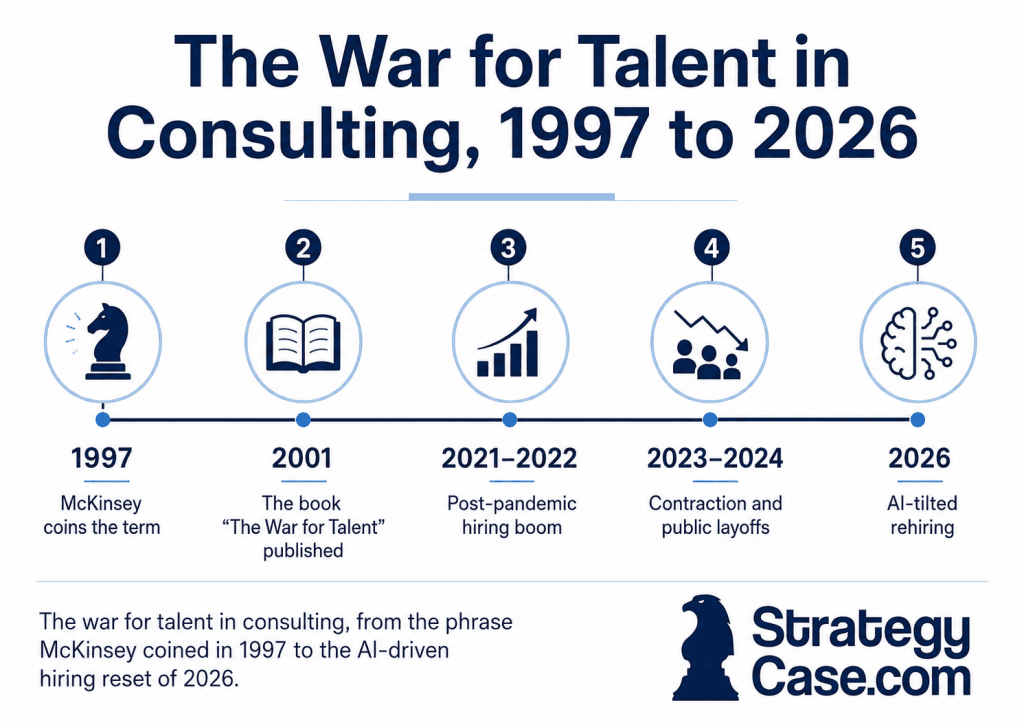
The phrase was coined by Steven Hankin of McKinsey & Company in 1997, and it went mainstream through the 2001 book “The War for Talent” by McKinsey consultants Ed Michaels, Helen Handfield-Jones, and Beth Axelrod, published by Harvard Business Review Press. The term and its origin are well documented. The book was built on a study of roughly 13,000 executives across 27 large companies, and its core argument was blunt: talent is a scarce strategic resource, and the companies that win are the ones that treat attracting and keeping it as a top priority rather than an HR chore.
That origin matters for two reasons. First, it is the clearest possible sign of how central people are to this industry. The firms that sell talent strategy to everyone else were the ones who realized, before anyone, that talent was becoming a battleground. Second, it means the ideas the whole corporate world now uses to fight this war, the “A player” mindset, differentiated rewards, aggressive recruiting from the best schools, were road-tested inside consulting first.
When you interview at McKinsey, you are being assessed against a talent philosophy the firm literally invented.
Why Consulting Is Ground Zero for the Talent War
Every industry competes for good people. Consulting competes harder because of how the business is built.
A consulting firm is a pyramid. A few partners sit on top, supported by a wide base of analysts, associates, and managers who do the analytical heavy lifting. The firm bills clients for that talent by the hour, so its revenue is a direct function of how many capable people it can put on projects. No bench of strong talent means no growth, full stop.
The model also runs on apprenticeship and “up or out.” Junior consultants are trained fast, pushed hard, and expected to rise or leave within a few years. That churn is deliberate, but it means the top of the funnel has to stay full at all times. The firm is not hiring to fill a seat. It is hiring to feed a machine that constantly consumes and promotes people.
Now add selectivity. Fewer than 1 in 100 applicants to McKinsey, BCG, or Bain ends up with an offer, based on what I have seen across the recruiting process and years of coaching candidates through it. The firms want a very specific profile, and they reject almost everyone. That is the war for talent from the firm’s side: not a shortage of applicants, but a shortage of applicants who clear the bar. If you want to understand where that bar sits, our guide on how candidates break into consulting lays it out.
How McKinsey, BCG, and Bain Compete to Attract Talent
When people think about how consulting firms win talent, they think about money. Money is real, but it is only one of four levers the Big 3 pull.
| Lever | What the firm offers | Why it works |
|---|---|---|
| Pay | Top-of-market base salaries, signing bonuses, and fast raises | Removes money as a reason to go elsewhere early in a career |
| Prestige | A globally recognized brand on your resume | Signals quality to every future employer and school |
| Development | Structured training, real client exposure, elite peers | Compresses years of learning into months |
| Exit options | An alumni network that opens doors for decades | Turns a hard 2 to 4 years into a lifetime of optionality |
The last two are what candidates underrate. A McKinsey, BCG, or Bain offer is not really a job offer, it is an option on your whole career. The compensation is strong from day one, but the deeper draw is what the brand and the network do for you afterward. Firms know this, and they sell the long game hard, because it is the part competitors cannot easily copy.
This is also why the war is fought at target schools years before graduation. Firms invest in campus events, sponsorships, and early-insight programs to build a relationship with strong students long before those students ever fill in an application. By the time recruiting opens, the firm wants you to already see it as the obvious choice.
Why Retention Became the Harder Half of the War
Winning talent is only half the fight. Keeping it is the half that has become harder.
The same qualities that make a consultant valuable to McKinsey make them valuable to a private equity fund, a tech company, or a startup that wants to hire them away. So firms fight a second, quieter war to hold on to their best people: faster promotions, sponsorship, interesting staffing, and the promise that the next two years will be worth it. The range of exit opportunities that makes an offer so attractive is exactly what makes retention so difficult.
I saw one side of this clearly during my time at McKinsey. Losing a cross-offer to BCG or another firm was almost unheard of, and the recruiting experience felt close to top-notch for nearly everyone who applied. The firm treated candidate experience as a competitive asset, because it was one. What shifted more recently is that the pressures of the pandemic era, the layoffs, the reputational hits, dented that experience in a way that would have been unthinkable a decade ago.
When a firm this good at the talent war starts to slip on candidate experience, it tells you how much the ground has moved.
How the Talent War Changed: Boom, Layoffs, and the AI Reset
The war for talent in consulting did not pause over the last few years. It went through three sharp phases, and 2026 sits at the end of the third.
The boom (2021 to 2022). Coming out of the pandemic, demand exploded and firms hired aggressively, pulling in record classes and stretching to grab talent before rivals could.
The contraction (2023 to 2024). The demand snapped back. Firms that had over-hired moved from quietly counseling people out to publicly announcing cuts, including McKinsey’s roughly 2,000 job reductions. For a moment, it looked like the war for talent was over.
The AI reset (2025 to 2026). It was not over. It narrowed. Hiring has recovered, but firms are now fighting for a different profile. The Big 3 are tilting toward engineers, data specialists, and consultants who are fluent with AI, while pulling back on the classic generalist hire. BCG’s tech and AI unit alone now runs into the thousands of people. Reporting from Bloomberg in 2026 shows AI now shaping how McKinsey, BCG, and Bain hire for entry-level roles, and Poets&Quants notes the firms are hiring a different profile rather than simply fewer people.
For where this is heading next, see our deeper analysis of AI’s impact on consulting hiring.
The lesson across all three phases is the same. The war for talent is not really about the raw number of hires. It is about who firms decide they cannot do without, and that definition keeps moving.
What the War for Talent Means for You as a Candidate
Most candidates read about the war for talent as an industry story. It is actually a personal one, because you are one of the two players in this game.
A recruiting process is a two-sided market. The firm is screening you, but it is also selling to you, and it is quietly competing with every other firm you might choose. That gives you more leverage than the screening process makes you feel you have. When you understand what a firm is desperate for right now, you can position yourself as exactly that person instead of as one more applicant to be filtered out.
In 2026, “exactly that person” increasingly means someone who is genuinely comfortable working alongside AI, who can structure a messy problem and use new tools to move faster on it. That is the profile the Big 3 are short of. If you can show it, you are on the winning side of the current talent war rather than the losing side of a keyword filter.
None of this removes the bar. Fewer than 1 in 100 still get through, and the case and fit interviews are unforgiving. But the mindset shift is real. Walk in knowing the firm needs people like you as badly as you need the offer, provided you prepare well enough to prove it. That is the whole idea behind StrategyCase: I have helped more than 700 candidates land offers at McKinsey, BCG, Bain, and other top firms by preparing them to walk in as the person the firm cannot afford to reject. If you want that kind of structured, insider preparation, our Case Interview Academy covers every step.
Frequently Asked Questions
What does “war for talent” mean?
The war for talent is the intense competition among employers to attract and keep skilled people when the supply of that skill is limited. In consulting, it describes how firms like McKinsey, BCG, and Bain compete, with each other and against other industries, for the small group of people who can do the work.
Who coined the term “war for talent”?
McKinsey & Company did. The phrase was coined by McKinsey’s Steven Hankin in 1997 and popularized by the 2001 book “The War for Talent,” written by McKinsey consultants Ed Michaels, Helen Handfield-Jones, and Beth Axelrod. Consulting did not just participate in the war for talent, it named it.
Is the war for talent in consulting still real in 2026?
Yes, but it has changed shape. After the 2023 to 2024 layoffs, hiring recovered, but firms are now competing hardest for AI-fluent, technical, and specialist talent rather than for generalists. The fight is narrower and more specific, not gone.
Why is consulting so competitive to get into?
Because a consulting firm sells its people, not a product. Its revenue depends directly on the quality of the talent it can put on client work, so it screens aggressively and rejects the large majority of applicants. Fewer than 1 in 100 applicants to MBB firms receives an offer.
How do consulting firms attract and retain talent?
They compete on four levers: top-of-market pay, a prestigious brand, fast development and training, and exit opportunities backed by a powerful alumni network. Retention is the harder half, because the same profile the firm wants is exactly what private equity, tech, and startups try to poach.
What does the war for talent mean for me as an applicant?
It means you have more leverage than the process makes you feel. Recruiting is a two-sided market, so knowing what firms are short of, currently, people who can work well with AI, lets you position yourself as a must-hire rather than as one more resume to filter.
Related Guides
- The future of consulting: where the industry and its hiring are heading next.
- Consulting exit opportunities: the career optionality that makes an MBB offer so valuable.
- The Big 3 consulting firms: McKinsey, BCG, and Bain: how the three firms differ and compare.
- The benefits of working in consulting: why the pool of applicants stays so deep.
Conclusion
The war for talent in consulting is not an abstract industry trend. It is the reason recruiting is brutal, the reason firms pay and promote the way they do, and the reason a McKinsey, BCG, or Bain offer is worth so much once you have it. Consulting coined the phrase in 1997, and in 2026 it is fighting the same war for a new kind of talent, one who is fluent with AI.
For you, the takeaway is simple. You are not a supplicant in this process, you are one of the two sides fighting it. The candidates who internalize that, and then prepare with real structure and insider feedback, are the ones who end up in the 1%.
If you want to walk into your interviews as the person a firm cannot afford to lose, start with StrategyCase. Book one-on-one coaching with a former McKinsey Senior Consultant, and prepare to win your side of the war for talent.
About the Author: Florian Smeritschnig is a former McKinsey Senior Consultant who spent five years at the firm and evaluated candidates on the other side of the recruiting table. Since then he has delivered 2,200+ mock interviews and coaching sessions and helped 700+ candidates win offers at McKinsey, BCG, Bain, and other top firms.

2 Responses
[…] his article covering the war for talent in consulting, Florian, a former McKinsey consultant turned coach for those trying to get a foot in at the top […]
[…] his article covering the war for talent in consulting, Florian, a former McKinsey consultant turned coach for those trying to get a foot in at the top […]