
Last Updated on May 11, 2026
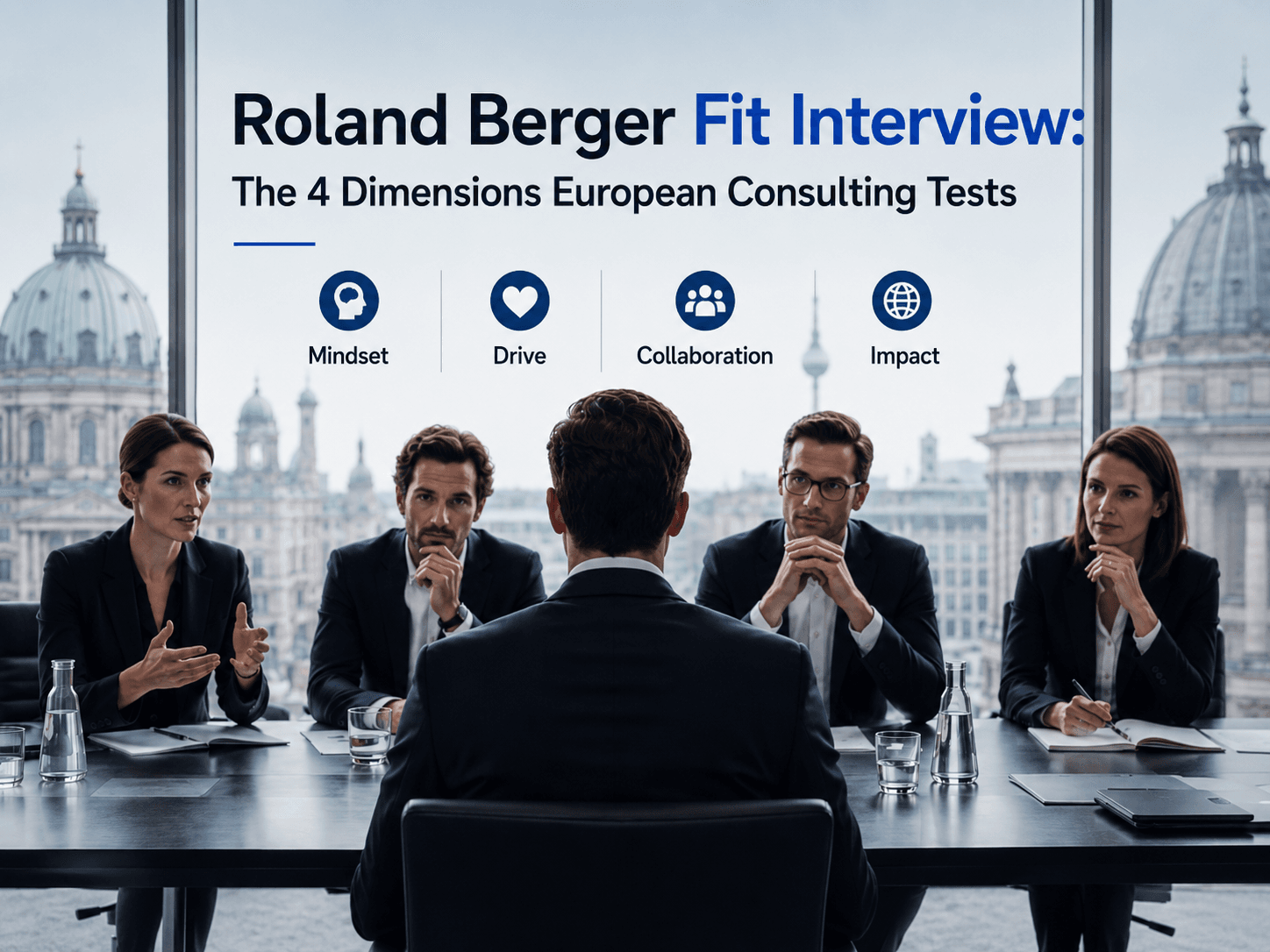
The Roland Berger fit interview tests something American consulting firms don’t explicitly test for: intellectual breadth. The German consulting tradition values Bildung — a broadly cultivated education that crosses disciplines, languages, history, and culture — as a marker of the kind of person who can sit comfortably with European industrial CEOs across decades-long client relationships. American firms test for analytical sharpness and behavioral signals. Roland Berger tests for those plus a fourth dimension that most non-European candidates don’t realize exists.
This guide reorganizes RB fit interview prep around the four dimensions the firm actually screens for, with attention to the specific questions that test each, what kills candidates on each, and the “why Roland Berger” answer that integrates all four into a coherent narrative. Direct comparison to both Oliver Wyman’s conversational interview and the Kearney fit interview is included since US-prepped candidates often need to adapt rather than relearn.
Key Takeaways
- Roland Berger filters on four dimensions: intellectual breadth (the Bildung tradition), presence and charisma (German consulting values Persönlichkeit), authentic European industrial interest, and entrepreneurial energy (founder-firm influence).
- Intellectual breadth is the most distinctive RB dimension and the most under-prepared by candidates from US-style consulting prep traditions.
- The “why Roland Berger” answer must integrate operational interest with European industrial commitment in ways that go beyond firm-specific knowledge.
- Behavioral content appears both in dedicated fit interview slots and embedded inside case discussions — the integration is more pronounced than at MBB.
- The partner-level interview in the final round tests intellectual breadth most directly. Most candidates underprepare for this and stumble on conversation about industries, history, or culture they haven’t engaged with.
The 4 Dimensions Roland Berger Hires For
Most fit interview prep focuses on standard dimensions: leadership, conflict, achievement, weakness, motivation. Those still matter at RB. But four firm-specific dimensions sit on top of that baseline, and your performance on these four is what differentiates RB-fit candidates from generic strong candidates.
Dimension 1: Intellectual Breadth (The Bildung Tradition)
The German concept of Bildung — cultivated education across disciplines, languages, history, philosophy, and culture — runs through European consulting culture more deeply than US prep ecosystems acknowledge. RB partners notice when candidates can engage substantively with a wide range of topics outside their formal training. They notice equally when candidates can’t.
How this dimension shows up in questions:
- Casual references to history, art, literature, or current events that test whether you engage or look blank
- Questions like “What’s an industry you find intellectually interesting outside your professional background?”
- Discussion of European political or economic developments that expects baseline literacy
- Open-ended questions like “What’s a book that changed how you think?”
What kills candidates on intellectual breadth:
- Inability to engage with topics outside your immediate professional or academic training
- Surface-level answers to questions about books, ideas, or industries
- Visible disinterest when conversation moves outside finance/strategy/operations
- Generic “I read business books” answers that don’t reveal genuine intellectual life
What wins on intellectual breadth:
- Authentic engagement with at least 3-4 topics outside your formal training (history, science, art, literature, contemporary politics, philosophy)
- Substantive views on books or ideas with specific examples, not generic recaps
- Comfort moving across topics in conversation
- Curiosity that reads as native, not performed
Dimension 2: Presence and Charisma (Persönlichkeit)
German consulting culture explicitly values Persönlichkeit — personality, presence, character — as a screening dimension. This isn’t theatrical confidence; it’s the calm, grounded presence of someone who can sit comfortably with a CEO and hold their own intellectually and personally. It’s hard to describe and immediately obvious in a room.
How this dimension shows up in questions:
- Open-ended introduction questions where the interviewer watches how you carry yourself
- Difficult questions designed to test composure under pressure
- Casual moments where the interviewer observes your demeanor when you think the formal evaluation isn’t running
- The partner interview specifically — partners are observing presence as much as content
What kills candidates on presence:
- Visible nervousness that doesn’t settle after the first few minutes
- Performed confidence that reads as inauthentic
- Inability to maintain composure when the interviewer pushes back
- Excessive deference (over-agreeing, hedging) or the opposite (overly assertive, dominant)
What wins on presence:
- Calm, grounded demeanor that doesn’t shift when the interviewer challenges
- Comfortable holding a substantive view without becoming defensive
- Genuine warmth without losing professional credibility
- Acknowledgment of uncertainty or disagreement without anxiety
Dimension 3: Authentic European Industrial Interest
RB’s client mix is heavily European industrial — automotive, aerospace, consumer/luxury, industrial goods, public sector. The firm filters candidates who treat these industries as scenery rather than as genuinely interesting subjects.
How this dimension shows up in questions:
- “Why are you interested in working with European industrial clients?”
- Questions about specific industries (automotive, luxury, aerospace) that expect substantive engagement
- Discussion of European industrial trends, regulatory developments, or competitive dynamics
- Implicit testing throughout case discussions when industries come up
What kills candidates on this dimension:
- Visible disengagement when conversation moves to industrial topics
- Generic interest answers that could apply to any industry
- Treating European industries as interchangeable
- Inability to discuss any specific industry with substance
What wins on this dimension:
- Authentic curiosity about how specific industries actually work
- Substantive engagement with at least one or two European industrial sectors
- Awareness of current trends in your target sectors
- Genuine interest in the long client relationships RB builds in these industries
Dimension 4: Entrepreneurial Energy (Founder-Firm Influence)
Roland Berger’s culture, shaped by its founder and reinforced by partner ownership, values entrepreneurial energy distinct from corporate consulting energy. Initiative, ownership, comfort with ambiguity, willingness to build something rather than execute existing playbooks.
How this dimension shows up in questions:
- “Tell me about a time you initiated something rather than executing on a plan.”
- Questions about ambiguity tolerance — projects without clear direction
- “If you weren’t applying to consulting, what would you be doing?” — testing for entrepreneurial inclinations
- Discussions of your career path that look for self-directed choices vs prescribed paths
What kills candidates on entrepreneurial energy:
- Stories that show executing well on someone else’s plan but never initiating
- Prescribed career paths with no self-directed elements
- Discomfort with ambiguity or projects without clear direction
- Energy that reads as institutional rather than founder-style
What wins on entrepreneurial energy:
- Stories about projects you initiated, not just executed
- Self-directed career choices with clear reasoning
- Comfort with ambiguity and incomplete information
- Energy that signals “I would build something here, not just deliver it”
The “Why Roland Berger” Answer That Integrates All Four
The “why this firm” question at Roland Berger is where the four dimensions integrate into a coherent narrative. The answer that wins isn’t just “why I want this firm.” It’s “why I am the kind of person this firm wants to hire.”
The integrated answer formula (90-120 seconds)
Component 1: Authentic European industrial interest (25-35 seconds).
A specific industry, sector, or business topic relevant to RB’s practice that you genuinely engage with. Not “I want consulting.” Not “I want operations.” Something concrete: “I’ve followed the European automotive transformation closely for the past three years…” or “The economics of the European luxury industry have been a fascination of mine since my undergraduate thesis on…”
Component 2: Roland Berger’s specific positioning (25-35 seconds).
Why RB specifically, beyond consulting in general. Reference the firm’s European identity, the founder-shaped culture, the partner-owned independence, or a specific recent firm publication or initiative. Not “I love your culture” — concrete firm content.
Component 3: Career trajectory alignment (25-35 seconds).
How RB fits the career path you’re already on or want to pursue. Connect your past, the firm’s strengths, and where you want to be in 5-10 years. The answer should make the RB choice make obvious sense for your specific arc.
Component 4: Cultural fit signal (15-25 seconds).
A brief but explicit signal that you understand what RB’s “entrepreneurship, excellence, empathy” cultural triad means and that you fit it. This can be embedded into the trajectory discussion or stated separately. Also mention your previous discussions with Roland Berger consultants that inspired you to apply.
What kills the “why Roland Berger” answer
- Treating Roland Berger as interchangeable with MBB or other strategy firms
- Generic “consulting at a top firm” framing
- No specific industry or sector engagement
- Pure career-driven rationale without intellectual or cultural fit signals
- Length over 2.5 minutes — answer reads as overprepared rather than substantive
- Disengagement when discussing European industrial topics
What wins the “why Roland Berger” answer
- Authentic engagement with a specific European industrial sector
- Reference to RB’s specific positioning, founder-shaped culture, or recent firm activity
- Honest career trajectory that makes RB choice obvious
- Cultural fit signal that’s specific rather than generic (make it personal and drop names of conversation partners)
The Partner Interview: Where Intellectual Breadth Decides
The Bewerbertag includes a partner-level interview (often the third or fourth session of the day). This session tests intellectual breadth most directly. Partners frequently use this slot to test whether you can hold a substantive conversation about industries, ideas, or current events outside the formal case structure.
Common partner-level questions and conversations:
- “What’s a recent business or economic development you’ve been thinking about?”
- “What’s an industry you find genuinely interesting and why?”
- Discussion of current European political or economic developments
- Conversations about books, ideas, or intellectual frameworks you find useful
- Open-ended questions about your career trajectory and longer-term aspirations
The candidates who lose partner conversations typically have one of three issues: surface-level answers that reveal lack of substantive engagement with the topic, performed intellectualism that reads as inauthentic, or rigid structured-thinking that fails to relax into a more natural conversational mode.
The candidates who win partner conversations are those who can sit comfortably across multiple intellectual topics, hold substantive views with appropriate humility, and engage with the partner as a peer in conversation rather than as a candidate being evaluated.
How Roland Berger’s Fit Differs from Oliver Wyman and Kearney
If you’ve already prepped for OW or Kearney fit interviews, here’s what to adapt for RB.
| Dimension | OW Conversational | Kearney Fit | Roland Berger Fit |
|---|---|---|---|
| Length | 30-60 min separate session | 12-18 min embedded in case | Mixed: dedicated session + embedded throughout |
| Top scoring trait | Substance, motivation, Financial Services (FS) depth | Humility, grit, collaboration | Intellectual breadth, presence, European industrial interest |
| Dominant cultural test | Quant intellectual maturity | Cultural fit + operations interest | Bildung + Persönlichkeit + entrepreneurial energy |
| “Why this firm” weight | High (FS depth focus) | High (operational interest focus) | Highest (4-component integration) |
| Storytelling format | Multiple stories, conversational | Multiple stories, embedded | Mixed: structured stories + open-ended intellectual conversation |
| Failure mode | Generic delivery, weak FS engagement | Wrong cultural signal, weak operational interest | Insufficient intellectual breadth, disengagement from European industrial topics |
The OW-prepped candidate’s adaptation: keep the substantive content, but add intellectual breadth across non-FS topics and authentic European industrial engagement. Different cultural signal — Bildung and Persönlichkeit instead of FS-specific intellectual depth.
The Kearney-prepped candidate’s adaptation: keep the cultural humility and team-first framing, but add intellectual breadth and European industrial engagement. The Bildung dimension isn’t tested at Kearney; you’ll need to build it for RB.
For broader fit interview frameworks that translate across firms, see the comprehensive fit interview guide.
Common Mistakes Candidates Make
After talking to candidates targeting Roland Berger across DACH, broader Europe, and global offices, three patterns keep showing up that aren’t well-documented elsewhere.
Mistake 1: Treating intellectual breadth as a “soft” dimension. US-prepped candidates often dismiss intellectual breadth as not really testable. RB partners genuinely score it, and the gap between candidates who’ve engaged broadly with ideas and those who haven’t is immediately visible. Build genuine intellectual range — read across history, philosophy, current events, and industries that interest you. Surface-level rehearsal fails.
Mistake 2: Generic “why Roland Berger” without European industrial substance. “I want to work in operations” is too vague. The answer that wins references specific European industrial work, specific RB practices, and a personal connection to the European industrial economy. Generic operational interest fails just as much as generic firm interest.
Mistake 3: Performed presence that reads as theatrical. Persönlichkeit is hard to fake. Candidates who try to perform calm grounded presence often come across as inauthentic. The fix is genuine work on calm, grounded demeanor — meditation, public speaking practice, mock interviews until your default mode is composed rather than anxious or performed.
A Compressed Prep Approach
Most candidates need 8-12 hours of focused prep on the Roland Berger fit interview specifically. Compressed approach:
Hours 1-3: Intellectual breadth foundation.
- Engage with 1-2 industries deeply through reading and conversation. Cover other industries too (current trends, opportunities, challenges)
- Build a list of 3-4 topics outside your formal training that you can discuss substantively
Hours 4-5: Story bank with all 4 dimensions.
- 6-8 detailed stories that demonstrate combinations of intellectual breadth, presence, European industrial interest, and entrepreneurial energy
- Each story 60-90 seconds, structured but delivered conversationally
- Practice naming the dimension each story demonstrates
Hours 6-7: “Why Roland Berger” integrated answer.
- Read 2-3 RB publications relevant to your target practice
- Draft and practice your four-component “why Roland Berger” answer
- Stress-test with a prep partner who plays skeptical interviewer
Hours 8-10: Partner-level conversation practice.
- Run 2-3 mock partner conversations focused on intellectual breadth
- Practice holding substantive 5-10 minute conversations on industries or ideas
- Refine demeanor and presence under sustained intellectual engagement
Hours 11-12: Integration and pressure-testing.
- Run a full mock final-round including individual case, group case, and fit interview
- Iterate on weak dimensions
Frequently Asked Questions
How is the Roland Berger fit interview different from McKinsey PEI?
McKinsey PEI is a separate ~20-minute discussion with a structured rubric scoring four dimensions (leadership, connection, drive, growth). Roland Berger’s fit content is a more rapid-fire question format, with a different rubric scoring intellectual breadth, presence, European industrial interest, and entrepreneurial energy. The cultural emphasis is more European and more breadth-oriented at RB.
What is Bildung and why does it matter for the Roland Berger interview?
Bildung is a German concept of cultivated education across disciplines, languages, history, philosophy, and culture. German consulting culture values Bildung as a marker of the kind of person who can sit comfortably with senior European executives across long client relationships. RB partners notice when candidates engage substantively with topics outside their formal training and when they don’t. It’s the most distinctive dimension of the RB fit interview.
How do I answer “why Roland Berger?”
Use a four-component integrated answer (90-120 seconds): authentic European industrial interest grounded in your background, RB’s specific positioning (founder-shaped culture, partner-owned, European identity, recent firm activity), career trajectory alignment, and cultural fit signal demonstrating you understand the “entrepreneurship, excellence, empathy” triad.
What questions does Roland Berger ask in the fit interview?
Common questions cluster around three themes: motivation and “why Roland Berger,” behavioral stories testing the four dimensions, and intellectual depth conversations testing breadth (especially in partner-level interviews). Specific questions include “what’s an industry you find intellectually interesting outside your professional background,” “tell me about a time you initiated something significant,” and open-ended discussions of current business and economic developments.
Is the Roland Berger fit interview easier than the case interview?
Different difficulty profile. The case interview tests structured thinking, group dynamics, and analytical depth. The fit interview tests cultural alignment, intellectual breadth, and authentic engagement with European industrial topics. Most candidates underprepare the fit relative to the case, particularly the intellectual breadth dimension.
Does Roland Berger ask brainteasers in the fit interview?
Rarely. The fit content focuses on personal stories, motivation, and intellectual conversation rather than brain teasers. Brainteasers can occasionally appear in case discussions but aren’t a primary fit interview component. For broader brain teaser preparation, see the consulting brainteaser course.
For preparation against the Roland Berger fit interview specifically, coaching with Florian is available. The Consulting Fit Interview Masterclass covers fit frameworks and answers that translate across firms.

