

Last Updated on September 22, 2026
Updated September 2026 · By Florian Smeritschnig, Former McKinsey Senior Consultant
An AI consultant in the US earns between roughly $95,000 and $300,000 in total compensation in 2026, and the range is that wide because “AI consultant” describes four different jobs, not one. Search the term and you get one blended average from job boards. It’s the single number that applies to nobody, and you end up negotiating against it.
Below is the pay for each of the four paths, at each level, with the sources. I spent five years at McKinsey and have since coached 700+ candidates into consulting offers, so I have seen offer letters from both sides of the table.
Key Takeaways
- “AI consultant” is not a job, it is four jobs. MBB AI strategy consultant, technical specialist inside a firm, Big 4 or Accenture AI consultant, and independent consultant. Same title, roughly 3x spread in pay.
- The highest-paying path is the least technical one. A post-MBA Associate in McKinsey’s QuantumBlack earns about $245,000 total, on the generalist consulting ladder, not the data science ladder.
- Inside MBB, the technical ladder pays less than the generalist ladder. Median reported total compensation for a McKinsey data scientist is about $209,000 and for a BCG data scientist about $215,000, below the post-MBA consultant band at the same firms.
- There is no AI premium at MBB. Your pay is set by your level and office, not by whether your project involves machine learning.
- The aggregator averages are broken by design. The US Bureau of Labor Statistics has no occupation code for “AI consultant” and splits the work across two codes whose median pay differs by about $38,000.
AI Consultant Salary in 2026: The Four Paths Side by Side
The verdict: if maximum pay is your goal, the MBB generalist consulting ladder pays the most at every level, and the technical AI specialist ladder inside the same firms pays 10 to 15% less at comparable seniority. Independent consulting has the highest ceiling and by far the highest variance.
Here is every path at a glance. All figures are US total cash compensation (base plus target bonus) for 2026, excluding signing bonuses.
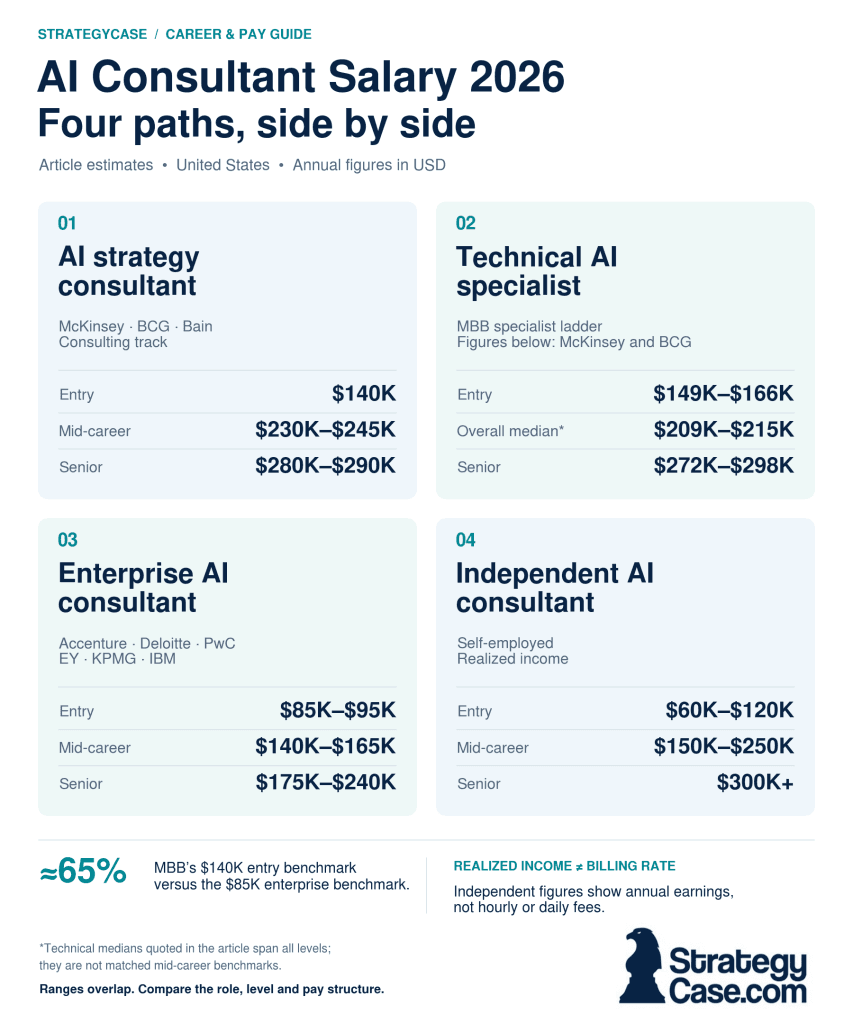
Three things to read off that table before anything else.
The entry gap is the widest gap in the set. An Accenture AI consultant starts at roughly $85,000. An MBB entry hire starts at $140,000. That is a 65% difference on day one, for job descriptions that read almost identically on a careers page.
Path 3 is where almost all the actual jobs are. Accenture, Deloitte, PwC, EY, KPMG, and IBM hire AI consultants by the thousand. MBB AI practices hire in the low hundreds. If you landed here after seeing a job posting titled “AI Consultant,” the odds are it’s a Path 3 role.
Path 4 numbers are realized income, not billing rates. That distinction kills more independent consulting plans than any other single mistake.
Why Every “Average AI Consultant Salary” You Will Find Is Wrong
The blended averages on job boards aren’t slightly off. They’re measuring a category that doesn’t exist. Four specific reasons why:
There is no occupation code for the job. The US Bureau of Labor Statistics tracks management analysts, which is where most consultants land, at a median annual wage of $101,860 as of May 2025. It separately tracks computer and information research scientists at a median of $140,300. An AI consultant does work that falls under both. Federal wage data therefore gives you two answers about $38,000 apart, and neither one is the job.
The job boards blend unrelated roles. Indeed’s artificial intelligence consultant salary page resolves to AI Architect data: a $153,917 average drawn from 1,400 job postings over 36 months, with a range of $91,341 to $259,363. An AI architect designs systems. An AI consultant advises clients. Different jobs, different pay, averaged together because the scraper matched on the word “AI.”
Outlier tech-company packages pollute the mean. This is the answer to the question Google surfaces alongside this one. The famous “$900,000 AI job” was a Netflix posting for a Machine Learning Platform product manager advertised at $300,000 to $900,000. Netflix later posted a generative AI product manager role at $240,000 to $700,000. Those are in-house product roles at a streaming company. That isn’t consulting, and it isn’t typical. Every average that includes it is inflated.
The search results themselves are not screening for relevance. As of September 2026, the tenth result for this keyword is a page about a sleep consultant. If the search engine can’t tell which kind of “consultant” you mean, the salary databases feeding it can’t either.
What does hold up is data segmented by a named employer and a named level. That is the rest of this article.
Path 1: AI Strategy Consultant at McKinsey, BCG, or Bain
MBB runs its AI work through dedicated units: McKinsey QuantumBlack, BCG X (the former GAMMA and Platinion), and Bain Vector. If you join one of these on the consulting track, you are paid on the standard consulting ladder for your office and level.
| Level | McKinsey | BCG | Bain |
|---|---|---|---|
| Entry (undergraduate) | $140,000 | $140,000 | $140,000 |
| Post-MBA (Associate / Consultant) | $245,000 | $242,000 | $230,000 |
| Engagement Manager / Project Leader / Manager | $290,000 | $280,000 | $290,000 |
| Associate Partner / Principal | $420,000 | $410,000 | $360,000 |
| Partner | $700K to $1.5M+ | $700K to $1.5M+ | $650K to $1.4M+ |
The number that surprises people: there is no AI premium. A QuantumBlack Associate and a generalist McKinsey Associate in the same office earn the same $245,000. The firms compete on pay with each other, not with OpenAI. Bands are set by level and office. Working on machine learning doesn’t add a line to your offer letter.
The full breakdowns sit in the McKinsey salary guide, the BCG salary guide, and the Bain salary guide, with the three compared side by side in our MBB salary comparison.
What the AI practices do change is who gets hired. They recruit engineers, data scientists, and PhDs far more actively than generalist offices do, which makes them the realistic entry point for technical candidates. If that is your background, the engineer to consulting guide and the PhD to consulting guide cover how the screening differs.
Not sure which MBB level your background maps to? That single question changes your first-year pay by more than $100,000. Book a coaching session and we will work out where your profile actually lands.
Path 2: Technical AI Specialist Inside a Consulting Firm
Every MBB and Big 4 firm also runs a specialist ladder: data scientists, machine learning engineers, and data engineers who build the models instead of owning the client relationship. Same building, same projects, different pay structure.
Self-reported compensation data on Levels.fyi puts McKinsey data scientists at $149,000 at entry rising to $272,000 at Principal, with a median of $209,000. BCG data scientists run $166,000 at L1 to $298,000 at L5, median $215,000.
Compare those medians against the post-MBA consulting band of $230,000 to $245,000 at the same three firms and the pattern is clear: the technical ladder pays roughly 10 to 15% less than the generalist ladder at comparable seniority.
That reads backwards to almost everyone who hears it. Here’s why. Consulting firms price the partner track, and the partner track runs through client ownership and selling work. The specialist ladder stops short of it, so it’s paid as senior technical staff rather than as pre-partner.
The skill that pays at a consulting firm isn’t building the model. It’s standing in front of a CFO and defending what the model implies.
This is the single most common misconception I correct in coaching calls with technical candidates. The pattern repeats almost every cycle.
The detail that matters, and that nobody tells you, is that which ladder your offer sits on is usually decided during recruiting, by which pipeline you applied through, before anyone asks you which you would prefer. If you want the generalist ladder, target it from the application onward. Switching later is possible, but slow.
Path 3: AI Consultant Salary at Accenture, Deloitte, and the Big 4
This is the volume market, and the numbers are considerably lower than MBB at every level.
| Level | Accenture Strategy & Consulting | Core EY Consulting | Monitor Deloitte (strategy) |
|---|---|---|---|
| Analyst / Staff | $85,000 | $95,000 | n/a |
| Consultant | $115,000 | $140,000 | n/a |
| Senior Consultant (post-MBA) | $140,000 | $165,000 | $240,000 |
| Manager | $175,000 | $200,000 | $275,000 |
| Senior Manager | $240,000 | $280,000 | $385,000 |
| Managing Director / Partner | $500K to $1M+ | $700K to $1.4M+ | $800K to $1.6M |
Two structural notes on this tier.
The strategy practices pay a real premium over the core consulting arms. Monitor Deloitte, EY-Parthenon, and Strategy& pay 20 to 35% above their firms’ core consulting bands, which is why the Monitor column above sits so far ahead of the EY one. Inside Accenture, the pure strategy practice pays 15 to 25% above core Accenture Consulting, while Accenture Technology and Accenture Song sit slightly below it. Most roles advertised as “AI consultant” at these firms are in the technology arms, not the strategy practices, which puts them at the bottom of the band.
Accenture pays partly in equity. It’s a public company, not a partnership, so senior staff get restricted stock instead of a partner draw. That changes the risk profile of the senior numbers.
Full detail is in the Accenture Strategy salary guide and the Deloitte consulting salary guide.
Path 4: Independent AI Consultant Day Rates and What They Actually Pay
Independent AI consultants don’t have a salary. They have a day rate, a utilization rate, and a cost base. Confusing the first with income is the most expensive error on this list.
Observed day rates in the US market in 2026 cluster in three bands.
| Tier | Day rate | Typical work | What justifies it |
|---|---|---|---|
| Implementation | $800 to $1,500 | Tooling, integrations, prompt and workflow builds | Delivery skill, commoditizing fast |
| Advisory | $1,500 to $3,000 | Use-case selection, roadmaps, build-vs-buy calls | A credible track record a buyer can check |
| Named specialist | $3,000 to $6,000+ | Board-level advice, scarce domain depth | Published work or a recognizable former employer |
Now the arithmetic that turns a rate into income. A realistic first-year independent bills 100 to 120 days. The rest of the year goes to selling, admin, and gaps between engagements. At $1,200 per day that is $120,000 to $144,000 gross, before self-employment tax, health insurance, software, and unpaid pipeline work. Realized take-home frequently lands below a Path 3 salaried job in year one.
At 150 billable days and a $2,500 rate, the same person clears $375,000 gross. The variable that moves independent income isn’t the rate. It’s utilization, and utilization comes from reputation and pipeline, which take years to build.
Two honest caveats. There’s no authoritative survey of independent AI consulting rates the way there is for salaried roles, so treat the bands above as observed ranges, not measured medians. And the going rate for generic generative AI implementation work has been falling as the skill commoditizes, while rates for genuinely scarce specialisms have held.
What Actually Moves Your AI Consultant Salary
Ranked by how much each factor moves the number, based on what shows up in offer letters rather than what job boards imply.
| Rank | Factor | How much it moves your pay | Where it applies |
|---|---|---|---|
| 1 | Employer tier | 40 to 65% at entry | Everywhere. Nothing else comes close |
| 2 | Ladder (generalist vs specialist) | 10 to 15% at the same firm | MBB and Big 4 |
| 3 | Entry credential (MBA or PhD) | ~$105,000 in year one at MBB | Paths 1 and 3 |
| 4 | Office location | 5 to 10% between US office tiers | Paths 1, 2, and 3 |
| 5 | Scarce technical depth | Real premium in industry, near zero at MBB | Paths 2 and 4 |
| 6 | Certifications | Near zero at MBB, modest elsewhere | Paths 3 and 4 only |
Two of those deserve a note.
On scarce technical depth, Robert Half’s 2026 technology salary guide puts AI/ML engineers at $134,000 to $193,250 and AI architects at $142,750 to $196,750, and reports that 87% of technology leaders pay above band for specialized skills. That premium is real in industry roles and largely absent at MBB, where bands are fixed.
On certifications, MBB and the Big 4 strategy practices hire on interview performance, so a credential does nothing there. It carries modest weight in Path 3 delivery roles and Path 4, where it gives a buyer who can’t otherwise judge you a reason to trust you.
Location: US Cities
Indeed’s data for AI architect roles gives the clearest picture of the US geographic spread, with the caveat that it is architect data rather than consultant data: Boston $195,773, San Francisco $188,955, Cambridge $174,908, New York $170,042, and Chicago $159,634.
MBB doesn’t work this way. Pay is set by office band, and tier-2 US offices pay 5 to 10% below New York, San Francisco, Chicago, Boston, and Washington DC.
Outside the US
Every figure above is US. Non-US offices at the same firms and levels typically pay 25 to 40% below US bands, adjusted to local market norms. Two anchors: EY London post-MBA Senior Consultants earn roughly £90,000 to £110,000 total cash compensation, and Levels.fyi reports a median of about ₹2.9M for QuantumBlack data scientists in India. Regional detail by level sits in each firm salary guide linked above.
The 2026 Paradox: AI Practices Are Growing While Entry-Level Hiring Shrinks
Both of these are true at once, and the combination is why the pay picture is confusing.
The BLS projects employment of computer and information research scientists to grow 22% between 2025 and 2035, against 10% for management analysts. AI-adjacent work is growing at more than twice the rate of consulting work generally. Fortune reported in September 2026 on LinkedIn research finding that the people winning top AI jobs are averaging $236,000 salaries.
At the same time, the generalist entry pyramid at the major firms is narrowing, because the research, benchmarking, and first-draft deck work that filled a first-year analyst’s day is the work AI does best. Our pillar on AI’s impact on consulting hiring covers the mechanics and the evidence in full, so this page won’t restate that argument.
What it means for your pay: AI practices are among the few places at MBB where headcount is still growing, the technical bar to get in is rising, and the pay band isn’t moving to reward the extra difficulty. Higher bar, same pay, better odds of getting an offer. That is the trade on the table in 2026.
How to Get Paid at the Top of These Bands
The gap between Path 3 at $85,000 and Path 1 at $140,000 isn’t a skills gap. Both hires can build a model. The difference is that one of them passed a case interview.
No certification, portfolio, or Kaggle ranking gets you into QuantumBlack, BCG X, or Bain Vector. What stands in the way is a case interview, a fit interview, and at most firms a screening assessment. Technical candidates fail these for predictable reasons: over-engineering the analysis, optimizing before structuring, and answering the question that’s interesting instead of the one the client asked. After 2,200+ mock interviews and coaching sessions, that cluster of errors is the most reliable pattern I see in engineers and data scientists.
Start with the StrategyCase complete guide to case interviews, which is free, then work the digital transformation and AI strategy case type, which is the case you are most likely to get when you apply to an AI practice.
Frequently Asked Questions
Do AI consultants make good money?
Yes, though the definition of good varies by a factor of three. An AI consultant at Accenture or a Big 4 technology practice starts around $85,000 to $95,000 in the US. An AI strategy consultant at McKinsey, BCG, or Bain starts at $140,000 and reaches $230,000 to $245,000 post-MBA. A senior independent consultant with a full pipeline can clear $300,000 or more.
What does an AI consultant do?
The work splits along the same lines as the pay. At MBB, an AI consultant spends most of their time on the strategy problem around the model: which use case is worth funding, what it is worth, how the organization has to change to use it, and whether the client should build or buy. At Accenture and the Big 4, the role skews toward implementation and delivery. On the specialist ladder, the job is building and validating models. Independent consultants do whichever of these their clients will pay for.
What is a $900,000 AI job?
It refers to a 2023 Netflix job posting for a product manager on its Machine Learning Platform, advertised at $300,000 to $900,000, which went viral and still anchors people’s expectations. It was an in-house product role at a tech company, not a consulting role. No consulting firm pays close to that below partner level. Numbers like it are a big reason the blended averages for this search term are useless.
How much does an AI consultant make per hour?
For salaried roles, divide total compensation by roughly 2,000 hours: about $42 to $48 per hour at Accenture or Big 4 entry level, $70 at MBB entry, and $115 to $125 at the MBB post-MBA level. Those figures assume a 40-hour week, which consulting isn’t, so real hourly pay is lower. Independent consultants bill $100 to $750 per hour depending on positioning, typically packaged as a day rate.
Do I need an AI certification to become an AI consultant?
Not for MBB or the Big 4 strategy practices. They hire on case and fit interview performance, and no certificate makes up for a weak case. Certifications carry modest weight for Path 3 technology delivery roles and for independent consultants, where a recognizable vendor credential gives a buyer a reason to trust you. If your goal is the top of the pay bands, interview preparation returns far more than any certificate.
Is an AI consultant paid more than a regular management consultant?
No, not at the same firm and level. This is the most common wrong assumption about this career path. At McKinsey, BCG, and Bain, pay is set by level and office, so a QuantumBlack Associate and a generalist Associate earn the same. In industry, AI-specific roles do carry a real skills premium, which is where the belief comes from. It doesn’t carry over into consulting pay bands. The employer tier, not the AI skill, sets the number.
Related Guides
- Will AI replace consultants? The honest answer on whether this career is a safe bet.
- The future of consulting Where the industry and its business model are heading.
- AI and the junior consultant How entry-level work and training are changing.
- Experienced hires at McKinsey, BCG, and Bain Which level and track your years of experience map to.
- Consulting exit opportunities What the role is worth on the way out.
The Number You Should Actually Care About
There’s no such thing as an AI consultant salary. There are four of them, and the gap between the highest and the lowest is wider than the gap between an entry hire and a manager on any one of them.
Before you benchmark an offer, settle three questions. Which path is it: MBB, Big 4, in-firm specialist, or independent? Which ladder does the offer sit on, generalist or technical? And which office band applies?
Answer those and you can value an offer accurately. Skip them and you’re negotiating against a blended average that describes nobody.
For technical candidates, the highest-return move in 2026 isn’t another certification. AI practices at MBB are hiring while generalist entry hiring narrows, and what stands between you and the top pay band is a case interview you’ve never practiced. Start with the free StrategyCase case interview guide, and if you want to know which level and ladder your background actually maps to, work through it with me directly.
The bar is higher than it was three years ago. So are the odds, if you prepare for the right thing.
About the author: Florian Smeritschnig is a former McKinsey Senior Consultant who spent 5 years at the firm, conducted more than 2,200 interviews, and has coached candidates to 700+ offers at McKinsey, BCG, Bain, and other top firms. He is the founder of StrategyCase.com and the author of three prominent consulting interview and career books.
