

Last Updated on July 16, 2026
By Florian Smeritschnig, Former McKinsey Senior Consultant. Updated July 2026.
Your first year in consulting is judged less on raw intelligence than on four things: how visible you are, how much ownership you take, how error-free your work is, and how fast you learn. Get those right and you will do well at McKinsey, BCG, Bain, or any top firm. Get them wrong, and no amount of brainpower will save you.
The shock of the first few months is real. The pace is relentless, the standards are unforgiving, and the analysts who get counseled out are rarely the least intelligent in the room. They are the ones who missed what actually gets judged.
I spent five years at McKinsey as a Senior Consultant, and I wrote the book on this in Consulting Career Secrets. Below are the 9 rules that separate first-year analysts who get promoted from those who quietly get managed out, the four mistakes that sink people, and a simple 90-day plan to start strong.
Key Takeaways
- Visibility beats raw technical skill. The first-years who get noticed speak up in meetings, own client-ready output, and add energy to the team.
- Almost nobody gets counseled out for one mistake. It is a repeated pattern: passivity, weak communication, and sloppy work, together.
- Treat your first 90 days as an audition. Over-communicate, ask for feedback every single week, and learn faster than your peers.
- Fewer than 5% of the analysts I started with at McKinsey were counseled out for performance in their first few years. The bar is high, but very passable.
- Interns are judged on their growth curve, not their starting point. Managers compare where you were on day one to where you are on the last day.
What Your First Year in Consulting Is Actually Like
Your first year in consulting is a compression chamber. You get more feedback, more exposure, and more distinct problems in twelve months than most jobs give you in three years. That is the grain of truth behind the old “one year in consulting equals three years anywhere else” line. It is an exaggeration, but not by as much as you would hope.
The role goes by a different title at every firm, which trips up a lot of new joiners comparing notes. Here is the map for the standard post-undergraduate entry role:
| Firm | Entry-level title (post-undergrad) |
|---|---|
| McKinsey | Business Analyst |
| BCG | Associate |
| Bain | Associate Consultant |
| Deloitte / Big 4 | Business Analyst or Consultant |
| Oliver Wyman | Consultant |
| Kearney | Business Analyst |
Whatever the title, the job is the same: you own a slice of the problem (a workstream), you turn messy data into a clear answer, and you present it to people far more senior than you. Expect long weeks, a steep learning curve, and an “up-or-out” culture that expects visible progress every few months. To see exactly where the analyst role sits and what each level earns, read our guide to the consulting hierarchy and salary.
None of this is meant to scare you. The upside is real, and the job remains one of the best launchpads in business. But you cannot survive what you refuse to see clearly.
The 9 Rules to Survive Your First Year in Consulting
These are the habits I saw separate the analysts who got promoted from those who struggled. They matter for full-time hires and interns alike. If anything, they matter more for interns, because your evaluation window is measured in weeks, not years.
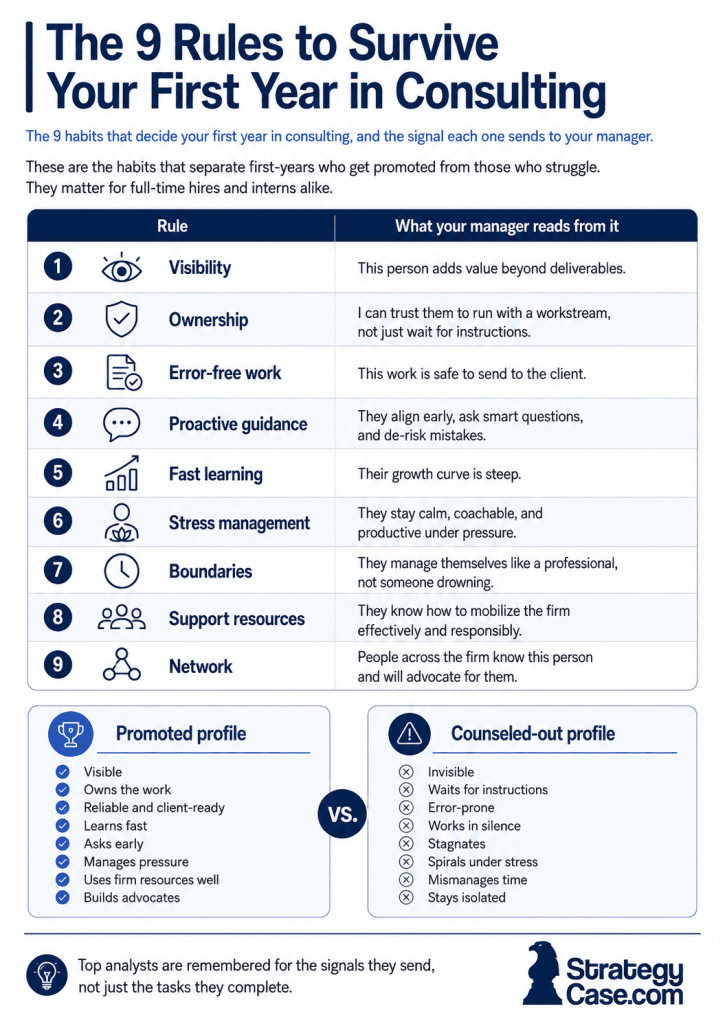
1. Make yourself visible
Visibility, not technical skill, is the single biggest reason first-years and interns succeed or fail. The best analysis in the world does nothing for your reputation if nobody senior knows you produced it.
Speak up in team meetings. Present your own slides to the client when you get the chance. Introduce yourself to leadership on the engagement. Bring positive energy when the team is tired. Even small gestures, like organizing food during a late crunch or setting up a team dinner, signal that you are engaged and add value beyond your deliverables.
Visibility is not politics. It is making sure your work has your name attached to it.
2. Take ownership, don’t just take orders
Owning your work means treating your workstream as your problem, not a task someone handed you. Waiting to be told every next step marks you as junior. Anticipating the next step marks you as promotable.
Adopt a proactive, solution-oriented mindset, and pair it with radical transparency. Keep your manager updated on progress and problems before they have to ask. Document what you are learning so you can speak to any part of your deliverable at any moment. Trust is built on reliability: high-quality work, delivered when you said it would be.
3. Deliver error-free, client-ready work
In consulting, a small error costs you disproportionately. A single wrong number in a model or a typo on a client slide plants a seed of doubt, and first-years do not yet have the reputation to absorb it.
Aim for every piece of work to be “client-ready,” meaning it could go straight to a C-level executive without anyone reviewing it first. That does not mean you will be perfect. It means the intention and the effort are visibly there. Triple-check your analyses. Read your slides out loud. When you are unsure, ask a colleague to sanity-check before it leaves your hands.
4. Ask for guidance before you need it
Proactively seeking input is a strength signal, not a weakness signal. The analysts who ask smart questions early avoid the big, expensive mistakes that come from working in silence for two weeks in the wrong direction.
Do three things consistently. Align with your team before you ever talk to the client on your own. Check in regularly so your work stays relevant as the engagement shifts. And explicitly ask for feedback every week or two, which shows you are hungry to grow. For interns especially, this matters, because your development timeline is compressed and your manager needs reasons to say yes to a return offer.
5. Learn faster than anyone expects
Your growth curve is the metric your project manager is quietly tracking. They compare your skill level in week one to your skill level in the final week, and that delta is what shows up in your review.
So maximize your learning surface. Volunteer for client calls. Jump into the problem-solving sessions. Watch how strong colleagues structure a problem or handle a difficult client, and ask them why they did it that way. Study the firm’s internal knowledge databases.
The rapid iteration and feedback cycles of consulting teach you self-organization and judgment that pay off for the rest of your career, whether you stay or leave.
6. Manage your stress before it manages you
Most first-year stress is self-inflicted, and it shrinks the moment you reframe the goal. Your job in the first months is not to be brilliant. It is to avoid major errors and to visibly want to learn. That standard is achievable, and hitting it builds the trust that lowers your stress further.
Remember that any single engagement or internship is temporary. A brutal week ends. And keep the bigger question in view: is consulting actually right for you long term? Considering that honestly takes the pressure off any one performance moment. If you are struggling with the lifestyle side, our guide to work-life balance in consulting is a practical place to start.
7. Protect your time and set boundaries
Going the extra mile is worth it in a short internship or your first months, but “extra mile” should mean more responsibility, not just more hours. Blindly working until 2 a.m. every night signals poor organization, not dedication.
Block time on your calendar for focused work and protect it. Setting clear boundaries and time blocks prevents overwhelm, and it quietly signals to your manager that you can handle your workload like a professional rather than someone drowning. Managers trust people who manage themselves.
8. Use your firm’s support resources
Top firms give you a support system most new joiners never fully use: research staff, visual graphics teams, knowledge experts, and external providers. Pulling them in at the right moment lifts the quality of your work and shows you can mobilize resources like a real consultant.
One rule: always clear it with your project manager first (in case of more expensive resource usage). Their involvement affects the project budget and how cost-effective the team looks to the client. Asking first is the difference between resourceful and reckless.
9. Go to every training and build your network
Say yes to every training, firm event, and networking opportunity you can, and do not limit yourself to the intern-only gatherings. The relationships you build in your first year become the network that staffs you on good projects, vouches for you in reviews, and smooths your transition to full-time.
If you can, work on more than one project during an internship. More projects mean more colleagues who have seen your work firsthand, which means more people in the room advocating for you when decisions get made.
Mistakes That Get First-Year Consultants Counseled Out
The habits above are the upside. Here is the downside, stated plainly. In my first few years at McKinsey, fewer than 5% of the analysts I started with were actually asked to leave for performance. But the ones who were almost always combined several of these mistakes, repeatedly. Rarely does one of these sink someone on its own.
Waiting to be told what to do
Passivity is the number one killer of first-year careers. Self-starters spot value to add without being assigned it, raise their hand the moment they are stuck, volunteer for extra work, ask for feedback unprompted, and communicate their needs early. Let team dynamics happen to you and you become invisible, which in an up-or-out culture is the same as falling behind.
Not understanding the client’s business
Showing up without a grasp of the client’s business destroys your credibility fast. Ramp up quickly: schedule calls with the previous team, read past engagement documents, mine the firm’s knowledge database, talk to internal industry experts, read the leadership’s published research, and set up Google Alerts for the client and its competitors. New to the account is fine. Clueless about the account is not.
Communicating poorly
Weak communicators struggle to get their ideas across in internal sessions and client meetings, and it caps their ceiling no matter how good their analysis is. Practice active listening. Ask clarifying questions. Summarize your understanding back to people. Learn both the verbal and the visual sides of communication by watching how strong colleagues do it and asking them to explain their choices.
Delivering sloppy work
Perfection is not required, but obviously flawed work that reaches a client damages trust in a way first-years cannot easily repair. Own your content down to the detail, so you can defend every number. When you are not sure, ask a colleague to review before you send. An occasional mistake is human. A repeated one is a pattern, and patterns are what get people counseled out.
Your First 90 Days: A Simple Plan
If you want one concrete framework to carry into your start date, use this. It maps the nine rules onto a timeline so you always know what to focus on next.
- Days 1 to 14 (land): Learn the client’s business, your team’s working norms, and the core tools. Book a 1:1 with your manager to align on exactly what “great” looks like for your workstream. Read the last team’s documents so you are not starting from zero.
- Days 15 to 45 (contribute): Own a module end to end. Send status updates before anyone asks for them. Request feedback every single week and act on it visibly.
- Days 46 to 90 (compound): Volunteer for client-facing moments. Build relationships beyond your immediate team. Turn the feedback you have collected into obvious improvements, so your growth curve is impossible to miss at review time.
At StrategyCase, the new joiners I coach who ramp the fastest almost always do one unglamorous thing well: they over-communicate. Preparing properly before day one helps too, which is why I wrote a full guide on how to prepare before starting at McKinsey, BCG, or Bain.
Frequently Asked Questions
Is the first year of consulting really that hard?
Yes, but the difficulty is more about pace and standards than raw intelligence. You will juggle a steep learning curve, long weeks, and client-ready expectations from day one. Most people who prepare, ask for help early, and stay coachable clear the bar comfortably.
Is one year in consulting really worth three years somewhere else?
The “one year equals three” line is an exaggeration, but there is real truth in it. The feedback density, senior exposure, and sheer range of problems you touch in twelve months compress learning that would take years in a slower environment. That is why consulting remains one of the strongest early-career accelerators.
How many hours do first-year consultants work?
Expect roughly 55 to 70 hours in a normal week at a top firm, with spikes on demanding engagements and lighter stretches between projects. Hours vary a lot by office, industry, and staffing. Our detailed guide on how much consultants work breaks it down by firm and level.
What gets a first-year consultant promoted instead of counseled out?
Consistent ownership, error-free work, visible communication, and a steep, obvious learning curve. Promotions go to the analysts who make their managers’ lives easier and whose growth is impossible to miss. People get counseled out for a repeated pattern of passivity, poor communication, and sloppy output, not for a single bad week.
Do consulting interns get return offers?
Most interns who hit the performance bar receive a return offer, because firms design internships as extended evaluations rather than short trials. Your growth curve, ownership, and how well you take feedback matter more than any single deliverable. See our guide to the McKinsey internship for how the evaluation works in practice.
How do I start strong before day one?
Rest first, then get ahead on the fundamentals: Excel, PowerPoint, and a working knowledge of your client’s industry. Walking in with the basics handled frees your attention for the things you can only learn on the job. Understanding the typical tasks of entry-level consultants before you start gives you a head start most new joiners do not have.
Related Guides
- Up-or-out in top-tier consulting firms
- Why companies hire management consultants
- How to kick off a new consulting project
- How to get promoted in consulting
Final Word
Your first year in consulting will test you, but it is far more survivable than the horror stories suggest. The analysts who thrive are not the smartest in the room. They are the ones who make themselves visible, take ownership, deliver clean work, ask for help early, and learn faster than anyone expects. Do that, and the up-or-out machine works for you instead of against you.

If you want the complete playbook, my book Consulting Career Secrets covers your whole consulting career from first day to exit, and the free career guides at StrategyCase walk you through every step in between. Start with the nine rules above, pick the one you are weakest at, and fix it this week.
About the author: Florian Smeritschnig spent five years at McKinsey as a Senior Consultant, where he evaluated candidates, and has since delivered 2,200+ mock interviews and coaching sessions. He founded StrategyCase.com and has helped clients secure 700+ offers at McKinsey, BCG, Bain, Tier-2, and Big 4 firms. He is the author of “The 1%: Conquer Your Consulting Case Interview,” “The 1%: Case Interview Workbook,” and “Consulting Career Secrets.”
