

Last Updated on July 16, 2026
By Florian Smeritschnig, former McKinsey Senior Consultant. Originally published July 27, 2021. Updated July 14, 2026.
To prepare before starting at McKinsey, BCG, or Bain, focus on three things in the weeks before day one: buy durable business attire and a carry-on suitcase that survives weekly flights, settle your home, admin, finances, and health, and then rest. Do not cram Excel or memorize frameworks. You learn the actual job on the job, and the firm expects exactly that.
The mistake I see new joiners make in how to prepare before starting in consulting is the opposite of what you would guess. They panic about hard skills they will be trained on anyway, then show up having done nothing about the dull logistics that genuinely wreck your first month: a half-furnished apartment, no airline status, an admin errand that needs a government office open only during hours you now spend at a client site.
I spent five years at McKinsey as a Senior Consultant, and I have coached hundreds of people through the jump from signed offer to first day. This guide is the checklist I give StrategyCase clients who just accepted an MBB offer, adapted from my book Consulting Career Secrets: what to buy, what to arrange, and what not to bother learning before you start.
Key Takeaways
- The single biggest prep mistake is over-preparing on skills and under-preparing on logistics. Firms train you; they do not furnish your apartment or earn your airline status for you.
- Buy high-quality business attire (one solid set is enough to start), a durable carry-on, and a travel kit. Quality over quantity: cheap suitcases die within months of weekly flights.
- Arrange your home, admin, finances, and health before day one, because your first months leave almost no time for errands during business hours.
- Learn almost nothing in advance. Rest, then lightly brush up on Excel and PowerPoint basics. The real learning is on the job, by observation and feedback.
- The prep is roughly the same across McKinsey, BCG, and Bain. Your office and your first project shape your experience far more than which of the three logos is on your badge.
Do You Actually Need to Prepare Before Day One?
For hard skills, mostly no. For logistics and mindset, yes. That is the honest verdict, and getting the balance right saves you a stressful first month.
Two camps will give you advice. Most people who have actually worked in consulting will tell you to prepare nothing and enjoy your last free weeks. A smaller group will tell you to drill Excel, PowerPoint, and mental math for months. The truth sits between them, but much closer to the first camp than nervous new joiners expect.
When I got my full-time offer, I contacted people inside McKinsey and the consultants who had interviewed me, asking what software to learn and how to get a head start. The unanimous answer was to relax, enjoy the time, and trust that I would learn on the job. I followed it reluctantly, and only once I started did I understand why it was right.
So the useful preparation is not academic. It is the practical groundwork that frees you to focus once the job begins. The rest of this guide covers the three buckets that matter: what to buy, what to arrange, and what (little) to actually learn.
One note if you landed here early: if you have not received the offer yet and you are reading ahead, your energy is far better spent on getting into consulting in the first place and on the interviews. Come back to this guide once the offer is signed.
The Pre-Start Timeline: What to Do in the Weeks Before You Start
Preparation is mostly a sequencing problem. Some tasks need lead time (a tailored suit, a health checkup, a housing move), and others you can knock out in an afternoon. Here is how I would phase the weeks between offer and day one.
| Timeframe | What to get done |
|---|---|
| 4 to 6 weeks before | Order your suit and shoes (allow time for tailoring and returns), book a health and dental checkup, and lock down your housing so you are not moving in during your first project. |
| 2 to 3 weeks before | Buy a durable carry-on and travel kit, join airline and hotel loyalty programs, finish any government or bank errands, and confirm your firm’s investment and stock policy. |
| Final week | Pack a project-ready go-bag, read your welcome email for start logistics and dress code, lightly refresh Excel and PowerPoint basics, then genuinely rest. |
| Day one | Bring your ID and paperwork, arrive slightly overdressed, and lead with curiosity rather than trying to look like you already know everything. |
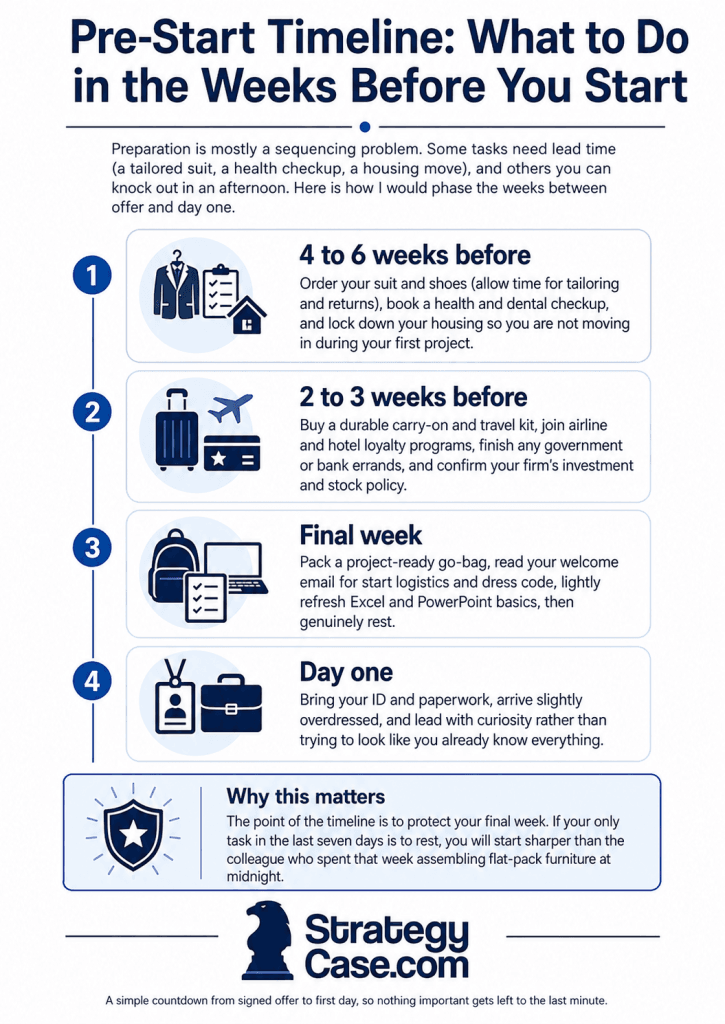
The point of the timeline is to protect your final week. If your only task in the last seven days is to rest, you will start sharper than the colleague who spent that week assembling flat-pack furniture at midnight.
What to Buy Before Starting Your Consulting Job
Your firm supplies all the technical equipment you need: laptop, laptop bag, phone, cables, secure drives, and adapters. Your job is to show up at the client site looking like a competent, trustworthy professional. That comes down to attire, a few grooming standards, and travel gear that survives the road.
Business Attire: The Baseline Wardrobe
You do not need a full designer wardrobe on day one. You need one solid, well-fitted set you can build on with your first paychecks. At a minimum, aim for a couple of key pieces, several shirts or blouses, two pairs of dress shoes, a season-appropriate coat, and a few simple accessories. A well-fitted, durable suit serves you far longer than an expensive label, so spend on fit and quality of cloth, not on the logo. Choose dress shoes with leather soles.
At their core, MBB firms remain fairly conservative organizations that often serve traditionally minded clients. The rules have loosened over the years. A partner once told me that just 15 years earlier, dark brown leather shoes were considered inappropriate for men, and only black was acceptable. That has relaxed, but conventions still exist, so dress for the image you want people to have of you.
| Men | Women | |
|---|---|---|
| Key piece | Suit in neutral, darker colors (navy or dark gray; black reads as formal in some geographies) | Skirt or trouser suit in neutral, darker colors, or dress pants with a blazer |
| Shirt | Shirt (white or light blue) with a classic tie and simple knot; buttons matching the fabric | Blouse (white or light blue); buttons matching the fabric |
| Shoes | Leather dress shoes (black or dark brown); socks long enough to never show bare skin | Flat or slight heel, closed toe, matching the outfit |
| Accessories | Leather belt matching the shoes, and a watch | Leather belt if it suits the outfit, a watch; jewelry optional |
Five principles keep you safe whatever you buy:
- Keep it subtle. Leave statement pieces at home. Skip sporty or festive items, stick to classic darker suits and crisp white or light-blue shirts, and keep accessories few and discreet. Keep everything, shoes especially, clean through the week.
- Fit matters more than price. Fully tailored is not required, but avoid anything visibly too big or too small.
- Prioritize comfort. You will wear this from early morning to late at night, so choose fabrics you can live in.
- When in doubt, overdress. It is easier to remove a tie or jacket than to conjure one. Slightly overdressed always beats underdressed.
- Pack a spare. Keep a backup shirt and tie on hand. An unexpected senior meeting or a last-minute client visit in a more formal city happens more often than you think.
How to Read a Project’s Dress Code
Dress code is set by the client environment, not a firm-wide rulebook, and it is usually spelled out in your project welcome email. If it is not, ask your team before you start.
The range is wide. A team at a global sporting-goods brand might wear smart-casual with brand sneakers on site, while a team at a traditional bank sticks to suits and ties. In industrial settings, safety rules take over entirely. I once watched our whole team, project partner included, make an emergency run to a safety-clothing store for steel-toe boots before a client warehouse visit. You cannot plan for that one. You simply read the room and adjust on the go.
Grooming standards are simpler and firm-agnostic. Keep a clean haircut and a neatly trimmed or clean-shaven look, wear your hair as you prefer, apply makeup tastefully if you choose to, go easy on strong scents, and skip flashy statement pieces like a gold luxury watch. The goal is to be memorable for your work, not your wardrobe.

Travel Gear That Survives Weekly Flights
Consulting is a weekly-travel job for most people, so your luggage takes a beating. This is the category where I learned the hard way. In my first year I burned through three cheap suitcases that could not handle weekly flights before I finally bought one good one. Prioritize quality over quantity: a solid carry-on for normal weeks and a larger check-in bag for longer trips.
Round it out with the accessories you would pack for any trip: a sleep mask, earplugs for noisy flights and hotels, a compact umbrella, noise-cancelling headphones, and an e-reader. Buy travel-sized toiletries and keep them in a clear zippered bag to move through airport security quickly and comply with the TSA liquids rule, or keep a full-sized set stashed in your hotel or team room for the length of a project.
Do not forget prescriptions and basic travel medicine. Finally, pack athletic clothes; most weeks you will find time for the hotel gym or a run, which does more for your stamina than any pre-reading.
For a full, concrete shopping list, see my guide to the must-buy items for new management consultants. And if you want a clear-eyed picture of what all this travel does to your calendar, read the honest version in work-life balance in consulting before you over-invest in a wardrobe you will rarely see in daylight.
What to Arrange Before Your First Day
Sort your personal life before your professional one begins. Once the job starts, everyday errands become genuinely hard to fit in, and small administrative chores turn into recurring annoyances. Clear them now so you are not burning vacation days on them later.
Sort Out Your Home and Living Situation
If you are relocating, be fully moved in before day one. Furnishing or apartment-hunting while you travel every week and use weekends to recover is miserable. A colleague of mine moved just before joining McKinsey and lived for three months with nothing but a bed and an empty fridge, until he finally took a week off to sort it out. Aim for a comfortable space to come home to after a hard week, because you will need it.
Handle Admin and Finances
Finish anything that requires a government office or a bank branch. A consultant’s hours and travel rarely line up with public-sector opening times, so a passport renewal or a registration errand that takes an hour now can take a painful month later.
Then plan for the money. For many people, a consulting job is the first substantial salary they earn, and it helps to know the actual numbers before you build a budget around them. You can see the full pay-and-promotion ladder at McKinsey and BCG to set realistic expectations.
One easy-to-miss item: check your firm’s investment and securities policy early. Some firms require you to sell certain holdings before you join or restrict what you can buy afterward. Sorting this before you start prevents a compliance headache in your first weeks.
Take Care of Your Health
Front-load your health admin while you have time and a predictable schedule. Book a general checkup, see your dentist, and update any vaccinations, some of which you may need for travel to particular regions (the CDC’s travel health pages are the authoritative source). Confirm your health insurance is in order, and check whether your firm provides private coverage as part of the package. Starting the job healthy and squared away is worth more than any head start on PowerPoint.
Sign Up for Travel Rewards Early
With heavy travel ahead, the points add up fast, so start collecting from your very first trip. Join the relevant airline frequent-flyer, hotel, and car-rental programs before your first project, and ask future colleagues which programs are worth concentrating on for status. Download the apps so check-ins and changes are painless on the road. The earlier you start and the more you consolidate, the sooner you reach status tiers that make constant travel far more bearable.
How to Prepare for the Actual Job (and What to Skip)
Here is the part new joiners most want to over-optimize, and where restraint pays off most. You are not expected to arrive knowing how to do the job. You are expected to learn it fast once you are in.
What Firm Onboarding and Training Actually Cover
Before your first engagement, every MBB firm runs formal onboarding, typically lasting from a few days to about three weeks depending on the firm, office, and cohort. You meet your peers, expand your network, and get introduced to the firm’s way of working, along with the basics of Excel, PowerPoint, their internal AI tools, teaming, client interaction, and how to communicate insights.
It is genuinely useful and a great way to build your first internal relationships. It will not, on its own, make you job-ready, and it is not meant to.
How You Really Learn: On the Job
The core of the job is a set of unwritten habits you pick up by doing, watching, and getting feedback. However experienced you are, you stay on a steep learning curve, because the moment you master one level you inherit the responsibilities of the next. A newly promoted engagement manager is adapting just as much as a first-week analyst.
A small story that captures it. On the first day of my first engagement, my engagement manager asked me for a simple Excel analysis, almost certainly to see what I could do. My Excel was thin, so I got it done but hardcoded some numbers. I was told, kindly, never to hardcode again, and I never did. Two weeks later, in our first formal feedback session, he admitted he had been worried at first but valued how quickly I learned from the mistake and adapted. That loop of small errors and micro-adjustments never really ends; and it’s the same for everyone. Even partners get constant feedback from more senior partners.
You learn by watching how colleagues build and format their models, by studying their slides to see what good visualization looks like, and by listening to how they talk to partners and clients. From associates to partners, people are genuinely willing to help, so ask for tips, shortcuts, and feedback constantly. Expect to search for Excel functions online in your first weeks; that is completely normal. If you lack knowledge in a specific industry, your firm’s internal experts and research resources will bring you up to speed quickly, and your onboarding will show you how to reach them.
At StrategyCase, the question I hear most from newly minted MBB hires is some version of “what will make me look competent in week one?” The answer is rarely a skill. It is speed of learning and good judgment about when to ask. At McKinsey, an informal rule of thumb was that if you had wrestled with a technical problem for more than five minutes, you should just ask the helpdesk. The logic is that your time is finite and best spent where you add real value, not fighting a formatting bug alone.
The Handful of Things Worth Brushing Up On
If you cannot resist doing something, keep it light. Refresh the basics of Excel and PowerPoint so the tools are not brand new (Microsoft’s own Excel help and training is a fine, free starting point), and get familiar with what to expect so day one feels less foreign. That is the sweet spot: rest and reset, but arrive knowing the shape of the job rather than trying to pre-learn it.
Then look slightly further ahead. The real test is not your first day, it is your first quarter, and your best next read is my guide to the practical habits that get analysts through their first months.
McKinsey vs. BCG vs. Bain: Does the Prep Differ?
Not in any way that should change your to-do list. The preparation is roughly 95 percent identical across the three firms. All of them issue your equipment, fly you to a central onboarding, expect business attire calibrated to the client, and expect you to learn the craft on the job.
The differences that exist are cultural and logistical rather than things you prepare for differently: training length and location vary by office and cohort, and each firm has its own internal knowledge tools layered on the same Microsoft stack. None of that rewards advance cramming. If you want the wider view of how the three compare as employers, see why McKinsey, BCG, and Bain lead the industry. For the prep itself, treat them as one and follow the buy, arrange, learn checklist above.
Frequently Asked Questions About How to Prepare Before Starting in Consulting
Should I prepare before starting at McKinsey, BCG, or Bain?
Lightly, yes, but not the way most people think. Handle logistics (clothing, luggage, housing, admin, health) and rest. Do not try to master consulting skills in advance; the firm trains you and expects you to learn the rest on the job.
What should I learn before starting a consulting job?
Very little. Refresh basic Excel and PowerPoint so the tools feel familiar, and read up on what the first weeks look like. Beyond that, your time is better spent resting. You will learn the real work by doing it, watching colleagues, and acting on feedback.
What should I buy before starting in consulting?
One solid set of business attire (a well-fitted suit, a few shirts or blouses, two pairs of dress shoes, a coat), a durable carry-on suitcase, and a travel kit (toiletries, sleep mask, earplugs, headphones, athletic wear). Prioritize quality, especially for the suitcase.
How long is consulting onboarding and training?
Formal onboarding at MBB firms typically runs from a few days to about three weeks, depending on the firm, office, and joining cohort. It covers tools, ways of working, and networking, but the bulk of your learning still happens once you are staffed on a real project.
What should I wear on my first day as a consultant?
Default to conservative business attire (a darker suit with a white or light-blue shirt), unless your welcome email specifies a more casual client dress code. When in doubt, slightly overdress; it is easy to remove a tie or jacket, and harder to formalize an outfit on the spot.
How far in advance should I start preparing?
Begin about four to six weeks out with anything that needs lead time, such as tailoring, health checkups, and a housing move. Handle loyalty programs, travel gear, and admin in the two to three weeks before. Keep your final week clear so you can start rested.
Related Guides
- ‘Up or Out’ in Top Consulting Firms: An Honest Perspective
- The 4 Types of Management Consulting Firms Explained
- Consulting Exit Opportunities: Paths and Career Options
- Why Management Consultants Are Paid So Much
- Working in Management Consulting: Key Pros and Cons
The bottom line: the best preparation before your first day at McKinsey, BCG, or Bain is deliberately boring. Handle the logistics, buy gear that survives weekly travel, and show up rested and curious instead of crammed. For the full insider playbook on your first months inside the firm, from your first client model to managing up, read Consulting Career Secrets, the book written for exactly this moment.
About the author: Florian Smeritschnig spent five years at McKinsey as a Senior Consultant, where he evaluated candidates for the firm. He founded StrategyCase.com in 2020 and has helped clients secure 700+ offers at McKinsey, BCG, Bain, Tier-2 firms, the Big 4, and boutiques, delivering 2,200+ mock interviews and coaching sessions. He is the author of “The 1%: Conquer Your Consulting Case Interview,” “The 1%: Case Interview Workbook,” and “Consulting Career Secrets.”
