
Last Updated on July 14, 2026
By Florian Smeritschnig, former McKinsey Senior Consultant. Updated July 14, 2026.
Consultants at McKinsey, BCG, and Bain typically work 50 to 80 hours a week while staffed on a client project, and the honest average sits in the low 60s. Between projects, that drops to 30 to 60 hours. The question of how many hours do consultants work is one if the most common ones I get from my clients and there is a lot of confusion around the actual number.
You have probably seen wildly different numbers, from “it’s basically a normal job” on a firm’s careers page to “I haven’t slept since Tuesday” on Reddit. Neither is the real picture, and getting it wrong before you sign an offer is an expensive mistake to make with two years of your life.
I spent five years at McKinsey as a Senior Consultant. Below is the honest version of consulting work hours, by firm, by level, and across a real week, without the recruiting gloss or the forum bravado. It is the same picture I lay out in Consulting Career Secrets, drawn from those years inside the firm and coaching hundreds of candidates into consulting careers.
Key Takeaways
- On a client project, consultants typically work 50 to 80 hours a week, with the honest average in the low 60s. Between projects, hours fall to 30 to 60.
- There is no systematic difference in hours between McKinsey, BCG, and Bain. Your project, your manager, and your staffing matter far more than the logo.
- Total hours barely fall as you get promoted, but your control over when you work rises sharply.
- Weekends are usually protected. True all-nighters happen only in rare crunch weeks, like the run-up to a board presentation or a private equity due diligence.
- Tier-2 firms often match or beat MBB hours. Big 4 advisory and in-house teams generally run lighter, closer to 40 to 55 a week.
How Many Hours Do Consultants Actually Work Each Week?
The number that matters depends on one thing: whether you are staffed. Consulting work splits into two very different modes.
Project time is when you are on a client engagement. This is the intense stretch: analysis, slide-building, client meetings, and travel. Bench time (some call it “the beach”) is the gap between projects, when you write proposals, help with recruiting, build knowledge, or take training. The workload during projects runs much hotter than during unstaffed weeks.
| Status | Typical weekly hours | Honest average | What fills the hours |
|---|---|---|---|
| On a client project | 50-80 | Low 60s | Analysis, slides, client meetings, travel |
| Between projects (“the bench”) | 30-60 | Low 40s | Proposals, recruiting, training, internal work |
On a project, only rarely does a week dip below 60 hours, and the busy stretches near a big deadline can push toward 80. Core hours land roughly between 9 a.m. and 9 p.m., stretching later at the client site early in the week. Those long hours are also a big part of why consultants are paid so much: the pay is compensation for intensity, not just intelligence.
The caveat: an “average week” is a statistical fiction. You will have 75-hour grinds and you will have 45-hour weeks where you leave at 5 p.m. three days running. What you are really signing up for is the swing, not the mean.
McKinsey vs. BCG vs. Bain: Is There Really a Difference?
Here is the verdict most candidates get wrong: across McKinsey, BCG, and Bain, there is no systematic difference in working hours. The office, the practice, and the specific team you land on drive far more variation than the brand on your business card.
| Firm | Typical weekly hours (on project) | What’s actually different |
|---|---|---|
| McKinsey | 55-70 | Strong “output over input” culture; hours track the work, not face time |
| BCG | 55-70 | Runs a formal predictability program (see below) |
| Bain | 55-70 | Tight team culture (“a Bainie never lets another Bainie fail”) |
The one structural difference worth knowing is BCG’s PTO program, which stands for Predictability, Teaming, and Open communication. It came out of four years of research at BCG by Harvard Business School professor Leslie Perlow, who showed that teams could deliver top-tier client service and still protect planned time off, as long as they engineered it deliberately (Harvard Business Review, “Making Time Off Predictable, and Required”).
It does not make BCG a 40-hour job, but it does mean protected-evening norms are baked into how teams are run.
At McKinsey, the equivalent lever was cultural rather than programmatic. A partner once told me, “We are an output-driven organization, not an input-driven organization.” Translated: nobody rewards you for sitting at your desk until midnight. Finish your work well and you go home.
How Consulting Hours Change by Level (Analyst to Partner)
Most people assume the hours ease off as you climb. They mostly don’t. What changes is your control over those hours.
A junior consultant works long, task-based hours because the analysis, the modeling, and the slides all land on their desk. A manager trades some late analytical nights for a heavier meeting load. A partner may not pull the same 1 a.m. slide sessions, but they are accountable for selling work, client relationships, and delivery risk, which never fully switch off.
| Level (McKinsey title) | Typical weekly hours | Nature of the hours | Control over schedule |
|---|---|---|---|
| Business Analyst / Associate | 55-65 | Analysis, modeling, slide production | Low |
| Engagement Manager | 55-70 | Coordination, client management, planning | Medium |
| Associate Partner / Partner | 50-70+ | Selling, client relationships, always “on” | High day-to-day, low over total load |
One useful lens is utilization, the share of your time that is billable to clients. Junior consultants often run the highest utilization, roughly 80 to 95 percent, because their job is delivery. Senior leaders run lower because their time goes to selling and firm-building. For context, the average billable utilization across professional-services and consulting firms worldwide was about 68 percent (Statista, 2023). High utilization is exactly why a first-year analyst feels the hours most.
A Real Week in the Life of an MBB Consultant
The classic project week peaks Monday through Wednesday, when you are physically at the client site, averaging 10 to 16 hours a day. Thursday is a cooldown and travel day, usually 10 to 12 hours. Friday, the designated home-office day, runs anywhere from 6 to 12 hours.
A representative week looks like this:
- Monday: Leave home around 5:30 a.m. for a 7 a.m. flight to the client. Work at the client site and the hotel until roughly midnight.
- Tuesday-Wednesday: Work 9 a.m. to midnight, with short breaks for lunch and dinner and one longer team dinner.
- Thursday: Start at 9 a.m., wrap by 5 p.m., then fly home, landing between 8 p.m. and 11 p.m.
- Friday: Work from home or the office, 9 a.m. to 5 p.m.
You try to recharge over the weekend, then the cycle repeats until the project ends and a new one begins. On top of client work, you are expected to contribute to recruiting, candidate evaluations, and events, plus an hour or two every couple of weeks for expense reports and admin.
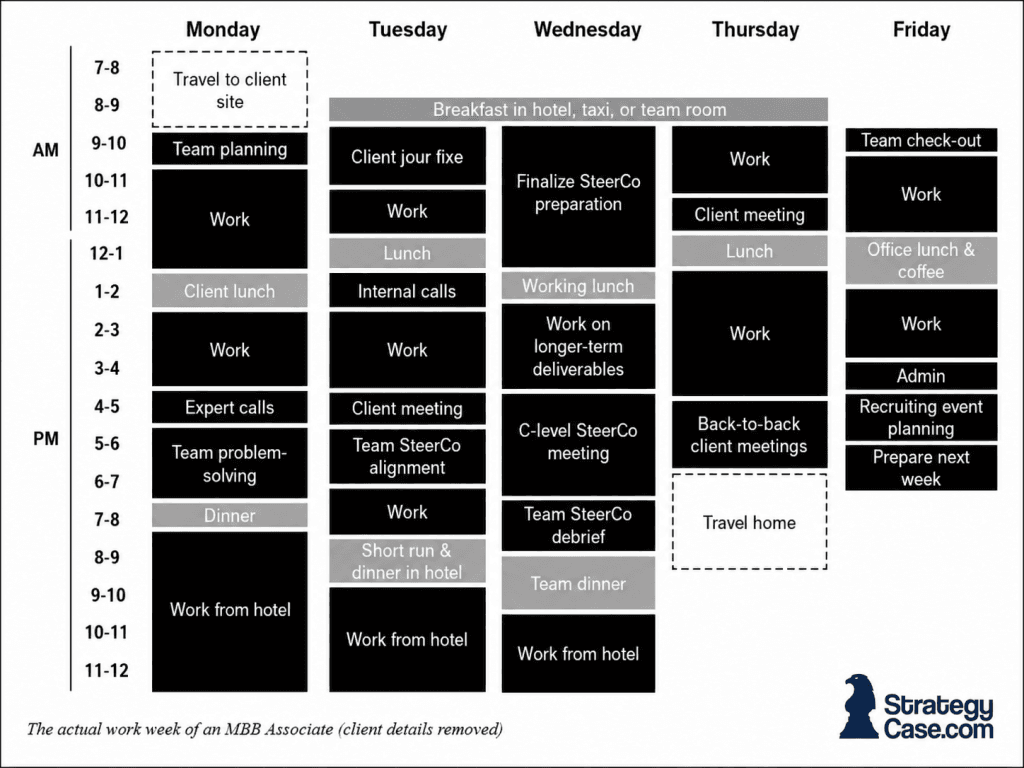
The real week of an MBB associate (client details removed): project work, team problem-solving sessions, check-ins, and the bi-weekly steering committee
In practice, the calendar is more fragmented than any tidy grid. Unplanned client visits, impromptu calls, and leadership drop-ins interrupt your core work. The bi-weekly steering committee, where the team updates C-level sponsors, is usually the most stressful stretch of the cycle. And you factor in travel at least twice a week: workable in an airport lounge, but slower and more cumbersome than a desk, and off-limits for confidential client materials in public.
What Actually Drives Your Weekly Hours
Two consultants at the same firm, same level, can live completely different lives depending on a handful of variables. These are the ones that decide your week:
- Project duration: Longer projects spread the load; short, sharp projects compress it into late nights.
- Project type: Turnarounds, restructurings, due diligence, and pure strategy tend to run hotter than implementation work.
- Leadership attention: More senior partners on a case often means more conflicting demands and longer hours.
- Your project manager: A strong manager who prioritizes and pushes back protects the team. A weak one inflates everyone’s hours.
- Client behavior: Demanding, political, or ex-consultant clients push hours up.
- Promotion cycles: A manager gunning for promotion often expects more from the team during their window.
- Scope creep and staffing: Expanding scope or a thin team lands squarely on your evenings.
- Your own speed: The concept of “face time” barely exists. Finish well and you leave. The better you are, the more you control your hours and the easier it is to push back on unreasonable asks.
Do Consultants Work Weekends and Pull All-Nighters?
Usually, no. This is the single biggest myth to correct.
At most MBB and Big 4 teams, weekends are actively protected, and a manager who routinely burns the team’s Saturday is seen as failing at their job, not grinding hard. Real weekend work shows up only in rare crunch periods: the final days before a major board presentation, or the closing stretch of a private equity due diligence on a tight deadline.
All-nighters follow the same logic. They happen, but they are the exception tied to a specific deliverable, not a Tuesday-night default. If a team is pulling all-nighters every week, that is a broken project or a broken manager, not the standard.

How Remote and Hybrid Work Changed Consulting Hours
The number that changed most since 2020 is not hours worked, it is hours traveled.
The old model was near-religious: Monday to Thursday on-site, Friday at home. After 2020, a lot of that went hybrid. Many engagements now run partly remote, with on-site time concentrated into key moments (kickoffs, workshops, steering committees) rather than four nights a week, every week. By 2026, travel has partly returned as clients pull teams back on-site, but the rigid four-nights-away default has loosened at most firms.
The honest catch: total working hours barely moved. Cutting a commute or a flight tends to get backfilled with more calls and more analysis. Hybrid consulting is less punishing on your body and your relationships, but it is not fewer hours. If anything, the always-reachable norm makes the boundary between “on” and “off” blurrier than it was on a plane with no signal.
Work Hours Outside MBB: Tier-2, Big 4, and In-House
Step outside the Big 3 and the range widens. The tier you join is one of the biggest levers on your lifestyle.
| Firm type | Typical weekly hours | The trade-off |
|---|---|---|
| Tier-2 (Oliver Wyman, Roland Berger, Kearney) | 55-75 | Often match or beat MBB hours; leaner support staff |
| Big 4 advisory / strategy (Monitor Deloitte, EY-Parthenon, Strategy&) | 50-65 | Slightly better balance, still project-driven |
| Boutiques | 45-70 | Varies widely by firm and practice |
| In-house / corporate strategy | 40-50 | Closest to a 9-to-5; a classic exit for balance |
The surprise for most candidates is that “less prestigious” does not automatically mean “easier.” Some Tier-2 firms run leaner teams and demand as much as MBB, while Big 4 advisory arms usually offer slightly more predictable hours. At the other end, in-house consulting inside a large corporation is the closest thing to a conventional schedule, which is exactly why so many consultants exit toward it.
So, Are the Long Hours Worth It?
That depends entirely on what you want out of the next few years, and it is worth answering honestly before you accept.
On the plus side, the hours buy an unusually steep learning curve, a strong network, and compensation that reflects the intensity. On the other side, the same hours and the constant low-grade stress are the top reason consultants eventually leave for better-balanced roles. Both things are true at once.
If you are trying to decide whether the trade is right for you, read the honest case on both sides in how to manage your work-life balance in top consulting firms, and compare the intensity against a common alternative in consulting versus investment banking. The rest of the StrategyCase careers library breaks down what the job actually feels like once the offer excitement wears off.
Frequently Asked Questions About Consulting Work Hours
Do consultants really work 80-hour weeks?
Not routinely. 80 hours is the top of the range, hit during crunch weeks near a big deliverable. The honest average on a project is the low 60s, and between projects it falls into the 40s.
How many hours do McKinsey consultants work?
Typically 55 to 70 hours a week on a project, the same range as BCG and Bain. There is no systematic difference in hours across the three firms.
Do consultants work weekends?
Usually not. Most MBB and Big 4 teams protect weekends, and routine weekend work signals a poorly run project. Real weekend work happens only in rare crunch periods, like a board presentation or a private equity due diligence.
How many hours do consultants work per day?
On a project, roughly 10 to 14 hours, with core hours around 9 a.m. to 9 p.m. Days run longest at the client site early in the week and shortest on the Friday home-office day.
Do consulting hours get better as you get promoted?
Total hours barely drop, but your control goes up. Partners choose which fires to fight and can shape their calendar; junior consultants absorb whatever the project throws at them.
Do consultants work more than investment bankers?
Usually a little less at the junior level. Junior bankers often log 70 to 90-plus hours, while consultants trade some of those hours for heavy travel. The intensity is comparable; the shape of the week is different.
Related Guides
- The 4 Types of Management Consulting Firms Explained
- Consulting Exit Opportunities: Paths and Career Options
- ‘Up or Out’ in Top Consulting Firms: An Honest Perspective
- Why McKinsey, BCG, and Bain Lead the Consulting Industry
- Working in Management Consulting: Key Pros and Cons
The bottom line: consulting hours are demanding but not the horror story recruiting forums make them out to be. Expect the low 60s on a project, protected weekends most of the time, and a schedule you control more as you grow. If you are weighing an offer and want a straight answer about the life before you commit, book a 1-on-1 coaching session with me at StrategyCase and we will pressure-test the decision together.
About the author: Florian Smeritschnig spent five years at McKinsey as a Senior Consultant, where he evaluated candidates for the firm. He founded StrategyCase.com and has helped clients secure 700+ offers at McKinsey, BCG, Bain, Tier-2 firms, the Big 4, and boutiques, delivering 2,200+ mock interviews and coaching sessions. He is the author of “The 1%: Conquer Your Consulting Case Interview,” “The 1%: Case Interview Workbook,” and “Consulting Career Secrets.”
