

Updated June 2026 · By Florian Smeritschnig, Former McKinsey Senior Consultant
Post-interview thank-you notes in consulting will not win you any offers, and they will not rescue a weak interview performance. In structured recruiting at McKinsey, BCG, and Bain, your result is decided in a scored debrief among the people who evaluated you, usually within hours of your final round, before any email lands in an inbox. So if you are refreshing your sent folder wondering whether the perfect note will tip the scales, the honest answer is that it won’t.
Having evaluated candidates at McKinsey and delivered 2,200+ coaching sessions since, I have never seen a thank-you note change a hire or no-hire call. What I have seen is candidates burn hours agonizing over an email the committee will never weigh. This guide gives you the honest verdict on whether a post-interview thank-you note matters in consulting, the few cases where sending one is genuinely worth it, and exactly how to write one if you decide to.
Key Takeaways
- A post-interview thank-you note is a courtesy with near-zero influence on a consulting hiring decision. It is neither expected nor scored.
- MBB interviewers usually decide your result in a debrief right after your round, so a note sent within 24 hours often arrives after the call is already made.
- It will not offset a weak case or fit performance. If the interview went badly, your energy belongs on a comeback plan, not an email.
- The downside of sending one is also near zero, so a short, genuine note is fine if you want to send it. Address it to your recruiter, not a hunted-down interviewer email.
- The only high-value reason to follow up is relationship-building for a future re-application (for example, a McKinsey Keep in Touch invitation), not the current decision.
Does a Thank-You Note Actually Matter in a Consulting Interview?
For consulting interviews specifically, no. A thank-you note does not meaningfully affect whether you get the offer.
This contradicts the standard career-advice line, so here is the evidence. The “always send one” camp leans on a widely-cited Accountemps (Robert Half) survey in which 80% of HR managers said they take thank-you messages into account when deciding who to hire. That figure is real, but it describes general corporate hiring, where a single hiring manager has discretion and the note is a genuine touchpoint with the decision-maker.
Consulting recruiting works differently. At McKinsey, BCG, and Bain, you are evaluated by consultants and partners against a structured rubric, and they align on a recommendation in a post-interview debrief, often the same day. The process is run by a recruiter or HR coordinator who frequently is not the person scoring you. Three things follow from that:
- The decision-makers usually never see your note. Your interviewers score the case and fit performance and move on. A thank-you email to a recruiter does not reach their scorecard.
- The timing rarely works. Final-round decisions are commonly made within hours. A note sent the next morning lands after the call.
- It is not part of the criteria. Firms publish what they assess, structured problem-solving, quantitative reasoning, communication, and personal fit. Etiquette after the fact is not on that list. McKinsey’s own interviewing guidance is entirely about how you think and communicate in the room.
The caveat: a note will not hurt you either, as long as it is brief and normal. The realistic impact sits at roughly zero, not slightly negative. So the decision to send one is about whether it is worth your time, not whether it is a hidden lever.
Why a Thank-You Note Won’t Save a Weak Interview
This is the part candidates least want to hear, so I will be direct: if your case or fit performance was weak, no email can fix it.
A thank-you note cannot retroactively make your structure MECE, your math accurate, or your synthesis crisp. Interviewers write their evaluation based on what happened during the conversation, your hypotheses, your quantitative work, your business judgment, and your communication. By the time you are drafting an email, that assessment is written.
Candidates routinely overestimate the note precisely when they sense the interview went poorly. The logic is understandable: the interview is out of your hands, the email is something you can control, so it feels productive. It isn’t. Polishing a thank-you message after a shaky case is the recruiting equivalent of rearranging deck chairs.
If you walked out knowing it went badly, skip the note entirely and put that energy where it counts. Get a clear read on what went wrong and build a real recovery plan. Around one in five MBB consultants landed their offer on a second attempt after closing a specific gap, and our comeback plan for a failed consulting interview walks through how to diagnose the rejection and reapply through the strongest channel. That is the move, not a better-worded thank-you.
So Is There Any Benefit to Sending One?
Generally, not much. For the current decision, the benefit rounds to zero. But the downside is also close to zero, and there are a few situations where a brief follow-up is genuinely worth sending.
- You are playing the long game. Consulting is a small world, and today’s interviewer may be tomorrow’s referral or reapplication contact. If you received a near-miss signal like a McKinsey Keep in Touch invitation, staying warm with the people you met has real value for round two. The note here is relationship maintenance, not decision influence.
- You genuinely connected with someone. If an interviewer gave you their card and you had a real conversation, a short, specific thank-you is normal professional behavior and can seed a future referral.
- You need to correct or add something material. If you flubbed a number you can now fix, or there is a relevant update to your candidacy (a competing offer with a deadline, a new credential), a brief note is a legitimate channel, usually through the recruiter.
- You are interviewing at a boutique or smaller firm. Outside MBB’s committee-style process, a single partner often has direct hiring discretion and a smaller candidate pool. There, a thoughtful note is slightly more likely to register, though it still won’t outweigh performance.
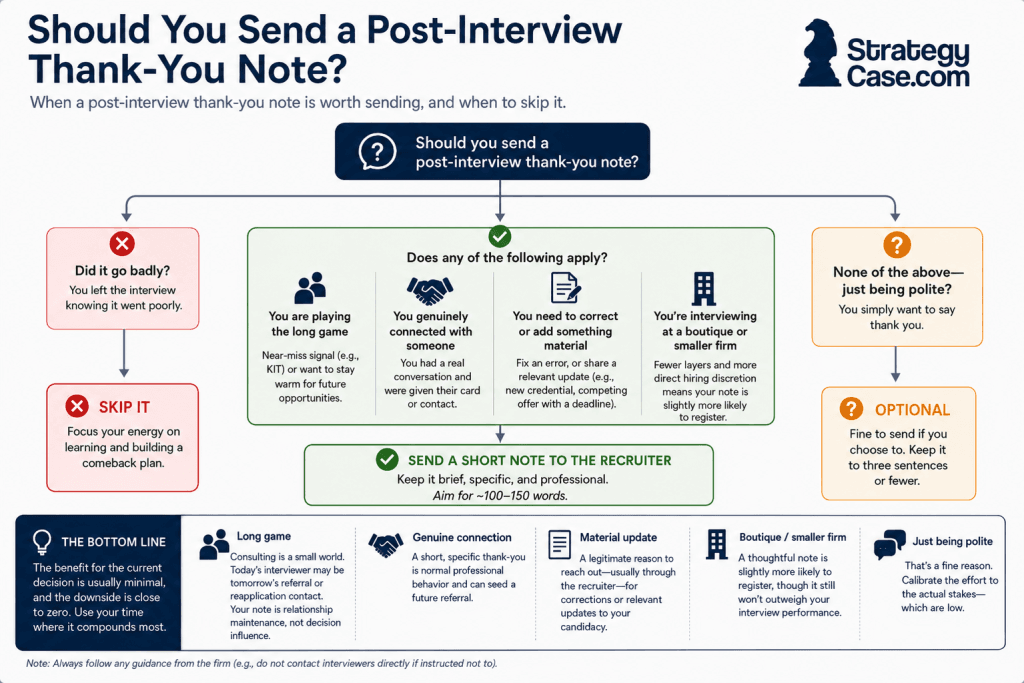
If none of these apply and you simply want to be polite, that is a fine reason too. Just calibrate the effort to the actual stakes, which are low.
If You Still Want to Send One, Here’s How to Do It Right
Decided to send one? Good, it is easy to do well and easy to overthink. Here is the version that helps a relationship and never hurts you.
Send it to the recruiter, not a hunted-down interviewer email
In most MBB processes you will not have your interviewers’ email addresses, and that is by design. Do not guess corporate address formats or cold-message them on LinkedIn to deliver thanks. That reads as exactly the kind of try-hard behavior the “is this desperate?” question is about. Send your note to the recruiter who has been your point of contact, and if you want to thank a specific interviewer, ask the recruiter to pass it along.
If the interviewer has given you their business card or email, you can contact them directly.
Timing: within 24 hours, but know the decision may already be made
If you are sending one, send it within 24 hours while the conversation is fresh. Just hold a realistic expectation: for final rounds, the debrief has often already happened. You are sending it as a courtesy and for the relationship, not to influence a verdict that is likely written.
Keep it short, specific, and free of asks
Three to five sentences. Thank them for their time, reference one specific thing from the conversation to show you were present, and restate your genuine interest. No essays, no re-pitching your whole candidacy, and no pressure for a status update in the same breath as “thank you.”
A template that won’t hurt you
Subject: Thank you, [Round/Position] interview, [Your Name]
Hi [Recruiter or Interviewer name],
Thank you for the time today. I especially enjoyed the discussion on [specific topic, e.g., the market-entry case and how the team thinks about prioritization]. It reinforced my interest in [Firm] and the kind of problems the office works on.
If it is helpful for me to share anything else as the process continues, just let me know. Thanks again, and I hope to stay in touch.
Best,
[Your Name]
What to avoid
- Generic, copy-paste lines. “Thank you for the opportunity” with no specific detail is worse than no note at all.
- Typos. A sloppy thank-you undercuts the only thing it signals, which is care.
- Status-chasing disguised as thanks. Do not use the note to push for a timeline. Follow up on status separately and only after the stated window.
- Length. If your note needs scrolling, cut it in half.
Other Post-Interview Situations Worth Handling Well
The thank-you note is one small piece of post-interview etiquette, and a minor one within the wider consulting application process. These situations matter more.
If you haven’t heard back
Wait until the timeframe the recruiter gave you has passed, then send one concise, polite status check. A single follow-up after the stated window is reasonable; repeated nudging is not. Keep it to two sentences: reaffirm your interest, and ask for an update when convenient.
If you’re rejected
Reply graciously, thank them, and ask for any feedback they can share. Then treat the rejection as information, not a verdict. The structured way to bounce back is the comeback plan linked above, including how to use a near-miss signal to your advantage.
If you get the offer
Respond with genuine enthusiasm, confirm the specifics (start date, team, location, deadline to decide), and ask any open questions before you commit. This is the one post-interview email that genuinely deserves your care.
Where to Actually Put Your Energy: Interview Performance
Here is the uncomfortable truth that most prep content avoids. The thank-you note is a 2% question that candidates treat like a 50% one, while the 98% that decides the outcome, your performance in the room, gets less attention than a piece of follow-up etiquette.
Your offer is won or lost on how you structure ambiguous problems, run the math, read exhibits, and communicate a recommendation top-down. That is what your interviewers score, and that is the only lever you actually control before the debrief. A note cannot add a point to it.
So if you are reading this before your interviews are done, redirect the worry. Build the skills that move the scorecard: first-principles structuring, clean math, sharp exhibit interpretation, and a top-down recommendation. That focus on real skill over surface polish is the whole premise behind StrategyCase’s prep. Our complete case interview guide covers the substance interviewers reward, and 1-on-1 coaching with me gives you the honest read on your weak spots that a thank-you note never could.
Demonstrating clear thinking, sound judgment, and composure leaves an impression no email can match. Send the note if you like. Just do not mistake it for preparation.
Frequently Asked Questions Post-Interview Thank-You Notes in Consulting
Do thank-you notes after an interview make a difference?
In general corporate hiring, surveys suggest many managers notice them. In consulting, they make essentially no difference to the decision. MBB interviewers score you against a rubric and debrief quickly, usually before a note arrives, and the recruiter who receives your email is typically not the person evaluating you.
Are post-interview thank-you notes still a thing?
Yes, they are still common and normal, and only a minority of candidates actually send them. But “common and normal” is not the same as “decisive.” In consulting, sending one is a polite-but-optional courtesy, not an expectation that affects your result.
Is sending a thank-you note after an interview desperate?
A short, specific note sent to your recruiter is not desperate. What reads as desperate is hunting down interviewer emails, messaging people on LinkedIn to thank them, sending multiple notes, or using “thank you” as cover to chase a decision timeline. Keep it brief and send it once.
How long should you wait to send a thank-you note?
If you are sending one, send it within 24 hours while the conversation is fresh. Waiting longer reduces what little point it has, because for final rounds the debrief is often already done.
Should I send a thank-you note to every interviewer?
You usually can’t, because you rarely have their email addresses, and that is fine. If you want to thank specific people, send one note to your recruiter and ask them to pass along your thanks rather than tracking down individual contacts.
What should I avoid saying in a thank-you note?
Avoid generic filler with no specific detail, anything that re-pitches your entire candidacy, and pressure for a status update. Avoid typos above all, since the only thing the note signals is attention to detail.
Related Guides
- The 2026 Comeback Plan After a Failed Consulting Interview
- Consulting Fit Interviews: The Only Guide You Need
- Consulting Case Interviews: A Comprehensive Guide
- How to Get a Referral for McKinsey, BCG, or Bain
- The McKinsey Keep in Touch (KIT) Program Explained
The Bottom Line
A post-interview thank-you note in consulting is a low-stakes courtesy. It will not earn you an offer, it will not save a weak interview, and it usually reaches an inbox after the decision is already made. The downside is just as small, so send a short, genuine note if you want to, especially when you are building a relationship for a future attempt. Just keep the effort proportional to the near-zero stakes.
Then spend the time you would have spent perfecting that email on the only thing that actually moves the decision: your performance in the room. Start with StrategyCase’s Case Interview Academy and walk into your next round prepared to win it outright.
About the author: Florian Smeritschnig is a former McKinsey Senior Consultant and the founder of StrategyCase. He spent five years at the firm and has since run more than 2,200 mock case interviews and coached hundreds of candidates into McKinsey, BCG, Bain, and other top firms.
