

Last Updated on October 13, 2026
By Dr. Florian Smeritschnig, former McKinsey Senior Consultant · Updated October 2026
The McKinsey Keep in Touch program (KIT) is McKinsey’s invitation-only talent pool. Members get KIT-only webinars, training sessions, and newsletters that highlight open roles, so the firm stays in contact until they apply or reapply. KIT is not an offer or a fast track, and McKinsey says KIT members are not assessed.
Whether your invite is good news depends on when it arrived. After a final round, it usually means the team wants another look at you. After a recruiting event or a Solve rejection, it keeps you in McKinsey’s pipeline. Forums blur the two, so the same email reads as “you were so close” in one thread and as a polite brush-off in the next.
I failed my first McKinsey application, reapplied, and got in. During my five years at the firm, I also evaluated candidates. Once I left the firm I started helping people break into it and I have worked with quite a few McKinsey KIT candidates over the last few years.
This guide reads your invite against McKinsey’s own KIT pages and lays out what to do before your next application.
Key Takeaways
- KIT is McKinsey’s invitation-only talent pool: KIT-only webinars, training sessions, and newsletters that highlight open roles. McKinsey says members are not assessed or given personal or professional advice.
- The invite isn’t reserved for near-misses. McKinsey sends it after recruiting events, and candidates report getting it after Solve, first rounds, and final rounds. Your stage tells you how close you came.
- KIT doesn’t lower the bar or replace the process. You still apply and interview again, and McKinsey says its standards for an interview and an offer are the same in every office.
- McKinsey publishes no general waiting period, so ask your recruiter for your earliest reapplication date in writing. Internship rejections are the exception: McKinsey encourages you to apply in your campus’s full-time window.
- Reapplicants who convert fix one diagnosed weakness and change how they prepare. More cases with the same method rarely change the result.
What Is the McKinsey Keep in Touch Program?
McKinsey Keep in Touch (KIT): an invitation-only program that keeps people McKinsey has met, at recruiting events or through an application, connected to the firm. Members get KIT-only webinars, training sessions, and email newsletters about open roles and McKinsey’s work. KIT members are not assessed, and joining doesn’t count as an application.
That description comes from McKinsey’s own Keep in Touch page and KIT FAQ. Three details on those pages matter more than anything you’ll read on Reddit:
- KIT isn’t only for rejected candidates. All three testimonials on McKinsey’s KIT page come from people who were invited after a McKinsey event (one of them a problem-solving bootcamp) and before they applied. All three later joined the firm: a business analyst in Milan, a junior specialist in London, and a knowledge analyst in Seoul.
- KIT doesn’t evaluate you. The FAQ says KIT members are “not assessed or given personal or professional advice.” Joining is not a step in your candidacy.
- Students are in “KIT Campus.” It ends when you graduate, and McKinsey asks graduates who want to stay connected to tell the firm as they start their careers.
So the KIT email proves less than most candidates hope. What it does say depends on the moment McKinsey sent it.
What You Get From KIT (and What You Don’t)
KIT is often described as mentoring and career support. McKinsey’s own pages describe something narrower:
| What KIT gives you | What KIT doesn’t give you |
|---|---|
| Invitation-only webinars, usually one hour, with log-in details sent a few days before | Feedback on your interviews or application |
| Training sessions on skills such as giving feedback and leadership | Career counseling or a personal mentor |
| Newsletters that highlight open roles, consultant stories, and McKinsey’s work | An interview slot or a place in a queue |
| An archive of past webinar recordings | A job, an internship, or a salary |
| A profile McKinsey asks you to keep up to date | A way around the standard application |
The left column is worth your time. Webinars on the practice or office you’re targeting give you specifics for your “Why McKinsey” answer, and they help you decide where to apply. The right column is why KIT alone won’t change your next interview.
For open roles and local events, McKinsey’s FAQ sends you to the office you already dealt with, not to the KIT team.
Is a McKinsey KIT Invite a Good Sign? It Depends on When It Arrived
Does everyone get one?
No.
Plenty of rejected candidates get a standard email with no invitation, and offices handle it differently. But McKinsey doesn’t reserve KIT for near-misses either. It sends invites at several points, so the email can’t tell you how close you came. The stage can.
| When your invite arrived | What it usually signals | Your next move |
|---|---|---|
| After a McKinsey event, before you applied | You’re in the talent pool. Nobody has evaluated you yet. | Apply when a role and the timing fit. Use the webinars to pick a role and an office. |
| After a pre-MBA or scholarship program passed on you | The door stays open for the main recruiting cycle. | Apply in the next internship or summer associate window. |
| After Solve or the resume screen, with no interview | A light signal. Candidates report it at this stage too, including some who say they did badly on Solve. | Fix the screen first: Solve, your resume, or both. |
| After a first-round interview | Someone saw potential, and something specific held you back. | Get feedback and rebuild that one skill before the next cycle. |
| After a final-round interview | The strongest version. You were close, and the gap is often one skill, or headcount and timing. | Ask for detailed feedback and your earliest reapplication date, in writing. |
My read on the last row: a KIT invite after a final round deserves to be taken seriously. By then partners have seen you, and the firm chose to keep the door open. Recruiters often share what held you back if you ask directly, and that feedback is the most valuable thing you take away from the rejection.
The first row is the one candidates misread most. If you joined KIT after an event, nothing has been decided about you, good or bad. Apply when you’re ready, and treat the webinars as research.
Does the Keep in Touch Program Help You Get Into McKinsey?
It can, and McKinsey has published examples. In a 2018 post on McKinsey’s careers blog, a Wharton MBA student describes applying to the firm’s Emerging Scholars program, not being selected, and signing up for Keep in Touch. She followed McKinsey’s research and new roles through the newsletters and webinars, applied that January for a summer associate role, and got the offer. The three testimonials on the KIT page follow the same arc: KIT first, an application later, then a job.
These are success stories McKinsey chose to publish. They show that KIT can lead to an offer, not how often it does, and McKinsey doesn’t publish a KIT conversion rate.
What KIT doesn’t do is lower the bar. When you reapply, you go through your track’s full process again, typically the online application, Solve, and case and PEI interviews. McKinsey’s careers FAQ says the standards for getting an interview and an offer are the same globally, and nothing on its KIT pages suggests KIT members face a lower one.
Two claims you’ll read elsewhere deserve caution:
- “KIT status works like a referral.” Some coaches, including former McKinsey associate partners, describe it that way on forums. McKinsey doesn’t document it. Even if your file carries a flag, the flag can help you get an interview, not pass one.
- “KIT shortens your waiting period.” Prep sites quote anything from 3 to 12 months. McKinsey doesn’t publish a number, and your recruiter sets your date.
Treat KIT as a warm introduction. Whatever it does for your application, the interviews score what you do in the room, and that’s where reapplicants win or lose.
When Can You Reapply to McKinsey After a KIT Invite?
McKinsey doesn’t publish a general waiting period. Its careers FAQ covers one case: if you weren’t selected for an internship, you can still apply for full-time roles, and McKinsey encourages you to reapply during your campus’s full-time recruiting window.
| Your situation | When you can apply next | Who sets it |
|---|---|---|
| Not selected for a McKinsey internship | Your campus’s full-time recruiting window | McKinsey (published in its careers FAQ) |
| In KIT after an event, with no application yet | Whenever a role fits (KIT Campus ends at graduation) | You |
| Rejected after Solve or an interview round | Commonly 12 to 24 months; some KIT candidates are invited back sooner, often for the next recruiting cycle | Your recruiter |
Our guide to the consulting ban period lists the typical windows by firm. For your own date, three rules apply:
- Get it in writing. Ask your recruiter for the earliest date or recruiting cycle you can apply in. A date you pieced together from forum posts is a guess.
- Don’t office-shop. The wait applies across every McKinsey office, and the standards are the same everywhere. When you’re eligible, one application takes up to three office or practice preferences, and you split 60 points between them. Our guide to McKinsey’s offices covers how to choose.
- Eligible doesn’t mean ready. A second rejection for the same weakness is harder to recover from than a later, stronger application. If the gap isn’t closed, wait a cycle.
What to Do Before You Reapply
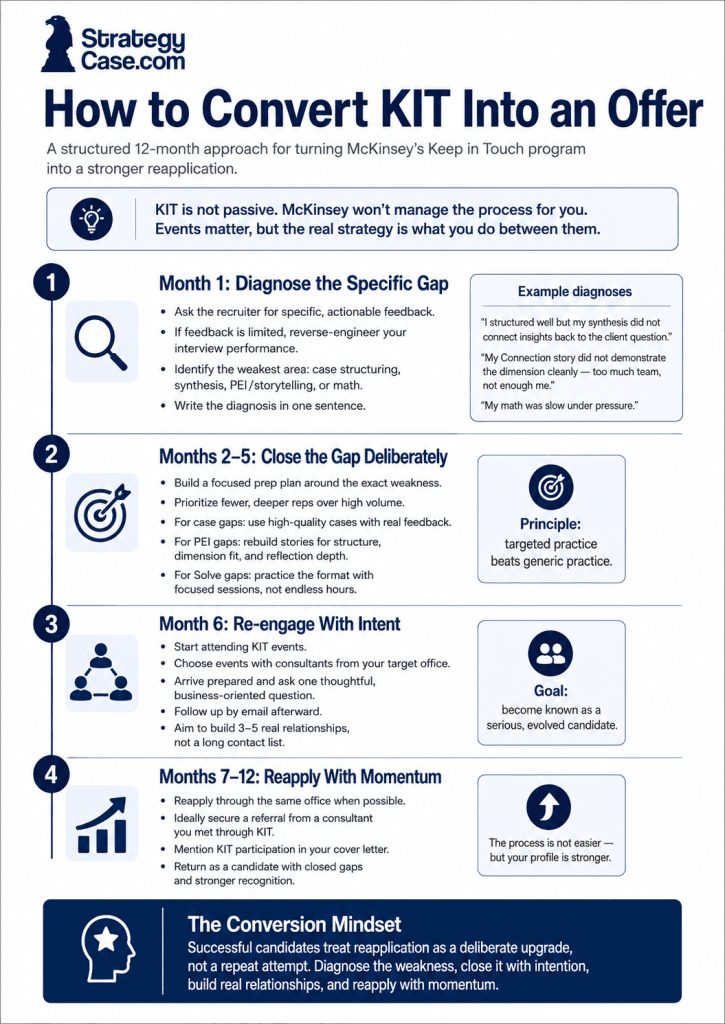
KIT won’t build this plan for you: its FAQ is explicit that the program doesn’t assess or advise. Here is the sequence I recommend.
1. Reply Within a Few Days
Thank the recruiter, accept the invitation, and ask two questions. Something like:
Thank you for letting me know, and for the invitation to Keep in Touch. I’d like to join and to apply again. If you can share it, what would need to look different next time, and from which recruiting cycle could I reapply?
Send it to the recruiter from your process, not to the KIT team, which doesn’t give individual feedback.
2. Write Your Gap in One Sentence
That sentence drives everything after it. For example:
- “I structured well, but my synthesis didn’t tie the insights back to the client’s question.”
- “My Connection story didn’t show the dimension clearly: too much team, not enough me.”
- “My math slowed down under pressure.”
If your recruiter won’t share specifics, work backward from your stage (see the table above) and from the moments you’d replay: the question that stalled you, the follow-up you couldn’t answer.
3. Rebuild the Skill, Not the Volume
This is where I went wrong the first time. I prepared for my first McKinsey application the way almost everyone does: the well-known books, memorized frameworks, case after case. I was rejected. For my second attempt I threw that approach out and worked on the underlying skills: breaking a problem apart from first principles, forming a view with incomplete information, and reading data for what it actually says.
I reapplied and got the offer.
Since 2020 I’ve coached clients to 700+ consulting offers through StrategyCase, and the reapplicants among them who converted share one pattern: their second application looked qualitatively different from their first. Match the fix to your sentence:
- Case gap: rebuild structuring, exhibit reading, and case math with the McKinsey case interview guide. StrategyCase’s Case Interview Academy drills those three skills with video lessons and thousands of practice exercises.
- PEI gap: rebuild two or three stories around McKinsey’s four dimensions (Leadership, Connection, Growth, and Drive) and test them against deep follow-up questions. The McKinsey PEI guide covers each dimension.
- Solve gap: treat Solve as its own workstream. The McKinsey Solve guide covers the current games.
- Profile gap: give your resume something new to show: wider scope at work, a quantified result, a promotion, or a degree.
4. Use KIT for What It’s Good At
- Pick two or three webinars tied to the practice or office you want, and note one specific takeaway from each for your “Why McKinsey” answer.
- Ask the office you dealt with, where you interviewed or attended an event, about local events and open roles. McKinsey’s KIT FAQ points you there.
- Update your profile whenever your experience changes, as McKinsey asks KIT members to do. If you’ve applied before, you can upload a new resume in McKinsey’s candidate portal.
- Meet consultants in your target office. A referral from someone who has seen how you think gives your next application an advocate.
5. Reapply With Proof of Change
Apply in the window your recruiter gave you, and let them know when you’ve submitted. Make the change visible: new experience on your resume, plus stories and cases that show the skill you fixed.
Keep in Touch vs. Connect with McKinsey, Early Access, and Forward
Searches for KIT often turn up McKinsey’s other programs. They work differently:
| Program | Who it’s for | How you get in | What it gives you |
|---|---|---|---|
| Keep in Touch (KIT) | People McKinsey met at an event or through an application | Invitation only | KIT-only webinars, training, and newsletters with open roles; no assessment or advice |
| Connect with McKinsey | Undergraduate and non-MBA master’s students in North America | Sign-up form | Recruiting-event invitations, newsletters, application and deadline dates, priority access to Solve |
| McKinsey Early Access | Admitted full-time MBA students in the US and Canada | Interest form each spring | Summer sessions, recruiter check-ins, priority access to Solve, a preview of summer associate roles |
| McKinsey Forward | Early-career professionals (eligibility varies by region) | Application through McKinsey.org | A free online learning program, not a recruiting track |
If you’re a student who hasn’t applied yet, don’t wait for a KIT invite. Connect with McKinsey and Early Access are the routes you can start yourself, and our McKinsey internship guide covers programs and timing.
Frequently Asked Questions
Does everyone get invited to McKinsey Keep in Touch?
No. Many candidates get a standard rejection with no invitation, and practice varies by office. The invite isn’t limited to final-round near-misses either: McKinsey sends it after recruiting events, and candidates report receiving it after Solve and after first-round interviews. It’s invitation-only, but it isn’t rare enough to read as a verdict on its own.
How do I log in to McKinsey Keep in Touch?
McKinsey doesn’t describe a separate KIT login. You join from your invitation email, RSVP to webinars through McKinsey’s KIT events page, and receive the log-in details for each webinar a few days before it starts. If you’ve applied before, your profile and resume sit in McKinsey’s candidate portal, and the KIT page lists a contact for the KIT team if a link doesn’t work.
Will McKinsey contact me about open roles through KIT?
Mostly through newsletters. McKinsey says KIT newsletters highlight open roles, but the program doesn’t assess members, so don’t wait for a recruiter to call. For a specific role or a local event, contact the office you dealt with, as McKinsey’s KIT FAQ suggests.
Can I apply to a different McKinsey office while I’m in KIT?
Not as a way around your waiting period. The wait applies across McKinsey’s offices, and the firm says its standards for an interview and an offer are the same globally. When you’re eligible, one application lets you list up to three office or practice preferences, so choose them deliberately.
What happens to my KIT membership when I graduate or change jobs?
KIT Campus ends when you graduate, and McKinsey asks you to let them know if you want to stay connected as you start your career. Changing jobs doesn’t affect your enrollment, but McKinsey asks you to update your profile whenever your professional experience changes.
Do BCG and Bain have a Keep in Touch program?
Not a branded one. BCG’s careers FAQ says you can apply for a specific role only once and recommends waiting at least 12 months after a rejection. Bain’s internship FAQ says Bain wants to stay connected with applicants it doesn’t select, through school events and a monthly newsletter.
Related Guides
- McKinsey application process: every stage from application to offer, so you know what you’re re-entering
- How to come back after a failed application or interview: the comeback plan for any consulting firm
- Consulting networking: build the relationships KIT won’t build for you
Final Word
The McKinsey Keep in Touch program keeps a door open, and how wide depends on the stage your invite arrived at. Get your feedback and your reapplication date in writing, then spend the months in between fixing the one thing that cost you the offer. Change how you prepare, not only how much.
If you want an expert read on what held you back, book a free StrategyCase consultation. Every session is with me personally, and I take on a limited number of clients each month. We’ll pin down the gap and decide whether you need coaching or a self-study plan. If you’d rather rebuild on your own, the Case Interview Academy covers the case skills McKinsey scores.
About the author: Dr. Florian Smeritschnig is the founder of StrategyCase.com and a former McKinsey Senior Consultant. Since 2020 he has delivered 2,200+ mock interviews and coaching sessions, and his clients have secured 700+ consulting offers, 340 of them at McKinsey, BCG, and Bain. He is the author of three books on consulting interviews and careers, including The 1%: Conquer Your Consulting Case Interview.
