
By Dr. Florian Smeritschnig, former McKinsey Senior Consultant · Updated October 2026
There is no single consulting ban period. BCG is the only MBB firm that publishes one: it recommends waiting at least 12 months after an unsuccessful application. McKinsey and Bain publish no general waiting period, so the date that counts is the one your recruiter gives you. And if you were turned down for an internship, McKinsey and BCG both say you can still apply for full-time roles.
If your rejection email arrived this fall, you’ll find numbers online ranging from 6 months to 2 years. Plan around the wrong one and you either wait a year longer than you need to, or you reapply before fixing what cost you the offer.
I’ve been on both sides of this. McKinsey rejected my first application, I applied again 14 months later and got the offer, and during my five years at the firm I evaluated candidates. Below is what each firm actually publishes and my experience from working with candidates who have been rejected before, as well as a plan for the months in between.
Key Takeaways
- BCG recommends waiting at least 12 months after an unsuccessful application. It’s the only MBB firm that publishes a number.
- McKinsey and Bain publish no general waiting period. Candidate reports range from about 6 months after a resume or test rejection to 24 months after interviews, so ask your recruiter for your date in writing.
- Internship rejections are the published exception: McKinsey and BCG let you apply for full-time roles in the next recruiting window.
- Each firm’s wait is its own. A McKinsey rejection doesn’t stop you from applying to BCG or Bain this season.
- Reapplicants who convert change how they prepare and what their profile shows. Waiting out the clock with the same CV rarely changes the result.
Consulting ban period (also called the cool-off period or reapplication waiting period): the time a consulting firm asks you to wait after an unsuccessful application before applying to it again. Most firms set it case by case and don’t publish it. BCG’s recommended 12 months is the exception among McKinsey, BCG, and Bain.
Ban Periods at McKinsey, BCG, and Bain: What Each Firm Publishes
Here is what the three firms say on their own careers pages, next to what candidates report in forums.
| McKinsey | BCG | Bain | |
|---|---|---|---|
| Published waiting period | None in its careers FAQ | “At least 12 months” after an unsuccessful application, as a recommendation (careers FAQ) | None |
| Rejected for an internship | You can still apply for full-time roles. McKinsey encourages you to reapply in your campus’s full-time recruiting window. | Unsuccessful summer interns applying for full-time roles are an exception to the one-year wait (UK careers page) | Bain says it encourages you to apply in the future and wants to stay connected about other roles (ACI FAQ) |
| Other offices | Not published. The wait applies across McKinsey offices, and the firm says its hiring standards are the same globally. | A London rejection “does not preclude you from being considered by other BCG offices” (UK careers page) | Not published |
| What my candidates report | About 6 months after a resume or Solve rejection; 12 to 24 months after interview rounds | 6 to 12 months; some recruiters name a specific date | About 12 months, or skipping one recruiting cycle; varies by office |
| Near-miss program | Keep in Touch (KIT), invitation only | None published | None published |
Candidate reports come from our own clients, threads on Glassdoor, Fishbowl, Reddit, and Wall Street Oasis. They describe individual cases, not firm policy.
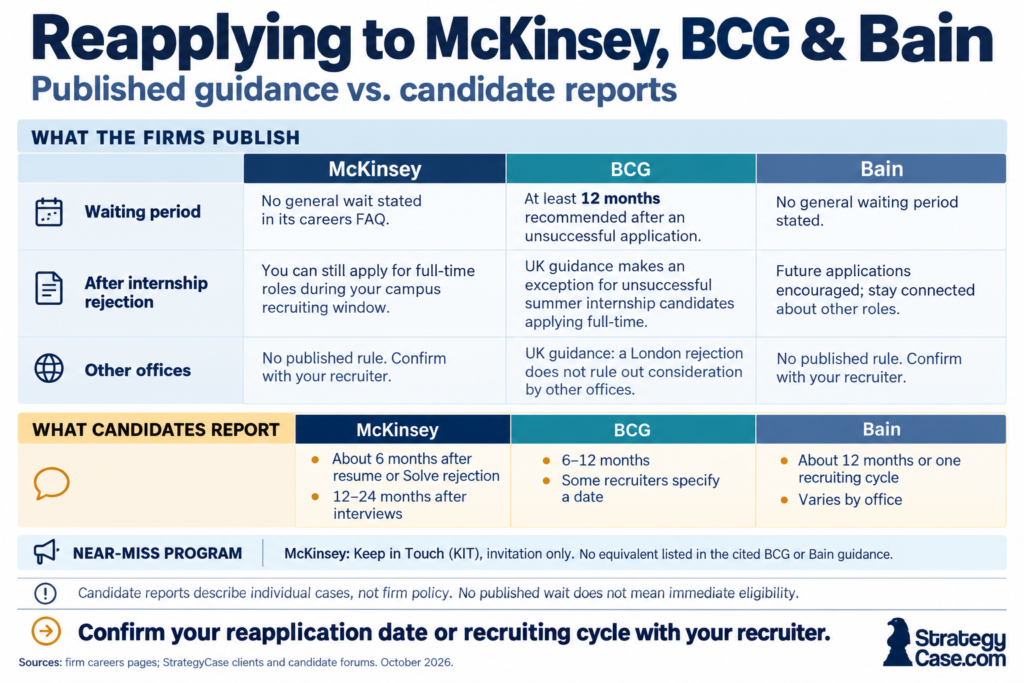
Only BCG puts a waiting period in writing. For McKinsey and Bain, your recruiter’s date is the one that counts.
Three things stand out in this table.
Only BCG puts a number in writing, and even BCG calls it a recommendation. Ban periods aren’t set in stone, and firms don’t enforce them with the same rigidity everywhere. The stage you reached, the office, and how much hiring the firm needs that year all move the date.
The internship route is the rule firms do publish. If an internship application failed, your next realistic shot is full-time recruiting, not a two-year wait. That’s the route I took: my McKinsey internship case interview didn’t go to plan, and 14 months later I applied for a full-time role and got the offer.
The only date that counts is your recruiter’s. Forum numbers mix stages, offices, and years. Ask for the earliest date or recruiting cycle you can apply in, and get the answer in writing.
Why the Numbers Online Disagree
The 6-to-24-month spread you see in forums reflects real differences between candidates.
- The stage you reached. A resume or online-test rejection tends to carry a shorter wait than a final-round rejection. McKinsey candidates report about 6 months for the first and 12 to 24 months for the second.
- Your level. Internship-to-full-time is a published exception at McKinsey and BCG. Experienced hires apply role by role, and BCG says you can apply for a specific role only once.
- Your office and the year. Hiring demand shifts from year to year, and offices apply their rules differently. Bain candidates in particular describe the wait as office-dependent.
Read any number, including the typical ranges in this guide, as the starting point for a conversation with your recruiter, not as your date.
Is a Rejection the End? How Often Second Attempts Work
No. Based on my experience, around 1 in 5 MBB consultants got in on their second try. No firm publishes this figure, so treat it as one insider’s estimate rather than data.
What separates the reapplicants who convert from those who don’t is rarely the waiting time. Since 2020 I’ve coached clients to 700+ consulting offers through StrategyCase, and the reapplicants among them who converted share one pattern: their second application looked qualitatively different from their first.
The rest of this guide is about making yours look that way.
When Does the Ban Period Start?
Usually from your last interview or your rejection, not from the day you applied. BCG’s UK careers page says candidates typically wait “a year after your last interview or application rejection.” McKinsey and Bain don’t publish a start date, so assume your rejection date and confirm it with your recruiter.
Two things don’t shorten the clock:
- Applying again for the same role. BCG’s FAQ says you can apply for a specific role only once and can’t resubmit.
- A second profile under another email. Don’t. It backfires and can turn a temporary wait into a permanent block. Firms keep your application history: BCG’s candidate profile shows “all your current and past applications,” and McKinsey’s careers FAQ names “restrictions on future applications” as a consequence of misrepresenting yourself in its process.
Can You Apply to Another Office or Firm During the Ban Period?
Another firm: yes. McKinsey, BCG, and Bain are separate companies with separate applicant systems. A rejection at one doesn’t start a clock at the other two, so you can apply to them in the same season.
Another office of the same firm: it depends on the firm.
- McKinsey: don’t office-shop. The wait applies across McKinsey offices, and the firm says the standards for an interview and an offer are the same globally. When you’re eligible, one application lets you rank up to three office or practice preferences with 60 points, so choose them deliberately.
- BCG: its UK careers page says a rejection by London doesn’t stop other BCG offices from considering you. Read that as “your history won’t block you automatically,” not as a way around the 12 months: BCG keeps one candidate profile per person, with your past applications on it.
- Bain: no published rule. Ask your recruiter before you apply to another office.
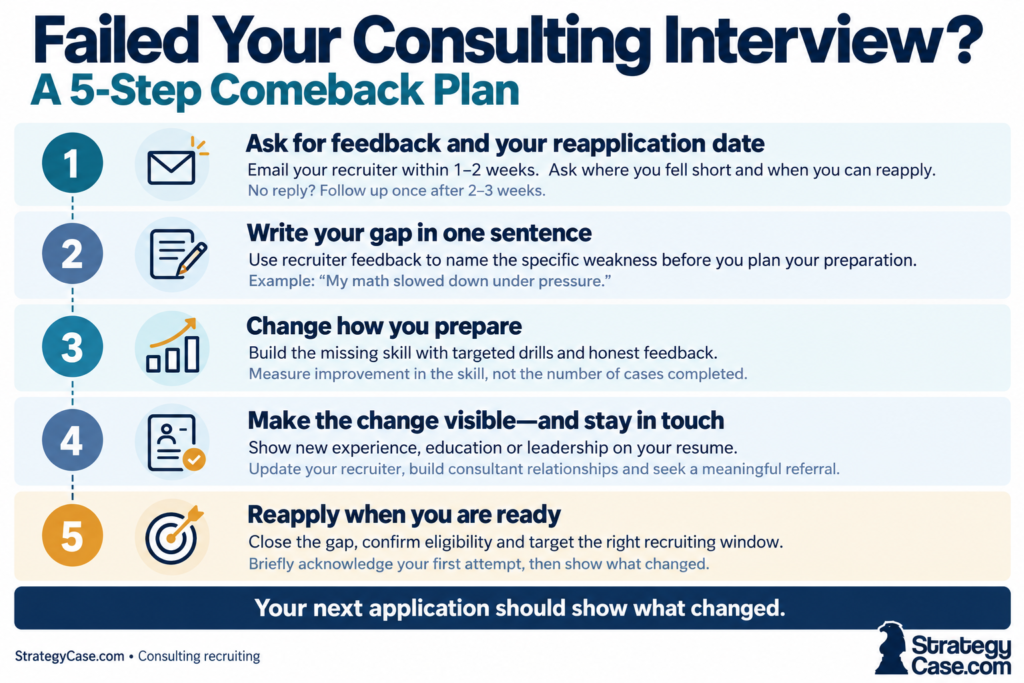
Failed Your Consulting Interview? A 5-Step Comeback Plan
The waiting takes care of itself. What you do during it decides whether your second application lands differently.
1. Ask for Feedback and Your Reapplication Date
Email your recruiter within a week or two of the rejection. Consulting recruiters are usually upfront and helpful, especially when they see potential. Keep it short:
Thank you for letting me know. I’m committed to consulting and plan to apply again. Could you share where my application fell short, and from which date or recruiting cycle I could reapply?
Expect a brief answer: the stage, sometimes the area. That’s enough to start. If you hear nothing after two or three weeks, follow up once.
2. Write Your Gap in One Sentence
Candidates are poor judges of where their own interview went wrong. That’s why the recruiter’s answer matters, and why you should turn it into one sentence before you plan anything. For example:
- “My structure was fine, but my synthesis didn’t tie the insights back to the client’s question.”
- “My PEI story showed the team’s result, not my own contribution.”
- “My math slowed down under pressure.”
Then match it to the stage you were rejected at:
| Where you were rejected | What it usually points to | What to change before you reapply |
|---|---|---|
| Resume screen | Profile signal: school, grades, experience, or no referral | A visible profile change and a referral; rework your consulting resume |
| Online test (McKinsey Solve, BCG’s online tests, Bain Sova or TestGorilla) | Unfamiliarity with the format and pacing | Prepare the exact format; start with our guide to consulting assessment tests |
| First-round case interview | A skill gap: structuring, math, or interpreting exhibits | Rebuild the skill instead of adding cases; StrategyCase’s free Case Interview Foundations course covers the basics |
| Fit interview or McKinsey PEI | Stories that don’t show what the firm scores | Rebuild three or four stories against the firm’s criteria; see the McKinsey PEI guide |
| Final round | A close call: judgment, presence, or that year’s headcount | More scope and seniority in your current role; a KIT invitation at this stage is a real signal |
Two notes on this table. Failing an online test is mostly a result of not preparing for that test, not a verdict on your ability. And a final-round rejection can come down to demand: when a firm needs fewer new hires, even highly qualified candidates get turned down.
3. Change How You Prepare, Not Only How Much
More cases with the same method rarely change the result. I learned this the hard way.
For my first McKinsey application I prepared the way almost everyone does: the well-known books, memorized frameworks, case after case. It didn’t work. For the second attempt I worked on the underlying skills instead: breaking a problem down from first principles, forming a view with incomplete information, and reading data for what it actually says.
Whatever your sentence from step 2, build the skill behind it with targeted drills and honest feedback. Counting cases tells you nothing about whether that skill improved.
4. Make the Change Visible, and Stay in Touch
Recruiters will see your first application next to your second, so the difference has to show on paper. Changes that do:
- New experience: a new role, a bigger project, or an internship. Interning or working at another respected consulting firm significantly improves your chances of a second shot.
- Further education: a master’s, an MBA, or courses that close a gap in your profile.
- Leadership outside work: an extracurricular role with real responsibility.
- Time abroad: some firms value international experience highly.
At the same time, don’t cut ties with the firm out of frustration. Stay in touch with the recruiter and update them when something changes. Connect with consultants, especially alumni from your university, and if you move cities, meet consultants in the local office. A referral from a current consultant gives your next application an advocate.
And if the firm asks you for a favor, help. A few months after my failed McKinsey interview, during my time in Hong Kong, a McKinsey Engagement Manager contacted me about a local recruiting matter. I spent 10 minutes helping, and the local recruiting manager remembered.
When I reapplied, my application was fast-tracked, and the interview invitation arrived one day after I submitted it. I got the offer. The favor helped, but it wasn’t the whole story. In those 14 months I had also done an internship at Kearney and a master’s degree in two foreign countries, and I approached case interviews in a completely different way.
5. Reapply When You’re Ready, Not When You’re Eligible
Eligible doesn’t mean ready. If the gap from step 2 isn’t closed, wait a cycle: a second rejection for the same weakness is harder to recover from than a later, stronger application. Time your application to your track’s recruiting window, which our consulting recruiting timeline lays out by firm.
When you apply, don’t make a big deal out of the first attempt. Recruiters already know your history. One sentence in your consulting cover letter is enough: acknowledge the first application, then spend the rest showing what changed. Told that way, a second application reads as commitment.
Near-Miss Signals: McKinsey KIT, and What BCG and Bain Do Instead
McKinsey Keep in Touch (KIT). KIT is McKinsey’s invitation-only talent pool. Members get virtual events and newsletters, and McKinsey’s KIT FAQ says they are “not assessed or given personal or professional advice.” McKinsey publishes no shorter wait for KIT members. Some near-miss candidates are invited back sooner, often for the next recruiting cycle, but your recruiter decides that. Our McKinsey Keep in Touch guide explains what an invitation signals at each stage.
BCG. No branded program. Its UK careers page says BCG is “happy to see candidates return to recruitment processes.”
Bain. Bain publishes no near-miss status and no shortened wait. Its internship FAQ says that if you aren’t selected, Bain wants to stay connected about other roles, through school events and a monthly newsletter.
Should You Wait It Out or Take Another Route?
You don’t have to spend the wait doing nothing. Three routes run in parallel with it:
- Apply to the other MBB firms now. Each firm’s wait is its own.
- Join a Tier-2 or Big 4 strategy practice. Real consulting experience at another respected firm significantly improves your chances of a second shot at MBB. See how to make the move from Tier-2 to MBB or switch from the Big 4 to MBB.
- Use the internship-to-full-time exception. If you’re still studying, your next shot is the full-time window, and you have the most room to change your profile before then.
Frequently Asked Questions
How long is the McKinsey cool-off period?
McKinsey doesn’t publish one. Its careers FAQ sets no general waiting period, so your recruiter gives you a date. Candidates commonly report about 6 months after a resume or Solve rejection and 12 to 24 months after interview rounds. If you were rejected for an internship, McKinsey encourages you to apply in your campus’s full-time recruiting window.
How long do you have to wait to reapply to BCG?
BCG recommends waiting at least 12 months after an unsuccessful application, so you have time to show new experience and growth. You can apply for a specific role only once. Unsuccessful summer interns applying for full-time roles are an exception, according to BCG’s UK careers page.
How long is Bain’s ban period?
Bain doesn’t publish one. Candidates most often report about 12 months, or skipping one recruiting cycle, and say it varies by office. Bain has no published near-miss status or shortened wait, so ask your recruiter for your earliest date.
I was rejected for a consulting internship. Can I apply for full-time?
Yes, at McKinsey and BCG. McKinsey’s careers FAQ says you can still apply for full-time positions and encourages you to reapply during your campus’s full-time recruiting window. BCG’s UK careers page lists unsuccessful summer interns applying for full-time as an exception to its one-year wait.
Does the ban period start when I applied or when I was rejected?
When you were rejected or last interviewed. BCG’s UK careers page describes the wait as typically a year after your last interview or application rejection. McKinsey and Bain don’t say, so ask your recruiter to confirm your earliest date in writing.
Will the firm know I applied before?
Yes. Firms keep your application history, and BCG’s candidate profile shows all your current and past applications. That’s not a problem. Mention your first application in one sentence and use the rest of your cover letter to show what changed.
Related Guides
- How to get into consulting: the application guide
- McKinsey application process, step by step
- How to pass the final-round case interview
- Experienced hires at McKinsey, BCG, and Bain
Your Next Step
A consulting ban period is a deadline you can plan around:
- BCG recommends at least 12 months; McKinsey and Bain publish no general wait, so get your date from your recruiter.
- An internship rejection opens the full-time window at McKinsey and BCG.
- Your second application has to look different: a diagnosed gap, closed, and a visibly stronger profile.
The hardest part is the diagnosis. Candidates rarely know which skill cost them the offer, and the feedback email won’t tell you much. Take the free StrategyCase 2-minute diagnostic to see where your preparation stands today. If you want a second opinion on your rejection and a plan for the months ahead, book a free intro call.
About the author: Dr. Florian Smeritschnig is the founder of StrategyCase.com and a former McKinsey Senior Consultant. Since 2020 he has delivered 2,200+ mock interviews and coaching sessions, and his clients have secured 700+ consulting offers, 340 of them at McKinsey, BCG, and Bain. He is the author of three books on consulting interviews and careers, including The 1%: Conquer Your Consulting Case Interview.
