
Last Updated on September 18, 2026
By Florian Smeritschnig, former McKinsey Senior Consultant · Updated September 2026
The McKinsey case interview, which the firm calls the Problem-Solving Interview, is an interviewer-led business case: the interviewer drives the questions, hands you the data you need, and scores you against a standardized rubric while you structure the problem, run the math, and build a recommendation. It feels different from a Bain or BCG case because you react to prompts instead of running the show, but here is the part most candidates miss: McKinsey still expects you to lead inside that structure.
I spent five years at McKinsey as a Senior Consultant, sat on the other side of the table, and have since run more than 2,200 mock cases with people targeting the firm and other top consulting firms. What I learned scoring real interviews is blunt: the offer is usually decided in the early stages of a case and in the PEI, not in the place candidates spend 90% of their prep.
This guide shows you the format you will actually face, the things your interviewer writes down, how to drive a case “within the rails,” and the mistakes that quietly sink strong candidates.
Key Takeaways
- The McKinsey case is interviewer-led: the interviewer controls direction and feeds you data, but still expects an expansive, custom framework upfront.
- Interviewer-led does not mean passive. You score by leading your answers, volunteering hypotheses, and synthesizing without being asked.
- The PEI (Personal Experience Interview) is equally important, not a warm-up. McKinsey reorganized it in summer 2025 into four dimensions: Connection, Drive, Leadership, Growth.
- More practice cases will not fix a structuring or communication problem. Prep against the rubric, with feedback and drills, not by grinding 50 cases.
What is the McKinsey case interview?
The McKinsey case interview is a job interview in which you solve a realistic business problem out loud while the interviewer assesses your structuring, quantitative reasoning, business judgment, and communication. McKinsey calls it the Problem-Solving Interview. It is interviewer-led, lasts about 25 to 30 minutes, and is paired with the PEI in the same session.
That pairing matters. At McKinsey, the case and the fit interview are not separate hurdles graded on different scales. They sit inside one conversation, and a brilliant case never saves a weak PEI.
How McKinsey’s interview process works
McKinsey runs one of the most standardized recruiting processes in consulting, and the case interview sits near the end of it. Before you reach a human, you typically pass a resume screen and then Solve Game, the firm’s gamified online assessment that replaced the old Problem-Solving Test and now screens candidates for most roles. Solve runs about 95 minutes; we cover it in detail in our McKinsey Solve Game guide.
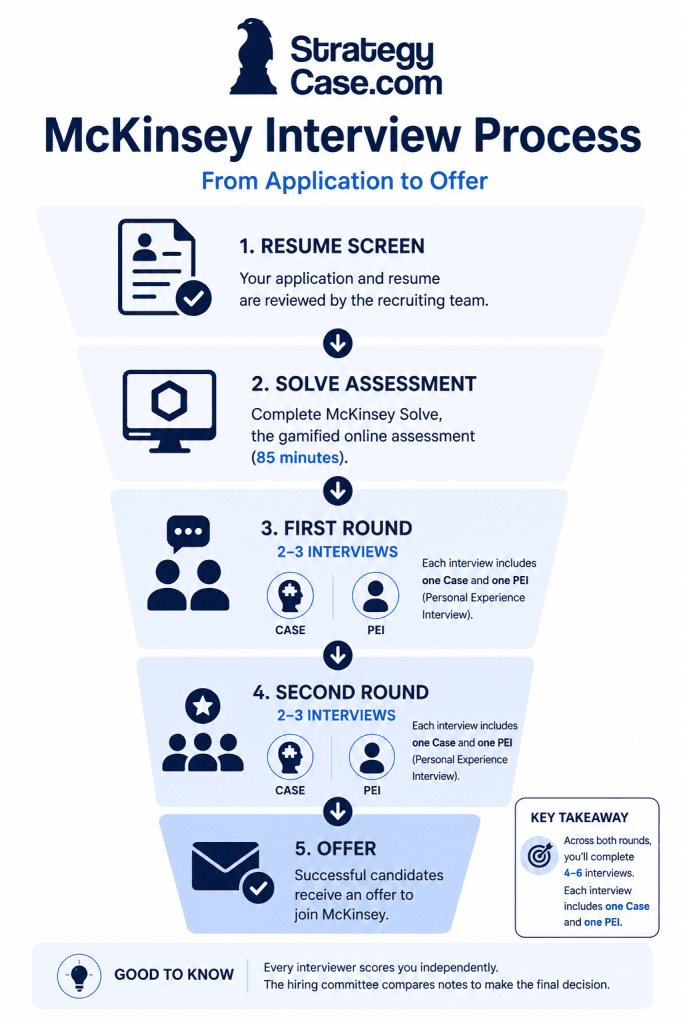
After Solve, the interviews come in two rounds:
- First round: usually two to three interviews, often led by Engagement Managers and Associates. Each interview contains a case plus a PEI.
- Final round: usually two to three interviews, led by partners. Same evaluation criteria, same cases and PEI dimensions. Some offices call this the “super day.”
Across both rounds you will typically face four to six interviews, each one a case and a PEI. Every interviewer scores you independently, and the office’s hiring committee compares notes. That independence is the whole design: McKinsey wants several calibrated reads on the same candidate to decide your offer.
Some offices also offer a McKinsey phone interview as a first screening device, which follows the same structure as an in-person interview.
Additionally, McKinsey is increasingly integrating AI-enabled assessments into its recruiting process, changing how candidates are screened and evaluated. Read more about it in our McKinsey AI Interview guide.
For a deeper dive into the overall process, see our McKinsey recruitment process guide.
Why McKinsey runs an interviewer-led case
McKinsey standardized its cases for the same reason it standardizes everything: consistency and fairness. In an interviewer-led case, the interviewer follows a prepared guide, asks each candidate broadly the same questions, and scores against the same rubric. That removes a lot of the luck and bias that come with a free-form, candidate-led conversation.
For you, the format has three practical consequences:
- The interviewer will hand you data as you need it, so you do not have to ask for every number upfront.
- The case moves in discrete questions (structure this, calculate that, what do you conclude), so the path is more predictable than a Bain or BCG case.
- You are scored on how you respond to each prompt, then how you connect the prompts into a story.
A full case usually runs three to six questions, and the count is itself a signal: interviewers tend to go deeper with candidates who are handling it well, thereby asking fewer questions overall. Expect at least one question to be a brainstorming or creativity prompt rather than math, because McKinsey cases have moved far beyond textbook archetypes. There is no framework for these cases; you build the logic from first principles, which is exactly what the firm is testing.
Interviewer-led does not mean passive
Here is the single most expensive misread I see. Candidates hear “interviewer-led” and switch into answer-the-question mode, waiting to be told what to do next. They go quiet between prompts. They never volunteer a hypothesis. And then they are baffled when the rejection cites “limited personal impact” or “did not drive the problem.”
McKinsey still scores leadership inside the rails.
Even though the interviewer sets the agenda, the firm is explicit that you must present a structured and exhaustive framework at the start, and the strongest candidates keep driving: they state what they would look at first, propose a hypothesis, and synthesize at every transition. You are not running the case, but you are very much leading your half of the conversation.
McKinsey vs. BCG and Bain: how the formats differ
All three firms test the same raw skills. The difference is who holds the steering wheel.
| McKinsey | BCG | Bain | |
|---|---|---|---|
| Format | Interviewer-led, standardized | Often candidate-led, some interviewer-led | Mixed; many offices now interviewer-led |
| Who drives | Interviewer sets the questions | You set much of the agenda | Increasingly the interviewer |
| Signature emphasis | Structure + exhaustiveness, prioritization | Creativity and independent structuring | Answer-first: lead with a hypothesis |
| Fit component | Heavy, formal PEI | Lighter, conversational | Structured behavioral |
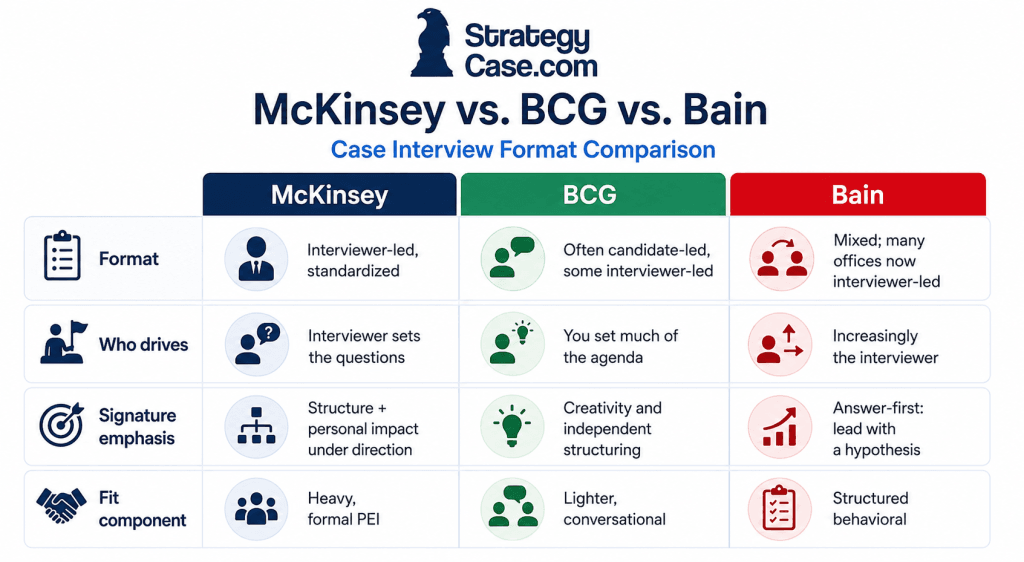
If you are prepping across firms, read this against our BCG case interview guide and Bain case interview guide for the contrast. In a McKinsey room, default to structure first and lead within the interviewer’s direction.
What’s different for McKinsey Cases?
McKinsey cases are rarely cookie-cutter. They are often more specific, more creative, and more tailored than the cases you may see in generic case interview practice.
That is especially true for structuring questions.
Most candidates prepare for a broad market entry question such as:
“What factors would you look at when deciding whether to enter the Chinese EV market?”
For this version, a standard market entry structure might still help. You could look at the market, customers, competition, economics, capabilities, risks, and entry strategy.
However, a real McKinsey-style structuring question may be much more targeted:
“What key product characteristics would you consider and analyze when looking at the Chinese EV market?”
This is a very different question.
You are no longer being asked whether the company should enter China. You are being asked what product characteristics matter in that market. A generic market entry framework would miss the point. The answer now needs to focus on factors such as range, battery performance, charging compatibility, price point, software features, interior design, brand perception, safety, after-sales service, and localization for Chinese consumer preferences.
That is why memorized frameworks fail in McKinsey interviews. They may give you a starting vocabulary, but they will not solve the actual question in front of you.
A strong candidate listens carefully to the exact wording, identifies the real analytical task, and builds a structure for that task specifically.
Consider another McKinsey-style example:
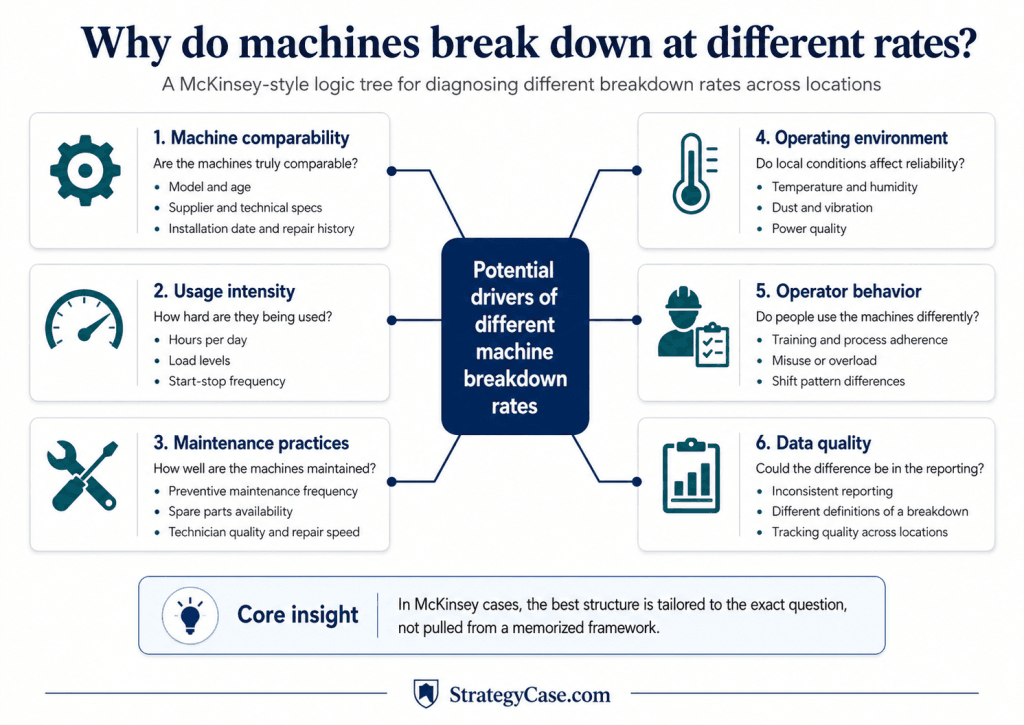
“You are working with an operator of a specific type of machine. These machines break down at different rates across different locations. What factors could explain why that happens?”
Again, there is no standard framework bucket that fits cleanly. This is not a profitability case, not a market entry case, and not a classic operations case in the generic sense. It is a diagnostic question.
A strong answer would build a custom structure around the possible drivers of machine breakdown rates. For example, you could investigate differences in the machines themselves, how they are used, how they are maintained, where they are located, who operates them, and how breakdowns are measured.
The logic might look like this:
First, I would check whether the machines are actually comparable. Different models, ages, suppliers, installation dates, technical specifications, or previous repair histories could explain different failure rates.
Second, I would look at usage intensity. Machines that run more hours per day, operate at higher loads, or experience more start-stop cycles may break down more often.
Third, I would examine maintenance practices. Locations may differ in preventive maintenance frequency, spare parts availability, technician quality, inspection routines, or speed of repair.
Fourth, I would assess the operating environment. Temperature, humidity, dust, vibration, power quality, and other local conditions may affect reliability.
Fifth, I would look at operator behavior. Training, adherence to operating procedures, misuse, overload, or differences in shift patterns could all drive breakdown rates.
Finally, I would check the data itself. The apparent difference in breakdown rates may partly come from inconsistent reporting, different definitions of a breakdown, or better tracking at some locations than others.
This is what McKinsey wants to see. Not a memorized framework, but a structured, tailored way of thinking.
The key lesson is simple: in a McKinsey case interview, the question usually matters more than the case context. If the context is “EV market entry,” but the question is about product characteristics, structure product characteristics. If the context is “machine operations,” but the question is about failure rate differences, structure the drivers of failure rate differences.
Many candidates lose points because they answer the case type they think they heard instead of the specific question they were actually asked. A strong candidate does the opposite: they slow down, isolate the precise question, and build a structure that directly answers it.
Less than 1% of candidates make it through the recruiting filters of McKinsey. You want to provide insights that the interviewer has not heard before and not be just like the other 99% that fail to impress.
Learning how to deconstruct problems is the key to success, not memorizing outdated approaches and frameworks of yesteryear.
Do not memorize a template for any case. McKinsey deliberately blends and twists these types, so treat the case type as a starting hint and build the structure from the specifics of the prompt.
How to approach a McKinsey case interview
In the McKinsey case interview, you will usually face three broad types of case questions: structuring, exhibit interpretation, and math.
Each question type tests a different part of your problem-solving ability. Structuring tests how you break down ambiguous problems. Exhibit interpretation tests whether you can extract insight from data. Math tests whether you can set up and execute quantitative analysis under pressure.
Together, these questions give the interviewer a clear picture of how you think, communicate, and make decisions in a client-like setting.
Structuring questions
Structuring questions appear in two main forms: the initial case structure and later-stage brainstorming questions.
The initial structure is the roadmap for the case. It breaks the client’s problem into smaller, more manageable components and shows the interviewer how you plan to investigate the issue. A strong McKinsey case structure is not a memorized framework. It is specific to the prompt, logically organized, MECE where possible, and designed to identify where the problem is most likely coming from.
A typical McKinsey structuring question might be:
“What factors would you look at to understand the problem better?”
A strong answer does more than list generic business areas such as market, competition, customer, and company. It explains which drivers matter most in this specific situation, why they matter, and where you would begin the analysis.
Brainstorming questions are closely related to structuring. They usually appear later in the case and ask you to generate ideas around a specific topic. For example:
“What ideas can you think of that could decrease customer check-out time?”
Here, McKinsey is not looking for a random list of ideas. The best candidates structure their brainstorming into clear categories, generate ideas with both breadth and depth, and explain why those ideas could move the client closer to the objective.
Exhibit interpretation questions
In exhibit interpretation questions, you are shown one or two charts, tables, or PowerPoint-style slides. Your task is to identify the key insight and connect it back to the case question.
This is where many candidates lose points. They describe what they see but fail to interpret what it means.
A strong candidate does three things. First, they orient themselves quickly by reading the chart title, axes, labels, and units. Second, they identify the main pattern or anomaly (insights are always outliers in a McKinsey case). Third, they explain the business implication and next steps.
The goal is not to say, “Revenue increased by 12%.” The goal is to say, “Revenue increased by 12%, but only because price went up. Volume declined, which suggests that customer demand may already be weakening. Let’s look deeper into this next.”
That is the difference between reading data and interpreting data.
Math questions
Math questions require you to solve a quantitative problem and then explain what the result means for the client.
This could involve profitability analysis, breakeven calculations, growth rates, capacity analysis, or operational calculations. In McKinsey interviews, the math itself is usually not advanced. The challenge is setting up the right approach, staying structured under pressure, and interpreting the result correctly.
A strong candidate lays out the calculation before starting, talks through the logic, uses reasonable rounding, performs the arithmetic cleanly, sanity-checks the result, and then translates the number into a business conclusion.
The weakest candidates often do the opposite. They start calculating without a clear plan, go silent, make preventable arithmetic mistakes, or state the final number without explaining its relevance.
How to think about McKinsey case questions
For structuring, brainstorming, and exhibit interpretation, there is rarely one single perfect answer. Some answers are simply better than others.
The strongest answers are broad enough to cover the key parts of the problem, deep enough to show real business thinking, and insightful enough to move the case forward. They are also hypothesis-driven. This means you do not just list everything that could matter. You also develop a view on where the answer is most likely to be found and use that view to guide your analysis.
This is an important mindset shift. Many candidates believe there is one correct framework for every case. In reality, there are often several valid ways to break down the same problem. Two strong candidates may use different structures and still arrive at a strong answer.
However, this does not mean that every structure is equally good. You can still miss the mark if your framework is too narrow, too generic, too broad, not MECE, not connected to the client’s objective, or not deep enough to guide real analysis.
For math and exhibit questions, the evaluation is more concrete. There is usually a correct calculation approach and a correct numerical direction, even if final answers vary slightly because of rounding. A small arithmetic mistake does not automatically fail you, but a wrong setup, missing logic, or missing interpretation can hurt your performance significantly.
McKinsey evaluates the full performance
McKinsey does not expect perfection on every single question. The interviewer evaluates the overall picture.
You can make a small mistake in one area and still pass if your overall performance is strong. For example, a candidate may perform very well on structuring and exhibit interpretation, make a minor math error, recover well, and still move to the next round.
At the same time, strong math alone is not enough. If you cannot structure ambiguous problems, interpret exhibits, communicate clearly, and show business judgment, accurate calculations will not carry the interview.
McKinsey is looking for spikes in performance, combined with a strong enough baseline across all core case skills.
One final difference surprises many candidates: in most McKinsey case interviews, there is no formal final recommendation at the end. Unlike many candidate-led cases, the interview often ends after the last interviewer-led question. You may still need to synthesize throughout the case, but you should not be surprised if the interviewer closes the case without asking for a final recommendation.
The McKinsey scorecard: what your interviewer is actually writing down
While you talk, your McKinsey interviewer is assessing you against a standardized set of case interview skills. This is why “do more cases” is weak advice. You first need to know which dimension you are losing points on: problem structuring, analytical rigor, quantitative problem solving, creativity, business sense, communication, or presence.
| McKinsey case interview skill | What McKinsey is really assessing | What a strong candidate does | Where candidates lose points |
|---|---|---|---|
| Problem structuring | Can you break a messy client problem into a logical, MECE framework built specifically for the prompt? | Builds a custom framework (broad, deep, insightful), prioritizes the most important branches, and explains where they would start and why. | Uses a memorized framework that does not fit the case, misses important drivers, or structures without prioritization. |
| Analytical rigor and logical thinking | Can you link your structure to a hypothesis-driven problem-solving approach? | Forms an initial hypothesis, qualifies their thinking, follows the structure, tackles likely high-impact areas first, and asks targeted questions. | Treats the structure as a checklist, jumps between topics, asks generic questions, or waits for the interviewer to guide the logic. |
| Quantitative problem solving | Can you set up the math, perform calculations accurately, read exhibits, and extract the business meaning? | Lays out the calculation clearly, uses pen-and-paper math and shortcuts, sanity-checks the result, and interprets what the number means for the client. | Goes silent during math, makes avoidable arithmetic mistakes, misreads charts, or states a number without explaining the implication. |
| Creativity and brainstorming | Can you think broadly and deeply about the problem, not just follow the obvious path? | Generates several relevant angles, explains why each matters, and adds depth with concrete business logic. | Gives shallow lists, repeats generic ideas, misses creative levers, or fails to connect ideas back to the case objective. |
| Business sense and judgment | Do your conclusions show commercial intuition, prioritization, and practical decision-making? | Interprets data in context, weighs trade-offs, commits to a reasoned view, and updates the hypothesis when new information appears. | Lists every possible factor, avoids taking a stance, overanalyzes low-impact issues, or misses the practical client implication. |
| Communication | Can you communicate like a consultant and make the interviewer trust you in a client setting? | Uses top-down communication, signposts clearly, keeps answers concise, ties back to the objective, and leads the interviewer through the logic. | Rambles, buries the answer, speaks bottom-up, fails to synthesize, or needs the interviewer to pull the answer out. |
| Maturity and presence | Do you show confidence, composure, and ownership under pressure? | Leads the conversation, stays calm during difficult questions, takes structured thinking time, and is comfortable with brief silence. | Gets visibly flustered, rushes into answers, apologizes excessively, or appears dragged along by the interviewer. |
The challenge is that McKinsey does not assess these skills in isolation. In a real case interview, they appear together. Your structure reveals your logic. Your math reveals your judgment. Your synthesis reveals your communication. That is why effective McKinsey case interview preparation needs to train the full problem-solving process, not just isolated frameworks or random practice cases.

The first few minutes carry more weight than they should
Interviewers are human. By the time you finish clarifying the prompt and laying out your structure, a few minutes are in, your interviewer has already formed a working impression and is now looking for evidence to confirm or break it. A clean, tailored structure in those first few minutes buys you the benefit of the doubt for the rest of the case.
A generic framework forces you to climb out of a hole you dug before the math even started. This is exactly why structuring is where I focus most early-stage coaching.
How to drive a McKinsey case within the rails
Interviewer-led or not, the McKinsey case follows a predictable arc. Here is how to lead your half of it at each step. The underlying skills are covered in our complete case interview guide; this is how they apply specifically at McKinsey.
Step 1: Clarify the objective, then structure
Repeat the problem back in one sentence, confirm the objective and any success metric, then ask for two minutes to structure. Build a framework that fits this prompt, not a textbook template. State the overarching branches, dive deeper, then say which one you would test first, why, and how. McKinsey expects this structure and behavior even though the interviewer is in control. Sharpen this with our structuring and framework guide and the fundamentals in our MECE guide.
Step 2: Lead with a hypothesis
Do not wait to be asked for a point of view. Say what you expect to be true and what would prove or disprove it: “My hypothesis is that the margin problem sits in cost, not price; I would want to see the cost breakdown to confirm.” That single habit is what scores “judgment” and “analytical rigor” at the same time.
Step 3: Do the math out loud and interpret it
When the interviewer hands you an exhibit or a calculation, narrate your setup before you compute, so a small slip does not read as a thinking failure. Then deliver the “so what,” not just the number. “Revenue is 1.2 billion, which is 15% below target, so the gap is concentrated in the new product line.” Learn this with our case interview math guide and chart interpretation guide.
Step 4: Synthesize before you are asked
At every natural break, summarize what you have learned and where it points. This is how you keep “driving” without taking the wheel from the interviewer. Close the case with a top-down recommendation, supporting arguments, and clear next steps, even if the interviewer does not explicitly prompt for it.
The McKinsey PEI: equally important, and most candidates underprep it
If you take one thing from this guide, take this: at McKinsey the Personal Experience Interview is not a soft warm-up. It is scored as rigorously as the case, and a weak PEI sinks a strong case. Most “case interview” content ignores it entirely, which is exactly why so many technically strong candidates get rejected.
McKinsey reorganized the PEI in summer 2025 into four dimensions: Connection, Drive, Leadership, and Growth (the older names you will still see in outdated guides were Personal Impact, Entrepreneurial Drive, Inclusive Leadership, and Courageous Change). In the PEI, the interviewer takes one story and probes it for 10 to 20 minutes with a long string of follow-up questions: what exactly did you do, why that choice, what did others think, what would you change. Prepare at least two distinct stories per dimension, so eight in total.
Structure each story with the SCORE method (Situation, Complication, Outcome expected, Remedial action, End result) so it lands with stakes and impact instead of rambling. This is a topic in its own right; prepare it properly with our McKinsey PEI guide, the broader consulting fit interview guide, and the SCORE framework walkthrough.
Common McKinsey case interview mistakes
After thousands of mock cases, the same failure modes show up again and again. None of them is about intelligence.
- Forcing a memorized framework. A “profitability framework” pasted onto a problem it does not fit is the clearest signal of a candidate who pattern-matches instead of thinks. Build the structure from the specific prompt.
- Going passive because it is “interviewer-led.” As covered above, silence between prompts reads as low personal impact. Keep volunteering hypotheses and synthesis.
- Doing math without meaning. A correct number with no interpretation scores poorly. Always answer the “so what.”
- Treating the PEI as filler. Walking in with one vague story and hoping for the best is how strong case performers still get dinged.
How to prepare for the McKinsey case interview
Most McKinsey prep fails for the same reason most case prep fails: candidates grind 50-plus cases chasing volume instead of building the underlying skill. That is motion, not mastery. Modern McKinsey interviews test first-principles structuring and hypothesis formation under incomplete information, not memorized archetypes, so doing more recycled cases just drills the wrong reflexes. For a deeper discussion of this mismatch, see our article on the gap between applicants and top consulting firms.
A better sequence:
- Prep against the rubric, not the case count. Find your weakest scorecard row (structuring, math, judgment, or communication) and attack that first. You want to become robust enough to not be rejected. Then, work on your strenghts to lift them up into the distinctive category. Those strongs will get you the offer.
- Drill the components deliberately. Build tight structures, run case math under time pressure, and interpret exhibits fast, each as its own skill with feedback, before stitching full cases together.
- Practice both the case and the PEI in the same session, because that is how McKinsey runs it.
- Get honest feedback from someone who has scored real interviews. You cannot self-diagnose your own case blind spots, which is where 1-on-1 coaching with a former McKinsey interviewer earns its keep.
For a structured path that covers all of this, StrategyCase’s Case Interview Academy walks through the cases, the theory, and drills that mirror McKinsey standards and difficulty levels. McKinsey’s own official careers resources are also worth reading for the firm’s framing in its own words.
Frequently asked questions
How hard is the McKinsey case interview, really?
Hard, but not because the business problems are exotic. The difficulty is the bar: McKinsey scores you against a precise rubric, runs four to six interviews, and pairs every case with a probing PEI. Around 1 in 100 applicants makes it through. The candidates who pass are not the smartest in the room; they are the most structured and the best prepared.
Is the McKinsey case interview-led or candidate-led?
Interviewer-led. The interviewer controls the direction, asks the questions, and hands you the data you need. But McKinsey still expects you to present a structured framework at the start and to lead your own answers, so do not mistake “interviewer-led” for “sit back and respond.”
What is the difference between the McKinsey case and the PEI?
The case is the business problem you solve out loud; the PEI is the behavioral interview where you walk through one personal story in depth across the dimensions of Connection, Drive, Leadership, and Growth. They usually happen in the same session, and McKinsey scores both. Acing one and bombing the other still means no offer.
How long should I prepare for a McKinsey interview?
Most candidates need six to eight weeks of deliberate practice. That is not 50 rushed cases; it is targeted skill-building against the scored dimensions, plus separate PEI preparation, with feedback. Experienced hires often need less time on frameworks and more on adapting their stories to the PEI format. See our case interview preparation timeline guide for more.
Do I still have to pass the Solve assessment before the case?
For most roles, yes. Solve is McKinsey’s gamified online screen and usually comes before the interview rounds. It tests problem solving in a different format from the case, so prepare for it separately with our McKinsey Solve Guide and Simulations.
Can I pass the McKinsey case interview from a non-business background?
Yes, and McKinsey expects plenty of candidates to. The firm actively recruits advanced-degree and non-traditional applicants (PhDs, MDs, JDs, and people from outside business) and does not assume prior business knowledge. What it does assume is that you can structure an unfamiliar problem and reason through it cleanly. If that is you, spend less time memorizing business concepts and more on structuring and the math, then layer in sector context with our case interview industry cheat sheets.
Related guides
- How to get into consulting: the full application and recruiting pillar
- McKinsey salary and career path: what a McKinsey offer is actually worth
- Case interview frameworks: the structuring foundation behind every McKinsey case
- Best case interview books: what to read, and what to skip
Final word
The McKinsey case interview rewards a habit most candidates never build: structure the problem before you solve it, then lead within the interviewer’s direction instead of waiting to be led. Get your structuring clean in the first few minutes, narrate your math, synthesize as you go, and treat the PEI as the important interview it actually is.
The process is genuinely tough, only about 1 in 100 applicants makes it through, but it is conquerable with the right preparation. Start with StrategyCase’s complete case interview preparation and build the structured, insider-calibrated approach that gets McKinsey offers.
About the author: Florian Smeritschnig is a former McKinsey Senior Consultant and the founder of StrategyCase. He spent five years at the firm, participated in recruiting from the other side of the table, and has since run more than 2,200 mock case interviews and coached candidates into 700+ offers from McKinsey, BCG, Bain, and other top firms.
