
Updated October 2026 · By Florian Smeritschnig, former McKinsey Senior Consultant
The McKinsey AI interview now comes in two in-room formats. The first is a live session where you work through a case task with Lilli, McKinsey’s internal AI, which the firm has piloted in some final rounds since January 2026. The second is new this fall: a roughly 10-minute conversation with an AI avatar that plays a client, piloted with undergraduate Business Analyst candidates in some North American offices.
In both formats, the AI doesn’t score you. The partners and assessors in the room do.
On October 14, 2026, The Wall Street Journal reported that some McKinsey candidates will now have to hold their own in a conversation with an AI client. Expect the prep industry to answer within weeks with “AI avatar practice” products and scripted client-handling lines. Most of that will train exactly the behavior McKinsey built this exercise to catch.
I spent five years at McKinsey and since 2020 I have delivered 2,200+ mock interviews and coaching sessions. My MBA coaching clients in the US were among the first to go through the Lilli session, so that part of this guide rests on what they reported back. For the avatar, I keep what McKinsey has said publicly separate from my own read. My verdict: the avatar is a listening test, and the candidates who arrive most scripted will find it hardest.
Key Takeaways
- McKinsey now uses AI at four points in hiring: a free AI practice tool (launched April 2026), an AI chatbot eligibility screen for some roles, the Lilli case session in some final rounds, and the new AI client avatar.
- The avatar conversation lasts about 10 minutes, happens in a McKinsey office after the case portion, and runs this fall for undergraduate Business Analyst candidates in some North American offices. McKinsey expects to extend it to other roles next year if the pilot works.
- The avatar gives no score. Partners or assessors in the room watch whether you hear what the client says, act on new concerns, and adjust your answer instead of steamrolling it.
- The Lilli session tests your judgment while working with an AI tool, not prompt engineering. My clients were told it was a non-evaluative pilot.
- Your case interviews and the PEI still carry the offer decision. Prepare for the avatar by practicing recommendations that get interrupted, not by memorizing lines.
- McKinsey AI interview: a candidate presenting a recommendation to an AI client avatar on a laptop while a partner observes
What Is the McKinsey AI Interview?
Definition: The McKinsey AI interview is any part of McKinsey’s interview process in which a candidate works with, or talks to, an AI system while McKinsey staff observe. In 2026 it takes two in-room forms: a case task solved alongside Lilli, McKinsey’s internal AI, and a short conversation with an AI avatar that plays a client.
Neither format replaces the case interview or the Personal Experience Interview (PEI). Both sit on top of them, and both are pilots at selected offices rather than global rules. If you’re early in your preparation, start with the core of the process in our McKinsey case interview guide, because that is still where offers are won and lost.
The pilot-first pattern is classic McKinsey. The McKinsey Solve assessment also began as a limited experiment before it became a standard step for most consulting roles.
The bigger source of confusion is the label itself. “McKinsey AI interview” now gets used for four different things, and only two of them happen in an interview room.
McKinsey’s Four AI Touchpoints in Hiring, Mapped
I have not found a single source that puts these side by side, so here they are in the order a candidate would meet them. Each row is backed by McKinsey itself or by credible reporting.
| Touchpoint | Where it sits | Who meets it | Does the AI judge you? | Source |
|---|---|---|---|---|
| AI prep tool | Before your interviews | Entry-level applicants (typically Business Analyst and Associate) once invited to interview | No. Practice only | Business Insider, May 2026 |
| AI-assisted screening chatbot | Early screening, some roles | Candidates whose role uses it; participation is voluntary | It checks objective eligibility criteria, and a human recruiter reviews before any rejection | McKinsey privacy notice, effective August 1, 2026 |
| Lilli case session | Final round, in person | Select offices since January 2026, mostly Business Analyst and MBA candidates | No. An interviewer observes | Financial Times reporting, January 2026; StrategyCase client reports |
| AI client avatar | Final round, after the case, in person | Undergraduate Business Analyst candidates in some North American offices, fall 2026 | No. Partners or assessors observe | The Wall Street Journal, October 14, 2026 |
The four AI touchpoints in McKinsey’s hiring process in 2026: AI prep tool, screening chatbot, Lilli case session, and AI client avatar.
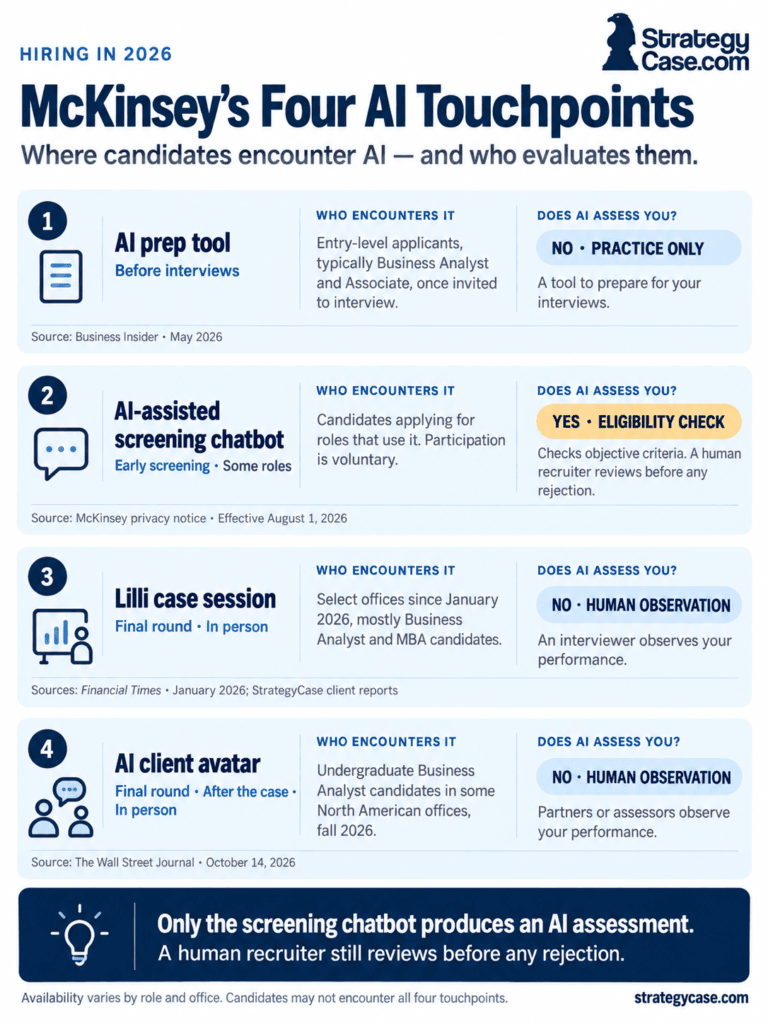
Where AI shows up in McKinsey’s hiring funnel in 2026. Only the screening chatbot produces an AI assessment of you.
Two things stand out. First, only the last two rows happen in an interview room, so only two of the four are a McKinsey AI interview in the sense most candidates mean.
Second, the one touchpoint that does produce an AI-generated assessment is the least discussed: the screening chatbot. McKinsey’s notice says it compares your answers against predefined criteria such as location, years of experience, languages, and required certifications. It doesn’t judge personality or soft skills, and you can object and be assessed another way.
The prep tool is the friendliest of the four. According to Business Insider, it generates unlimited quantitative case questions across 15 industries, and about 10,000 people used it in its first month. If you receive access, use it for math reps. It won’t prepare you for the conversation half of the interview, which is exactly where the avatar now sits.
The McKinsey AI Avatar Interview: What We Know
Everything in this section comes from McKinsey partners speaking to the WSJ unless I say otherwise. McKinsey hasn’t published a candidate guide for the avatar, and none of my clients has taken it yet. Treat the details as a first report on a pilot.
Format, Timing, and Who Gets It
| Detail | What has been reported |
|---|---|
| Who | Undergraduates applying for Business Analyst roles |
| Where | Some North American offices |
| When | Fall 2026 recruiting; other roles next year if the pilot succeeds |
| Scale | Likely hundreds of candidates |
| Length | About 10 minutes |
| Setting | In a McKinsey office, on a laptop, after the case portion of your interviews |
| Who is watching | Partners or interview assessors, in the room |
| AI scoring | None. The tool provides no score or assessment of its own |
The Client the Avatar Plays
The avatar has been trained on several client personalities. One example is the “professorial” client, who wants to understand the reasoning behind the firm’s recommendation before accepting it.
What the avatar isn’t matters just as much. Saleem Zafar, a partner in McKinsey’s Dallas office who helped design the pilot, said it isn’t built to play an unhinged client or to ask gotcha questions. The aim is to reflect the ordinary run of client situations consultants meet day to day, about 80% of them by his estimate.
That should reset your expectations. You aren’t preparing for a stress interview. You’re preparing for a normal client conversation, which is harder to fake than it sounds.
The Stadium Example
Zafar described one scenario. A city has hired McKinsey to work out where to put a new athletic stadium, and the avatar plays the mayor. She wants to hear your recommendation, but as you share it, she raises further concerns and adds layers of context you didn’t have when you built your answer.
So the exercise starts roughly where a case interview ends. You already have a recommendation. The test is what happens to it once the client starts talking.
What the Partners in the Room Watch
Zafar’s own checklist was simple. Did you hear the thing the client said that mattered? Did you act on it? Or did you blow through it with your own agenda? He summed up the whole exercise as one question: “how do you respond to changing stimuli?”
Translated into what an assessor is likely to note, I would expect four behaviors to carry the weight:
- Listening: You catch the concern that matters, including the one the client mentions in passing.
- Adjusting: When new information arrives, you change the recommendation or explain clearly why it still holds.
- Restraint: You don’t repeat your prepared structure more forcefully when the client pushes back.
- Plain language: You explain your reasoning the way a mayor would talk, without consulting shorthand.
That list is my interpretation, not a published McKinsey rubric. It follows from what Zafar described and from how McKinsey judges client-facing work once you’re on the job.
The AI avatar interview loop: listen to the client, restate the concern, decide whether the recommendation changes, and explain the trade-off .
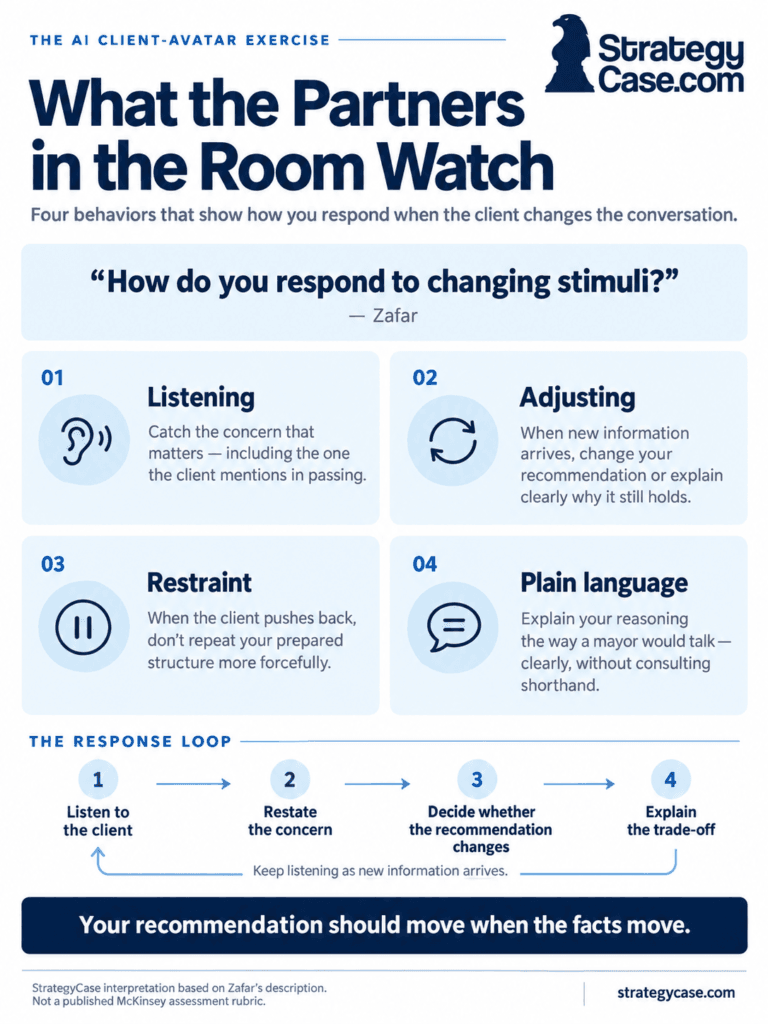
The behavior the avatar exercise is built to surface. Your recommendation should move when the facts move.
How the Stadium Conversation Can Go Two Ways
Here is a hypothetical illustration of the same scenario, run by two candidates who did equally well on the case.
Candidate A opens with a crisp recommendation: build at the riverfront site, because the land is cheapest and highway access is best. The mayor mentions that residents near the river fought the last development and that she faces re-election next year. Candidate A says community concerns can be managed through outreach, then returns to land costs. Ten minutes later, the recommendation is unchanged, and the mayor’s main worry got one sentence.
Candidate B opens with the same recommendation. When the mayor brings up the residents, B pauses and asks what went wrong last time and when the decision has to be public. B then says the riverfront still wins on cost, but proposes testing the second site properly, because a project stuck in local opposition delivers none of the savings. B closes by naming what would have to be true for the riverfront to stay the answer.
Both candidates knew the analysis. Only one showed the partner what they would be like in front of a real mayor.
Why McKinsey Built an AI Client
Blair Ciesil, a McKinsey partner who co-leads global recruiting, gave the WSJ the core reason. Candidates often arrive with stories so rehearsed that interviewers struggle to see the person underneath, and the avatar gives the firm a read on human qualities that doesn’t rely on preparation.
The complaint isn’t new. McKinsey’s own interviewing guidance already asks PEI candidates to come ready for a conversation rather than a rehearsed story, and asks case candidates to listen carefully and offer tailored solutions instead of standard frameworks. In May, McKinsey’s global talent attraction co-leader Marie Christine Padberg told Business Insider that outside prep services most often misdirect candidates by overpreparing them.
Here is my read, as someone who worked at McKinsey and now coaches candidates to get into the firm. The avatar is the firm designing around the prep industry. A PEI story can be memorized, and so can a case framework. A mayor who changes the problem halfway through your answer can’t be.
That’s the clearest version yet of what I have argued for years: preparation built on scripts and templates trains exactly the behavior that fails in front of a real client. I have been arguing against this type of prep since I started coaching a few years ago.
The partners gave two further reasons, and both are practical:
- Fairness. Some human interviewers play a much tougher client than others in role-plays. An avatar trained on set personalities gives every candidate a comparable counterpart.
- Prediction. Zafar framed recruiting as predicting who will succeed in the job. When I was at McKinsey, business analysts talked to clients early, in interviews, working sessions, and quick check-ins on the numbers. Watching one such conversation is a more direct signal than asking about one.
The Lilli Session: McKinsey’s First AI Interview
The Lilli session was the first McKinsey AI interview format, and it tests something different. Instead of talking to an AI, you work with one.
What My Clients Experienced
My MBA coaching clients in the US went through it in early 2026. They first completed two traditional interviews, each with a case and a PEI story. The third session was different: an interviewer guided their work with McKinsey’s internal AI tool on case scenarios and exhibits, on a McKinsey-issued laptop. They described it as exploratory and less guided than the formats they had drilled, and McKinsey told them clearly it was a test format, not a scored assessment.
The Financial Times reported in January (summarized here by CIO) that assessors watched how candidates framed questions and interpreted the answers, and that the exercise was not essential for employment. Based on my clients’ reports, the trial started in select US offices in January 2026 and reached select European offices by the end of that month. It ran in in-person final rounds only.
How the Lilli Session Works
You complete a realistic consulting task by working live with the AI tool. Strong candidates treat it like a sharp but junior team member: fast, useful, and occasionally wrong. The work moves through a loop:
- Prompt the AI with focused questions tied to the problem, after stating your own hypothesis.
- Review every output for relevance, accuracy, and gaps.
- Refine or re-prompt when the response is generic or incomplete.
- Synthesize the useful pieces into a structured, client-ready answer.
What McKinsey Evaluates in the Lilli Session
| Capability | What the interviewer watches for |
|---|---|
| Judgment | Deciding what to trust, adapt, or discard in the AI’s output |
| Structure | Framing focused questions and organizing outputs logically |
| Iteration | Refining prompts to close gaps, step by step |
| Communication | Explaining your reasoning and next steps clearly |
The two failures my clients’ debriefs pointed to are related. Some candidates treat the AI as an answer engine, ask vague questions, get generic output, and freeze. Others relay what the tool produced without prioritizing it or tying it back to the client problem, and then can’t explain why they kept one point and dropped another. Both read as weak judgment, not weak prompting.
The reason McKinsey tests this is in its own numbers. Lilli aggregates the firm’s 40-plus knowledge sources, answers more than 500,000 prompts a month, and 72% of the firm is active on it. When a tool is that embedded in client work, watching a candidate use it is a preview of the job.
How to Prepare for the McKinsey AI Interview
Preparation for the McKinsey AI interview should be proportional to the stakes. Both in-room formats are pilots, and the case and PEI still carry the decision. That said, the avatar rewards a skill most candidates never practice, so a small amount of targeted work goes a long way.
Which Format You Are Likely to Meet
| Your situation | AI client avatar | Lilli session | What to do now |
|---|---|---|---|
| Undergraduate, Business Analyst, North American office, in-person final round | Possible this fall | Possible | Add short client-conversation drills to your case practice and ask your recruiter which components your round includes |
| MBA candidate (Associate) | Not in the current pilot; possible from 2027 | Possible at select offices | Prepare lightly for Lilli and watch for the avatar next season |
| Experienced hire | Not in the current pilot | Unlikely, especially in virtual rounds | Keep your focus on the case, the PEI, and any expertise interview |
| Candidate in Europe or Asia | Not in the current pilot | Possible at select European offices | Prepare lightly for Lilli and confirm the format with your recruiter |
Whatever your situation, ask your recruiter directly which components your final round includes. It takes 30 seconds and removes the guesswork.
Drills for the Avatar Conversation
You don’t need an AI avatar to prepare for one. The skill is listening and adjusting under new information, and a human practice partner trains it better than an app.
- Finish a case, then get interrupted. After each practice case, have your partner play the client and raise one new concern after your recommendation. Respond without restarting your whole structure.
- Restate before you answer. Open your reply by naming the concern in the client’s words. It proves you listened and gives you a few seconds to think.
- Decide out loud. Your recommendation either changes, holds with a condition, or holds for a reason you can state. Practice reaching each of those, not just the one you prefer.
- Translate for a non-consultant. Explain your recommendation to a friend outside business in under a minute, with no “levers,” “MECE,” or “synergies.”
- Land it in 10 minutes. A recommendation, one trade-off, and a next step. Time yourself.
Two things to skip. Don’t memorize client-handling lines such as “I really hear your concern.” Assessors spot those immediately, and they are the rehearsed behavior the avatar was built to expose. And never use AI live in an interview: McKinsey’s guidance lists generating real-time answers during an interview, and using AI in assessments unless specifically permitted, as not allowed.
Preparing for the Lilli Session
An hour or two with any public AI tool (ChatGPT, Claude, or Gemini) is enough. Pick a business problem, state your hypothesis before you prompt, check every number the tool gives you, re-prompt when the answer is generic, and practice summarizing the useful parts out loud. You can’t get access to Lilli beforehand, and you don’t need it.
Keep the Case and the PEI at the Center
Both AI formats reward the same foundation as the case: a clear structure you can bend without breaking it. That’s what StrategyCase’s McKinsey Interview Academy is built to develop, from structuring and case math to the PEI. On the fit side, the advice for the avatar and the McKinsey PEI is the same: know your stories well enough to tell them as a conversation, and you won’t need a script.
What the McKinsey AI Interview Means for Your Preparation
The avatar is a pilot today, but the direction is clear. McKinsey expects to use it for other roles next year if this season works, which puts MBA and experienced-hire candidates in line for 2027.
McKinsey isn’t alone. Bain has started running an immersive case in some final rounds, including roughly 10 minutes of working alongside ChatGPT, which we break down in our Bain AI interview guide. Two of the three MBB firms are moving the interview closer to the actual job: messier information, a real-feeling client, and tools consultants use every day. For the wider picture, see our analysis of where AI in consulting interviews is heading.
None of this makes the fundamentals less important. It makes memorized versions of them less useful. The candidates who do well in the AI formats will be the ones who can structure a problem, hold a view, and change it when a client gives them a good reason.
Frequently Asked Questions
Does the McKinsey AI avatar score my interview?
No. McKinsey partners told the WSJ that the AI tool provides no scoring or assessment of its own. Partners or interview assessors sit in the room and observe how you handle the conversation. Whether their read formally counts during the pilot hasn’t been published, so treat it as observed and ask your recruiter.
Who gets the McKinsey AI avatar interview?
In fall 2026, undergraduates applying for Business Analyst roles in some North American offices, likely several hundred candidates. McKinsey expects to extend it to other roles next year if the pilot succeeds. MBA, experienced-hire, and non-North American candidates aren’t in the current pilot.
Is the McKinsey AI avatar the same as the Lilli interview?
No. In the Lilli session, you work with McKinsey’s internal AI to solve a case task while an interviewer watches your judgment. In the avatar conversation, an AI plays a client who questions your recommendation for about 10 minutes. One tests how you use AI; the other tests how you handle a client.
What questions does the McKinsey AI avatar ask?
There is no published question bank. Based on the reported example, the avatar plays a client such as a mayor reacting to your recommendation, asking about your reasoning and adding concerns or new context as you go. Expect follow-up questions, not trick questions: McKinsey says it isn’t designed to ask gotcha questions.
Can I use ChatGPT or other AI during my McKinsey interview?
Only when McKinsey provides the tool as part of the exercise, as in the Lilli session. McKinsey’s interviewing guidance lists generating real-time answers during an interview, and using AI in assessments unless specifically permitted, as not allowed. Using AI to prepare is encouraged.
Can I opt out of McKinsey’s AI-assisted interview?
For the screening chatbot, yes. McKinsey’s privacy notice says participation is voluntary and that you can object, in which case you’re assessed through other means. McKinsey hasn’t published an opt-out for the avatar or Lilli sessions, so raise it with your recruiter if you have a concern.
Related Guides
- The McKinsey Application Process, Step by Step
- AI Case Interview Prep: How to Use It (and Where It Fails You)
- Final-Round Interviews With Partners
- The McKinsey Technical Expertise Interview, Explained
- How AI Is Changing Consulting Careers and Hiring
The Bottom Line
The McKinsey AI interview is no longer one thing. In the room, it is either a case task with Lilli or a short conversation with an AI client, and in both, humans are doing the judging. The avatar is the more revealing of the two, because it tests what preparation alone can’t produce: hearing a client, taking the point seriously, and adjusting your answer without losing your structure.
So prepare like a strong McKinsey candidate first, with real case and PEI fluency. Then practice getting interrupted. If your recommendation can survive a mayor with new information, it will survive the partner watching you.
Not sure whether your answers bend or break under pushback? Book a free consultation. We will establish a baseline of where you stand, diagnose what is holding you back, and plan your preparation around the format you will actually face.
About the author: Dr. Florian Smeritschnig is the founder of StrategyCase.com and a former McKinsey Senior Consultant. Since 2020 he has delivered 2,200+ mock interviews and coaching sessions, and his clients have secured 700+ consulting offers, 340 of them at McKinsey, BCG, and Bain. He is the author of three books on consulting interviews and careers, including The 1%: Conquer Your Consulting Case Interview.
