

Updated October 2026 · By Dr. Florian Smeritschnig, former McKinsey Senior Consultant
The Bain AI interview is an immersive case interview with a ChatGPT segment built in. You get 40 minutes alone with 10 to 20 slides describing a client situation and complete a set of template slides. You then present your answer in up to 10 minutes. During the discussion that follows, the interviewer hands you a computer with ChatGPT for about 10 minutes to see how you use AI on the case.
For most of 2026, nobody outside Bain could tell you that. Every guide on this topic, including the first version of this one, worked from rumors: a Bain-built AI tool, an unknown format, a rollout “around summer.” Candidates holding a final-round invite were preparing for a test that didn’t exist in that form.
Bain’s 2026 candidate instructions now spell the format out. Candidates preparing for a Bain Partner round shared them with me in October 2026, and they match what Bain presented at an EMEA MBA recruiting webinar. Below I break down each phase, what the interviewer is most likely scoring, and a prep plan that fits into the week you probably have left.
A note on where I stand: I evaluated candidates at McKinsey and have delivered 2,200+ mock interviews and coaching sessions since 2020. I haven’t sat in a Bain immersive case myself, so I keep what Bain has confirmed separate from where I’m applying an interviewer’s judgment.
Key Takeaways
- The format is now known. 40 minutes of solo prep on 10-20 slides, a presentation of up to 10 minutes, then a discussion that includes about 10 minutes of ChatGPT on a computer Bain provides.
- The tool is ChatGPT. Earlier reports pointed to a Bain-built tool. The 2026 instructions name ChatGPT, which every Bain employee already has through ChatGPT Enterprise.
- It’s Bain’s written case, compressed. Less prep time, fewer slides, and a shorter pitch than the classic Bain written case, plus an AI segment. Deciding fast what to ignore is what separates candidates.
- ChatGPT arrives after you’ve committed to an answer. You use it to stress-test and extend your own recommendation, so the interviewer is scoring your judgment about the output.
- Two things cover most of the prep. The core written-case skills (exhibit reading, pen-and-paper math, answer-first delivery) plus a short, rehearsed ChatGPT routine.
What Is the Bain AI Interview?
Bain AI interview (definition): Bain’s 2026 “immersive” case interview, in which candidates prepare a client case alone from 10-20 slides for 40 minutes, present their recommendation in up to 10 minutes, and then use ChatGPT for about 10 minutes during the discussion. Bain evaluates how candidates apply AI tools in a realistic work context.
Bain’s candidate materials call it an immersive case interview. Bain recruiters have also described it as an interactive case study. “Bain AI interview” is the name most candidates search for. All three describe the same exercise.
Bain gives candidates a plain reason for it: its consultants use AI in their day-to-day work, and the firm wants the interview to reflect that. The choice of tool follows from the same logic. According to Bain, every employee has access to ChatGPT Enterprise, its teams have built 19,000+ custom GPTs, and its in-house knowledge platform, Sage, is powered by ChatGPT. Bain also runs a client-facing partnership with OpenAI. Testing candidates on the tool they would open in their first week is the obvious move.
It also fits what Bain’s recruiting leaders say in public. In an August 2026 episode of Bain’s Beyond the Bio podcast, Ron Kermisch, Bain’s global head of talent acquisition, and Keith Bevans, its global head of consultant recruiting, said Bain is hiring more people as AI spreads, not fewer. The trait they emphasized was technical curiosity: an instinct to explore new tools and apply them to client problems.
The Bain AI Interview Format, Step by Step
Here is the format as Bain’s 2026 candidate instructions describe it. The full block runs about 80 minutes: 40 minutes of preparation, then a 40-minute interview.
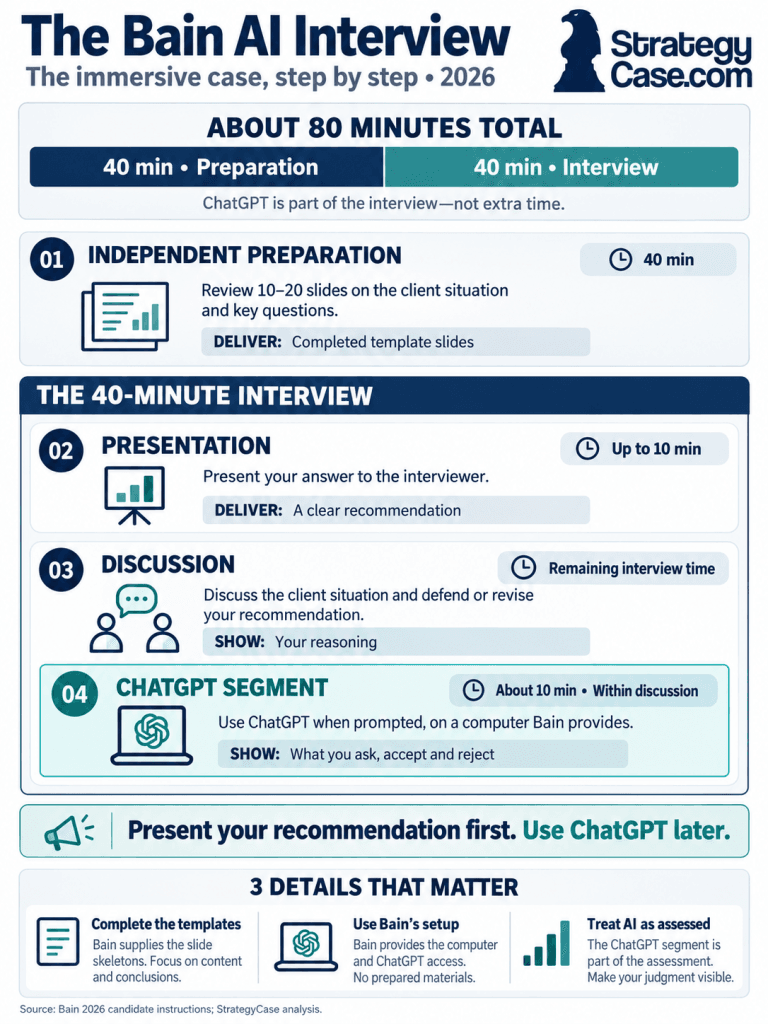
The Bain immersive case runs about 80 minutes. ChatGPT appears only after you’ve presented your recommendation. Source: Bain 2026 candidate instructions, StrategyCase analysis.
| Phase | Time | What happens | What you hand over |
|---|---|---|---|
| Independent preparation | 40 min | You review 10-20 slides on a client situation and the key questions the client faces | Completed template slides |
| Presentation | Up to 10 min | You present your answer to the interviewer | A clear recommendation |
| Discussion | Rest of the 40-min interview | You discuss your recommendation and the client’s situation | Your reasoning, defended or revised |
| ChatGPT segment | About 10 min, inside the discussion | The interviewer prompts you to use ChatGPT on a computer they provide | Visible judgment: what you ask, what you accept, what you reject |
Three details in the instructions matter more than they look:
- You complete templates. Bain gives you the slide skeletons. Your work is the content and the conclusions. Nobody is grading slide design.
- Bain provides the computer and the ChatGPT access. You don’t bring or prepare any materials, so plan for a machine and a ChatGPT setup that aren’t yours.
- AI sits under “what will I be tested on.” Bain frames the ChatGPT segment as part of the assessment. Treat it as scored.
What’s confirmed and what’s still open
| Status | Detail |
|---|---|
| Confirmed (Bain’s 2026 candidate instructions) | 40 minutes of prep, 10-20 slides, template slides to complete, a presentation of up to 10 minutes, a discussion, about 10 minutes of ChatGPT on a Bain computer |
| Corroborated (Bain EMEA MBA recruiting webinar, 2026, as reported by attendees) | Candidates work on a business problem independently, present for around 10 minutes, and may be asked to show live how they prompt and use ChatGPT |
| Observed | The invitations I saw was for Partner rounds at a European office |
| Still open | Whether offices outside EMEA run it, whether every final round includes it, whether calculators are allowed, what task the interviewer sets for ChatGPT, and how much weight the segment carries |
One correction belongs up front. Earlier reporting, including the first version of this guide, expected candidates to use a Bain-built tool such as Sage. The instructions name ChatGPT. If you have been reading about “Bain’s internal AI interview tool,” that detail is out of date.
How the Immersive Case Differs From Bain’s Written Case
If you have prepared for Bain’s written case, most of that work carries over. The immersive case runs the same exercise on a shorter clock and adds an AI segment.
| Classic Bain written case | 2026 immersive case (AI interview) | |
|---|---|---|
| Prep time | About 55 min | 40 min |
| Slide pack | 20-30 slides | 10-20 slides |
| Your output | Populate templates | Complete template slides |
| Presentation | 15-20 min | Up to 10 min |
| Q&A | 15-20 min | Discussion, including about 10 min of ChatGPT |
| AI use | None | ChatGPT, when the interviewer prompts you |
The shorter clock matters in one specific way. With 40 minutes and up to 20 slides, you have about two minutes per slide for reading, math, and filling templates combined. Candidates who read every slide in full run out of time before they reach a recommendation. Selection is the skill this format rewards most: deciding quickly which slides carry the answer and which are there to distract you.
How to Use the 40 Minutes of Preparation
Here is the time split I’d use. It adapts the method from our written-case guide to the shorter clock and to the fact that Bain hands you the templates.
- Minutes 0-3: Read the key questions and the empty templates first. The templates show you what Bain expects you to conclude. Every slide you read after this is either evidence for a template or noise.
- Minutes 3-8: Skim the whole pack once. Tag each slide to the template it feeds, or mark it as noise. Don’t calculate anything yet.
- Minutes 8-30: Fill the templates one at a time. For each exhibit, write the “so what” in one line. Do the math on paper and sanity-check the magnitude. Our guides to interpreting charts and data in case interviews and case interview math cover both.
- Minutes 30-36: Write the storyline. Recommendation, three supporting reasons, the biggest risk, and next steps. Give every slide an action title that states the conclusion (“Rising churn drives the profit decline,” not “Customer analysis”).
- Minutes 36-40: Prepare your opening line and your open questions. Rehearse the first 60 seconds of your pitch in your head. Then write down two or three assumptions you couldn’t verify from the pack. Those become your best ChatGPT prompts later.
Step 5 is the one most candidates will skip, and it’s the cheapest edge in this format. When the interviewer turns the screen toward you, you already know what you want to test.
How to Present Your Answer in 10 Minutes
Ten minutes is tight for 10-20 slides of material, so budget it before you start talking:
- Minute 1, the answer. State your recommendation and the three reasons behind it before any detail. This is the answer-first style Bain rewards in every case format.
- Minutes 2-8, the evidence. Walk through your completed templates, one conclusion per slide. Read the action title, point to the number that proves it, move on.
- Minutes 9-10, risks and next steps. Name the risk most likely to change your answer and what you’d do next to test it.
That sequence is the Pyramid Principle in its most practical form: the conclusion on top, the support underneath.
In the discussion, expect the interviewer to push on your weakest assumption. Defend your logic where the data supports it and revise cleanly where it doesn’t. Changing your answer for a good reason scores better than holding a position the evidence has already left behind.
The ChatGPT Segment: What the Interviewer Is Watching
Look at the order of the phases. By the time ChatGPT appears, you have already committed to a recommendation. So the segment can’t be testing whether AI can solve the case. It tests whether you can use AI to extend and stress-test your own thinking, in front of a senior person, in about 10 minutes.
When I worked with candidates at McKinsey, the final number rarely decided anything on its own. What decided it was how the candidate got there: whether they structured the problem cleanly, knew which analysis mattered, and caught their own mistake before I did. A ChatGPT window changes none of those questions. It moves them onto a screen where the interviewer can watch them play out in real time.
Consulting has a name for this skill: managing the analyst. A good consultant gives an analyst a sharp instruction, reviews the output critically, catches the error, and turns the result into something a client can act on. Replace “analyst” with “ChatGPT” and you have this segment.
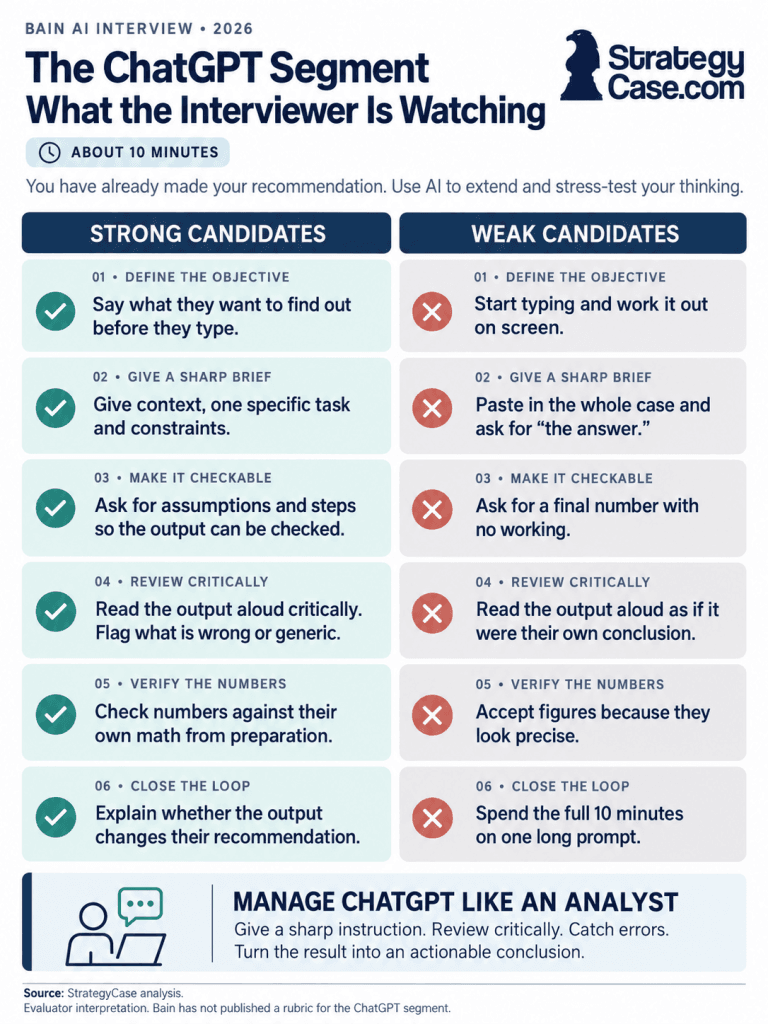
What separates strong and weak candidates in Bain’s ChatGPT segment, from an interviewer’s perspective. Source: StrategyCase analysis.
| What strong candidates do | What weak candidates do |
|---|---|
| Say what they want to find out before they type | Start typing and work it out on screen |
| Give context, one specific task, and constraints | Paste in the whole case and ask for “the answer” |
| Ask for assumptions and steps so the output can be checked | Ask for a final number with no working |
| Read the output aloud critically and flag what’s wrong or generic | Read the output aloud as if it were their own conclusion |
| Check numbers against their own math from the prep | Accept figures because they look precise |
| Close by saying whether the output changes the recommendation | Spend the full 10 minutes on one long prompt |
This table is my read on what a senior interviewer looks for, based on how case interviews are scored. Bain hasn’t published a rubric for the ChatGPT segment.
A prompt routine that fits in 10 minutes
Ten minutes allows about three or four exchanges once you count typing, reading, and talking. Don’t improvise the shape of your prompts. Use one routine every time:
- Context: who the client is and what you’ve recommended.
- Task: one specific job.
- Constraints: what to assume, what to leave out, how long the answer should be.
- Format: steps, a ranked list, or a short table you can check quickly.
Three prompts worth having ready, with the brackets filled from your case:
- Stress-test the recommendation: “I’m advising [client] to [recommendation] because [reasons 1, 2, and 3]. List the five strongest arguments against this, ranked by how likely each is to change the decision.”
- Check an assumption you couldn’t verify: “Estimate [figure] for [market and region]. Show each assumption on its own line so I can check them one by one.”
- Plan the next step: “Draft a two-week plan to test [riskiest assumption]: the analyses, the data sources, and which result would change the recommendation.”
Narrate while you type. Silent prompting looks like waiting for the machine to think for you. Keep the last minute for synthesis: what you take from the output, and whether it changes your answer.
Practical details most candidates won’t think about
- It won’t be your ChatGPT. Expect a fresh setup with no memory, custom instructions, or saved chats. Practice in a new chat with personalization switched off.
- It won’t be your keyboard. A borrowed laptop slows your typing. Short prompts beat long ones.
- ChatGPT can be confidently wrong. If a number disagrees with your own pen-and-paper math, say so and explain which one you trust and why. That moment is the clearest proof of judgment you can give an interviewer.
How to Prepare for the Bain AI Interview
Start with what not to do. Grinding practice cases through an AI chatbot and calling it AI practice builds volume without judgment. It trains you to consume AI output, while Bain is testing whether you can direct and correct it.
If your final round is a week away
| Day | Focus |
|---|---|
| Day 1 | One full 40-minute drill on a written-case pack with templates. Time each of the five steps. |
| Day 2 | Exhibit and math sprints: a one-line “so what” per chart, pen-and-paper calculations under a timer. |
| Day 3 | A second 40-minute drill, then deliver the 10-minute presentation out loud and record it. |
| Day 4 | ChatGPT drills: take your Day 3 recommendation, open a fresh chat, and run the 10-minute routine with a timer. Repeat three times with different tasks. |
| Day 5 | A full 80-minute dress rehearsal with a partner who plays the interviewer and asks you to use ChatGPT mid-discussion. |
| Day 6 | Fit preparation. Bain’s hiring process includes a conversation about your past experience, so tighten your stories with our Bain fit interview guide. |
| Day 7 | Light review and rest. |
If you have a month or more
Build the skills the 40 minutes depend on: structuring, exhibit interpretation, and case math. These are also the skills you use to judge ChatGPT in the room. You can’t challenge a market estimate you couldn’t build yourself.
Then bring AI in deliberately. Practice handing ChatGPT one defined sub-task at a time while you keep ownership of the structure and the answer. Our guide to AI case interview prep covers where AI practice helps and where it quietly hurts. The whole sequence (skills first, a timed format drill, then AI on top) is how StrategyCase structures case preparation.
Bain vs. McKinsey: How the AI Interviews Compare
McKinsey moved first with its own AI interview. The two formats differ in ways that change how you prepare.
| Bain AI interview | McKinsey AI interview | |
|---|---|---|
| Tool | ChatGPT | Lilli, McKinsey’s internal AI |
| Where it sits | Inside the immersive case discussion | A separate component in select final rounds |
| Does it count? | Bain lists it under what you’re tested on, so treat it as scored | Launched as a non-evaluative pilot |
| Where it’s confirmed | EMEA (2026 candidate instructions and recruiting webinar) | US pilot from January 2026, then select European offices |
Our McKinsey AI interview guide covers the Lilli format in detail. Both firms are testing the same underlying thing: whether you stay in charge of the problem when a capable tool is in the room. For the wider shift across firms, see how AI is changing consulting interviews.
The Bottom Line
For Bain candidates in the 2026 cycle with an immersive case on the calendar, the verdict is simple. Spend most of your remaining prep on the compressed written case and a smaller, focused slice on the ChatGPT routine. The 40 minutes decide whether you walk in with a recommendation worth stress-testing. The 10 minutes of ChatGPT decide whether you look like someone Bain can put in front of a client with AI on the table.
Both halves reward the same habit. You own the answer, and every tool in the room works for you.
Frequently Asked Questions
Is the Bain AI interview real?
Yes. Bain’s 2026 candidate instructions describe an immersive case interview in which candidates use ChatGPT for about 10 minutes during the discussion, and Bain presented the same exercise at an EMEA MBA recruiting webinar. Bain hasn’t published the format on its public careers site, and it isn’t yet clear whether every office runs it.
Can I use ChatGPT in a Bain interview?
Yes, during a defined window. In the immersive case, the interviewer prompts you to use ChatGPT for about 10 minutes as part of the discussion, on a computer Bain provides. You don’t bring your own device, account, or prepared materials.
Is the Bain AI interview run by an AI?
No. A Bain interviewer runs it. ChatGPT is a tool you use for part of the discussion, and the interviewer evaluates how you use it. It isn’t an AI-conducted video interview.
Which round is the Bain AI interview in?
The invitations I’ve seen placed it in a Partner (final) round at a European office. Bain hasn’t confirmed that every office uses the same placement, so check your own invitation for the format details.
How do I prepare for the ChatGPT part of the Bain interview?
Practice a 10-minute routine in a fresh ChatGPT chat. State what you want to learn, then give context, one task, constraints, and a format you can check. Critique the output out loud and finish by saying whether it changes your recommendation. Run it on your own practice-case answers with a timer.
How is the immersive case different from Bain’s written case?
It’s shorter. You get 40 minutes of prep instead of about 55, a pack of 10-20 slides instead of 20-30, and a presentation of up to 10 minutes instead of 15-20. It also adds a ChatGPT segment to the discussion.
Related Guides
- Consulting Case Interviews: The Complete Guide
- Bain SOVA Test and Online Assessment Guide
- BCG Case Interview Guide
- The Big 3 Consulting Firms: McKinsey, BCG, and Bain
Where to Go From Here
The Bain AI interview tests what every Bain case has always tested, on a tighter clock and with a new tool on the table. Three next steps:
- Drill the 40 minutes. Run timed written-case packs with templates until the five-step split feels automatic.
- Rehearse the 10-minute ChatGPT routine. Fresh chat, timer on, narrate as you go, and close with what the output means for your answer.
- Strengthen the skills underneath. Exhibit reading, pen-and-paper math, and answer-first delivery carry both halves of the interview.
Start the free StrategyCase Case Interview Foundations course: 40+ videos and 7+ hours of instruction on structuring, exhibits, and case math. For the timed drills this format punishes you for skipping, the Case Interview Academy adds video lessons and thousands of practice drills across case structuring, exhibit interpretation, and case math. If your interview is more than a few weeks out and you want a personal plan, 1:1 coaching with me starts with a baseline of where you stand and builds the plan from there. Spots are limited each month.
The format will keep evolving. The habit it rewards won’t: stay in charge of the problem, whatever tool is on the desk.
About the author: Dr. Florian Smeritschnig is the founder of StrategyCase.com and a former McKinsey Senior Consultant. Since 2020 he has delivered 2,200+ mock interviews and coaching sessions, and his clients have secured 700+ consulting offers, 340 of them at McKinsey, BCG, and Bain. He is the author of three books on consulting interviews and careers, including The 1%: Conquer Your Consulting Case Interview.
Last updated: October 2026. I’ll update this guide as candidates in other regions report on the format.
