
Last Updated on June 15, 2026
By Florian Smeritschnig, former McKinsey Senior Consultant · Updated June 2026
The BCG case interview rewards one instinct above all: you drive. BCG cases are candidate-led: you set the structure, walk the interviewer through your thinking, and steer toward the recommendation yourself. McKinsey hands you the wheel one question at a time; BCG hands you the whole car. Get comfortable owning the case end to end and most of the interview falls into place.
I spent years at McKinsey on the other side of the recruiting table, and I’ve run 2,200+ mock cases with candidates targeting firms like BCG. The ones who get the offer rarely have the fanciest framework. They drive a clean structure, show real business creativity, and never make the interviewer pull the analysis out of them.
This guide covers the BCG case interview format you’ll actually face, the online screens, the candidate-led method step by step, the creativity BCG scores for, and the mistakes that quietly sink strong candidates.
Key Takeaways
- BCG cases are candidate-led: you build and drive the structure, rather than answering the interviewer’s prompts one at a time the way you would at McKinsey.
- Before the live rounds, most candidates face online screens: the Consulting Career Assessment, the BCG Online Case (Casey) chatbot, the Pymetrics, and, at some offices, a separate Cognitive Test.
- The candidate-led method is three moves: open and structure → drive the analysis → synthesize top-down. You own every transition.
- BCG explicitly rewards creativity and business judgment, not memorized frameworks; there is rarely one “right” answer.
- Final rounds at some offices add a written case; treat it as a separate skill and prepare it on its own.
What is the BCG case interview?
The BCG case interview is a job interview where you solve a realistic business problem out loud while the interviewer assesses your structuring, quantitative reasoning, business judgment, creativity, and communication. BCG’s signature is the candidate-led format: you drive the structure and analysis yourself, instead of being walked through it question by question.
That one difference (you own the case rather than react to it) is what makes a BCG round feel distinct from a McKinsey one, and it’s where most preparation goes wrong.
How the BCG interview process works
Boston Consulting Group (founded in 1963 by Bruce Henderson) runs a multi-stage process. Before you reach a live case, you’ll typically pass a resume screen and one or more online assessments. From there, the live interviews fall into two types across first and final rounds:
- Case interviews: candidate-led business problems that test analytical ability, creativity, and your instinct to drive.
- Fit (behavioral) interviews: your motivation, leadership, and teamwork (covered in its own section below).
A typical path looks like this:
| Stage | What it is | What it tests |
|---|---|---|
| Resume screen | CV and cover letter review | Academic signal, brand, fit |
| Online assessment | CCA, BCG Online Case (Casey), Pymetrics, and/or cognitive test | Structured thinking, numeracy, judgment under time |
| First round | Usually 2 interviews, each a case + short fit | Driving a case, quant, communication |
| Final round | 2–3 interviews with senior partners/MDPs; some offices add a written case | Business judgment, creativity, maturity |
The BCG online case and screening assessments
BCG front-loads more screening than most firms, and candidates routinely underprepare for it. The main screen for most offices currently are the Consulting Career Assessment and the BCG Cognitive Test. Some offices sitll run the BCG Online Case (Casey): an interactive chatbot that runs you through a case-style problem on a timer, scoring your structure and math without a human in the room. Some offices also use a separate cognitive test on top of it.
These screens decide who reaches the live rounds, so treat them as real gates, not formalities. Work through our BCG online case guide for the Casey format and our BCG Cognitive Test walkthrough for the aptitude screen. Clearing both early frees you to focus on the live cases.
Candidate-led vs. interviewer-led: who drives the BCG case
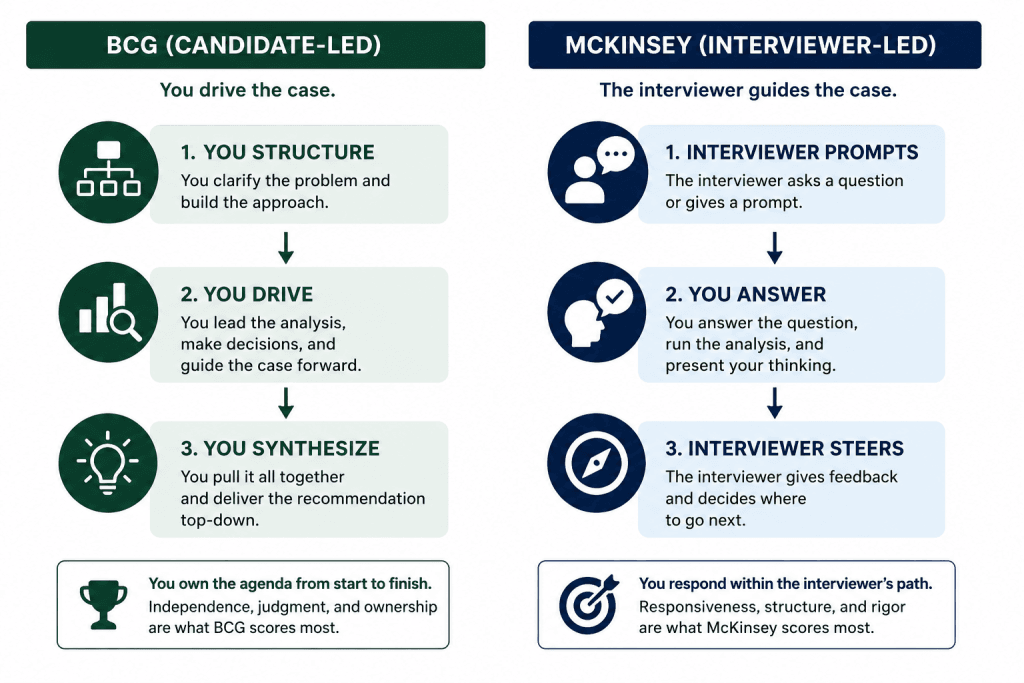
Here’s the distinction most candidates miss when they prep for BCG and McKinsey/Bain the same way. BCG cases are predominantly candidate-led; McKinsey’s are interviewer-led. The skill being tested looks similar, but the room feels completely different.
| Candidate-led (BCG) Case | Interviewer-led (McKinsey) Case | |
|---|---|---|
| Who drives | You set the agenda and walk through your structure | The interviewer guides you question by question |
| Your job | Lead the problem-solving end to end | React sharply to each prompt, then connect it back |
| Skill tested | Independent structuring and steering | Structured thinking under direction |
| Feel | Open-ended conversation you own | Segmented, predictable path |
Formats vary by office and round, and the Casey online case is its own timed, chatbot-led format. But in the live BCG room, default to driving. If you wait to be prompted, you read as passive, which is the single most common reason strong McKinsey-trained candidates stumble at BCG.
Quick note: Bain has also transitioned to a more interviewer-driven case format. For more on that, check out our Bain Case Interview Guide.
What makes BCG different from McKinsey and Bain
All three firms test the same raw skills; the difference is emphasis. McKinsey runs interviewer-led cases and leans on its Personal Experience Interview. Bain wants the answer first: a hypothesis up front, then proof, nowadays usually in an interviewer-led format too. BCG wants you to drive a clean structure and show creative business judgment along the way.
If you’re prepping across firms, anchor on our complete guide to case interviews for the shared fundamentals, then adjust the instinct firm by firm.
The candidate-led method: how to drive a BCG case
Driving a BCG case interview is a skill you can build deliberately. Here’s the three-move method I drill with BCG candidates, with a worked example.
Worked example (BCG-style prompt):
A regional airport has flat passenger numbers and wants to grow profit without adding flights. The CEO asks how BCG would approach it.
Step 1: Open and structure
Clarify the objective in one line, then lay out your own structure before you analyze anything. For the airport, you might split profit into aeronautical revenue (airline fees), non-aeronautical revenue (retail, parking, real estate), and different cost elements. Say your structure out loud, signpost where you’ll start, and ask for buy-in. You’re setting the agenda, and that’s the candidate-led job.
A tight structure here beats a clever one. Build it from first principles around this problem, not a memorized template. The structuring reps behind this are exactly what our case interview frameworks guide trains.
Step 2: Drive the analysis
Walk the interviewer through each branch yourself, pulling in the numbers and asking for data when you need it. Do the math cleanly, state the “so what” after every calculation, and connect each finding back to the objective. When you hit a branch that invites ideas (new revenue from underused terminal space, say), that’s where BCG wants to see creative case interview brainstorming, not a shrug. The other key skills for this section of the case are case math and exhibit interpretation.
The key is momentum. You decide what to analyze next and why; the interviewer should rarely have to ask “what would you look at now?”
Step 3: Synthesize top-down
Close with a crisp, top-down recommendation: the answer first, then two or three reasons, then next steps. A BCG synthesis isn’t a summary of everything you did. It’s the decision the CEO should make, stated the way you’d brief a partner. Candidates who drive cleanly but trail off at the end leave the strongest signal on the table.
Creativity and business judgment: what BCG rewards
BCG is the MBB firm most associated with rewarding creativity, and that reputation is earned. Interviewers want to see that you can generate genuinely different ideas, weigh them with judgment, and stay comfortable when there’s no single right answer.
This shows up in two places. In the structure, BCG rewards branches a templated candidate wouldn’t think of. In the recommendation, it rewards a defensible point of view over a hedge. Practically, that means practicing idea generation under pressure, not to be gimmicky but to show the business intuition BCG hires for. Restating a textbook framework is exactly the move that reads as average in a BCG room.
The BCG written case and final-round formats
At some offices, the final round adds a written case: you get a pack of slides and data, build a recommendation on your own, and present it. It tests the same judgment as a live case, but the output craft (reading exhibits fast, writing action titles, defending under challenge) is its own skill.
Don’t fold it into general case practice. Work through the BCG written case section of our written-case guide for the output mechanics, and our chart interpretation guide for turning data into clean exhibits.
The BCG fit interview (behavioral)
Cases are only half the bar. BCG’s fit interview assesses motivation, leadership, teamwork, and why BCG specifically. Several offices have moved toward structured behavioral formats to reduce subjectivity.
Structure each story with the SCORE method (Situation, Complication, Outcome expected, Remedial action, End result) so your examples land with stakes and impact instead of rambling. Prepare this properly with our consulting fit interview guide, and come with four or five flexible stories rather than one rehearsed script.
Common BCG case interview mistakes (and how to avoid them)
After enough mock cases, the same three failure modes show up again and again:
- Waiting to be led. Candidates trained on McKinsey-style cases sit back and wait for prompts. In a candidate-led BCG case, that reads as passive. Drive: decide the next step and explain why.
- Reciting a framework. Pulling a memorized structure off the shelf signals pattern-matching, not thinking. Build the structure from the specific problem, and let BCG see the creativity.
- Skipping the synthesis. Strong analysis with a mumbled ending wastes the case. Always close top-down with a clear recommendation, reasons, and risks, the way you’d brief a partner.
How to prepare for the BCG case interview
Most BCG prep fails for the same reason most case prep fails: candidates grind 50+ cases chasing volume instead of building the underlying skill (learn more about why most candidates fail their interviews here). That’s motion, not mastery. Modern interviews (BCG’s included) test first-principles structuring, creativity, and judgment with incomplete data, not memorized archetypes. Doing more recycled cases just drills the wrong reflexes.
A better sequence:
- Clear the online screens early so the online assessments and any cognitive tests aren’t hanging over your live-round prep.
- Drill structuring until your frameworks are tight and built for the specific problem, with feedback rather than as a one-off.
- Practice driving a full candidate-led case, including the opening and the top-down synthesis, until owning the room feels natural.
- Get honest feedback from someone who has sat on the other side of the table. You can’t self-diagnose the passivity or weak-synthesis habits that cost BCG offers, which is where 1-on-1 case coaching earns its keep.
That skill set is what StrategyCase is built to train, and what separates strong candidates is structured practice over raw talent. BCG’s own official interview-prep resources are worth working through for their practice cases.
Frequently asked questions
Is the BCG case interview hard?
It’s demanding but conquerable. BCG accepts well under 1 in 100 applicants, so the bar is high, but the case itself is a learnable skill. The candidates who struggle usually under-practice driving the case and over-rely on memorized frameworks, not raw ability.
What is the BCG online case (Casey)?
Casey is BCG’s interactive chatbot case: a timed, online assessment that walks you through a case-style problem and scores your structure and math without a human interviewer. Many offices use it as a screen before the live rounds.
Is the BCG case interview candidate-led or interviewer-led?
Predominantly candidate-led. You set the structure and drive the analysis yourself, unlike McKinsey’s interviewer-led format where you answer prompts in sequence. Formats vary by office, but in the live BCG room you should expect to lead.
How many rounds does BCG have?
Usually one or more online assessments, then a first round of about two interviews, then a final round of two to three interviews with senior partners. Some offices add a written case in the final round.
Does BCG still use a written case?
At some offices, yes, typically in the final round. It’s a separate skill from the live case: you read a data pack, build a recommendation alone, and present it. Prepare it on its own rather than assuming live-case practice covers it.
How long should I prepare for a BCG interview?
Most candidates need six to eight weeks of deliberate practice: focused skill-building with feedback, not 50 rushed cases. If you’re also sitting the online case or a cognitive test, build those into the timeline instead of cramming them into the final week. See our consulting preparation plan guide for more help.
Related guides
- Case interview math: the quant skill every BCG case tests
- BCG salary and career path: what a BCG offer is actually worth
- Market sizing cases: a sub-skill BCG loves to test
- Best case interview books: what to read, and what to skip
- The Big 3 consulting firms: how McKinsey, BCG, and Bain compare
Final word
The BCG case interview comes down to a habit most candidates never build: take the wheel. Drive a clean structure, show real business creativity, and close with a recommendation you’d be willing to defend in front of a partner. Do that and you’ll read as someone who already thinks like a BCG consultant, which is the entire point of the exercise.
The process is genuinely tough, but it’s conquerable with the right preparation. Start with StrategyCase’s complete case interview preparation and build the candidate-led instinct that gets BCG offers.
About the author: Florian Smeritschnig is a former McKinsey Senior Consultant and the founder of StrategyCase. He has run 2,200+ mock case interviews and coached hundreds of candidates into McKinsey, BCG, Bain, and other top firms.
