

Last Updated on September 10, 2026
By Florian Smeritschnig, former McKinsey Senior Consultant · Updated September 2026
Case interview brainstorming asks you to generate ideas (usually the causes of a problem or the options to solve it) out loud, and it tests structured creativity: the interviewer grades whether your ideas are broad, deep, organized into MECE buckets, and insightful, not how many you can list. It usually arrives mid-case, sounds open-ended (“what are all the reasons this plant might be underperforming?”), and rewards candidates who impose a structure before they speak.
Brainstorming is where I watched many candidates lose their interviews. Not in the math, not in the framework, but in the moment the interviewer asked for ideas and they started rattling off disconnected thoughts with no structure. After five years at McKinsey and more than 2,200 cases now with StrategyCase and PrepLounge, I can tell you exactly what separates a strong brainstorm from a generic one, and how to build the skill before your interview.
Key Takeaways
- Brainstorming tests structured creativity. Interviewers grade breadth, depth, MECE discipline, and insight, not idea count.
- It is the same broad, deep, and insightful standard used for any structure, applied to generating ideas instead of scoping a problem.
- Generate ideas with three techniques: mind mapping, linking, and expansion. Communicate them with the Pyramid Principle.
- Use a 4-step method: clarify the question, take 60 to 120 seconds to structure, present top-down with numbered buckets, then prioritize with a hypothesis.
- The biggest failure is idea-dumping without hierarchy. The fix is a MECE top layer of 3 to 4 buckets before any detail.
What brainstorming questions actually test
Every major firm uses brainstorming, McKinsey, BCG, Bain, the Big 4, and Tier-2 firms, and it shows up mid-case rather than at the start. Typical openers:
- “What are all the reasons a coffee chain might be losing market share?”
- “What levers could this hospital pull to reduce patient wait times?”
- “Beyond price, what could differentiate our product in this category?”
The interviewer is grading four things at once, which are the same properties that define any strong structure:
- Breadth (broad): can you cover the problem exhaustively without gaps?
- Depth (deep): can you go two or three layers down with concrete sub-ideas?
- MECE discipline: are your buckets mutually exclusive and collectively exhaustive, not a pile of overlapping thoughts?
- Insight (insightful): can you offer a non-obvious angle that shows business judgment, not a case-prep checklist?
Deliver one or two of these and you get a pass. Deliver all four and you stand out. Most candidates deliver one or two and then wonder why the scorecard reads “structured but generic.”
Brainstorming vs framework questions
Candidates confuse these constantly. Both test structured thinking and both produce a MECE tree, but the mental mode and the scorecard differ. The simplest way to keep them straight is altitude.
| Framework question | Brainstorming question | |
|---|---|---|
| When it comes | Start of the case | Mid-case, after some analysis |
| What it wants | Categories of analysis to scope the problem | Specific ideas: causes or solutions |
| Output | An investigative scaffold | Concrete answers |
| Altitude | 30,000 feet | 5,000 feet |
A framework answer to a scooter startup case scopes the investigation: market demand, competition, infrastructure, regulation, unit economics. A brainstorming answer to the same case on business development levers generates ideas: student partnerships, geofenced app promotions, campus launch tours, gamified referrals, commuter subscriptions. For how to build the scaffold itself, see our case interview frameworks guide.
What a great brainstorm looks like: broad, deep, and insightful
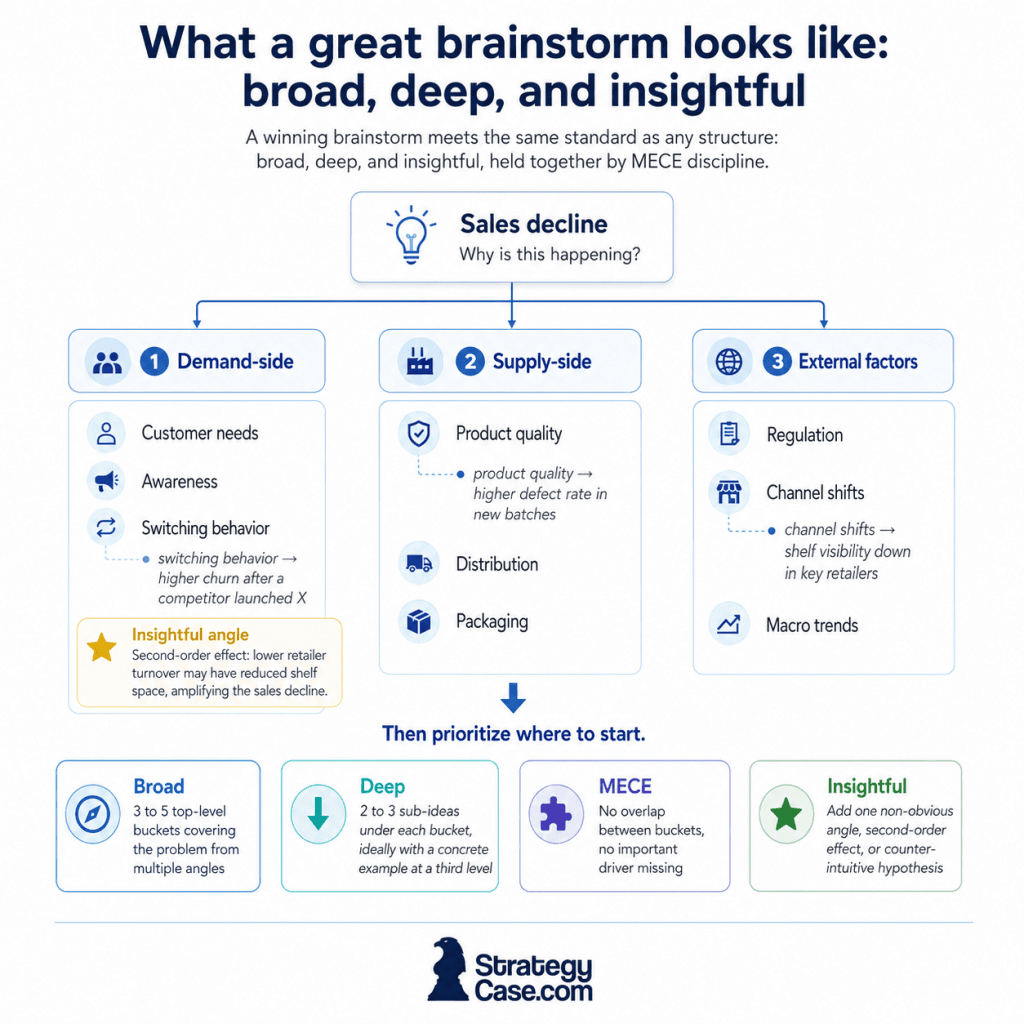
A winning brainstorm meets the same standard as any structure, broad, deep, and insightful, held together by MECE discipline. Miss one and you lose points even when the individual ideas are fine.
- Broad: 3 to 5 top-level buckets covering the problem from multiple angles. Fewer looks thin; more looks unstructured.
- Deep: 2 to 3 sub-ideas under each bucket, ideally with a concrete example at a third level. “Product issues” is not an answer; “product issues → quality (higher defect rate in new batches), feature gap (competitor launched X), packaging (shelf visibility down)” is.
- MECE: no overlap between buckets, no important driver missing. “Customer issues” and “marketing issues” overlap; “demand-side” and “supply-side” do not. This is the MECE discipline that keeps the structure clean.
- Insightful: the non-obvious angle, a second-order effect, a counter-intuitive hypothesis, an analogy from another industry. Without it you sound like a clever student; with it you sound like a consultant.
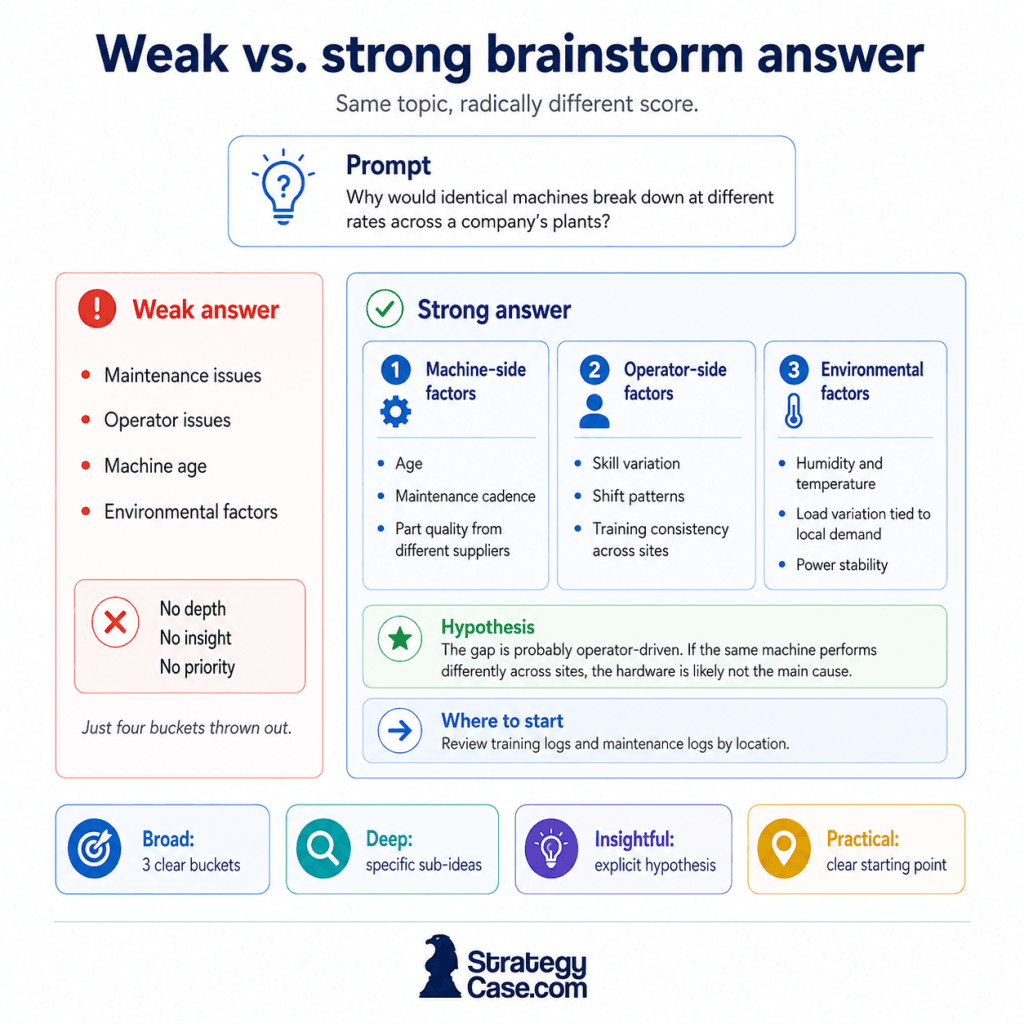
Here is the difference in practice. The prompt: “Why would identical machines break down at different rates across a company’s plants?”
Weak answer: “Maintenance issues, operator issues, machine age, and environmental factors.” Four buckets thrown out, no depth, no insight, no priority.
Strong answer: “I’d split this into three buckets. First, machine-side factors: age, maintenance cadence, and part quality from different suppliers. Second, operator-side factors: skill variation, shift patterns, and training consistency across sites. Third, environmental factors: humidity, temperature, load variation tied to local demand, and power stability. My hypothesis is that the gap is operator-driven, because if the same machine performs differently across sites, the hardware is probably not the cause. I’d start with the training and maintenance logs by location.”
Same topic, radically different score.
Three techniques to generate ideas fast
Structure is half the battle; you still have to produce ideas under a ticking clock. These are the three idea-generation techniques I teach and used myself at McKinsey.
Mind mapping
Put the problem at the center and branch outward, then branch each branch. For “revive a legacy snack brand”: Product (reformulation, new sizes, line extensions), Marketing (creator partnerships, gym sampling, nostalgia storytelling), Distribution (subscription DTC, health-food retail, corporate pantries). Mind mapping is the fastest move when the page is blank and the clock is running.
Linking
Take two ideas and connect them into a third. This is where insight comes from. Link “eco-friendly packaging” with “community wellness” and you get a packaging-return program that earns product credit, tied to a wellness-meets-sustainability story. The idea did not exist in either bucket alone; it emerged from connecting them. Strong candidates use linking in the prioritization step (“these two reinforce each other, I’d sequence them together”).
Expansion
Take one idea and drill until you have extracted every dimension. “Referral program” expands into reward tiers, social mechanics (shareable links, leaderboards), placement surfaces (checkout, post-purchase email, in-app), and measurement (attribution, CAC by channel, lifetime value). Expansion is how you add depth to a shallow bucket, and how you answer the dreaded follow-up: “what else?”
Move between top-down (start with buckets, drill into specifics) when the problem is broad, and bottom-up (generate concrete ideas, then cluster them) when specifics come to mind first. Strong candidates use both inside a single brainstorm.
The 4-step method to answer in the interview
This is the delivery method I have refined across thousands of coaching hours. It works at McKinsey, BCG, Bain, and the Big 4.
- Clarify the question. Paraphrase it back in one sentence to confirm scope and buy a few seconds. Ask one clarifying question if needed, not three.
- Request thinking time. Take 60 to 120 seconds. Write the question in shorthand, sketch 3 to 4 top-level buckets with a technique above, add 2 to 3 sub-ideas under each, and circle where you will start. Candidates who dive in immediately almost always go shallow.
- Present top-down with numbered signposting. “I’ve structured this around three areas. First, machine-side factors. Second, operator-side. Third, environmental.” Then walk each bucket and signpost transitions. This mirrors how consultants talk in client meetings, which is exactly what is being tested.
- Prioritize and integrate with the case. Do not stop at the list. Close with a hypothesis: which bucket you would tackle first and why, and the next analytical step. This is where most candidates drop points by falling silent and waiting for the interviewer to react.
When the interviewer pushes back with “what else?”, treat it as an invitation, not a trap. Integrate the input into your existing structure (“good point, that fits under the environmental bucket as a fourth sub-idea”) rather than scrapping your tree. Never abandon your structure at the first nudge, and never dig in when the input genuinely reveals a gap.
Communicate it with the Pyramid Principle
The Pyramid Principle, developed by Barbara Minto at McKinsey, is the cleanest way to deliver a brainstorm under pressure. Lead with the synthesis, support it, then detail it:
- Top: your key message (“I see three main levers to grow revenue”).
- Middle: the 3 to 4 supporting buckets (expand the product line, optimize pricing, strengthen the online channel).
- Base: the specific sub-ideas and examples under each.
Then close with prioritization. Burying the synthesis at the end is the single most common communication mistake in case interviews. Leading with the answer is what clients and interviewers both want, so practice it in everyday writing (emails, messages, updates): top point first, reasons second, details third. After a few weeks it becomes your default.
How to practice brainstorming the right way
Most candidates practice brainstorming by doing more full cases. That is the wrong move. Brainstorming is a discrete skill, and it builds faster with isolated reps.
- Do isolated drills, not more full cases. Learn the right brainstorming techniques, then run several prompts back to back: 90 seconds to structure, 2 to 3 minutes to deliver out loud, 30 seconds of silence between reps. This builds idea-generation speed and structural discipline faster than grinding end-to-end cases. It is the core of StrategyCase’s structuring and brainstorming drills.
- Practice under a visible timer. A hard 90-second stop simulates interview adrenaline. Without pressure, you over-engineer structures that collapse on the day. Important note: When you learn a new skill, take more time initially to internalize and practice until structuring and brainstorming becomes more natural. Speed is a byproduct of skill and should come over time. If you are just starting out, it’s fine to take 5 minutes to brainstorm.
- Use real business problems. Pull a Financial Times or Harvard Business Review headline instead of recycled textbook prompts. Brainstorm ad-hoc on the street when you see a business (e.g., how can this barber shop increase customer visits?). Real problems build the business judgment behind the “insight” quality, and sector fluency is the multiplier.
- Train lateral thinking. Creativity is trainable. Open-ended drills push you toward the non-obvious angles that score as insight, and our industry cheat sheets close the sector-knowledge gaps that feed them.
- Embrace creativity alongside structure. MECE is necessary, but it’s not sufficient. If every bucket in your structure is something the interviewer has already heard from the last 20 candidates, you’re graded as “structured but unoriginal.” The insight quality matters. Push yourself to include non-obvious angles in every brainstorm, a second-order effect, a counter-intuitive hypothesis, an analogy from a different industry.
- Optimize note-taking for speed. You have about 60 seconds of writing time before you have to start speaking. Use shorthand: P = Profit, R = Revenue, C = Cost, Q = Quantity, $ = Price. Arrows for causation (→), pluses for increases (+), minuses for decreases (−). Single-word labels per sub-bucket. You’re not writing an essay. You’re writing a scaffold you can talk from. Research on interview performance shows candidates typically complete 70-80% of their answer structure before speaking and develop the remaining 20-30% live during delivery. Get comfortable thinking while presenting.
- Build an error log. After every practice session, write down what went wrong. Track yours for 20 sessions. Patterns will emerge. Fix one at a time.
- Don’t memorize. Candidates sometimes memorize “the three drivers of customer satisfaction” or “the six reasons profitability declines.” Memorized lists don’t work on their own, interviewers spot them instantly. The memorized structures are a starting point you have to customize to the specific case. Airline passengers care about different satisfaction drivers than restaurant guests. Know the patterns, but adapt every time.
- Get real feedback. A practice partner catches maybe half your weaknesses; a trained eye catches all of them. Most candidates in 1-on-1 coaching are surprised how many creative angles they have missed for weeks because they lacked the right thinking techniques. If coaching is not an option, record yourself and watch it back the next day.
10 common brainstorming mistakes that cost offers
| Mistake | What it looks like |
|---|---|
| Idea-dumping without hierarchy | Eight disconnected thoughts with no top layer |
| Skipping the Pyramid Principle | Burying the synthesis at the end |
| MECE violations in the top layer | Overlapping buckets |
| Only textbook buckets, no creativity | Reads like a case-prep book, zero original thinking |
| Assertions without rationale | “The cause is X” with no stated reason |
| Shallow sub-ideas | Naming a bucket but not populating it |
| Flat lists with no prioritization | Every idea treated as equally important |
| Ignoring feasibility and cost | Ideas that are fine in theory, impossible in practice |
| Tuning out interviewer input | Missing the “what else?” hint |
| Rigid memorized frameworks | The same 4Ps or 3Cs in every case, never customized |
The first two, idea-dumping and skipping the Pyramid Principle, are where roughly 80% of weak brainstorms fail. Fix those first; the rest is incremental.
Frequently asked questions
How is brainstorming different from a framework question?
A framework question comes early and asks for categories of analysis to scope the problem. A brainstorming question comes mid-case and asks for specific ideas, causes or solutions. Both need MECE structure, but the framework sits at 30,000 feet and the brainstorm drops to 5,000 feet to generate concrete options.
What makes a brainstorming answer “broad” and “deep”?
Broad means 3 to 5 top-level buckets that cover the question entirely. Deep means 2 to 3 sub-ideas under each bucket, with at least one concrete example. A broad-but-shallow answer feels generic; a deep-but-narrow one feels incomplete. Strong answers hit both, then add an insight.
How do I come up with creative ideas fast under pressure?
Use three techniques. Mind map to fill a blank page quickly, link two ideas into a third for non-obvious angles, and expand a single idea into all its dimensions for depth. Then borrow from other industries (“how would a SaaS company solve this?”) and think about second-order effects, not just first-order ones.
How much time do I get to brainstorm in a case interview?
Usually 60 to 120 seconds to structure before you speak. McKinsey-style interviews allow roughly two minutes; candidate-led BCG and Bain cases expect 60 to 90 seconds. Always take the time, sketch your buckets, then deliver. Diving in immediately is the fastest path to a shallow answer.
Why does MECE matter so much in brainstorming?
MECE keeps your buckets from overlapping or leaving gaps, so the interviewer can follow your hierarchy and trust you have covered the problem. After listing your top buckets, stress-test them: could any idea fit in two buckets (exclusivity), and is there a whole category you missed (exhaustiveness)?
Is it OK to memorize brainstorming structures?
Memorize the patterns, never the answers. Knowing that profit splits into revenue and cost is useful; reciting “the four drivers of customer satisfaction” in every case is a red flag interviewers spot instantly. Use memorized structures as starting points, then customize to the specific case in front of you.
Related guides
- The complete case interview guide: how brainstorming fits the full skill set
- Real case interview examples: worked brainstorms and full cases
- How to communicate in a case interview: delivering ideas top-down under pressure
- What makes candidates succeed: the habits behind case interview offers
- Case interview feedback sheet: download a free case interview scoring sheet for your practice
Final word
Brainstorming is where candidates either stall or stand out. The ones who stall spray disconnected ideas and watch the scorecard drop. The ones who stand out bring a MECE top layer, two or three layers of depth, at least one insight the interviewer has not heard before, and a prioritized close that ties back to the case. In other words, they are broad, deep, and insightful on demand.
None of this is innate; it is a trained skill, built with isolated drills under time pressure, real business problems, and honest feedback. Start with StrategyCase’s Case Interview Academy, which includes the structuring and brainstorming drills that build this exact skill. Modern case prep is broken because it drills memorization instead of skills. Fix the skill, and the offers follow.
About the author: Florian Smeritschnig is a former McKinsey Senior Consultant and the founder of StrategyCase. He spent five years at the firm, interviewed candidates from the other side of the table, and has since run more than 2,200 mock case interviews and coached hundreds of candidates into McKinsey, BCG, Bain, and other top firms.
