

Updated July 2026 · By Florian Smeritschnig, Former McKinsey Senior Consultant
A consulting coffee chat is a 25 to 45 minute informal conversation with a consultant (typically Senior Associate, Engagement Manager, or Partner) at McKinsey, BCG, Bain, or another consulting firm, used by the firm to assess your fit and used by you to learn about the firm and secure a referral.
Most coffee chats are now conducted virtually via Zoom or Teams, last 30 minutes on average, and are deliberately low-stakes in tone but high-stakes in outcome: the consultant’s post-chat feedback meaningfully influences whether you reach the interview stage. Below is the full breakdown of what to expect, the three question types you will face, the prep checklist, the explicit framework for asking for a referral, and the firm-by-firm differences in how MBB handles coffee chats in 2026.
After 5 years at McKinsey conducting coffee chats with hundreds of candidates and 7+ years coaching candidates through MBB recruiting, I can tell you exactly what consultants are evaluating, the mistakes that quietly disqualify candidates, and how to convert a coffee chat into a referral that lifts your application meaningfully above the noise.
Key Takeaways
- Duration: 25-45 minutes typical (30 minutes most common). Virtual or phone since 2020; in-person at on-campus events or office visits.
- Conducted by: Senior Associates, Managers, Engagement Managers, sometimes Partners or recruiters.
- Three question types: Basic background questions (almost always), deeper fit questions (sometimes), occasional mini-case questions (rare).
- Real purpose: The firm is evaluating your communication, curiosity, and culture fit. You are evaluating fit and angling for a referral.
- The referral is the goal: A coffee chat with a referral lifts your application screening odds by 3-5x. Most consultants will refer if you make the meeting feel easy and ask explicitly near the end.
- What to wear: Business casual minimum for video calls; business formal for in-person at the office. When in doubt, overdress slightly.
- Follow-up: Email thank-you within 24 hours. Connect on LinkedIn. Stay in periodic light touch (every 2-3 months) through the recruiting cycle.
What a Consulting Coffee Chat Actually Is
A coffee chat in consulting is a structured informal conversation that serves three purposes simultaneously:
1. Soft screening for the firm. The consultant you meet with provides post-chat feedback to the recruiting team. This feedback is not formal scoring, but it influences whether your application gets prioritized in the screening stage and whether you receive an interview invitation. A consultant who reports back “I would not want this person on my team” almost always means you do not advance.
2. Talent attraction for the firm. Consulting firms compete intensely for top candidates. The coffee chat is partly the firm’s marketing, showing you what the people are like, what the work feels like, and why this firm specifically is the right home. Strong candidates routinely have multiple competing offers; the coffee chat is the firm’s first chance to make you want to choose them.
3. Networking for you. A successful coffee chat puts a current consultant in a position to refer you, advocate for you internally, and answer your questions about firm culture and recruiting logistics. A referral from a current consultant is one of the strongest single signals you can attach to your application, particularly from a non-target school or non-target background. For more on general networking with consulting firms, see our consulting networking guide.
In 2026, the format has settled into a stable pattern:
- Duration: 30 minutes is the modal length. 25-minute chats happen when consultants are between client meetings. 45-60 minutes is rare but happens when the consultant is genuinely interested or unusually free.
- Medium: Virtual (Zoom, Microsoft Teams, occasionally Google Meet) is now the default. Phone-only coffee chats happen at the recruiter’s request when the consultant is traveling. In-person coffee chats occur at on-campus recruiting events and during office visits.
- Conducted by: Senior Associates / Senior Consultants (the most common), Engagement Managers / Project Leaders, Associate Partners, Partners (less common but possible), and occasionally recruiting team members.
- Tone: Deliberately informal. The consultant will be friendly, ask about your background, share their experience, and answer your questions. The structure is conversational, not interrogative.
- Outcome: Either a referral, a positive note to recruiting, a neutral note, or (less commonly) a negative note. Coffee chats with negative outcomes are rare because consultants typically only agree to chat with candidates who already cleared an initial screen.
The Three Question Types You Will Face
Coffee chat questions fall into three categories, in decreasing order of frequency.
Type 1: Basic Background Questions (Almost Always)
These are the standard opener questions that every coffee chat includes. They are not scored individually but the consultant is watching whether your answers are clear, structured, and authentic.
The 8 questions you should be prepared for:
- Introduce yourself / walk me through your resume. (Most common opener.)
- Why do you want to work in consulting?
- Why do you want to work for [our firm specifically]?
- Why do you want to leave your current role? (For experienced candidates.)
- What are your career aspirations?
- Have you had previous touchpoints with our firm? Do you know anyone here?
- Are you familiar with our recruiting process? Any questions about it?
- What questions do you have for me?
Each of these has a “right” answer pattern. The “walk me through your resume” answer should be 90 seconds, structured chronologically with one specific quantified achievement per role. The “why consulting” answer should reference 2-3 specific aspects of the work (variety of problems, exposure to senior leaders, structured problem-solving), never “I want to learn business” (too generic) and never “I want exit options” (signals you do not actually want consulting).
Type 2: Deeper Fit Questions (Sometimes)
These are fit-interview-style questions that consultants use when they want to dig deeper into how you handle real situations. They are not standard in every coffee chat, but show up when the consultant is genuinely evaluating you (rather than just doing PR for the firm).
Common examples:
- Tell me about a challenging leadership experience.
- Tell me about a time you failed. (Or: a time you struggled.)
- What are your strengths and weaknesses?
- Tell me about a situation where you had to influence someone.
- Describe a time you had to adjust to a major setback.
These are full fit-interview territory. If you have not prepared structured fit stories yet, you should; they will appear in the actual interview rounds too, with significantly more depth. The comprehensive fit interview guide covers the SCORE framework and the typical story patterns. For McKinsey specifically, see the McKinsey PEI (Personal Experience Interview) guide.
Type 3: Mini-Case Questions (Rare)
Occasional consultants will ask a short market sizing or quick-math question to test whether you can think on your feet. This is uncommon in coffee chats, true case interviews are reserved for the formal interview rounds, but it does happen, especially with consultants who are themselves fresh out of training and excited to “case” candidates.
Typical mini-case questions:
- How many cars are sold in Germany per year? (Classic market sizing.)
- How many cups of coffee does a Starbucks store serve in a day?
- How would you estimate the size of the US dental floss market?
If you get one of these, treat it like a proper case: clarify the question, structure your approach top-down, walk through your assumptions, and arrive at a number. Speed is less important than the structure of your thinking.
For broader case interview preparation, see the consulting case interview comprehensive guide.
How to Prepare for a Consulting Coffee Chat
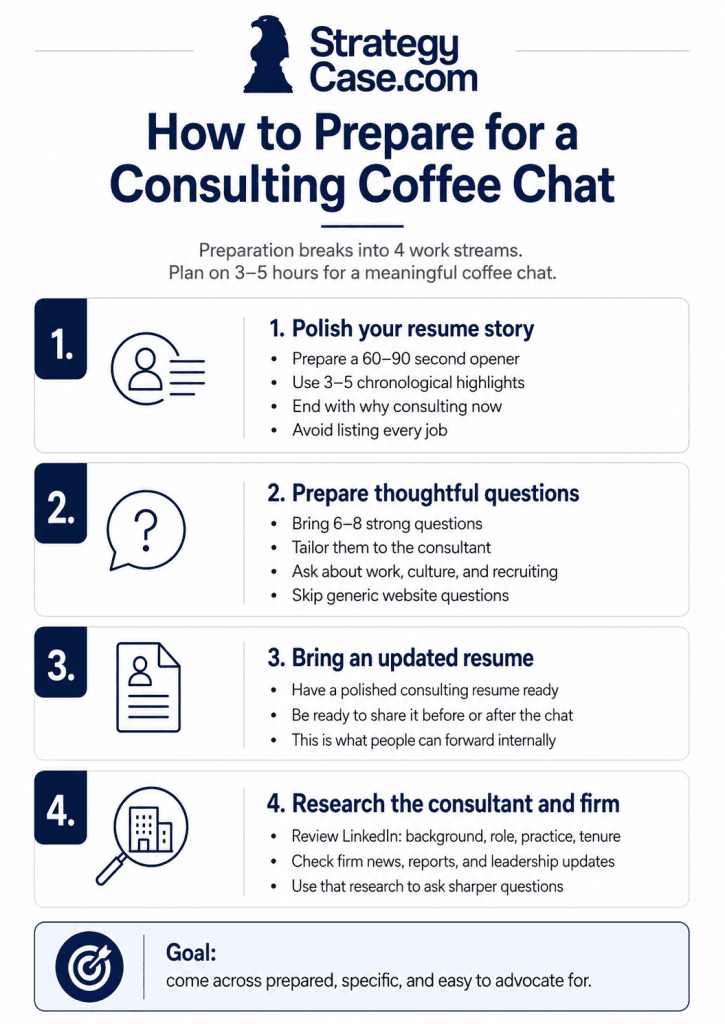
Preparation breaks into four work streams. Plan on 3-5 hours of preparation for a meaningful coffee chat (this is not a 30-minute task).
1. Polish your “walk me through your resume” answer
This is the opener of 90%+ of coffee chats. Your answer should be 60-90 seconds, structured chronologically through 3-5 highlights, ending with why you are interested in consulting now. Practice this until it feels natural, not memorized, but smooth.
A typical structure:
- Education: 10-15 seconds (what you studied, why, one notable thing)
- Role 1 (most recent or most relevant): 25-30 seconds (what you did + one quantified achievement)
- Role 2: 20-25 seconds (same format)
- Why consulting now: 15-20 seconds (specific aspects of the work that appeal)
Avoid: chronological listing of every job, generic “I want to learn business” framing, mentioning compensation or exit opportunities as motivators.
2. Prepare 6-8 thoughtful questions of your own
Many candidates underprepare here, which is a missed opportunity. The questions you ask reveal how much you have thought about the firm and the role.
The single biggest improvement to your questions: tie each question to the specific consultant you are talking to. Instead of “What are the future trends at McKinsey?” ask “What types of projects are you personally working on right now, and how have they changed over the past 12 months?”
Strong question categories with examples:
About the consultant’s experience:
- When you first joined, what aspects surprised you most?
- Can you share an experience with a project team that really stood out, and why?
- What’s the biggest lesson you’ve learned in your time at [firm]?
About the work itself:
- What types of projects are you working on this year?
- How has the day-to-day work shifted with hybrid models and AI tooling?
- What’s the balance between strategy work and implementation work in your practice?
About culture and fit:
- What kind of person tends to do well at [firm]?
- What’s different about the [city] office specifically?
- How does your firm think about work-life balance vs delivery?
About the application process:
- Are there any on-campus events or info sessions you’d recommend I attend?
- Is there anything in particular you’d suggest I focus on as I prepare?
Skip: questions that you could have answered with 10 minutes on the firm’s website. Skip generic “what’s the future of consulting” questions.
3. Update and bring your resume
Have a polished, current version of your consulting resume ready to share, by email before the chat (helpful but not required) or available for sharing immediately after. If the consultant asks for it to forward to recruiting, you do not want to hand them a half-finished or outdated draft.
This is the single highest-use prep item that most candidates underweight. A polished resume is the artifact the consultant uses to advocate for you internally.
4. Research the consultant and the firm
Spend a few minutes on the consultant’s LinkedIn. Note: their educational background, prior roles, current practice area, any published thought leadership, and how long they have been at the firm. Use this information to ask informed, specific questions during the chat.
Spend 20-30 minutes on the firm’s recent news, latest published reports, and any recent leadership announcements. Demonstrating that you know what’s happening at the firm signals genuine interest.
How to Ask for a Referral
This is the single most important moment in the coffee chat, and the part most candidates handle poorly.
The goal: Get the consultant to volunteer a referral (best), or to agree to refer you when you formally apply (good), or to introduce you to the right recruiter (still useful).
The framework: Ask explicitly, but indirectly, near the end of the conversation. Do not ask in the first 10 minutes. Do not be aggressive. Do not be coy.
Three phrasings that work:
1. The information-gathering phrase: “Are referrals common at your firm? I want to make sure I follow the right process when I apply.”
This phrasing is low-pressure. If the consultant says yes (which they almost always will), you have opened the door for them to volunteer the referral. If they don’t volunteer, you can follow up with “Would you be open to referring me when I submit my application?”
2. The explicit ask: “I’m planning to apply in [month/cycle]. Would you be willing to refer me when I submit?”
This is direct and respectful. Most consultants who had a positive conversation with you will say yes. Some will say “Yes, send me your resume and I’ll submit it through our internal referral system.” Others will say “Send me a heads-up when you apply, and I’ll mark you in the system.”
3. The general-help phrase: “Is there anything you could help me with that would strengthen my application?”
This is broader than just a referral. It often produces an offer of a referral, but it can also surface other help (introductions to other consultants, advice on a specific interview round, recommendations on case prep). Strong consultants who like you will frequently volunteer multiple kinds of help.
Timing: Ask in the last 5-10 minutes of the conversation. Asking too early signals that the referral is the only thing you wanted from the chat (which it functionally is, but you should not appear to be transactional). Asking too late means you ran out of time.
If the consultant says no or hesitates: Take the no gracefully. “Of course, I understand, thank you for being honest. Is there anything else you’d suggest I focus on as I prepare?” Then continue the conversation naturally. A reluctant consultant who reports back positively about your composure can still help your application meaningfully.
For the full referral-getting process beyond coffee chats, see how to get a referral for McKinsey, BCG, or Bain.
What to Wear and How to Show Up
For virtual coffee chats:
- Business casual minimum: collared shirt, sweater, blazer optional. Solid colors.
- Background: clean, minimal, well-lit. A bookshelf or plain wall is fine; a cluttered bedroom is not.
- Camera at eye level: position your laptop so the camera is roughly at eye level (use a stack of books if needed). Looking down into your camera is a subtle but real negative signal.
- Audio: use a headset or AirPods if possible. Laptop microphones pick up echo and background noise.
- Lighting: face a window or a lamp. Backlit silhouettes are a common error.
For in-person coffee chats at the office:
- Business formal: suit (navy or dark grey), white or light blue shirt, conservative tie for men, blazer-and-blouse or professional dress for women.
- Polished shoes: leather, recently shined.
- Arrive 5-10 minutes early: not earlier (annoying), not on the dot (signals lateness risk).
For in-person at an on-campus recruiting event:
- Business casual to business formal depending on the event’s stated dress code.
- When in doubt, overdress slightly.
The dress code is a screening signal, not because it’s directly evaluated, but because candidates who get it wrong signal that they have not done basic research about consulting culture.
Common Mistakes That Quietly Disqualify Candidates
After hundreds of coffee chats (as a consultant for McKinsey and later on in mock interviews and hiring decisions of my own), here are the patterns that produce negative consultant feedback:
1. Generic “why consulting” answers. “I want to learn business and have impact” is the equivalent of saying nothing. Have 2-3 specific reasons tied to the work itself.
2. Treating the chat as an interview. The chat is informal by design. Candidates who answer questions in stiff, over-rehearsed paragraphs come across as nervous and uncalibrated to consulting culture.
3. Not asking questions, or asking generic ones. Walking in with no questions or with Google-able questions signals low effort.
4. Asking for too much. Asking the consultant for “advice on every step of the application,” requesting a 1-hour follow-up call, or asking them to review your resume in detail are all asks that exceed the implicit social contract of a 30-minute chat.
5. Talking down or pressing too hard for the referral. Asking “So can I count on a referral?” in the first 10 minutes, or pushing back when a consultant gives a soft no, both produce immediate negative feedback.
6. Being late or disorganized. Logging in 2 minutes late to a 30-minute chat costs you 7% of your conversation time and signals poor preparation. Always log in 1-2 minutes early.
7. Not following up. Failing to send a thank-you email within 24 hours signals that the chat was not important to you. Consultants who do not get follow-ups occasionally forget to flag the candidate to recruiting.
8. Hiding gaps or controversial career choices. Consultants are skilled at spotting inconsistency. If your CV has an unexplained 9-month gap, address it briefly and confidently rather than glossing over it.
Follow-Up Etiquette After a Coffee Chat
Within 24 hours: Send a thank-you email. 4-6 sentences. Reference one specific thing from the conversation (a piece of advice, a project they mentioned, an observation about the firm), confirm any next steps (when you’ll apply, what you’ll follow up on), and reiterate genuine interest in the firm.
Example template:
Hi [Name], thank you for taking the time to chat today. I particularly appreciated your perspective on [specific topic from chat], it gave me a much clearer sense of how [firm] approaches [practice/work type]. As we discussed, I’ll plan to submit my application in [month] and will keep you posted. Please let me know if there’s anything I should be doing in the meantime. Thanks again, [Your name]
Within 48 hours: Connect on LinkedIn with a personalized message referencing the chat.
2-3 weeks later (only if no formal application has happened yet): A brief light-touch update. Something like “Quick update, I’ve submitted my application as of [date]. Wanted to keep you in the loop. Thanks again for the conversation.”
Every 2-3 months through the recruiting cycle: Optional but valuable. Light-touch updates on your progress (you started case prep, you completed a specific milestone, you have an interview scheduled). Do not over-message, every 2-3 months is the right cadence.
Firm-by-Firm Differences in MBB Coffee Chats
The three MBB firms run coffee chats with slightly different conventions in 2026.
McKinsey: Most structured of the three. McKinsey often pre-schedules coffee chats with specific candidates the recruiter has flagged, lasting exactly 30 minutes. The consultant typically has been briefed on your background. McKinsey consultants are slightly more likely than BCG or Bain to ask brief fit-interview-style questions in the coffee chat. References to PEI dimensions (Connection, Leadership, Drive, Growth) sometimes surface even at this informal stage.
BCG: Slightly more informal in tone, with longer average duration (often 35-45 minutes). BCG consultants are more likely to share their own experience in detail and slightly less likely to dig into your fit story. BCG coffee chats often include more conversation about specific case types and BCG’s approach to candidate-led case interviews.
Bain: The most informal of the three by feel, and the most explicitly oriented toward culture fit assessment. Bain consultants frequently emphasize the “Bainie” cultural concept (teamwork, intellectual humility, fun) and observe how naturally you fit into a conversation. Bain coffee chats often run shorter (25-30 minutes) but are more deliberately evaluating cultural compatibility.
Tier-2 strategy firms (LEK, Oliver Wyman, Roland Berger, Kearney, Strategy&): Generally follow the same pattern as MBB but with slightly more flexibility on the structure. These firms often use coffee chats earlier in the recruiting funnel as a soft pre-screen before formal application.
Big 4 strategy practices (Monitor Deloitte, Strategy&, EY-Parthenon, KPMG Strategy): Coffee chats are less standardized. They may take the form of “informational interviews” coordinated through campus career services or directly via LinkedIn outreach. The bar for getting a coffee chat is lower; the bar for converting it to a referral is higher.
Setting Up Your Own Coffee Chat
If a consulting firm has not proactively offered you a coffee chat, you can initiate one yourself. The success rate is meaningful, roughly 15-30% of cold outreach to consultants on LinkedIn produces a coffee chat acceptance, but the effort is non-trivial.
The approach that works:
- Identify the right consultant. On LinkedIn, search for consultants at the firm and office you are targeting, ideally at the Senior Associate / Senior Consultant / Engagement Manager level (more senior consultants are too busy; more junior consultants have less influence). Look for shared background signals: same university, same prior employer, same hometown, same major.
- Send a brief, specific outreach message. Maximum 100 words. Identify the shared background signal explicitly. State why you are reaching out (interest in [firm], application planned for [month]). Ask specifically for a 20-30 minute conversation about their experience at the firm.
- Send 20-30 outreach messages to reach 5-10 productive coffee chats. Cold outreach has a base rate of 25-50% positive response, so you need volume to produce meaningful results.
- Follow up once if no response. A single follow-up after 10-14 days lifts your response rate. Two or more follow-ups are pushy and produce negative signals.
- Attend on-campus events and office visits. Some of the highest-quality coffee chats come from in-person events where you naturally meet consultants. Always follow up via LinkedIn within 48 hours after meeting someone in person.
The combination of proactive outreach plus reactive availability (attending events the firm holds) typically produces enough coffee chat opportunities for a serious candidate during the recruiting cycle.
Frequently Asked Questions
What is a consulting coffee chat?
A consulting coffee chat is a 25 to 45 minute informal conversation with a consultant at a firm like McKinsey, BCG, or Bain, used by the firm to assess your fit and by you to learn about the firm and secure a referral. Most coffee chats are conducted virtually via Zoom or Teams, last 30 minutes on average, and influence whether you advance to the formal interview stage.
How long does a consulting coffee chat last?
Most consulting coffee chats are 30 minutes. The range is typically 25-45 minutes. Shorter chats (25 minutes) happen when consultants squeeze the meeting between client commitments. Longer chats (45-60 minutes) happen when the consultant is genuinely interested in the candidate or has unusual free time.
What questions do consultants ask in a coffee chat?
Coffee chat questions fall into three categories: basic background questions (walk through your resume, why consulting, why this firm, almost always), deeper fit-interview-style questions (tell me about a leadership experience, a failure, a setback, sometimes), and rarely, mini-case questions like market sizing exercises. The basic questions appear in nearly every chat; fit questions in maybe half; case questions in roughly 1 in 10.
Should I ask for a referral in a coffee chat?
Yes, but indirectly and in the last 5-10 minutes of the conversation. Three phrasings work: “Are referrals common at your firm?” (low-pressure information-gathering), “Would you be willing to refer me when I apply?” (direct and respectful), or “Is there anything you could help me with that would strengthen my application?” (broader ask). Most consultants who had a positive conversation will volunteer to refer when asked properly.
What should I wear to a consulting coffee chat?
For virtual coffee chats: business casual minimum (collared shirt, sweater, optional blazer) with a clean background and good lighting. For in-person at the office: business formal (suit, white or light blue shirt, polished shoes). For on-campus events: business casual to formal depending on the event’s dress code. When in doubt, overdress slightly.
How do I prepare for a McKinsey coffee chat?
McKinsey coffee chats are slightly more structured than BCG or Bain. Prepare a polished 60-90 second resume walkthrough, 6-8 thoughtful questions tied to the specific consultant’s experience, and structured fit stories (consultants occasionally probe McKinsey PEI dimensions even at the coffee chat stage). Research the consultant on LinkedIn for 20-30 minutes before the chat. Have your updated consulting resume ready to share.
Are consulting coffee chats actually interviews?
Technically no, practically yes. The chat is deliberately informal in tone but the consultant provides feedback to recruiting after the conversation. This feedback meaningfully influences whether you reach the formal interview stage. Treating the coffee chat as low-stakes is one of the most common mistakes candidates make.
How many coffee chats should I do per firm?
For MBB firms specifically, 2-3 coffee chats per firm is a reasonable target. One with a Senior Associate or Senior Consultant who can share day-to-day perspective, one with an Engagement Manager or Project Leader who can share career trajectory insight, and ideally one with a Partner or Associate Partner who can provide senior-level perspective. Avoid having more than 5-6 coffee chats per firm, the marginal value drops and you start to look opportunistic.
What is the difference between a coffee chat and a fit interview?
A coffee chat is informal, 30 minutes typical, low-stakes in tone but high-stakes in outcome (the consultant provides recruiting feedback). A fit interview is formal, part of the structured interview round, typically 30-45 minutes, and scored against specific dimensions (leadership, personal impact, entrepreneurial drive, courageous change at McKinsey; comparable dimensions at BCG and Bain). The coffee chat is pre-recruiting; the fit interview is during recruiting.
How do I follow up after a consulting coffee chat?
Within 24 hours, send a thank-you email referencing one specific thing from the conversation, confirming next steps, and reiterating genuine interest in the firm. Connect on LinkedIn within 48 hours with a personalized message. Send a brief application update 2-3 weeks later when you formally apply. Stay in periodic light touch (every 2-3 months) through the recruiting cycle.
The Bottom Line
A consulting coffee chat is one of the highest-use 30-minute investments in your MBB recruiting process. Done well, it produces a referral that lifts your application screening odds by 3-5x and gives you a current consultant who advocates for you internally. Done poorly, it produces a quiet negative signal that meaningfully hurts your chances, and you may never know it happened.
The candidates who consistently convert coffee chats into referrals share three traits: they show up prepared (resume polished, questions ready, consultant researched), they treat the chat as a real conversation rather than an interview (curious, engaged, authentic), and they ask explicitly for the referral near the end without making the entire conversation feel transactional.
If you want a structured plan for the full MBB recruiting cycle, including coffee chats, networking, fit interview preparation, and case interviews, book a 1-on-1 coaching session. For broader context on the application process, see GPA requirements for McKinsey, BCG, and Bain, MBB target schools, and how to get a referral for McKinsey, BCG, or Bain.
A coffee chat that goes well is the closest thing to a free pass through CV screening that exists in MBB recruiting. Treat it with the seriousness it deserves.
About the author: Florian Smeritschnig is a former McKinsey Senior Consultant and the founder of StrategyCase. He spent five years at the firm and has since run more than 2,200 mock case interviews and coached hundreds of candidates into McKinsey, BCG, Bain, and other top firms.
