

Updated July 2026 · By Florian Smeritschnig, former McKinsey Senior Consultant
To answer “Why consulting?”, lead with the work itself, the variety of problems, the speed of learning, and early exposure to senior leaders, then back it with a specific example from your own experience and connect it to why you want that firm. Keep it to 60 to 90 seconds, and never build the answer around money, prestige, travel, or exit opportunities.
Most candidates treat “Why consulting?” as a throwaway. They recite the same three reasons everyone gives, and they sound rehearsed and interchangeable. That is a problem, because this question is a screen. In my years evaluating candidates and interviewing candidates, a brilliant answer almost never won someone the offer, but a generic or self-serving one planted a doubt that followed the candidate through the rest of the interview.
This guide shows you what interviewers actually check, a simple framework to build your answer, example answers with the reasoning behind them, and the McKinsey wrinkle most guides miss. It comes from evaluating candidates at McKinsey and coaching more than 700 people into McKinsey, BCG, and Bain through StrategyCase and PrepLounge.
Key Takeaways
- “Why consulting?” is a downside screen. A strong answer rarely wins the offer on its own, but a generic or materialistic one costs you credibility for the rest of the interview.
- Lead with the work: the variety of problems, the steep learning curve, early exposure to senior leaders, and real client impact. Never lead with pay, prestige, travel, or exit options.
- Use Pull, Proof, Path: what genuinely pulls you toward consulting, proof of that pull from your own experience, and the path this specific firm puts you on.
- “Why this firm?” is won in the research. Name specific work, a value you actually share, and ideally a person at the firm you have spoken to.
- McKinsey usually does not test this inside the PEI. It might come up as a quick ice-breaker question.
What “Why Consulting?” Is Really Testing
Interviewers use this question to check four things at once: whether you understand what consulting work actually involves, whether your motivation is genuine, whether you can give a clear and structured answer under mild pressure, and whether you are likely to stay.
Here is the part most guides skip. When I interviewed candidates, I was not scanning for the “best” reason to join consulting. I was scanning for red flags.
A thoughtful answer rarely moved a candidate from a maybe to a yes. But a weak one, all prestige and no substance, or a vague “I like solving problems,” made me wonder whether the person had really thought about the job or was applying because everyone else in their cohort was. That doubt then colored how I read the rest of their fit answers.
So treat this question as risk management. Your goal is not to dazzle. Your goal is to sound like someone who knows exactly what they are signing up for and genuinely wants it.
Two more things worth knowing:
- The question comes in variants: “Why do you want to work in consulting?”, “Why did you choose consulting?”, and “Why consulting and not banking or industry?” The core answer is the same; only the framing shifts.
- It almost always pairs with “Why our firm?” Prepare them together, because a strong “why consulting” that falls apart on “why this firm” is worse than an average answer to both.
The Pull, Proof, Path Framework
Every convincing answer I have heard does three things in order. I teach candidates at StrategyCase to build theirs the same way, using a structure I call Pull, Proof, Path.
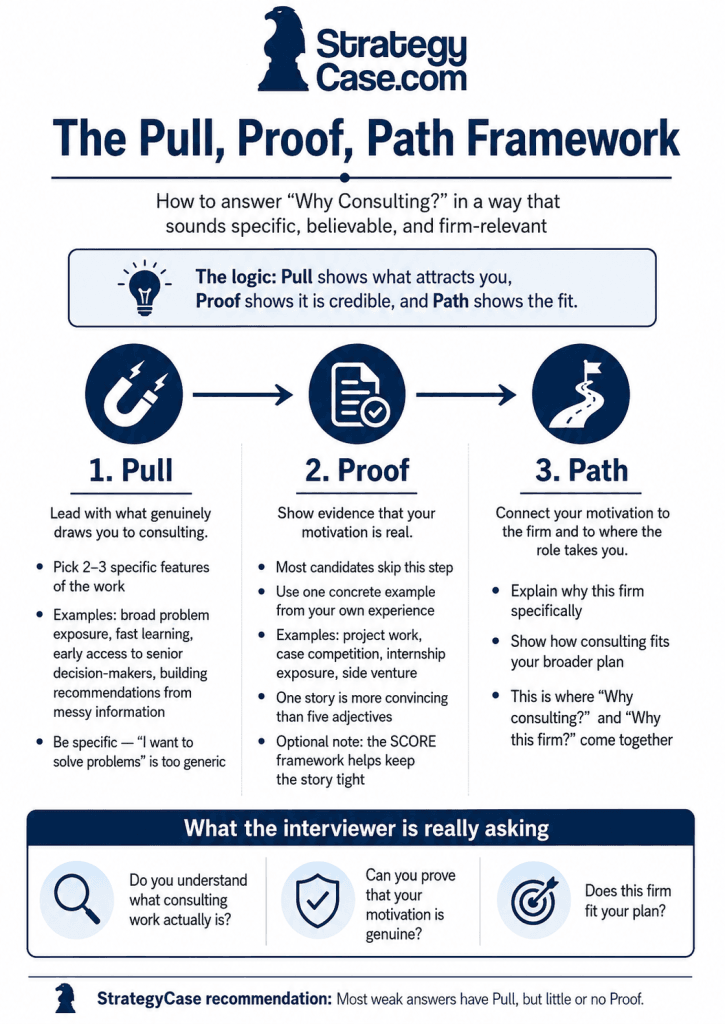
The Pull, Proof, Path framework: lead with what pulls you to the work, prove it with your own experience, then connect it to the firm’s path. Most candidates do all Pull and no Proof, which is why their answers sound generic.
Pull: what genuinely draws you to the work. Pick two or three specific features of consulting that actually appeal to you: the range of industries and problems, the pace at which you learn, working directly with senior decision-makers early, or building a recommendation from messy, incomplete information. Specific beats broad. “I want to solve problems” is true of almost every job.
Proof: evidence that the pull is real. This is the part most candidates skip, and it is what separates a believable answer from a scripted one. Point to something in your own history that shows the pull is genuine: a project where you loved untangling a hard problem, a case competition, an internship where you shadowed a consulting team, or a side venture where you had to learn a new domain fast. One concrete story does more than five adjectives. If you want a clean way to tell that story, the SCORE framework keeps it tight.
Path: why this firm and where it takes you. Close by connecting your motivation to the specific firm and to where you want to go. This is where “Why consulting?” and “Why this firm?” meet, and I cover the firm-specific part in its own section below.
Put together, the three parts answer the real question behind the question: do you know what this work is, can you prove you want it, and does this firm fit your plan?
Why Consulting? Reasons That Actually Land
When candidates ask me which reasons are “safe,” I push back on the framing. There is no magic reason. There are reasons you can back with evidence and reasons you cannot. These land because they map to what the job actually is:
- The variety of problems. Consultants switch industries and problem types every few months. If you get bored doing the same thing, this reason is genuine and easy to prove with your own restlessness.
- The learning curve. You are expected to get up to speed on a new business in days. Candidates who love learning fast, and can show it, are credible here.
- Early exposure to senior leaders. Few jobs put a 23-year-old in a room with a client’s executives. If proximity to real decisions motivates you, say so.
- Client impact and problem ownership. You watch your analysis turn into decisions worth millions. Tie this to a time you cared about the outcome of your work, not just finishing the task.
- Skill building for what comes next. It is fine to want the toolkit consulting builds, structuring, communication, and commercial judgment, as long as you frame it as building toward a goal rather than fleeing toward an exit.
To make these reasons more convincing, it helps to understand why companies hire management consultants in the first place. The better you grasp the value consultants create, the more specific your “why” becomes.
What Not to Say (And Why Interviewers Catch It)
Some reasons are true for almost everyone and disqualifying to say out loud. Interviewers hear them constantly, and each one signals a specific risk:
- Money, prestige, or travel perks. These say you are here for what consulting gives you, not for the work. Everyone knows the pay is good; leading with it tells the interviewer you will leave the moment a better-paying option appears.
- Exit opportunities. “Consulting opens doors” was one of the most common answers I heard, and one of the weakest. It tells the firm you see the job as a two-year layover before your real career. Firms invest heavily in first-year training and want people who might stay.
- Resume or brand building. Wanting McKinsey or BCG on your CV is not motivation for the work. It is motivation for the logo.
- Indecision. “I am not sure what I want to do, and consulting keeps my options open” is honest and fatal. It reads as a lack of direction.
- MBA sponsorship or benefits. Naming the perks of the package as your reason makes you sound transactional.
Here is the subtle version interviewers are trained to catch. Most candidates know not to say “money,” so they dress it up. “I want to work on high-impact problems,” delivered with no example underneath, is prestige-seeking in a nicer suit.
The fix is always the same: proof. A reason you can back with a story from your own life reads as genuine; a reason you only assert reads as rehearsed.
“Why This Firm?” Going Beyond the Website
“Why our firm?” is where most answers collapse into interchangeable praise: “You have a great reputation, smart people, and interesting clients.” Every firm has those. None of it distinguishes you.
Strong firm answers are built from research the average candidate does not do:
- Specific work. Name a practice area, a type of engagement, or a published piece of the firm’s thinking that genuinely interests you, and say why. Read the actual McKinsey, BCG, and Bain careers and insights pages rather than repeating what everyone says about them.
- A value you actually share. Firms differ in culture: one leans analytical and top-down, another more collaborative and hands-on. Pick a difference that is real to you and connect it to how you work.
- People. The strongest firm answers name a person. “I spoke with two consultants at your Munich office, and the way they described the team pushed me toward you” is almost impossible to fake and instantly credible. This is one more reason networking before you apply pays off.
The test for any “why this firm” reason: could you say the exact same sentence about the other two MBB firms? If yes, it is not a reason, it is filler.
The McKinsey Exception: When “Why Consulting?” Is Not Asked Directly
Here is something most “Why consulting?” guides get wrong: McKinsey often does not ask the question directly in the fit interview.
McKinsey’s fit interview runs on the Personal Experience Interview (PEI), a structured deep look into a few of your real stories around themes like personal impact, leadership, and drive. A blunt “Why consulting?” or “Why McKinsey?” is not a standard part of that format the way it is at BCG and Bain.
That does not mean you can skip the preparation. Your motivation for consulting still has to come through, woven into your stories and any informal conversation with your interviewer, and it can surface in the values and purpose conversation some interviewers open with. BCG and Bain, by contrast, ask “Why consulting?” and “Why our firm?” much more explicitly, so prepare a clean spoken version for them.
The practical takeaway: build the substance of your answer regardless of firm, but expect to deliver it as a set piece at BCG and Bain and as an undercurrent at McKinsey.
Example Answers (With What Makes Them Work)
“Why Consulting?”: Student or Recent Graduate
“During my finance internship, the part I looked forward to was a three-week stretch where we had to figure out why a product line was losing money. I liked pulling that problem apart more than the finance work itself. Consulting is that, permanently: a new problem every few months, in a new industry, with people who are better than me at it. I want the steepness of that learning curve early, and I want to build the structuring and communication skills that come from doing it under pressure.”
Why it works: it opens with a real experience (Proof), names specific features of the work (Pull: variety and learning), and frames skill-building as ambition rather than an exit plan. No prestige, no “opens doors.”
“Why This Firm?”: Any Level
“Two things pulled me toward Bain specifically. First, your results focus and the answer-first way your teams work matches how I like to think; I get to the recommendation and then build the support. Second, I spoke with a consultant in your London office (use her name), who walked me through a retail turnaround she led, and the ownership she had two years in was exactly the responsibility I am looking for.”
Why it works: it names a real cultural difference and ties it to how the candidate works, then names a specific person and engagement. You could not paste this answer onto a different firm.
“Why Consulting?”: Experienced Hire
If you are switching in from industry, your answer should lean harder on Proof, because you have more of it. “After six years in operations, I noticed the projects I fought to be staffed on were always the cross-functional, ambiguous ones. I want to do that full time, across companies, instead of once a year.” Experienced hires who connect consulting to a genuine pattern in their career are far more convincing than those who recite the same reasons a 22-year-old would.
How to Deliver It: Structure, Length, and Energy
A good answer delivered badly still costs you. Focus on three things:
- Structure it top-down. State your reasons first, then expand. “I want to move into consulting for two reasons. First, the variety. Second, the pace of learning.” This signposting is the pyramid principle applied to a fit answer, and it is exactly the structured communication interviewers are scoring.
- Keep it to 60 to 90 seconds. Long enough to show substance, short enough to leave room for follow-ups. If you are still talking at two minutes, you are rambling.
- Sound like you mean it. Interviewers read tone and body language as much as words. A reason you actually believe carries energy on its own. If you are naturally reserved, push your energy slightly above your comfort level, because flat delivery reads as low interest.
One warning: do not over-rehearse to the point of sounding memorized. Know your two or three reasons and your proof story cold, but let the exact wording come out fresh. A word-perfect recitation is easier to distrust than a slightly imperfect answer that clearly comes from a real place.
Frequently Asked Questions
How do you answer “Why consulting?” in an interview?
Lead with the work: the variety of problems, the speed of learning, and early exposure to senior leaders. Back it with a specific example from your own experience that shows the interest is real, then connect it to the firm. Keep it to 60 to 90 seconds and avoid pay, prestige, and exit opportunities.
Why do you want to work in consulting? (sample short answer)
“Because I want to work on a new, hard problem every few months rather than the same one for years, and consulting is the one job built around that variety, surrounded by people I will learn from fast.” Then add one sentence of proof from your own background.
What should you not say when asked “Why consulting?”
Avoid money, prestige, travel perks, exit opportunities, resume or brand building, indecision (“keeping my options open”), and MBA sponsorship. Each one signals that you are there for what consulting gives you rather than the work itself.
Does McKinsey ask “Why consulting?”
Usually not directly. McKinsey’s fit interview runs on the Personal Experience Interview, which digs into your real stories rather than asking “Why consulting?” or “Why McKinsey?” outright. You still need the motivation ready, because it surfaces inside your stories and any informal conversation. BCG and Bain ask the question much more explicitly.
How long should your “Why consulting?” answer be?
Aim for 60 to 90 seconds. State your reasons top-down, expand each briefly with a piece of proof, and stop. Anything past two minutes starts to sound like rambling and eats the time your interviewer wants for follow-ups.
Why consulting and not investment banking or industry?
Name what consulting offers that the alternative does not: breadth of problems and industries versus the narrower focus of banking or a single company, and the pace of learning that comes from constant new contexts. Keep it about what pulls you toward consulting, not what you dislike about the other path.
Answer Every Fit Question With Confidence
“Why consulting?” is one question in a fit interview that will also test your leadership stories, your failures, your resume, and your reasons for the firm. Confidence across all of them comes from the same place: clarity on what each question checks, a structure to build your answer, and enough practice that it sounds like you.
That is what the StrategyCase Consulting Fit Interview Masterclass is built to do. It walks through every common fit question, including “Why consulting?” and “Why our firm?”, with the structures and examples I developed from evaluating hundreds of candidates and getting them into MBB. If you want direct feedback on your own answers, one-on-one coaching gives you a mock fit interview with a former McKinsey consultant.
Related Guides
- Consulting Fit Interviews: The Only Guide You Need
- How to Answer “Tell Me About Yourself”
- Strengths and Weaknesses in a Consulting Interview
- Provide an Example Where You Led a Group to a Difficult Goal
About the author: Florian Smeritschnig is a former McKinsey Senior Consultant and the founder of StrategyCase.com. He spent 5 years at McKinsey, and has since delivered 2,200+ mock interviews and coaching sessions, helping 700+ candidates land offers at McKinsey, BCG, Bain, and other top firms.
