
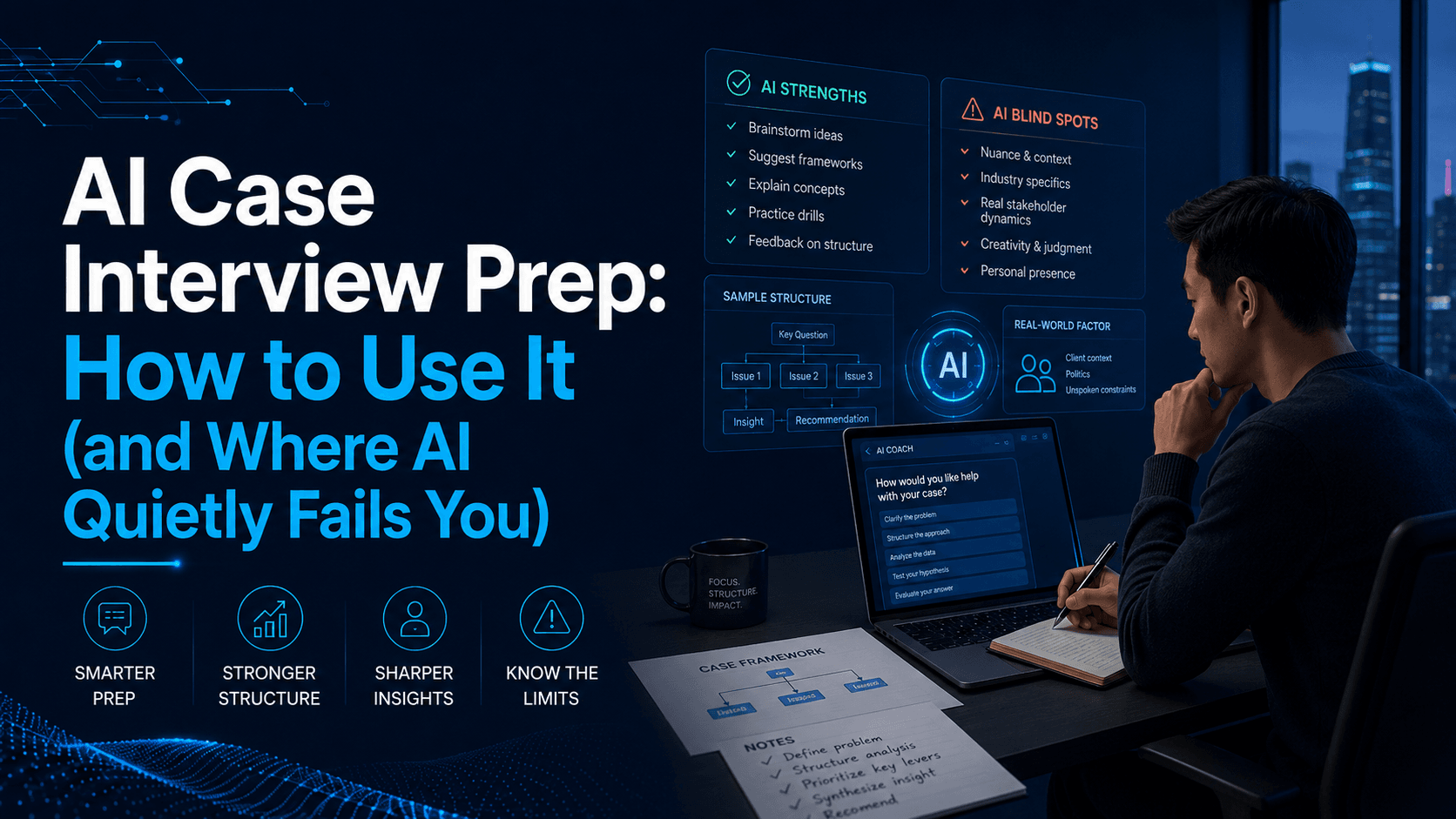
By Florian Smeritschnig, former McKinsey Senior Consultant. Updated July 2026.
You have been running cases with ChatGPT for weeks. The frameworks look clean, the answers sound polished, and you feel like you are improving faster than you ever did with a book. You are probably building the wrong muscle.
AI is genuinely useful for parts of case prep, but used the way most candidates use it, it trains you to sound like the average of every case answer on the internet, which is exactly the profile interviewers filter out.
After evaluating candidates at McKinsey and coaching 700+ into MBB offers, here is what AI does well, where it fails you, and the workflow that actually works.
Key Takeaways
- “AI case interview prep” usually means practicing cases with AI tools, not an interview run by a robot. Both exist. This guide covers both.
- AI is strong for drilling, blindspot-hunting, and communication reps. It is weak at the one thing interviewers score hardest: prioritized, tailored structure.
- The core risk is the illusion of progress. Polished output feels like skill and is not.
- Use AI after you structure, never before. The 5-step AI-safe workflow below keeps the judgment in your head.
- Some real interviews are now AI-conducted (McKinsey, Bain). That raises the bar for structure, it does not lower it.
What Is an AI Case Interview?
An AI case interview refers to two different things: using AI tools (ChatGPT, case simulators, AI coaches) to practice case interviews, or a live interview conducted or screened by an AI system. Most people searching the term mean the first. Firms like McKinsey and Bain are piloting the second.
Both meanings matter, so keep them separate in your head.
The first is a prep method: you rehearse cases against a chatbot or an AI case simulator that generates prompts, exhibits, and feedback. That is what this guide is mostly about, because that is where candidates are quietly sabotaging themselves.
The second is a format: the interview itself involves AI, from an AI-led problem-solving conversation to an automated screen before a human round. If that is what you are here for, read how AI now sits in the consulting interview for the big picture, then the firm-specific playbooks for McKinsey and Bain further down. The rest of this article makes you better at both, because both reward the same thing: structure you own.
The Illusion of Progress in AI Case Prep
The ease and speed of AI prep create a dangerous feeling: progress without substance. Ask an AI tool to structure a case and it returns a clean, logical framework in seconds. It reads well and feels right. That feedback loop quietly swaps one thing for another. You start producing better-looking answers without building better thinking.
Here is the part most candidates miss. AI tools are trained on a huge average of public case-prep material and generic business frameworks built by authors who have never worked in consulting (e.g., Cosentino with Case in Point). They are not trained on real MBB interviewer logic, the evaluation criteria partners actually use, or the judgment calls that separate a strong performance from a weak one (because they are confidential and not public).
What you get is the wisdom of the crowd: a smoothed-out version of what a framework should look like, not what makes an interviewer lean in. Remember. 99% of consulting applicants fail, which is exactly why the wisdom of the crowd is the wrong source for your case prep!
So AI is excellent at output quality and blind to input quality. You can generate a passable MECE structure without understanding why those buckets matter, how they connect, or why they fit this problem. That is the hidden tax of AI-assisted prep. It trades speed for skill, polish for capability, and generic competence for the sharpness that earns offers.
What Interviewers Actually Evaluate
Interviewers are not mainly checking whether you reach the right answer. They are reading how you think, and specifically whether you think the way consultants think.
Structure is the primary signal, but not just any structure. Interviewers want structure that shows judgment: the ability to isolate the few dimensions that drive the problem and commit to them fast. They want to see you choose what matters most.
This is where AI frameworks fail you. Because AI draws from broad averages, it produces balanced structures that cover every base. In the room, that reads as generic and unfocused. The AI framework says “let us look at customers, competitors, company, and market.” The candidate who gets the offer says “this is a mature B2B market with high switching costs, so I want to start with retention economics before we touch acquisition.” One shows judgment. The other shows recall.
When I evaluated candidates, I could usually tell inside the first two minutes who had built their structure themselves and who was reciting something they had absorbed. The tell was never polish. It was what happened when I pushed on a bucket and asked “why start there?”
Owners had a reason tied to the case facts. Reciters had a smoother version of the same generic tree. AI cannot teach you that difference, because it does not know the difference. It is averaging thousands of “decent” trees, not showing you what “exceptional” looks like to the person deciding your offer.
What AI Is Genuinely Good At, and What It Can’t Do
AI can accelerate real parts of your prep. It can also entrench the exact habits that get you dinged. The line is simple: AI amplifies structure you already have, and it cannot create the structure you don’t.
| AI is genuinely good at | AI cannot do for you |
|---|---|
| Hunting blindspots in a structure you already built | Building a prioritized structure from a vague prompt |
| Introducing common metrics and models in an unfamiliar industry | Making the judgment call on where to start and why |
| Reps on verbalizing and tightening your communication | Tailoring structure to the specific business situation |
| Stress-testing assumptions and generating counterarguments | Holding logic together under interruption and pressure |
| Drafting practice prompts and exhibits to drill against | Calibrating you to what a partner scores as exceptional |
Read the right column again. Every item is a judgment skill that only develops through live reps with real feedback, not through studying frameworks a tool produced with no time pressure and no pushback. AI optimizes for completeness. Interviewers reward prioritization. Those two goals point in opposite directions, which is why leaning on AI for structure trains the wrong instinct.
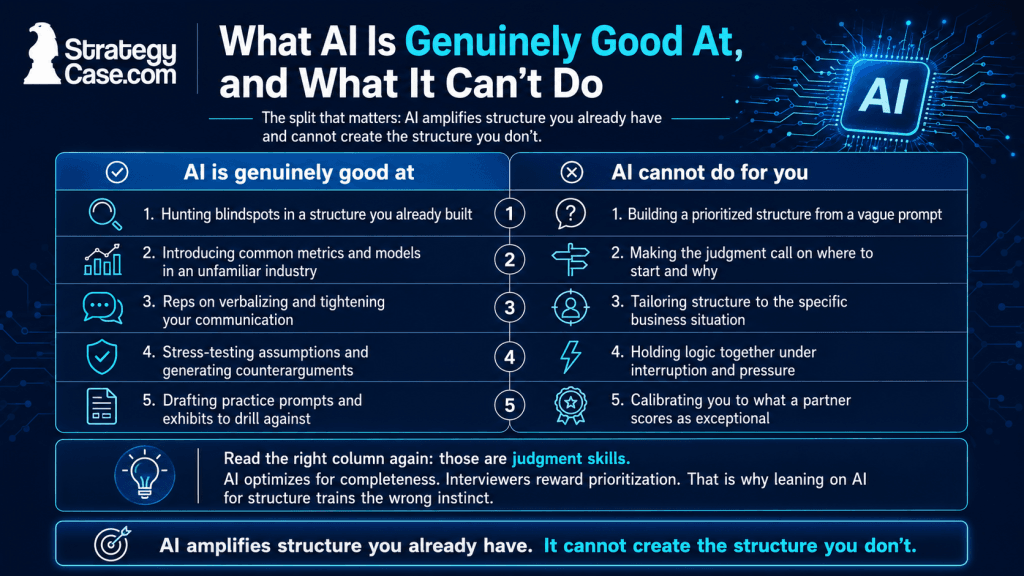
The split that matters: AI amplifies structure you already have and cannot create the structure you don’t.
The Hidden Failure Mode: Sounding Like Everyone Else
The most damaging pattern is one candidates rarely notice. They practice against AI, absorb its clean frameworks, repeat that across dozens of cases, and feel productive. What they have actually trained is the habit of thinking in the same averaged-out way the tool thinks, which is the opposite of how strong candidates think.
Interviewers see hundreds of candidates. They develop a sharp sense for “generic good” versus “genuinely sharp.” AI-generated frameworks sit squarely in generic good: logical, organized, mostly MECE, and forgettable. And the pattern collapses in the room, because when a partner hands you a prompt, you cannot open a chatbot.
You have to out-think the 20 other candidates they saw this month, and if all your prep trained you to think like an average, you sound like the average.
Watch for the symptoms interviewers use to spot AI-shaped prep:
- Over-broad frameworks: the same four buckets on every case instead of a sharp choice about what drives this one.
- Generic cuts: internal versus external, revenue versus cost, applied to any problem rather than this business.
- No prioritization: every branch presented as equally important, with no “I would start here, because.”
- Missing the insight: technically correct, but blind to the one detail that actually moves the case.
These are not random misses. They are the predictable output of prep that optimized for AI-validated frameworks instead of interviewer-validated thinking.
AI Case Interview Tools: What They Do and Where They Fall Short
Search “ai case interview” and you get a wall of tools: chatbots, case simulators, and AI coaches. They are not equally useful, and none of them replace the reps that build judgment. Here is how the categories actually differ.
| Tool type | Best for | Where it falls short |
|---|---|---|
| General chatbots (ChatGPT, Claude, Gemini) | Blindspot checks, counterarguments, communication reps, industry primers | Invents plausible-sounding structure; agrees with you too easily; no calibration to MBB standards |
| AI case simulators | Volume reps on prompts and exhibits, quick self-serve practice at any hour | Recycles a narrow set of case archetypes; scores completeness over judgment; feedback is generic (be careful: all products I have tried are not created by former consultants or interviewers but developers with no deep knowledge about case interviews) |
| AI feedback / coaches | A rough second opinion on clarity and logic gaps | Cannot see what a partner rewards; mistakes polish for insight; no accountability for your final structure (be careful: all products I have tried are not created by former consultants or interviewers but developers with no deep knowledge about case interviews) |
Two things to hold onto. First, an AI sparring partner is only as good as the pressure it applies, and most tools apply almost none, because they are built to be encouraging. Second, a simulator that hands you the same profitability and market-entry archetypes trains pattern-matching, which is the very reflex modern interviews are designed to defeat. Tools are fine as a drilling layer on top of real structure work.
They are dangerous as the foundation. For structure you can defend under pressure, work from real cases and feedback in the complete guide to case interviews and drill case interview frameworks the way interviewers actually test them.
How Top Candidates Use AI: The 5-Step AI-Safe Workflow
Strong candidates and struggling candidates both use AI. The difference is when, how, and with how much skepticism. The rule that separates them: structure first, AI second, always. Follow this sequence.
- Structure from first principles, tools closed. Take the prompt, close every AI tab, and build your own structure in a couple of minutes. Write it down. Commit to specific buckets, a priority, and a starting point before you look at anything.
- Verbalize and commit. Say the structure out loud as if a partner is across the table. Record yourself. This builds the performance muscle and exposes whether your structure sounds sharp or merely looks tidy on paper.
- Then bring in AI to attack it. Now open the tool. Share your structure and ask it to find gaps, propose alternatives, and pressure-test your assumptions. Read its feedback critically: is it pushing you sharper, or just safer and more generic?
- Rebuild from memory. Close the tool again and reconstruct your improved structure without looking. If you cannot, you did not internalize it, you copied it. Judge the result on judgment and insight, not neatness.
- Calibrate against real MBB standards. Compare your structure to real cases, and get feedback from someone who has seen what earns offers. This is the step AI cannot do, and it is the one that moves your ceiling. If you want that calibration directly, 1-on-1 coaching with a former McKinsey consultant is built for exactly this.
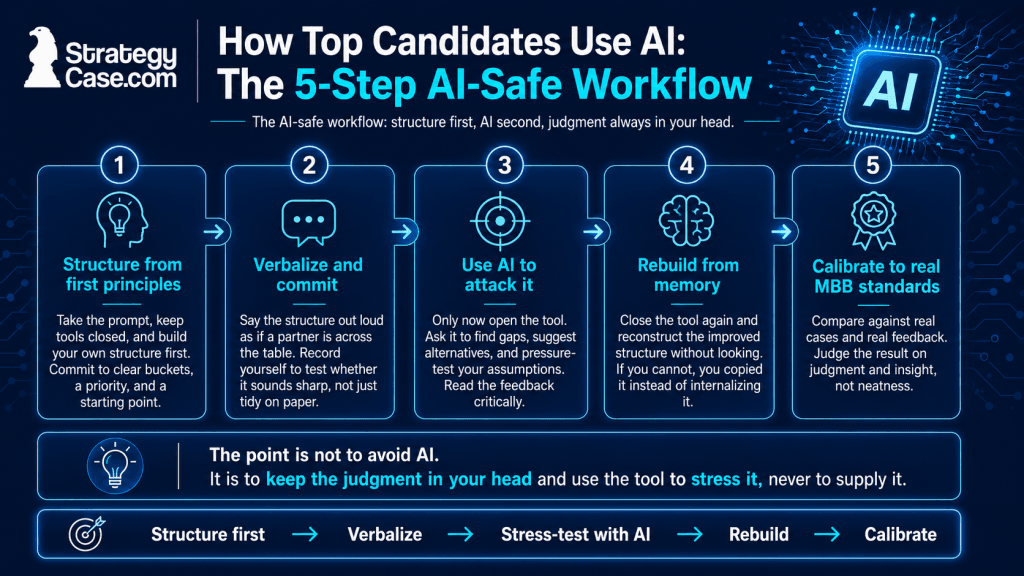
The AI-safe workflow: structure first, AI second, judgment always in your head.
The point is not to avoid AI. It is to keep the judgment in your head and use the tool to stress it, never to supply it.
Will Your Real Case Interview Be AI-Conducted?
Increasingly, part of it might be. Firms are piloting AI inside the actual process, from AI-led problem-solving conversations to automated screens ahead of human rounds. That does not make structure less important. It makes it more important, because an AI screen scores your reasoning without the benefit of the doubt a friendly human might extend.
If AI is in your interview loop, prepare for the format specifically. Go firm-specific with the McKinsey AI interview and the Bain AI interview guides. The prep habits in this article carry straight over: own your structure, prioritize out loud, and defend your reasoning when it is challenged.
AI Case Interview FAQs
Can I use ChatGPT to practice case interviews?
Yes, but only as a sparring partner after you have built your own structure. Use it to find gaps, generate counterarguments, and rehearse communication. Do not ask it to structure the case for you, because that trains you to reproduce generic frameworks instead of your own judgment.
Are AI case interview simulators worth it?
For raw reps and convenience, they can help. For building the judgment interviewers score, they are limited since they are usually built by industry outsiders with no interviewer or coaching experience. Most recycle a narrow set of case archetypes and reward completeness over prioritization. Treat a simulator as a drilling layer on top of real case work, not as your main preparation.
Can AI give me real feedback on my case structure?
It can flag obvious logic gaps and clarity issues. It cannot tell you whether your structure would impress a McKinsey or Bain partner, because it has no access to how those partners actually evaluate. That calibration only comes from real cases and experienced feedback.
Will my McKinsey or BCG interview be conducted by an AI?
Parts of some processes now involve AI, and firms are actively piloting it. Check the firm-specific McKinsey and Bain guides linked above to see what is real today. Either way, the preparation is the same: own a prioritized structure you can defend.
Are case interviews going away because of AI?
No. As AI makes it easier for weak candidates to sound competent, firms lean harder on the case interview to find the judgment AI cannot fake. The bar for structure is rising, not falling.
What is the best way to practice cases with AI?
Structure first with tools closed, verbalize and commit, then use AI to attack your structure, rebuild it from memory, and calibrate against real MBB standards. That five-step loop keeps the thinking yours.
The Bottom Line: AI Won’t Fail You, Weak Structure Will
The problem with AI case prep was never the AI. It is the belief that AI-level performance is good enough to earn an offer. AI produces competent, logical, average frameworks. Firms do not hire average. They hire the candidate whose structure is sharper, better prioritized, and more insightful than the field, and that is precisely what a tool trained on the field cannot give you.
Use AI as one tool among many. Build your judgment from sources calibrated to real MBB standards, and keep your structure in your head, not in the tool, so it holds up the moment a partner pushes back. If you want that structure trained the right way, the Case Interview Academy and the The 1%: Case Interview Workbook drill it against realistic cases, and StrategyCase coaching gives you the calibration AI cannot.
About the author: Florian Smeritschnig is a former McKinsey Senior Consultant who spent 5 years at the firm, conducted more than 2,200 candidate interviews through StrategyCase and other platforms, and has coached his candidates to 700+ offers at McKinsey, BCG, Bain, and other top firms. He is the founder of StrategyCase.com and the author of three consulting interview and career books: “The 1%: Conquer Your Consulting Case Interview,” “The 1%: Case Interview Workbook,” and “Consulting Career Secrets.”
