Last Updated on September 10, 2026
By Florian Smeritschnig, former McKinsey Senior Consultant · Updated September 2026
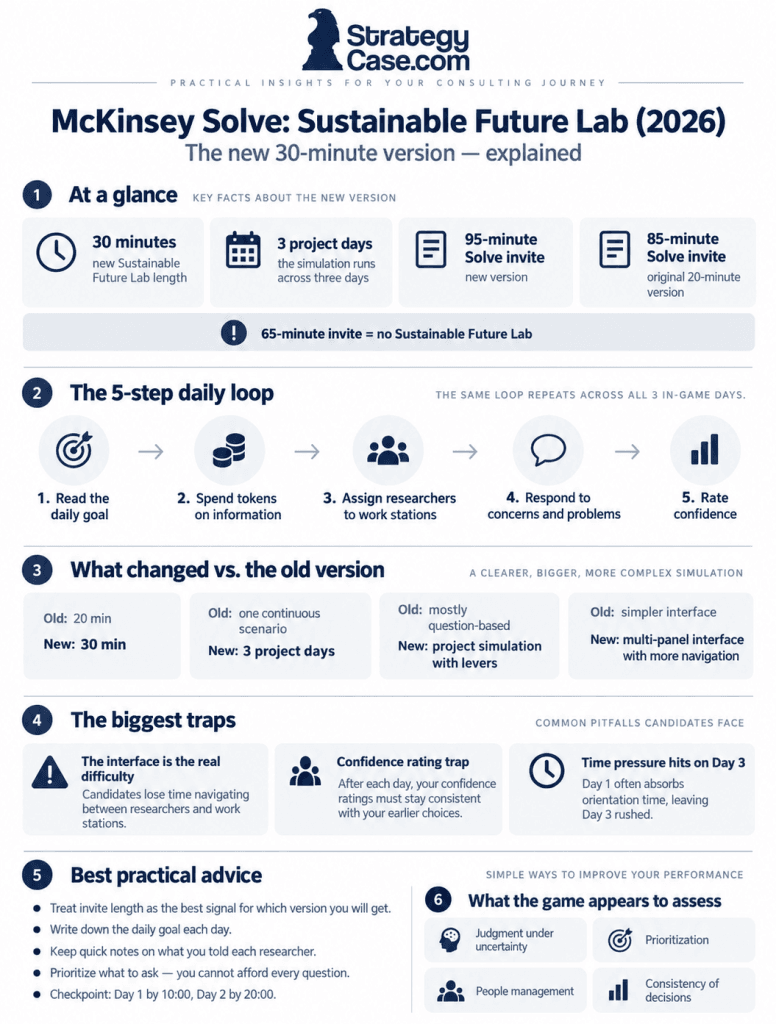
McKinsey has rebuilt the Sustainable Future Lab. The new version runs 30 minutes and splits the work across three project days, and candidates who get it receive a 95-minute Solve invite instead of the 85-minute one.
That matters because almost every guide online, including this page until recently, describes the first build: 20 minutes, 13 questions, one continuous scenario. If you prepare for that and the new interface loads instead, you lose your first minutes working out where the buttons are.
Below is what changed, how the three-day loop actually works, and the one mechanic that catches almost everyone.
Key Takeaways
- McKinsey now runs a rebuilt Sustainable Future Lab: 30 minutes, split into three project days, with a far more involved interface than the original build.
- Your invite length is the tell. 95 minutes means the new version, 85 minutes means the original 13-question version, 65 minutes means no Sustainable Future Lab at all.
- Each day follows the same loop: read the daily goal, spend tokens on information, assign researchers to work stations, respond to their concerns, then rate confidence.
- The interface is the real difficulty. Learning to move between researchers and work stations costs time that the old version did not charge you.
- Time pressure is real now. Candidates finish Day 3 in a rush, which usually does not happen in Red Rock or Sea Wolf.
- Keep a written note of the advice you give each researcher. You get asked to rate their confidence once the day closes, and by then you will not remember.
McKinsey Sustainable Future Lab (2026): Quick FAQ
Is the McKinsey Sustainable Future Lab different in 2026?
Yes. McKinsey shipped an updated build with a longer runtime, a redesigned interface, and a project split across three days. The judgment being tested looks similar to the first version, but the mechanics around it changed substantially.
How long is the new Sustainable Future Lab?
30 minutes, up from 20 in the original build. That extra time is not slack. The new interface takes longer to read and operate, so the module feels tighter, not looser.
My Solve invite says 95 minutes. What does that mean?
You are getting the new Sustainable Future Lab. The arithmetic is straightforward: Red Rock at 35 minutes, Sea Wolf at 30, and the rebuilt Sustainable Future Lab at 30 adds up to 95. An 85-minute invite points to the original 20-minute version.
What are the tokens in the Sustainable Future Lab?
Tokens are the limited currency you spend to buy information during each project day. You can use them to question a researcher or to pull details from a work station, and you cannot afford to ask everything.
Do I assign researchers to work stations myself?
Yes. On each day you decide which researcher goes to which work station, using whatever you have learned about their mood, their self-assessed strengths, and what each station needs.
Why does the game ask me to rate confidence after each day?
The module asks you to rate how confident the researchers feel, how confident you feel, or both, after a day of work and about the project overall. It is a consistency check: your rating has to square with the decisions you just made.
Is the new Sustainable Future Lab tightly timed?
Tighter than the original. The clock is the binding constraint on Day 3 for most candidates.
Is there a right answer in the Sustainable Future Lab?
No. There is no answer key to memorize. McKinsey is reading whether your choices hold together across three days, not whether you picked a designated best option.
Does the old 13-question version still exist?
It still shows up on 85-minute invites. Treat the invite length as the deciding signal rather than what a friend saw last month in another region.
What Changed in the Updated Sustainable Future Lab
The first Sustainable Future Lab, rolled out in early 2026, was a reading test with a decision attached. You worked through roughly 13 scenario questions in 20 minutes, most of them three-option multiple choice, with one drag-and-drop prioritization exercise at the front.
The new build is a project simulation. You are running a research project across three days, and the game gives you levers rather than answer options alone.
| Original version | New version | |
| Module length | 20 minutes | 30 minutes |
| Full Solve invite | 85 minutes | 95 minutes |
| Structure | One continuous scenario, ~13 questions | Three project days, same loop each day |
| Your inputs | Multiple choice, one drag-and-drop ranking | Token spending, researcher assignment, responses, confidence ratings |
| Interface | Text screens with answer options | Multi-panel, with researchers and work stations to move between |
| Question style | Concise scenario prompts | Same style, noticeably wordier |
| Time pressure | Manageable | Real, and it bites on Day 3 |
The underlying evaluation looks unchanged. Several questions in the new version read like slightly longer versions of ones from the first build. What changed is how much you have to operate before you get to answer them.
Which Version Will You Get? Read Your Invite Length
Before anything else, open your invitation email and find the stated duration. This is still the only signal that holds up across regions and roles.
| Invite length | What you get | Sustainable Future Lab? |
|---|---|---|
| 65 minutes | Red Rock and Sea Wolf only | No |
| 85 minutes | Red Rock, Sea Wolf, original Sustainable Future Lab | Yes, 20-minute version |
| 95 minutes | Red Rock, Sea Wolf, rebuilt Sustainable Future Lab | Yes, 30-minute version |
Do not guess from secondhand reports, and do not assume the newest version because it is newest. Both builds are in circulation right now, and the rollout pattern for the first version was region by region over several months. Read the number on your own invite.
If you got 95 minutes, everything below applies to you directly.
How the New Sustainable Future Lab Works: The Three-Day Loop
The project runs across three in-game days. Each day puts you through the same five steps, and the state you leave a day in carries into the next one.
Step 1: Read the daily goal and hold onto it
Every day opens with a goal for that day. It is not the same as the overall project objective, and it is the thing your later choices get judged against.
Write it down. Once you are three screens deep into researcher conversations, the daily goal is easy to lose, and the assignments you make are supposed to serve it.
Step 2: Spend tokens to buy information
You get a limited number of tokens each day, and you spend them to learn things you would otherwise be guessing at. There are two places to spend them.
Researchers. You can ask a researcher one of two questions:
- How do you feel about working on the project today?
- Where do you think you can contribute most?
The first buys you their state. The second buys you their self-assessment. Those are different pieces of information, and which one is worth more depends on what the day’s goal needs from you.
Work stations. Each station also offers you a choice of two questions, buying you detail about the work itself rather than the people doing it.
You cannot ask everyone everything. That constraint is the point. Deciding what you need to know before you can act well is the same judgment call a consultant makes in the first week of an engagement, and it is being measured here.
Step 3: Assign researchers to work stations
This is the core decision of each day. You place your researchers at work stations based on whatever you have managed to learn about them.
There is no formula. A researcher who told you they contribute most on analysis is not automatically the right pick for the analysis station if they also told you they are struggling today. You are weighing capability against state against what the day’s goal requires, with incomplete information on all three.
Step 4: Respond to concerns and problems
Researchers raise issues during the day. Some are about the work, some are about how they are doing, and you choose how to respond.
These read like the questions from the original Sustainable Future Lab, just longer. The same trap applies: the most agreeable response is rarely the strongest one, and neither is the most forceful. What gets rewarded is a response that addresses the concern and keeps the day’s goal moving.
Step 5: Rate confidence
At the close of each day you rate confidence. Sometimes it is how confident the researchers feel, sometimes how confident you feel, and there is a project-level version too.
This step sounds trivial. It is the hardest part of the module, and it deserves its own section.
If you want to practice simulations of Red Rock, Sea Wolf, and Sustainable Future Lab, use our suite here: Complete McKinsey Solve Game Guide and Simulations (all modules explained and playable).
The Confidence Rating Trap
Here is a key mechanic:
You spend a day questioning researchers, assigning them, and responding to their problems. Then the game asks you to rate how confident a researcher feels after that day’s work. By that point you have made a dozen decisions, and you genuinely cannot remember how reassuring the thing you told that particular researcher four screens ago actually was.
So you guess. And a guess is exactly what this step is designed to catch, because your rating has to be consistent with the advice you gave.
The fix is a piece of paper. Keep a running list of your researchers, one line each, and after every exchange add two or three words about what you told them and whether it was supportive or demanding. When the rating screen arrives, you read your notes instead of reconstructing the day from memory.
This costs you about five seconds per interaction. Based on candidate debriefs, it is one of the highest-return habits you can bring into the new version, because the difficulty of reconstructing earlier interactions only becomes apparent once candidates have worked through the full three-day sequence.
The Interface Is the Real Difficulty
The judgment questions in the new Sustainable Future Lab are not harder than the old ones. Operating the game is.
You have researchers on one side and work stations on the other, and you have to move between them repeatedly within a single day: check a researcher, check a station, come back, assign, respond. The first day is largely spent learning where things live.
That is a design choice, not an accident. McKinsey has effectively added a layer of working-memory load on top of the judgment test, which is a reasonable proxy for doing analytical work while also managing people. But it means the module now punishes candidates who arrive cold in a way the original never did.
If you have not seen the interface before test day, budget most of Day 1 to orientation and accept that your Day 1 decisions will be your weakest.
Time Pressure: Why Day 3 Is Where Candidates Rush
Candidates report significantly more time pressure in the new game compared to Red Rock and Sea Wolf.
The reason is that the 30 minutes are not divided evenly in practice. Day 1 eats a disproportionate share because you are learning the interface, Day 2 runs closer to normal, and Day 3 gets whatever is left. If Days 1 and 2 overrun, you are making your final and most consequential decisions at speed.
Set yourself a hard checkpoint. Ten minutes gone, Day 1 done. Twenty minutes gone, Day 2 done. That leaves Day 3 a full third of the clock, which is roughly what it needs. Enforcing that split is worth more than any answer strategy, because rushed Day 3 decisions are where consistency breaks, and consistency is the thing being scored.
This also changes how the module compares to the rest of the McKinsey Solve. The original version was the low-pressure one. The new version is not.
What McKinsey Is Testing
McKinsey has never published a rubric for this module, and anyone showing you a scoring grid invented it. Based on the mechanics, we can infer which judgment traits the module appears designed to surface.
- Prioritization under a hard constraint. Tokens are limited on purpose. What you choose to find out, and what you accept not knowing, is a direct read on how you prioritize.
- Decision-making with incomplete information. You will always assign researchers knowing less than you would like. The test is whether you commit sensibly or stall trying to buy certainty you cannot afford.
- Reading people, not just tasks. The two researcher questions give you mood and self-assessment. Candidates who only ever ask about contribution, and never about state, show a specific blind spot.
- Matching capability to need. Assignment is where judgment becomes visible. Anyone can read a profile; the question is whether you place people where the day’s goal actually needs them.
- Consistency across the whole project. Three days, one project, and choices that carry forward. Contradicting yourself on Day 3 is the clearest negative signal available in this module.
These are the same five judgment areas the original build tested. The new version just gives McKinsey more ways to observe them.
Is the Sustainable Future Lab a Situational Judgment Test?
It behaves like one, though McKinsey does not label it that way.
You get realistic team scenarios, you choose how to respond, and you are read on the pattern rather than any single choice. Bain uses comparable logic in the Sova test, and platforms like TestGorilla apply the same approach across industries.
The difference is the wrapper. A standard situational judgment test presents you with independent vignettes. The new Sustainable Future Lab embeds the judgment inside a project you are actively running, so your earlier decisions constrain what is even reasonable later. That is a meaningfully harder thing to fake.
How It Compares to Red Rock and Sea Wolf
| Feature | Red Rock | Sea Wolf | Sustainable Future Lab (new) |
|---|---|---|---|
| Length | 35 minutes | 30 minutes | 30 minutes |
| Focus | Optimization | Constrained optimization | Project judgment |
| Format | Quantitative | Analytical | Behavioral simulation |
| Time pressure | High | High | High, concentrated on Day 3 |
| Key skill | Math and logic | Data interpretation | Prioritization and consistency |
| Can you prepare? | Yes, heavily | Yes, heavily | Yes, but for mechanics and habits |
One thing has not changed: Red Rock and Sea Wolf still set your baseline. If you underperform on the analytical games, strong judgment in the Sustainable Future Lab will not rescue the application. Treat this module as the part that can cost you an offer rather than the part that wins one.
A Decision Framework That Survives All Three Days
The framework I gave for the original version still holds. The new build just adds a layer above it.
At the day level, before you spend a single token:
- What does today’s goal actually require?
- What is the one thing I do not know that would most change my assignments?
- What did I decide yesterday that I need to stay consistent with?
At the decision level, for every choice inside the day:
- What is the objective? Move the work forward while keeping the team functional. It is almost never one at the expense of the other.
- What is the constraint? Tokens, time, a researcher’s state, a station’s requirements, or your own missing information. Name it before you act.
- What action moves both forward? Avoid the extremes. Purely driving ignores the people; purely accommodating ignores the goal.
- What signal does this send? Every choice says something about how you operate. Aim for a coherent style across three days rather than the locally optimal answer on each screen.
Run the day-level questions three times and the decision-level questions on every screen, and your choices will hold together even when you are rushing.
Common Mistakes in the New Version
Treating it like the old 20-minute module
Candidates who prepared on the original format arrive expecting to read and click. They lose Day 1 to the interface and never recover the clock. If your invite says 95 minutes, prepare for the new mechanics specifically.
Spending tokens evenly
Asking every researcher the same question to be thorough is the most common token mistake. Spend where the day’s goal creates genuine uncertainty and leave the rest unasked.
Only asking about contribution, never about state
The two researcher questions are not interchangeable. Candidates who never once ask how someone is doing look like people who manage tasks and not teams, which is precisely the read this module is designed to produce.
Guessing on the confidence ratings
Covered above, and worth repeating because it is the most avoidable error in the module. Take notes.
Hunting for the right answer
Most options are defensible. There is no key. What gets scored is whether your three days form one coherent approach, so a run of individually clever but mutually inconsistent choices scores worse than a steady, slightly conservative line held throughout.
Optimizing for niceness
Always picking the warmest response is a strategy, and it is a losing one. Consulting requires you to be supportive and to keep the work moving, and the module gives you plenty of chances to demonstrate you can do both.
How to Prepare
Preparation for this module is about mechanics and habits, not answers.
- See the interface before test day. The single biggest cost in the new version is orientation time. Whatever you use to practice, make sure you have moved between researchers and work stations under a clock at least once.
- Fix your time splits. Ten minutes per day, checkpointed. Write the two checkpoint times on your scratch paper before you start.
- Build the note-taking habit. One line per researcher, updated after each exchange. Practice it until it is automatic, because you will not have spare attention on test day.
- Decide your token policy in advance. A simple default such as “two questions on people, one on the work, unless the day’s goal says otherwise” beats improvising under time pressure.
- Pick your operating style and hold it. Directional but collaborative is the line that survives three days. Choose it before you start rather than drifting between styles screen to screen.
If you want to run the whole battery under real conditions, our McKinsey Solve simulations cover Red Rock, Sea Wolf, and the Sustainable Future Lab. The point of practising this particular module is not to learn answers, it is to spend your orientation time somewhere that does not count.
What We Know and What We Do Not
Consistent information:
- The new build runs 30 minutes and appears on 95-minute invites.
- The project is split across three days with a consistent per-day loop.
- Tokens buy information from researchers or work stations, with two question options at each.
- You assign researchers to work stations, respond to their concerns, and rate confidence at the end of each day.
- The questions match the style of the original version and are longer.
- The time limit binds. Day 3 is where it shows.
Reasonable inference:
- The evaluation still centres on judgment and cross-decision consistency, since the question style and the branching structure carried over.
- The interface complexity is deliberate rather than incidental, given that it adds load without adding questions.
Not known:
- Any scoring model, weighting, or point system. Nobody outside McKinsey has one.
- Whether the new build is replacing the original everywhere or running alongside it long-term.
- Whether the confidence ratings feed scoring directly or only serve as a consistency check.
Anyone presenting the unknowns above as settled fact is guessing. Prepare for the mechanics, which are observable, and ignore the scoring theories, which are not.
What Should You Focus on For Now?
If you want to prepare specifically for Red Rock and Sea Wolf (the two core analytical games) as well as the new Sustainable Future Lab, we’ve built a simulation suite that mirrors the real Solve experience.
The simulations are designed to fully resemble the real assessment, allowing you to practice structured thinking, data interpretation, and optimization under time pressure. Rather than relying on generic tips, the suite trains you on the relevant skills, including hypothesis-driven decision-making, prioritization, and numerical reasoning, ensuring you build the analytical and personal foundation required to perform at a top level in the Solve.
Click on the image below to learn more about our Solve Game Simulations.
McKinsey Solve Game Guide 24th Edition
SALE: $169 / $99
Related Guides
- McKinsey PEI. The behavioral interview the Sustainable Future Lab most resembles, and the next place your judgment gets tested.
- The McKinsey application process. Where Solve sits in the full timeline, from CV screen to offer.
- McKinsey Values and Purpose interview. The other screen where McKinsey reads judgment rather than analysis.
- How long should you prepare for consulting interviews. Planning your runway before the Solve invite lands.
Final Thoughts
McKinsey rebuilding this module a few months after launching it tells you where the Solve is going. The firm wants to watch candidates run something, not answer questions about running something, and each revision moves further in that direction.
For you, the practical implications are small and specific. Check your invite length. Learn the interface before test day rather than during it. Take notes on what you tell people. Hold your time splits so Day 3 is not a scramble.
None of that requires guessing at a scoring model. It requires showing up already knowing how the game works, which is the only advantage available in a test with no answer key.
If you want to walk in having already played all three modules under time, the StrategyCase Solve simulation suite is where to do it.
About the Author: Florian Smeritschnig is a former McKinsey Senior Consultant who spent five years at the firm and evaluated candidates on the other side of the recruiting table. When McKinsey replaced its paper test with the digital Solve assessment in 2019, he launched the first prep resource dedicated to it, starting with a written guide and later building the realistic Solve simulations StrategyCase uses today. Since then he has delivered 2,200+ mock interviews and coaching sessions and helped 700+ candidates win offers at McKinsey, BCG, Bain, and other top firms. Learn more about Florian, or work with him one-on-one.