
Last Updated on September 9, 2026
Updated September 2026 · By Florian Smeritschnig, Former McKinsey Senior Consultant
The McKinsey Solve Game, the firm’s assessment tool, filters out roughly 75-80% of candidates before they ever speak to a consultant. It runs three modules back to back, and your invite will say either 85 or 95 minutes depending on which version of the third game, Sustainable Future Lab, McKinsey sends you. Red Rock, Sea Wolf, and Sustainable Future Lab all track process signals behind every click, not just your final answers.
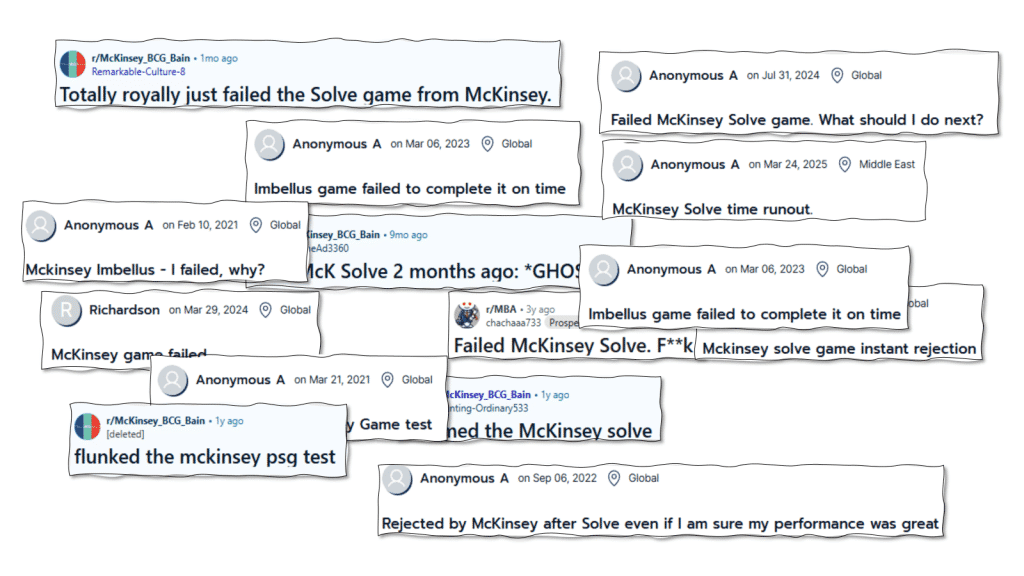
Most candidates treat Solve like a puzzle game and get screened out. They practice in the wrong direction, freeze on the interface, and watch the clock burn while McKinsey logs every backtrack and hesitation as a weak process signal. One failed attempt locks you out of reapplying for 12 to 24 months, depending on the office.
I spent five years at McKinsey as a Senior Consultant and through our prep have helped 9000+ candidates through this exact assessment. Among StrategyCase users who use our suite, the reported pass rate is 89%. This guide walks you through the current 2026 format, the dual-scoring logic most write-ups miss, and the three-layer preparation model that separates passers from the 75-80% who do not make it.

Key Takeaways
- McKinsey Solve runs three games back to back: Red Rock Study (35 min), Sea Wolf (30 min), and Sustainable Future Lab (20 or 30 min).
- Check your invite length. 95 minutes means the rebuilt Sustainable Future Lab, a 30-minute simulation split across three project days. 85 minutes means the original 20-minute, 13-question version.
- Every click is tracked. McKinsey scores both product (outcome quality) and process (how you got there), which is why “just run more practice games” is the wrong prep approach.
- Estimated unaided pass rate is 10 to 20%. Candidates who train strategy first, then drill mechanics, then run realistic simulations, consistently outperform volume-based prep.
- You cannot retake Solve for 12 to 24 months after a fail, so treating it as “just part of the funnel” is the costliest mistake I see.
What the McKinsey Solve Game Actually Is in 2026
McKinsey retired the old paper Problem Solving Test (PST) in 2019 and replaced it with a gamified assessment built in partnership with Imbellus (later acquired by Roblox in 2020). The test has cycled through multiple formats since. As of September 2026, the live version delivered to all candidates contains three modules:
- Red Rock Game, 35 minutes of ecosystem research, quantitative analysis, and rapid-fire mini-cases
- Sea Wolf Game (Ocean Treatment), 30 minutes of multi-constraint optimization across contaminated ocean sites
- Sustainable Future Lab Game, 20-30 minutes of behavioral judgment scenarios, depending on which build you get
Total active test time is 85 or 95 minutes. The difference is the third module: McKinsey rebuilt Sustainable Future Lab in 2026, and the new version runs 30 minutes instead of 20. An 85-minute invite means the original build, a 95-minute invite means the new one. Add 5 to 10 minutes of untimed tutorials before each game, plus tech setup. Plan for more than two hours of uninterrupted focus on test day.
The invitation arrives by email after you pass the resume screen. You get a time window, usually 3 to 7 days, to complete Solve at home on your own computer. No interviewer, no proctor, no pause button, no retake inside the lockout window if you fail.
Why McKinsey Replaced the PST
Three reasons, in the order that actually drives the decision inside the firm:
1. Bias reduction. The PST disadvantaged non-native English speakers and candidates from certain academic backgrounds. Gamified simulations score reasoning without literacy penalties and reduce business-background bias.
2. Cost and scale. McKinsey reviews more than 1 million applications per year. A self-serve digital test cuts first-round screening costs by an order of magnitude.
3. Signal quality. The assessment captures process data (click streams, backtracks, time-on-task) that a paper test cannot. That gives recruiters a second dimension to evaluate beyond “did they get the right answer.”
That third point is the one most candidates miss, and it is why generic “do more questions” prep fails. I will come back to it.
If you want to learn more about McKinsey’s rationale for the Solve Game, Fortune spoke with Katy George, McKinsey & Company’s chief people officer, regarding the impact of prevailing labor market trends on the consulting firm’s talent strategy.
Where Solve Sits in the McKinsey Funnel
Solve is the second gate, right after the resume screen and before any human interviewer is involved. Pass Solve and you move to the first-round McKinsey Case Interview and Personal Experience Interview. The assessment is employed across all offices and roles, and sometimes even used to screen candidates for recruiting events.
Fail it and the application cycle ends, typically with an automated rejection email and no feedback on your performance. This is why candidates who plan to “wing it and see what happens” usually regret that choice. One weak test window ends a recruitment cycle you spent months preparing for.
If you complete the McKinsey Solve Game remotely, feedback typically arrives within 1 to 14 days, depending on office processes and candidate volume. Delays are more common in regions with batch-based recruiting decisions, and rare outliers may wait longer.
How the Solve Scores You (The Part Most Guides Get Wrong)
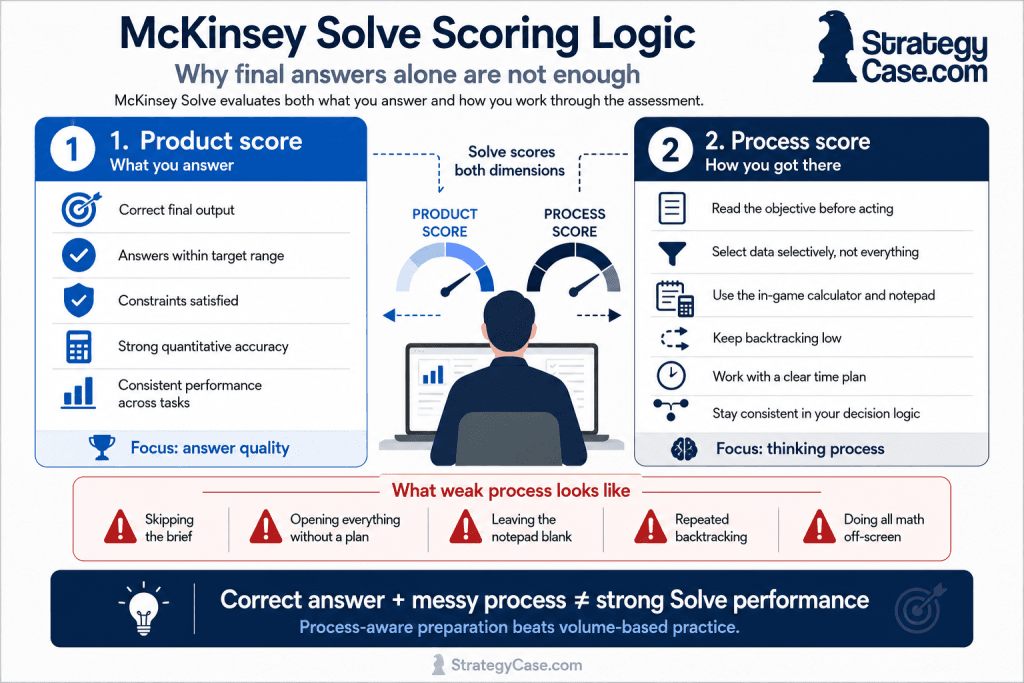
Solve uses a dual-scoring system: a product score (the quality of your answers) and a process score (how you arrived at them). Both matter. They are weighted roughly equally, which is why the assessment resists brute-force volume prep.
Product signals include:
- Whether your final output is correct or within an optimal range
- How close your quantitative answers fall to the target band
- Whether your choices satisfy all constraints in the brief
- If you improve across different variations of the same game
Process signals include:
- Time spent reading the brief vs jumping to action
- Number of data sources opened (too many and too few both raise flags)
- Back-and-forth between screens (excessive backtracking reads as indecision)
- Consistency of approach across similar tasks
- Use of in-game tools (calculator, notepad) vs silent off-screen work
A candidate who pastes a correct answer from an external calculator but leaves the in-game notepad blank looks analytically sloppy to the scoring engine, even if the number is right. The system is built to watch how a consultant thinks, not just what they conclude.
- Problem identification: The ability to recognize the underlying issue that requires resolution
- Information analysis: The skill to source, filter, and interpret data from multiple inputs
- Strategic solution development: The ability to form, test, and refine hypotheses
- Decision making: The capacity to draw sound conclusions under time pressure
- Adaptability: The agility to adjust approach when conditions change
- Quantitative reasoning: The ability to interpret and apply numerical data.

This is also why candidates who do 50 random online “PSG simulators” often still fail. Volume trains your fingers to click fast. It does not train you to click in a way that signals structured thinking. For a deeper read on why this approach fails at McKinsey specifically, see our piece on the gap between consulting preparation and what firms want.
The Three Current Solve Modules
The 2026 Solve runs three modules back to back, each scored on its own. Here is what each one is, with a link to the full walkthrough when you want to go deep. The first two are stable. The third has two versions in circulation right now, and your invite length tells you which one you are getting.
1. Red Rock Study (35 minutes)
Red Rock is the closest Solve gets to a digital case interview. You play a wildlife researcher studying an endangered species, moving through an investigation stage, a quantitative analysis stage, a report, and a round of rapid-fire mini-cases. It rewards reading the objective before you open any data and committing to one clean analytical path. Our Red Rock Game guide breaks down all four stages and what the scoring engine rewards.
2. Sea Wolf Simulation (30 minutes)
Sea Wolf is a multi-constraint optimization game where you match microbes to three contaminated ocean sites under time pressure. It is built so you cannot necessarily find a perfect answer in 30 minutes, so the winning move is to treat each site as its own case, budget your time, and lock in a strong-enough solution before moving on. Our Sea Wolf game guide covers the four phases, the common traps, and the per-site strategy.
3. Sustainable Future Lab (20 or 30 minutes)
Sustainable Future Lab is behavioral rather than analytical, and it is the one module McKinsey has already rebuilt once. Two versions are live.
The original, rolled out in early 2026, runs 20 minutes: 13 scenario-based questions where you rank priorities and make trade-off decisions inside an environmental research team.
The rebuilt version runs 30 minutes and splits the work across three project days. Each day you read a daily goal, spend a limited pool of tokens to question researchers or work stations, assign researchers to work stations, respond to the problems they raise, and rate confidence at the close of the day. The interface is far more involved, and it is the only Solve module where I still feel the clock after hundreds of run-throughs.
Either way, the module scores your judgment and consistency rather than any math. Our Sustainable Future Lab guide covers both versions, the three-day loop in detail, and how to prepare for each.
| Your invite says | Third module you get |
|---|---|
| 65 minutes | No Sustainable Future Lab |
| 85 minutes | Original version: 20 minutes, 13 questions |
| 95 minutes | Rebuilt version: 30 minutes, three project days |

The Pass Rate Nobody Talks About
McKinsey does not publish Solve pass rates. Based on candidate reports and discussions since November 2019:
- Unaided pass rate (no structured prep): roughly 10 to 20%
- With random online simulators only: roughly 40 to 50%
- With strategy-first structured prep and realistic simulations: 75 to 90%
The gap between “grinding simulators” and “structured preparation” is the entire point of this article. More reps alone do not fix a weak approach. They make a weak approach faster.
The Three-Layer Prep Model
After watching candidates either pass or get filtered at this stage, the pattern is clear. Candidates who pass build their prep in three layers, not three stacks of practice games.
Layer 1: Strategy Layer (What to Do and Why)
Before you touch a simulator, write a game-by-game strategy playbook (or use one that has been written for you). It should read like a consulting workplan, not a study guide.
For Red Rock:
I will read the research objective for 60 seconds before selecting any data. I will select the key data sources, not everything available. I will budget 5 minutes for the Investigation, 10 minutes for analysis, 5 minutes for the report stage, and 10 minutes for the mini-cases. I will use the in-game calculator for every calculation.
For Sea Wolf:
I will follow the rules of the game that set me up for success, already at the first task. I will set the right filters first, then shortlist, then pick. I will allocate 10 minutes per site and stop when time is up, even if I think I could do better. I will not backtrack after committing to a treatment plan.
For Sustainable Future Lab:
I will rank priorities around stakeholder impact and project viability, not personal preference. I will answer decisively and not revisit earlier answers. Consistency across scenarios matters more than any single response. If I get the three-day version, I will hold to 10 minutes per day so Day 3 is not a scramble, and I will keep a one-line note on what I told each researcher so my end-of-day confidence ratings match the advice I actually gave.
This layer is the basis of your approach and game-taking strategy. Skip it, and everything below is wasted effort.
Layer 2: Realistic Simulation Layer (Pattern Recognition)
Now drill the strategies and key skills. Run full-length simulated games, first individually and then back-to-back to simulate the full 95-minute Solve Game.
This layer builds the reflexes needed to execute your strategy without cognitive overhead. A common issue candidates report is encountering the Solve scenarios for the first time during the actual assessment. As a result, they must simultaneously learn the interface and layout while solving the underlying problems.
If you have practiced with simulations modeled after the McKinsey games, you already know what to expect. This allows you to focus on execution rather than orientation, applying your plan with speed and consistency.
Layer 3: Thorough Debrief and Improvements
Run them with reflection built in. After each simulation, look at your score, compare sample answers with your answers. Also, consider your process: What did it look like? Where did you backtrack? Where did you run over on time? Where did you guess without structure?
A handful of well-run, reflected-on simulations beats 50 random attempts every time. Our McKinsey Solve Game Guide and Simulations are built around exactly this three-layer model.
The Mistakes That Wreck Your Process Score
In order of how often they show up in debriefs with candidates who failed:
1. Skipping the brief. Opening data before reading the objective signals unstructured thinking. Budget the first 45 to 60 seconds of each game for reading or organizing only.
2. Having no plan or strategy. The scoring engine rewards selective, hypothesis-driven actions and decisions.
3. Leaving the notepad empty. No process footprint equals no evidence you thought through the problem. Use the in-game tools.
4. Excessive backtracking. Changing screens multiple times reads as indecision. Select, commit, and move on.
5. External tool reliance. Candidates doing all math on their phone or on scrap paper leave no in-game process signal. The scorer cannot see your reasoning.
6. Ignoring the tutorial. Tutorials are untimed. If you did not practice with a simulation, use them to memorize the interface. Candidates who skip tutorials burn a few minutes per game just orienting themselves.
7. Treating Sustainable Future Lab like the other games. There is no right-answer grid. Consistent judgment across scenarios matters more than any single response. On the rebuilt three-day version, the added trap is the interface: candidates who see it for the first time on test day lose most of Day 1 to orientation and then rush Day 3.
Test Day Tactics That Actually Move the Dial
Sleep beats one more practice run. Cognitive performance drops 20 to 40% when fatigued. If you are torn between another simulation the night before and an extra hour of sleep, sleep wins.
Start in the morning if you can. Peak cognitive performance for most candidates is 2 to 4 hours after waking. Schedule Solve inside that window when possible.
Test your setup the day before. Run a browser check on the machine you will use. Close background apps. Have water and a snack within reach. Phone off the desk, in another room if you can.
No Zoom, no email, no notifications. Solve takes 95 active minutes plus tutorials. A single interruption can cost you a full game.
Reset between modules. Five deep breaths between games. Do not let Red Rock frustration bleed into Sea Wolf. Each game is scored independently.
Read every instruction twice. Interface quirks differ by module. A missed instruction in Sea Wolf about forced selections has cost more than a few candidates the offer.
How Solve Fits Into the Full McKinsey Application
Solve is one filter in a multi-stage funnel. To put it in context, the full process usually runs:
1. Resume screen. Our consulting resume guide covers what survives.
2. McKinsey Solve (Digital Assessment), often in combination with the resume screening, or, in some offices combined with a single first-round interview.
3. First-round interviews, two to three cases and two to three PEI interviews
4. Second-round (final) interviews, two to three cases and PEIs
Compound the probabilities of passing each round and you land at the roughly 1% overall acceptance rate McKinsey publicly reports. Solve alone removes four out of five candidates. Preparation here makes all the difference for the entire funnel.
Frequently Asked Questions
How long is the McKinsey digital assessment in 2026?
85 or 95 minutes of active test time across three modules (Red Rock, Sea Wolf, Sustainable Future Lab), plus 5 to 10 minutes of untimed tutorials per game. The number on your invite tells you which version of Sustainable Future Lab you are getting: 85 means the original 20-minute build, 95 means the rebuilt 30-minute one. Budget more than two hours of uninterrupted focus from start to finish.
Can I prepare for the McKinsey Solve?
Yes, despite McKinsey’s official line that “no preparation is needed.” Candidates who prep with structured strategy and realistic simulation consistently pass. What does not help is grinding random simulators without reflection.
What is the pass rate for McKinsey Solve?
McKinsey does not publish it. Based on StrategyCase survey data across thousands of users and discussions with case coaching clients, unaided pass rates sit around 10 to 20% (depending on office and recruiting demand). Structured preparation pushes that to 75 to 90% depending on the prep depth.
Is Solve the same in every country?
The three-module structure is standard across all countries and roles. What varies right now is the third module: some candidates get the original 20-minute Sustainable Future Lab and some get the rebuilt 30-minute version, which is why invites currently show either 85 or 95 minutes.
What happens if I fail Solve?
You cannot retake it for 12 to 24 months depending on office. A Solve fail typically ends the application cycle for that window with no feedback.
Does McKinsey track my behavior during the game?
Yes. Every click, hover, backtrack, and tool usage feeds the process score alongside your final answers. This is why process-aware preparation outperforms volume-based prep.
Can I use a calculator or external notes?
Use the in-game calculator and notepad as your primary tools. External tools leave no process footprint and weaken your scoring profile. A single off-screen sheet for quick side calculations is fine. Doing all your math off-screen is not.
Why does my Solve invite say 95 minutes?
Because you are getting the rebuilt Sustainable Future Lab. McKinsey redesigned the third module in 2026 and the new version runs 30 minutes instead of 20, which pushes the total from 85 to 95. The new build splits the project across three days and uses a much more involved interface, so if your invite says 95, prepare for that version specifically rather than the 13-question one most guides describe.
What to Do Next
The McKinsey Solve assessment is conquerable, but only if you treat it like a structured skill to develop, not a game to play more of. Three actions to take this week:
1. Build your game-by-game playbook first. Strategy before simulation, every time.
2. Drill the mechanics daily for a few days to a week. Working through simulations of the game and gaining familiarity with the interface, questions, and answer patterns beats guessing or just reading about the assessment every time.
3. Reflect after every practice run. What did your process look like, not just how did you score?
If you want the strategy, mechanics drills, and realistic simulations built into one structured program, our McKinsey Solve Game Guide and Simulations walk through exactly that.
You get one shot per 12 to 24 months at Solve. Prep like it matters.
Even when a formal reapplication wait period varies by program and office, a weak result typically means you must return later with a stronger profile and a better story.
About the Author: Florian Smeritschnig is a former McKinsey Senior Consultant who spent five years at the firm and evaluated candidates on the other side of the recruiting table. When McKinsey replaced its paper test with the digital Solve assessment in 2019, he launched the first prep resource dedicated to it, starting with a written guide and later building the realistic Solve simulations StrategyCase uses today. Since then he has delivered 2,200+ mock interviews and coaching sessions and helped 700+ candidates win offers at McKinsey, BCG, Bain, and other top firms. Learn more about Florian, or work with him one-on-one.

15 Responses
Hello, thank you for this introduction. I would like to ask about one thing. In the ecosystem… From all 8 species – they have to survive? Or they can be eaten by predators? I understand how to create the food chain, but still…if you create a food chain and the species do not replicate, they will be eaten by predators…
Dear Lenka,
All species in the food chain (animals and plants) need to survive. The sum of the calories provided by a species – the sum of calories needed for the predator species should always be positive.
Cheers,
Florian
hi Florian,
I only have 3 hours before the PSG is due, is it possible or useful to buy the guide given such a short time limit?
Thank you
Dear Angelina,
3 hours would be enough to read through the strategy section, watch the videos and familiarize yourself with the Excel. While not ideal and we receommend more time to practice, it would still make sense.
Cheers,
Florian
[…] using digital badges to recognise learning and, for example, the consultant company McKinsey uses a game during its recruitment process,” adds Nikoletta-Zampeta […]
Hello Florian Daniel or Colleague,
I am very pleasantly surprised to see this guide that you have masterfully complied. Having tips from insiders is such a confidence boost! I purchased this pack without hesitation and am hoping to try it out before investing in the comprehensive 6h coaching program.
Nonetheless, I wonder if you can email me back by helping me with downloading the actual guide? I encountered a technical issue whereby I completed my payment on my phone, but it became impossible to download it via my laptop. I am very worried as the deadline of the test is approaching so could you please get back to me asap?
Many Thanks
Aspiring Consultant
Hey there,
I have just sent you your documents, which also contain access to the video program.
Please let me know if I can assist further.
Kind regards,
Florian
Hi, how long would you suggest I prepare for the McKinsey digital assessment test after purchasing the digital assessment guide? 2 weeks? 4 weeks?
Hi Emmanuel,
We have candidates that prepare between 2 days and 1 month. The shorter your preparation time, the more your focus should be on learning the proven strategies we outline in our guide (so that you can implement them properly on the game day) and go through and practice the most effective and important tools we provide you with to quickly raise your skill levels.
Obviously, when you have more time on your hands, you can prepare in a much more relaxed way and go deeper with all our exercises and tools. Generally, I would say that 2 weeks is the sweet spot we have seen with our candidates and it is rare for them to fail after they have gone through all exercises and tools, practiced the preparation tips, and have our game-plan and strategies internalized over this time period.
4 weeks would give you enough time to prepare without a rush, and in parallel to the case interview practice. In any case, should something change in the game between your purchase and the testing date, we will send you a new version of the guide and the videos free of charge!
Let me know if you have any further questions!
All the best for your preparation and your application.
Florian
I heard that there are also other games that could be part of the PSG like predicting and preventing an environmental disaster. Are you sure that there are ‘only’ the 2 two games you describe?
Hi Luiz, we talk briefly about these potential other scenarios in our Problem Solving Game Guide. Be aware that they were used during the trial stages in 2018/19 only and none of our more than 700 customers has reported on them pro-actively. From the 80+ customers we interviewed since November 2019, all went solely through the ecosystem game and the tower defense-like game. In the ecosystem game, recent candidates report having done the mountain ridge scenario and not the reef (even though this has no impact on the actual gameplay).
Hi, how do I know if I passed the ecosystem simulation task?
Hi Patricia, on an aggregate level the game looks at both your product score (did you produce a good outcome?) and your process score (did you perform well under stress while working towards the outcome?).
In order to pass the ecosystem simulation, ideally, you reach the threshold McKinsey set for both scores (which is unknown). For the product score, you should be able to test your hypotheses during the game and see if your food chain is actually sustainable and works out. However, for the process score, you can only take a guess. McKinsey and Imbellus record every movement of your mouse, every click, as well as how long you pause, go back and forth in the menus, etc. In short, the more you have worked in a calm and collected manner towards selecting your food chain, the higher the chances to reach a solid process score.
Hi, I have one question, Is McKinsey problem-solving game material included in Mc Kinsey program?
Hi Federico, do you mean the Video Academy or the Interview coaching?