
By Florian Smeritschnig, former McKinsey Senior Consultant · Updated October 2026
A consulting assessment test is an online screen that firms use to cut the applicant pool before a single human reads your case structure. McKinsey Solve, BCG’s Consulting Career Assessment, and Bain’s TestGorilla are the best-known examples. Most candidates treat these screens as formalities and get filtered out before they reach a live round, which is exactly what the tests are built to do.
I evaluated candidates on the other side of the table at McKinsey, and I have run 2,200+ mock interviews and coaching sessions since. Time and again I watch strong applicants get cut at this stage for one reason: they prepare for the case interview and ignore the gate of consulting assessment tests sitting in front of it.
This guide maps every major consulting assessment test by firm and by type, explains what each one screens for, and points you to the deep-dive guide for each.
Key Takeaways
- A consulting assessment test is an online gate, not a formality. Firms use it to thin huge applicant pools before spending consultant time on live interviews.
- The tests fall into four types: game-based simulations, numerical and logical aptitude tests, behavioral games, and one-way video interviews. Most firms now combine two or more.
- McKinsey uses Solve. BCG uses the Casey online case, a Consulting Career Assessment, a cognitive test, Pymetrics, and a one-way video. Bain uses different online tests such as the TestGorilla and SOVA.
- Tier-2 and Big 4 firms screen too. Kearney, L.E.K., and Accenture all run their own online tests, and candidates routinely underestimate them.
- The fastest way to pass any of them is to build the underlying skill (numeracy, structured problem-solving) rather than memorizing one test’s shortcuts. Those are the same fundamentals the live case rewards.
What is a consulting assessment test?
A consulting assessment test is an online, timed screen that consulting firms send candidates after the resume review and before live interviews. Depending on the firm, it measures problem-solving, numerical and logical reasoning, or behavioral traits, and it decides who advances to a human interviewer.
The label covers formats that look nothing alike: an interactive ecological simulation at McKinsey, a chatbot-run case at BCG, a numerical reasoning test at L.E.K. What they share is their role in recruiting. They are gates, and they reject far more candidates than they pass.
Why consulting firms use online assessments
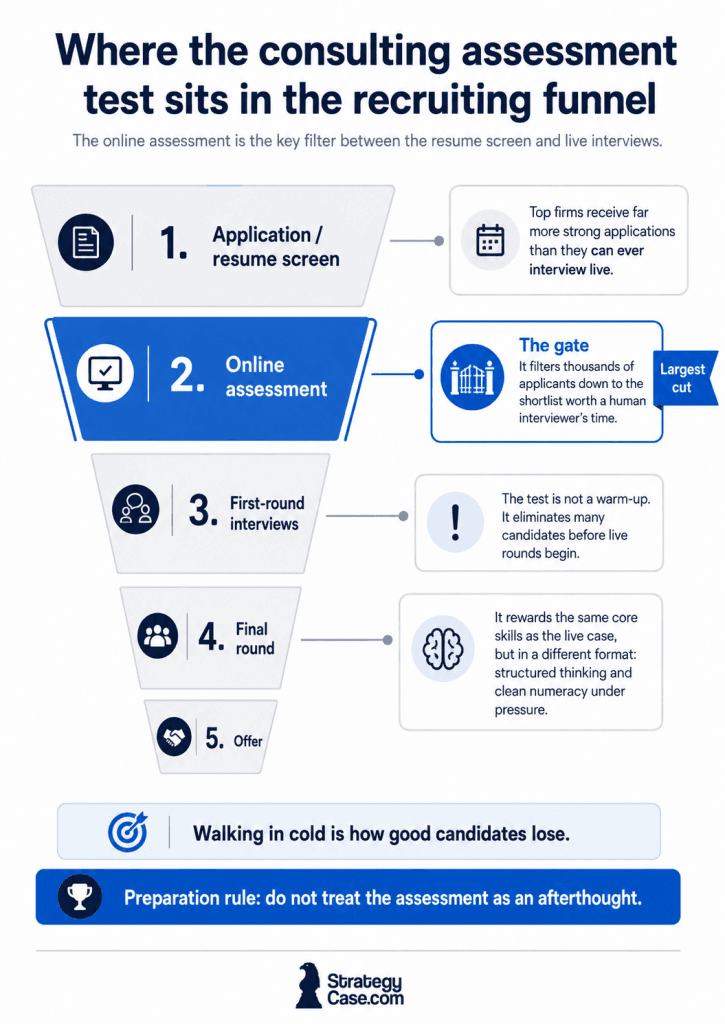
Top firms receive far more strong applications than they could ever put through a live case interview (McKinsey careers). No consultant or partner can interview the whole applicant pool in person, so the online assessment thins the stack down to the candidates worth a human’s time.
When I was at the firm, that filtering was the whole point. The screen did a job no interviewer could: it cut thousands of resumes to a shortlist before anyone scheduled a case. The test is no warm-up. It quietly eliminates most applicants before the live rounds even begin.
Most candidates over-prepare for the live case, treat the assessment as an afterthought, and then get rejected by a chatbot. The firms reward the same core skills at both stages, structured thinking and clean numeracy under pressure, but the screen tests them in a format you need to understand in advance.
Walking in cold is how good candidates lose.
The four types of consulting assessment tests
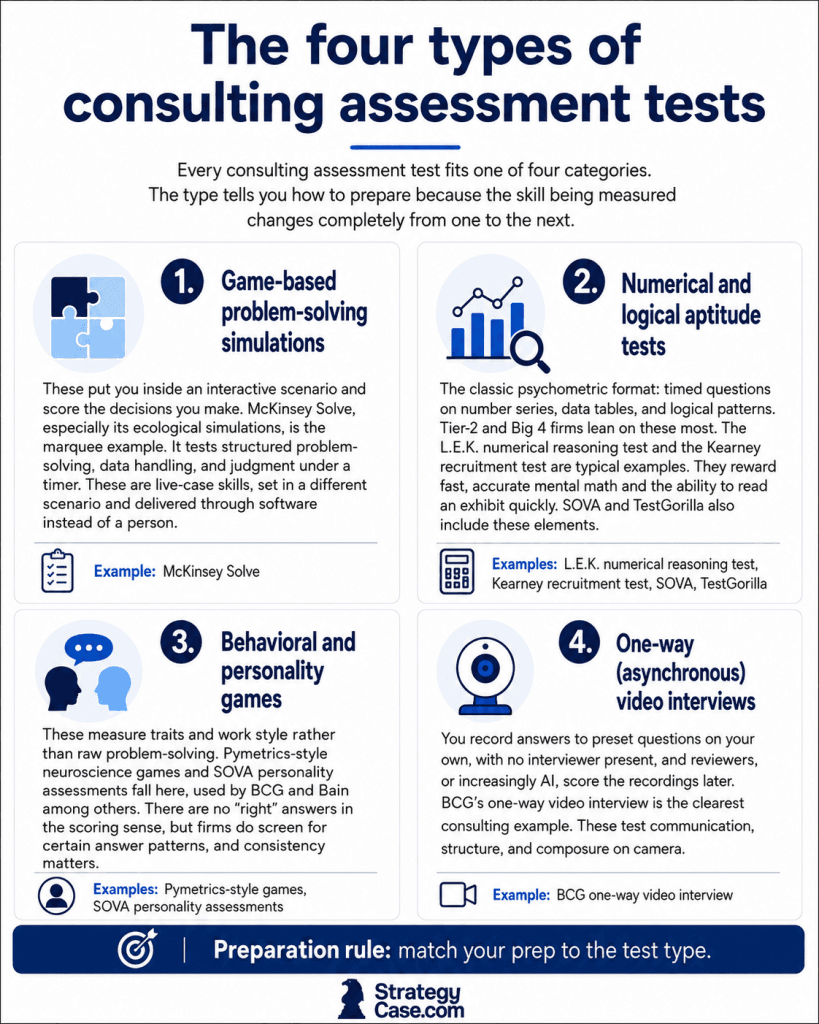
Every consulting assessment test fits one of four categories. The type tells you how to prepare, because the skill being measured changes completely from one to the next.
1. Game-based problem-solving simulations
These put you inside an interactive scenario and score the decisions you make. McKinsey Solve (the ecological simulations) is the marquee example. It test structured problem-solving, data handling, and judgment under a timer. These are the live-case skills (set in a different scenario), delivered through software instead of a person.
2. Numerical and logical aptitude tests
The classic psychometric format: timed questions on number series, data tables, and logical patterns. Tier-2 and Big 4 firms lean on these most. The L.E.K. numerical reasoning test and the Kearney recruitment test are typical examples. They reward fast, accurate mental math and the ability to read an exhibit quickly. The SOVA and TestGorilla also include these elements.
3. Behavioral and personality games
These measure traits and work style rather than raw problem-solving. Pymetrics-style neuroscience games and SOVA personality assessments fall here, used by BCG and Bain among others. There are no “right” answers in the scoring sense, but firms do screen for certain answer patterns, and consistency matters.
4. One-way (asynchronous) video interviews
You record answers to preset questions on your own, with no interviewer present, and reviewers (or increasingly AI) score the recordings later. BCG’s one-way video interview is the clearest consulting example. These test communication, structure, and composure on camera.
Consulting assessment tests by firm
Here is the cross-firm map. Use the table for the picture at a glance, then jump to the firm you are applying to for the specifics and a full preparation guide.
| Firm | Assessment(s) | Type | What it screens for |
|---|---|---|---|
| McKinsey | Solve (Sustainable Future Lab, Red Rock, Ocean Cleanup) | Game-based simulation | Structured problem-solving, decision-making under uncertainty |
| BCG | Casey online case; Consulting Career Assessment, cognitive test; Pymetrics; one-way video | Simulation + aptitude + behavioral + video | Structured thinking, numeracy, traits, communication |
| Bain | Online test; TestGorilla; SOVA (with Pymetrics/HireVue at some offices) | Aptitude + behavioral | Numerical/logical reasoning, work-style traits |
| Kearney | Recruitment test | Aptitude (numerical, verbal, logical) | Reasoning accuracy under time |
| L.E.K. | Numerical reasoning test | Aptitude (numerical) | Data interpretation and mental math |
| Accenture | Digital assessment | Aptitude + behavioral | Reasoning and role fit |
McKinsey: the Solve assessment
McKinsey screens with Solve, a set of ecological simulations that score how you build and defend decisions rather than whether you memorized a framework. The current rotation centers on the Sustainable Future Lab, the Red Rock Study and the Ocean Cleanup scenarios. Start with our McKinsey Solve assessment hub, which covers the format, scoring, and a full preparation plan.
BCG: Casey, the CCA, the cognitive test, Pymetrics, and the video interview
BCG front-loads more screening than any other MBB firm (BCG careers). The main gates for most offices are the Consulting Career Assessment, the BCG Cognitive Test, BCG Online Case (Casey), an interactive chatbot that runs you through a timed case and scores your structure and math with no human in the room. On top of it, many offices add the BCG Pymetrics games and a BCG one-way video interview. Clearing these early frees you to focus on the live rounds. Click here for an overview of all BCG online assessments.
Bain: the online test, TestGorilla, and SOVA
Bain’s screening varies by office, but it usually starts with one test (Bain careers). Depending on where you apply, you face Bain’s TestGorilla assessment or the Bain SOVA test, which blends aptitude and behavioral measures. Confirm with your recruiter which one your office uses, because the preparation differs. Some offices also use the Pymetrics test in addition.
Tier-2 and Big 4: Kearney, L.E.K., and Accenture
The firms outside MBB screen with the same rigor, and candidates routinely underestimate them. The Kearney recruitment test and the L.E.K. numerical reasoning test are demanding aptitude tests, and the Accenture digital assessment combines reasoning with behavioral questions. Treat a Tier-2 or Big 4 screen with the same respect you would give an MBB one.
How to prepare for any consulting assessment test
The mistake I see most often is candidates drilling one test’s surface shortcuts instead of the skill underneath. The firms built these screens to measure the same fundamentals the live case rewards, so build those first.
- Fix your math before anything else. Most screens are won or lost on speed and accuracy with numbers. Our case interview math drills train the exact mental arithmetic and exhibit reading these tests punish you for lacking.
- Practice structuring under a timer. Game-based screens reward a clean structure built fast. Work through the comprehensive case interview guide until first-principles structuring feels automatic.
- Learn your specific test’s format in advance. Each firm’s screen has its own quirks: what it scores, how it penalizes guessing, whether you can revisit answers. The firm-specific guides above exist so you never meet the format for the first time on test day.
- Be skeptical of generic AI simulators. Many recycle outdated case models and create a false sense of readiness through sheer volume. A few quality reps on the real skill beat a hundred low-fidelity practice runs.
If you would rather follow one structured plan across every screen and the live interviews, StrategyCase’s firm-specific practice tests and simulations are designed to mirror each firm’s evaluation standards, and 1-on-1 coaching with Florian gives you targeted feedback on your specific weak spots.
Frequently asked questions
Are consulting assessment tests hard to pass?
Yes. They are built to reject most candidates. Pass rates are not published, but the assessment is usually the largest single cut in the process, ahead of the live interviews. The upside is that they test learnable skills, so structured preparation moves your odds meaningfully.
Can you get rejected at the assessment stage even with a strong resume?
Absolutely, and it happens constantly. A standout resume gets you invited to the assessment, but it does not carry into the score. Plenty of candidates with elite backgrounds are cut here because they assumed the screen was a formality and walked in unprepared.
Do all consulting firms use online assessments?
Most major firms now do, including all of MBB, several Tier-2 firms such as Kearney and L.E.K., and the Big 4. The specific test varies by firm and sometimes by office, so always confirm with your recruiter which assessment you will face.
Can you use a calculator or AI on a consulting assessment?
It depends on the test, and you should never assume. Some allow a basic calculator, many game-based screens are built so a calculator gives little edge, and using outside AI tools usually breaks the rules. Prepare to perform without crutches.
How long do consulting assessment tests take?
Most run between 60 and 90 minutes, though formats vary. Game-based simulations like McKinsey Solve tend toward the longer end. A focused numerical reasoning test can be shorter. Budget for a quiet, uninterrupted block and a stable internet connection.
How do I prepare for a consulting assessment in a week?
Prioritize hard: drill mental math daily, complete two or three full timed runs of your specific test format, and review every mistake. One week is enough to fix careless errors and learn the format, even if it is not enough to build raw numeracy from scratch.
Related guides
- The case interview guide breaks down the live round that follows the test screen.
- How to get into consulting walks through the full application and recruiting process.
- The consulting fit interview guide covers the behavioral round that comes after the case.
The bottom line
Treat the consulting assessment test as a real round, because it is the one that eliminates many candidates. Find out which screen your target firm uses, learn its format from the firm-specific guide, and build the math and structuring skills underneath it instead of memorizing shortcuts. Do that, and the gate stops being the place your application quietly dies.
