
Last Updated on September 10, 2026
By Florian Smeritschnig, former McKinsey Senior Consultant · Updated September 2026
A case interview tests how you structure and solve an ambiguous business problem under pressure, the format consulting firms like McKinsey, BCG, and Bain use to hire. A product management interview tests how you define a problem, weigh trade-offs, and decide what to build for users, the format companies like Google and Meta use to hire PMs. Both are open-ended and verbal, yet they reward almost opposite instincts.
That is where candidates get caught. Treat the two as interchangeable, and you will import the consulting structure-first reflex into a PM loop, or bring PM-style exploration into a case, and lose to people who matched the format. I evaluated candidates at McKinsey for 5 years and have coached hundreds since, including plenty who interviewed for both. This guide shows you exactly where the formats diverge and how to prepare for each.
Let’s look at the case interview vs product management interview in more detail.
Key Takeaways
- A case interview rewards rigid structure and hypothesis-driven analysis; a product management interview rewards problem definition, user judgment, and prioritization.
- The single biggest cross-over mistake is consultants imposing a framework before they have defined the user, and PMs exploring forever when a case needs a fast, top-down answer.
- Case interviews lean heavily on math under time pressure. PM interviews lean on qualitative trade-offs, with lighter numbers.
- “Which is harder” is the wrong question. Both have a high bar; difficulty depends on whether your instincts already match the format.
- Prepare for one format first, build real skill, then adapt. Splitting your prep early usually weakens both.
What Is a Case Interview?
A case interview is a job interview in which you solve a realistic business problem out loud while the interviewer evaluates how you think. Top consulting firms (McKinsey, BCG, Bain), Tier-2 firms, the Big 4 consulting arms, and in-house strategy teams all use the format. McKinsey describes the same skills on its own interviewing page.
The objective is not to test business knowledge. It is to see whether you can take a vague problem and work toward a defensible answer in a disciplined way.
A typical case follows a predictable flow:
- You receive a business problem, such as falling profits or a strategic decision.
- You build a structured breakdown of that problem.
- You work through math, charts, and idea generation.
- You synthesize your findings into a clear recommendation.
What matters is the path, not just the destination. Interviewers score core dimensions:
- Structure: can you break a vague problem into clear, logical components.
- Hypothesis-driven thinking: do you prioritize and test ideas instead of analyzing everything.
- Quantitative and qualitative analysis: can you handle case math and data interpretation under time pressure.
- Communication: can you explain your thinking top-down and concisely.
When I evaluate candidates, the verdict often forms in the first few minutes, in how someone frames the problem before touching a single number. Strong candidates are precise and efficient. Weak ones ramble, overanalyze, or force a memorized framework onto a problem it does not fit.
What Is a Product Management Interview?
A product management interview assesses whether you can build, improve, and manage products by making sound decisions under uncertainty. Companies like Google, Meta, Amazon, and thousands of startups use it to hire PMs.
The key difference in objective: instead of solving a problem someone hands you, you are expected to define the problem yourself.
A typical PM interview mixes a few question types:
- Product design: design a product for a specific user group.
- Product strategy: positioning, growth, and competition.
- Execution and metrics: what to measure, how to prioritize, how to improve a number.
The format is looser and more open-ended than a case. Interviewers look for:
- User thinking: do you genuinely understand user needs and pain.
- Trade-offs: can you balance competing priorities and constraints.
- Prioritization: can you decide what matters most, and defend it.
- Communication: can you explain your reasoning and your decisions clearly.
Strong candidates show clear judgment, flexible structure, and a real focus on the user. Weak ones jump to a solution too fast, skip the trade-offs, or stay generic.
Case Interview vs Product Management Interview: Side-by-Side
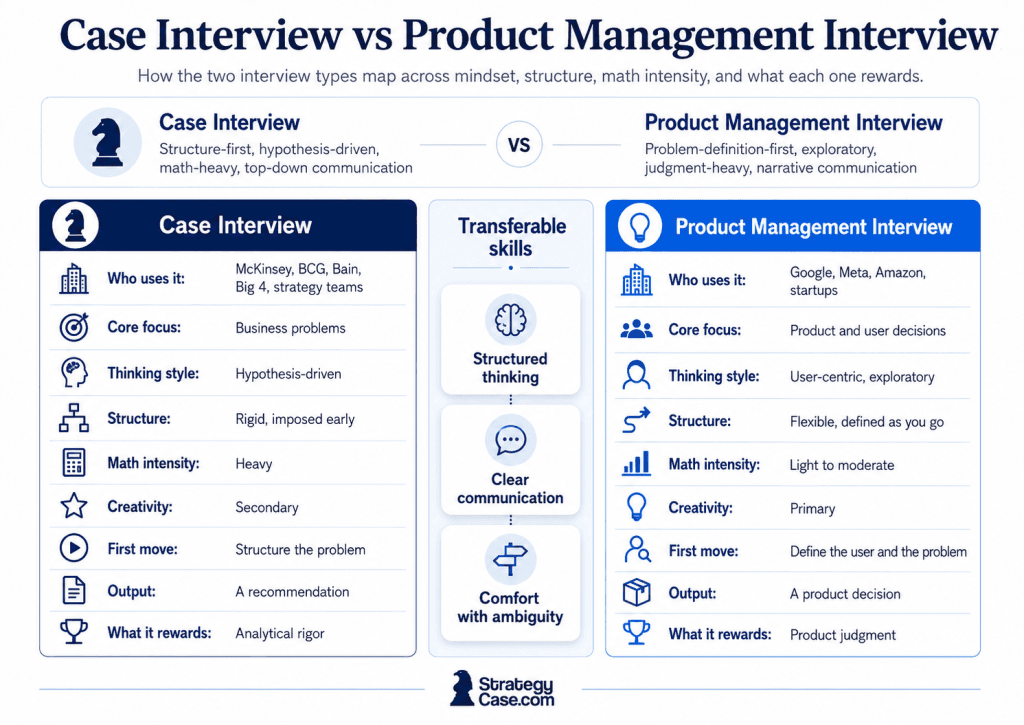
Here is the comparison at a glance.
| Dimension | Case Interview | Product Management Interview |
|---|---|---|
| Who uses it | McKinsey, BCG, Bain, Big 4, strategy teams | Google, Meta, Amazon, startups |
| Core focus | Business problems | Product and user decisions |
| Thinking style | Hypothesis-driven | User-centric, exploratory |
| Structure | Rigid, imposed early | Flexible, defined as you go |
| Math intensity | Heavy | Light to moderate |
| Creativity | Secondary | Primary |
| First move | Structure the problem | Define the user and the problem |
| Output | A recommendation | A product decision |
| What it rewards | Analytical rigor | Product judgment |
The Skill Differences That Decide the Outcome
Four differences separate a strong case answer from a strong PM answer. Get these backward and the rest of your prep will not save you.
Structure-first vs problem-definition-first
A case interview asks you to impose structure on an ambiguous problem immediately. The goal is a clean, MECE breakdown that guides the analysis.
A PM interview flips that. Before solving anything, you define the problem: who is the user, what is the core need, and what does success look like. The mistake I see most from consultants moving into PM loops is reaching for a framework before they have earned the right to use one. In a case, that reflex wins. In a PM interview, it reads as someone who did not listen.
Hypothesis-driven vs exploratory
In a case, strong candidates form a point of view early and test it with targeted analysis. That focus is the whole point; it keeps you from boiling the ocean.
In a PM interview, the same speed works against you. You are expected to explore users, constraints, and directions before you narrow down. Lock onto a hypothesis too soon and you solve the wrong problem confidently.
Quantitative rigor vs qualitative judgment
Case interviews lean hard on numbers. You estimate market sizes, run calculations, and read charts accurately while the clock runs. Shaky math is one of the fastest ways to lose a case.
PM interviews still use numbers, mostly in metrics questions, but the weight sits on qualitative judgment: understanding behavior, weighing trade-offs, and prioritizing by impact. A perfect calculation does not rescue a weak product instinct.
Communication: top-down vs narrative
Case communication is top-down and tight. You lead with the answer, organize the supporting logic, and cut anything that does not move you forward.
PM communication is more of a narrative. You walk through your reasoning, surface trade-offs out loud, and iterate as the conversation develops. The same answer delivered in the wrong style lands badly in the other room.
Which Skills Transfer Between Consulting and Product Management
This matters because consultants are one of the largest feeder pools into product management, and plenty of candidates run both processes at once.
The skills that carry over cleanly:
- Structured thinking. Breaking a messy problem into parts helps everywhere.
- Clear communication. Both rooms reward people who are easy to follow.
- Comfort with ambiguity. Neither interview hands you clean inputs.
The skills that do not transfer, and quietly hurt you:
- The framework reflex. A consultant’s instinct to structure first can stop a PM candidate from ever defining the user.
- Answer-first speed. The hypothesis-driven pace that wins cases looks like jumping to conclusions in a PM loop.
- Math dominance. Strong case math earns little credit when the question is really about judgment.
If you are a consultant eyeing a PM move, the transition is common and doable, and it is one of the well-trodden consulting exit opportunities. Just know that your biggest case-interview strengths need re-tuning, not reuse.
Interview Question Examples
Seeing the questions side by side makes the difference concrete.
Case interview examples
Case questions revolve around a business problem with a clear objective:
- “Why is customer satisfaction declining?”
- “How can we reduce employee turnover?”
- “Estimate the market size for product Y.”
These ask you to break the problem into a structure, analyze data, test hypotheses, and drive to a supported answer. For dozens of worked examples, see our collection of real case interview examples.
Product management interview examples
PM questions are open-ended, with no single correct answer:
- “Design a product for college students.”
- “How would you improve Instagram?”
- “What metric would you track for feature Y?”
These ask you to identify and prioritize user needs, define the problem before solving it, weigh trade-offs, and justify your decisions. The emphasis is judgment and user understanding, not a “right” conclusion.
Which Interview Is Harder?
This is the most common question I get, and it is framed incorrectly.
Difficulty is not absolute. It depends on whether your instincts already match the format. Case interviews feel harder if you are uncomfortable with numbers and fast structured reasoning. PM interviews feel harder if you lean on rigid structure and have not built user intuition.
The honest answer: both have a brutal bar, because you are not judged in isolation. You are judged against a pool of strong candidates, and at the top firms only about 1 in 100 applicants gets through. Hiring cycles have lengthened and more screening now runs through AI-assisted tools, which raises the bar further. Pick the format that fits how you already think, then close the gap on the rest.
How to Prepare for Each
The prep approaches share a backbone (deliberate practice with feedback) but diverge sharply in what you drill.
How to prepare for case interviews
Case prep should be skill-driven, not framework-driven. Memorizing templates is exactly the habit that gets candidates rejected.
Focus on:
- Structuring: turning ambiguous problems into clear, logical breakdowns.
- Math under pressure: fast, accurate calculations.
- Chart interpretation: pulling the insight out of an exhibit quickly.
Practice with live cases and partners, plus targeted drills that isolate one weak skill at a time. If you want a system that mirrors how top firms actually evaluate candidates, StrategyCase’s Case Interview Academy bundles the theory, real cases, and skill drills end to end, and our case interview guide is a free place to start.
How to prepare for product management interviews
PM prep needs a different mindset. Structure helps, but judgment and user focus decide the outcome.
Focus on:
- Product frameworks used lightly, as a prompt, never a script.
- User thinking: understanding needs and behavior before features.
- Prioritization: making clear, defensible trade-offs.
Practice product design and strategy questions across different contexts, and run mock interviews to sharpen how you reason out loud. The goal is to think like a PM, not to recite answers.
Can You Prepare for Both at the Same Time?
There is overlap, but the underlying mindsets pull in different directions, which makes parallel prep harder than it looks.
The overlap is real: structured thinking and clear communication help in both. The conflict is also real: a case rewards analytical, hypothesis-driven speed, while a PM interview rewards user-centric exploration. Train them together from day one and most candidates blur the two and underperform in both.
The approach that works:
- Prioritize one format first, usually the one tied to your nearer deadline or stronger instinct.
- Build a genuine foundation in that format.
- Then adapt deliberately to the second, naming out loud what changes.
Depth first, then context-switching. Not both at once.
Final Verdict: Which Path Fits You?
At a high level the divide is clean. Case interviews are structured, analytical, and hypothesis-driven. Product management interviews are user-centric, creative, and decision-focused. Both demand strong thinking and communication; they just point those skills at different targets.
Use three questions to decide where to put your energy:
- What role are you actually targeting? Consulting offers point to cases; PM roles point to product interviews. Run the process that matches the offer you want.
- Where are your instincts already strong? If numbers and structure come naturally, you have a head start on cases. If you obsess over how products feel for users, PM interviews will suit you.
- What is your timeline? With one deadline close, commit to that format now and adapt later. Splitting early is the most common way to weaken both.
Whichever you choose, success does not come from memorizing answers. It comes from building the underlying skill and applying it under pressure. If you are leaning consulting and want honest feedback on where you actually stand, book a 1-on-1 session with StrategyCase and we will pressure-test your case performance before the real thing does.
Frequently Asked Questions
What is the main difference between a case interview and a product management interview?
A case interview centers on structured business problems and rewards hypothesis-driven analysis. A product management interview centers on product and user decisions and rewards judgment, prioritization, and problem definition. The format is similar; the mindset is not.
Is a case interview harder than a product management interview?
It depends on your strengths. Analytical candidates who are comfortable with math and structure usually find cases more natural. Creative, user-focused candidates often do better in PM interviews. Both have a high bar at top firms.
Do product managers need case interview skills?
Partly. Structured thinking and clear communication transfer well and help in PM work. But PM roles need user understanding and prioritization that a pure case-interview skill set does not cover, so treat case skills as a foundation, not the finished product.
Can a management consultant switch to product management?
Yes, and many do; it is one of the most common consulting exits. The shift is mostly mental: you trade answer-first, framework-led thinking for user-first problem definition. Your structuring and communication carry over, but your fastest case instincts need re-tuning.
Can I prepare for case interviews and PM interviews at the same time?
You can, but it is rarely efficient. The two mindsets conflict, so most candidates do better preparing for one format deeply, then adapting to the second, rather than splitting attention from day one.
Are product management case study interviews the same as consulting case interviews?
No. A “PM case study” still judges product sense and user judgment, even when it looks like a business case. A consulting case judges structured, quantitative problem-solving. Same word, different bar, so prepare for the one the company actually runs.
About the Author: Florian Smeritschnig is a former McKinsey Senior Consultant who spent five years at the firm and evaluated candidates on the other side of the recruiting table. Since then he has delivered 2,200+ mock interviews and coaching sessions and helped hundreds of candidates win offers at McKinsey, BCG, Bain, and other top firms.
