

Last Updated on July 9, 2026
Updated July 2026 by Florian Smeritschnig, former McKinsey Senior Consultant.
At the case interview stage, roughly 10 to 15% of candidates who reach a McKinsey, BCG, or Bain interview walk away with an offer. Zoom out to everyone who applies, and the overall case interview success rate at MBB falls below 1%. Tier-2 firms and the Big 4 strategy arms are more forgiving, but less than most candidates hope.
Here is the part that trips people up: your real odds are not one number. They are the product of every stage in the full recruiting funnel, and the case interview is only the most visible one. Most candidates fixate on case odds while the CV screen and the online assessment quietly reject 80 to 90% of applicants before a single case begins.
I spent five years at McKinsey as a Senior Consultant evaluating candidates, and I have delivered 2,200+ mock interviews and coaching sessions since. This guide gives you the real case interview success rates by firm and by stage, why they sit so low, what changed in 2026, and the specific levers that move your personal odds toward the 1%.
Key Takeaways
- Once you reach the case rounds, offer rates are about 10-15% at McKinsey, BCG, and Bain, 15-20% at Tier-2 firms, and 20-25% at Big 4 strategy divisions.
- Overall, from application to offer, MBB sits under 1%. Most rejections happen at the CV screen and online assessment, not in the case itself.
- Firms do not publish these numbers. The ranges here are calibrated estimates, anchored to public application and hiring volumes plus first-hand evaluation experience.
- The bar rose in 2026: McKinsey’s headcount fell more than 10%, its biggest drop on record, so firms are inviting and hiring fewer candidates (Fortune).
- Success is skill-based, not luck-based. The candidates who convert train real problem-solving skills, not memorized frameworks.
What “Case Interview Success Rate” Actually Means
The case interview success rate is the share of candidates who pass the case interview stage and receive an offer. It comes in two very different flavors: the case-stage rate (offers divided by candidates who actually reached a case interview) and the overall rate (offers divided by everyone who applied). Confusing the two is the single most common mistake candidates make when they judge their odds.
The case-stage rate is the number you can influence with preparation. It answers: “Once I am in the room, what are my chances?” The overall rate folds in the CV screen, referrals, and online assessments, most of which happen before you ever solve a case.
Both matter, but for different reasons. The overall rate tells you how selective the firm is. The case-stage rate tells you what your prep actually buys you. Throughout this guide, every table labels which one it is showing.
Case Interview Success Rate by Firm (2026)
Here is the by-firm breakdown for the two rates that matter. Read the case-stage column as “your odds once you reach the interview,” and the overall column as “your odds the day you hit submit on the application.”
| Firm / Tier | Case stage (interview → offer) | Overall (applied → offer) |
|---|---|---|
| McKinsey | ~10-15% | under 1% |
| BCG | ~10-15% | ~1% |
| Bain | ~10-15% | ~1% |
| Tier-2 (Oliver Wyman, Roland Berger, Kearney, LEK) | ~15-20% | ~1-3% |
| Big 4 strategy (Deloitte S&O, Strategy&, Monitor, EY-Parthenon) | ~20-25% | ~2-5% |
How I built these numbers. No consulting firm publishes stage-by-stage pass rates. These figures are my estimates, anchored to two things: the firms’ own publicly reported application and hiring volumes (McKinsey alone fields around 1 million applications a year and hires roughly 1% of them, per CNBC and Fortune reporting), and five years evaluating candidates at McKinsey plus 2,200+ mock interviews since. Treat them as well-calibrated ranges, not audited statistics.
McKinsey Case Interview Success Rate
McKinsey runs the most selective front end of any firm. Brand pull drives extreme application volume, and the McKinsey Solve assessment adds a filter before interviews even begin (the firm has said its problem-solving game reached more than 150,000 candidates in a single stretch, per Fortune). Once you reach the McKinsey case interview, the offer rate is roughly 10 to 15% across rounds. Overall, from application to offer, McKinsey sits under 1%.
BCG Case Interview Success Rate
BCG tends to invite slightly more candidates to interviews than McKinsey, but the in-room bar is just as high. Case-stage offer rates land around 10 to 15%, with an overall rate near 1%. The idea that BCG is “easier” than McKinsey is mostly a myth: the front-end screen is a touch wider, the interview standard is not lower. For more, see our BCG case interview guide.
Bain Case Interview Success Rate
Bain leans harder on referrals and targeted recruiting, so a slightly higher share of its interview pool is pre-qualified. That can make the case-stage rate feel marginally friendlier, around 10 to 15%, with an overall rate near 1%. Do not mistake a warmer process for a softer bar. Bain’s final-round expectations match McKinsey’s and BCG’s. See our Bain case interview guide for more.
Tier-2 Firms (Oliver Wyman, Roland Berger, Kearney, LEK)
Tier-2 strategy firms are genuinely more attainable, but “more attainable” still means competitive. Case-stage offer rates run about 15 to 20%, and overall rates land in the 1 to 3% range. These firms field fewer applications than MBB and often move faster, which rewards candidates who prepare early.
Big 4 Strategy Divisions (Deloitte S&O, Strategy&, Monitor, EY-Parthenon)
The strategy arms of the Big 4 are the most forgiving of the group, with case-stage offer rates around 20 to 25% and overall rates of roughly 2 to 5%. They hire in larger volumes and screen slightly less aggressively at the top of the funnel. The case format still tests the same core skills, so strong preparation transfers directly to MBB later.
The Full Funnel: Where Candidates Actually Get Cut
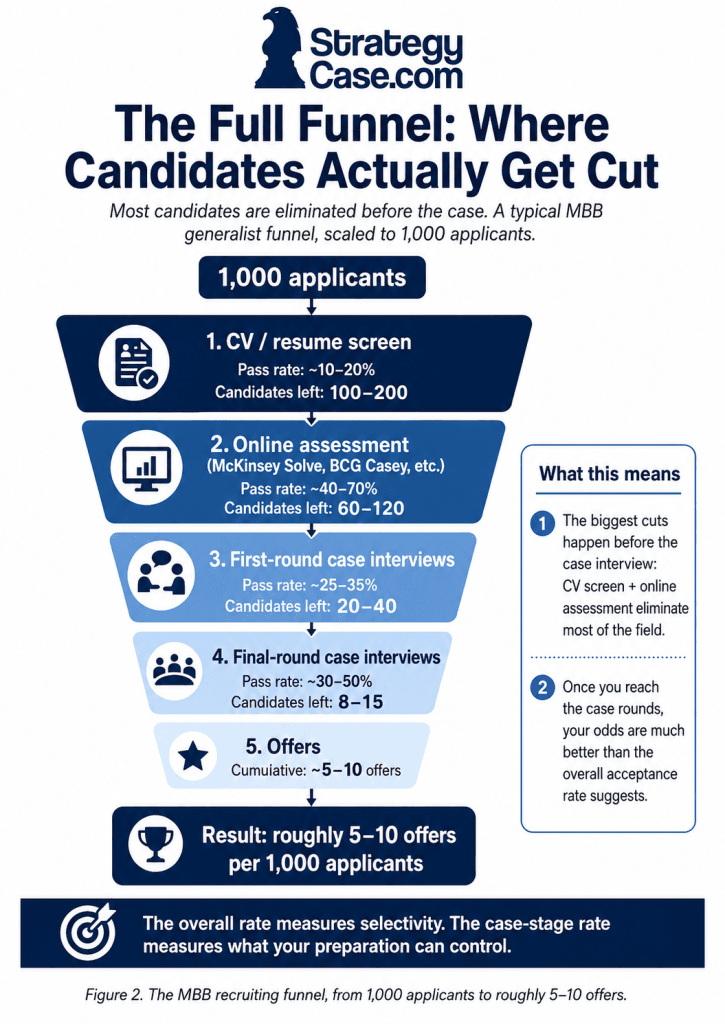
The case interview success rate looks brutal until you see where the cuts happen. Most candidates are eliminated before the case, not during it. Here is the funnel for a typical MBB generalist role, scaled to 1,000 applicants so the math is easy to follow.
| Funnel stage | Pass rate | Candidates left (per 1,000 who apply) |
|---|---|---|
| CV / resume screen | ~10-20% | 100-200 |
| Online assessment (McKinsey Solve, BCG Casey, etc.) | ~40-70% | 60-120 |
| First-round case interviews | ~25-35% | 20-40 |
| Final-round case interviews | ~30-50% | 8-15 |
| Offer | cumulative | ~5-10 |
Two things jump out. First, the CV screen and the online assessment do most of the filtering: by the time you reach a first-round case, 85 to 90% of the original field is already gone. Second, once you are in the case rounds, your odds are far better than the sub-1% overall number suggests. That is the whole point. The overall rate measures the firm’s selectivity. The case-stage rate measures what your preparation can control.
Why Case Interview Success Rates Are So Low
Three forces stack on top of each other to push the numbers down.
You compete against a pre-selected field. By the case round, everyone left is smart, credentialed, and prepared. The screen already removed the weak applications. Passing means beating people who are as capable as you are, on a skill most of them have practiced for months.
You have to perform consistently, not once. A single strong case is not enough. MBB runs two rounds with two to three cases each, plus a fit interview in every one. One flat case in the final round can undo four strong ones. The bar is sustained excellence across five or six separate evaluations.
The real standard is higher than “get the right answer.” Interviewers are not checking whether you reached a number. They are testing how you structure ambiguity, how you reason with incomplete data, how you communicate under pressure, and whether they would put you in front of a client next month. That is a much taller bar than most prep material prepares you for.
The Biggest Misconception About Your Odds
Most candidates treat the case interview like a test with a memorizable answer key. Learn the frameworks, run the templates, and the offer follows. That belief is exactly why so many well-prepared people still fail.
Modern MBB evaluation is skill-based, not recall-based. Interviewers can spot a memorized framework in seconds, and it works against you. They want to see original structuring built for the specific problem in front of you, not a profitability template you pattern-matched from a casebook. This gap between how candidates prepare and what firms actually test is the core reason preparation so often misses the mark.
This matters more in 2026 than it did five years ago. As firms lean on AI for the routine analytical work, the human bar in interviews shifts toward judgment, creativity, and communication, the parts a model cannot replace. The candidates who convert are the ones who can think, not the ones who can recite.
What Actually Drives Case Interview Success
When I evaluated candidates, offers clustered around a handful of skills. Volume of cases practiced was not one of them.
The skills that separate offers from dings:
- First-principles structuring. Building a tailored, MECE approach to a novel problem, not forcing a stock framework onto it.
- Case math under pressure. Fast, accurate mental math with clean setup and no calculator panic.
- Data and chart interpretation. Pulling the “so what” from an exhibit quickly and turning it into a next step.
- Hypothesis-driven thinking. Leading with a view and testing it, instead of analyzing everything and hoping an answer appears.
- Executive communication. Answer-first, structured, concise, the way a consultant briefs a partner.
What the top few percent of candidates do differently is subtle: they drive the case instead of waiting to be led, they connect each analysis back to the client’s actual decision, and they stay composed when the interviewer pushes. None of that comes from grinding 100 cases. It comes from deliberate skill-building, which is the opposite of how most people prepare.
How to Improve Your Own Case Interview Success Rate
You cannot change the firm’s selectivity. You can change your case-stage rate, and that is where your effort pays off. Three steps, in order.
Step 1: Train core skills, not frameworks. Break the case into its component skills (structuring, math, charts, communication) and drill each one until it is automatic. Isolated skill work fixes weaknesses that full cases only hide. The StrategyCase Case Interview Academy is built around exactly this progression, because skill-first beats volume-first every time.
Step 2: Practice on realistic, modern cases. Once the fundamentals hold, run full cases that reflect how MBB actually interviews today, not recycled 2015 casebook problems. Quality and realism beat quantity. Twenty well-chosen cases with reflection outperform 80 done on autopilot.
Step 3: Get high-quality feedback. You cannot see your own blind spots. Feedback from someone who has evaluated real candidates is the fastest way to close the gap between “I finished the case” and “I would have hired you.” That honest, specific input is what 1-on-1 coaching with a former McKinsey evaluator exists to provide.
Case Interview Success Rate by Candidate Type
Your background shifts your odds well before the case begins, mostly by changing how likely you are to clear the CV screen.
Target-School Candidates
Recruits from core target schools enter with the highest overall rates, because the CV screen and on-campus pipeline favor them. Once inside the case rounds, though, the bar is identical to everyone else’s. A target-school pedigree gets you the interview; it does not solve the case for you.
Experienced Hires
Professionals moving in from other industries face a tougher screen and often skip the campus pipeline entirely, so their overall rate is lower. But strong candidates convert well once interviewing, because real business experience shows up in how they handle ambiguity. If you are switching in, our guide to the experienced-hire case interview covers what changes.
Non-Traditional Backgrounds
Non-target and unconventional candidates carry the steepest overall odds, driven almost entirely by the screen. The case round itself is a level playing field. Every year, candidates from non-target schools out-case Ivy League MBAs, because the interview rewards demonstrated skill, not the name on your degree. See our guide on getting into consulting with a non-traditional background.
Bottom line: background moves your overall rate by changing your odds of getting the interview. It barely moves your case-stage rate. Once you are in the room, preparation is the great equalizer.
Case Interview Odds vs Other Competitive Careers
For context, here is how consulting stacks up against the paths candidates most often weigh it against.
- Investment banking. Comparable overall selectivity at bulge-bracket firms, but the interview tests technical finance knowledge you can memorize. The case interview tests live problem-solving you cannot.
- Tech product management. Similar single-digit acceptance rates at top firms, with interviews spread across product sense, analytics, and behavioral rounds rather than concentrated in the case.
- Big 4 audit and accounting. Meaningfully higher acceptance rates than strategy consulting, with a less demanding interview bar.
What makes consulting fundamentally different is that the interview is not a knowledge test you can cram. It is a skills test that mirrors the actual job. That is why preparation quality, not raw intelligence or a memorized playbook, is what predicts who gets the offer.
Has the Bar Changed in 2026?
Yes, and it moved against candidates. After years of aggressive growth, MBB slowed hiring sharply. McKinsey’s headcount fell more than 10% over roughly 18 months, the largest decline in the firm’s history, per Fortune. Fewer open seats means fewer interview invitations and fewer offers from the same or larger applicant pool.
At the same time, AI is reshaping consulting hiring: firms need fewer junior analysts for routine analytical work, so they raise the human bar for the ones they do hire. The practical effect on your odds is simple. The case-stage rates in this guide are, if anything, tightening, and the premium on genuine skill over memorized frameworks has never been higher.
Final Verdict: How Hard Is It Really?
Breaking into consulting is one of the hardest career moves out there. Overall odds under 1% at MBB are real, and 2026’s hiring slowdown made them tougher. But that number describes the firm’s selectivity, not your ceiling.
Here is what actually determines the outcome. The overall rate is set by the screen, which is largely fixed by the time you apply. The case-stage rate, 10 to 15% at MBB, is set by your preparation, and preparation is fully within your control. Consulting is one of the few elite paths where skill development translates almost directly into results. What you practice, and how you practice it, decides which side of the 10-15% you land on.
If you want to prepare the way the candidates who convert actually prepare, skills first, real feedback, modern cases, start with the StrategyCase Case Interview Academy or book a coaching session with a former McKinsey consultant. The odds are long. They are also beatable.
Frequently Asked Questions
What percentage of candidates pass the McKinsey case interview?
Roughly 10 to 15% of candidates who reach McKinsey’s case rounds receive an offer. Across everyone who applies, McKinsey’s overall success rate is under 1%, because most candidates are cut at the CV screen and the McKinsey Solve assessment before any case begins.
Is BCG easier to get into than McKinsey?
Only slightly, and mostly at the front end. BCG invites a marginally wider interview pool, but the in-room case bar is just as high, with a similar 10 to 15% case-stage offer rate. The “BCG is easier” idea is largely a myth.
What is the hardest consulting firm to get into?
By overall acceptance rate, McKinsey is the most selective of the big firms, driven by the highest application volume and an extra assessment filter. At the case stage itself, McKinsey, BCG, and Bain are roughly equal in difficulty.
What percentage of final-round candidates get an offer?
In the final round, roughly 30 to 50% of candidates convert to an offer at MBB. The final round is where offers are decided, but the pool reaching it is already tiny, usually under 2% of original applicants.
Can you pass a case interview without prior consulting experience?
Yes. Most successful candidates have no consulting background. The case interview tests structuring, quantitative reasoning, and communication, all of which are learnable skills. Preparation quality matters far more than prior industry experience.
How many case interviews do you have to pass to get an MBB offer?
Expect two rounds with two to three cases each, so five or six cases total, plus a fit interview in every round. You have to perform consistently across all of them; one weak case in the final round can cost you the offer.
Related Guides
- Consulting Case Interviews: A Comprehensive Guide
- The Big 3 Consulting Firms: McKinsey, BCG, and Bain
- What Separates Successful Case Interview Candidates
- Case Interview Frameworks (and Why Memorizing Them Backfires)
- What Are the Big 4 Consulting Firms?
About the author: Written by Florian Smeritschnig, founder of StrategyCase.com and a former McKinsey Senior Consultant who evaluated candidates at the firm and has since delivered 2,200+ mock interviews and coaching sessions, helping 700+ candidates secure offers at McKinsey, BCG, Bain, and other top firms.
