
Last Updated on September 18, 2026
By Florian Smeritschnig, former McKinsey Senior Consultant · Updated September 2026
“Give me an example of a time you led a group to achieve a difficult goal.” It sounds like a softball question before the case. It isn’t. Most candidates reach for the story where they had a title (captain, president, project lead) and let the title do the talking. In a consulting fit interview, that story falls flat, because consultants lead without authority from day one, and that is exactly what this leadership question is built to test.
The strongest answers for leadership questions in a consulting interview pick a moment when you moved a group, then structure it with the SCORE method so the interviewer hears influence, not a job title.
I evaluated candidates at McKinsey and have coached hundreds into MBB. Below are the story-selection rules, the structure, and three word-for-word sample answers.
Key Takeaways
- The leadership question tests influence, not authority. The best stories are ones where you led people who did not report to you.
- Firms grade a “line, not a dot”: they want a pattern of leadership across your life, not one lucky highlight.
- Structure every answer with SCORE (Situation, Complication, Outcome expected, Remedial actions, End result) and spend ~80% of your airtime on Remedial actions, the part that shows what you did.
- You do not need a formal title. A student who unstuck a stalled group project often beats a “team captain” who just held a role.
- McKinsey, BCG, and Bain weight leadership differently. Calibrate the same story to each firm instead of memorizing three separate ones.
What the Leadership Question Is Really Testing
When a consulting firm asks you to describe leading a group to a difficult goal, it is not collecting a nice story. It is checking three things at once, and most candidates only answer the first.
Can you influence people? Consultants arrive on a client team with no line authority over anyone in the room, often people two decades more senior. The job is to move that group anyway. So the interviewer is listening for whether you create alignment, not whether you were “in charge.”
Do you have a drive to achieve? A “difficult goal” only counts if it was genuinely at risk. Firms want evidence you push past the point where most people quit, and that you set a bar higher than what was asked of you.
Can you solve the underlying problem? Leadership in consulting is not cheerleading. It is diagnosing why a group is stuck and removing that specific blocker. The best stories show a clear, structured intervention, not generic motivation.
There is a fourth thing firms check that candidates rarely think about: consistency. Interviewers want leadership to be a line through your life, not a single dot. One impressive story raises the question of whether it was a fluke. When I evaluate candidates, a strong leadership answer almost always connects to other moments in the conversation, the way the candidate describes their internship, a side project, a sports team.
The dots formed a line. Pick a story you can defend as part of a pattern.
How to Pick Your Leadership Story
Story selection decides most of the outcome before you say a word. Get this wrong and no amount of polish saves the answer.
The single most common mistake I see across 2,200+ coaching sessions: candidates pick the story with the most impressive title instead of the most impressive influence. “I was president of the 400-member student association” sounds big, but if the story is really about running meetings and delegating, it shows administration, not leadership.
The interviewer learns that you held a role, not that you can move people.
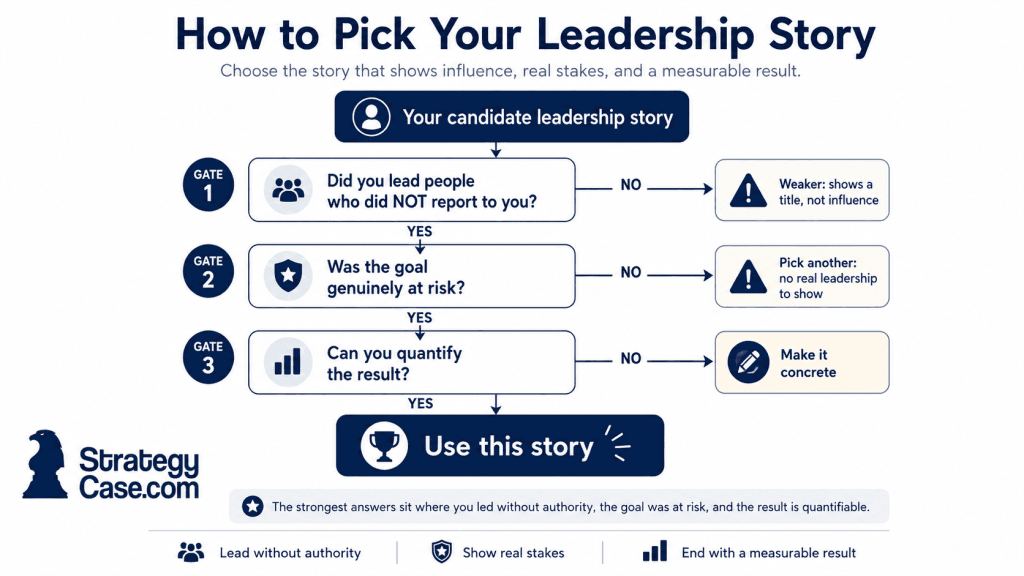
Run every candidate story through three filters:
- Did you lead without formal authority? The strongest stories are ones where nobody had to follow you and they did anyway. A title is fine, but the moment inside the story should be about earning followership, not exercising it.
- Was the goal truly at risk? If success was always likely, there is no leadership to demonstrate. You need a real complication: a deadline about to slip, a team splitting, a resource pulled, a stakeholder blocking you.
- Can you quantify the result? Vague endings (“it went well”) read as fiction. You need a number or a concrete, verifiable outcome.
What If You Have No Formal Leadership Experience?
This is the worry I hear most from students and career changers, and it is almost always misplaced. You do not need a manager title. You need a moment where a group was stuck and you were the one who unstuck it.
Look in places you are discounting. A class project where two people clashed and you brokered the path forward. A volunteer event that was falling apart logistically. A workplace where you were the most junior person but ended up coordinating a deliverable across two teams because nobody else would. A sports team, a club, a family business, a hackathon. Informal leadership is more convincing for consulting, not less, because it mirrors exactly how the job actually works.
If you genuinely cannot find one story, that is useful feedback: go create one in the months before you apply. Volunteer to own something hard. That is also the honest answer to why depth of preparation matters more than another practice case.
Structure Your Answer With the SCORE Method
Once you have the story, structure carries it. I recommend the SCORE method over STAR for consulting fit interviews because it forces you to make the stakes explicit, which is where leadership answers usually go thin.
| Step | What it covers | How long |
|---|---|---|
| S: Situation | The context: project, team, your role, the goal. Just enough to orient. | ~10% |
| C: Complication | The specific thing that put the goal at risk. The tension. | ~5% |
| O: Outcome expected | What would have happened if nobody intervened. Raises the stakes. | ~2.5% |
| R: Remedial actions | What you did, decision by decision, to move the group. | ~80% |
| E: End result | The quantified outcome plus one sharp lesson. | ~2.5% |
The discipline that matters: spend most of your airtime on Remedial actions, told in the first person. This is the part interviewers grade, and it is the part nervous candidates rush. “We aligned and delivered” is not an action. “I met each member one-on-one, found the real disagreement was about scope, and proposed a decision rule we could all live with” is.
Two failure modes to avoid. Hiding behind “we” so heavily that your individual contribution disappears (the interviewer cannot score a team). And the opposite, claiming sole credit so hard that you sound like someone who steamrolls colleagues. Consulting wants both: clear personal ownership and genuine team orientation. Say “I” for your decisions and “the team” for the win.
Sample Answers: Leading a Team to a Difficult Goal
Below are three full answers using SCORE, calibrated to three experience levels. They are templates: swap in your real details and numbers. Notice that in all three, the leadership comes from influence, and the metrics are concrete.
Student Example: Unsticking a Stalled Group Project
Situation: In my final year, I was one of five students on a capstone consulting project for a local food bank. Nobody was the assigned leader.
Complication: Three weeks before the deadline, the two strongest members deadlocked on direction, one wanted a broad strategy, the other a deep operational fix, and the group split into camps. Work stalled completely for about ten days.
Outcome expected: If the deadlock held, we would miss the client presentation, fail the deliverable, and embarrass the food bank in front of its board.
Remedial actions: I had no authority over anyone, so I could not just assign the answer. I met both leads separately and realized they were not actually disagreeing on strategy, they were disagreeing on scope. I proposed a simple decision rule: we would solve the one problem the food bank’s director said cost her the most volunteer hours, and nothing else. That reframed the fight from “who is right” to “what does the client need.” I split the work by each person’s strength, set three checkpoints, and took the unglamorous integration role myself so no one felt I was grabbing the spotlight.
End result: We delivered on time. The food bank adopted two of our three recommendations and cut volunteer onboarding time by roughly 30% the following quarter. I learned that without a title, leadership is mostly about creating a clear question everyone can rally around.
Early-Career Example: Driving a Cross-Team Workstream
Situation: As the most junior analyst in my group, I was asked to coordinate a project to cut our invoice-processing time, working across finance and operations, two teams I did not manage.
Complication: The two departments would not share data and openly blamed each other for the delays. Our senior sponsor was stretched thin and had effectively checked out.
Outcome expected: Without movement, the project would quietly die, and we would keep eating a processing backlog that delayed supplier payments by weeks.
Remedial actions: Because I could not order anyone to cooperate, I built a single shared metric both teams cared about: days from invoice received to paid. I ran a 15-minute standup twice a week, kept it ruthlessly short, and made the data visible to both sides so the conversation stopped being about blame. When I needed the sponsor, I escalated with one specific ask rather than a complaint, which got me a fast yes. I deliberately engineered an early quick win in week two to build momentum.
End result: We cut average processing time by about 40% over three months, and the two teams kept the standup running after the project ended. The lesson I took: influence without authority starts with finding the one number everyone already wants to move.
Experienced-Hire Example: Leading a Team Through Resistance
Situation: I led a 12-person team to launch a new customer portal on a deadline that could not move, just after a reorganization.
Complication: Half the team had been reassigned from a project that was abruptly cancelled. Morale was low, and several people assumed they would be cut next, so they were quietly disengaging at the exact moment I needed them.
Outcome expected: If I did not turn that around, we would see attrition mid-project and miss a launch that the commercial team had already promised to clients.
Remedial actions: I was transparent about what I did and did not know about the reorganization, rather than pretending it had not happened. I re-scoped roles to match people’s real strengths instead of their old job descriptions, which gave the skeptical half visible ownership. I negotiated a two-week buffer from leadership by presenting a realistic re-plan with milestones instead of asking for vague “more time.” And I paired the most skeptical engineers with the two people who were still energized, so momentum spread sideways rather than top-down.
End result: We launched on the revised date with zero mid-project attrition, and the portal hit 25% adoption in its first quarter against a 15% target. It reinforced something I now coach: in a crisis, people follow the leader who tells them the truth and gives them something concrete to own.
How McKinsey, BCG, and Bain Calibrate Leadership Differently
The same story works at all three firms, but you should adjust the emphasis. Do not memorize three separate stories. Calibrate one.
| Firm | What to dial up | Note |
|---|---|---|
| McKinsey | Creating the environment where the team can succeed. | McKinsey runs this as the Personal Experience Interview. Prepare the Leadership dimension specifically. |
| BCG | Curiosity, creativity, and how you brought a divided group along. | BCG looks for the collaborative, driven “BCGer.” Show you energized people, not just a plan. |
| Bain | Results, likability, and team-first framing (“a Bainie never lets another Bainie fail”). | Bain weights whether people would want to work with you. Lead with warmth and a clean result. |
McKinsey is the important caveat. It assesses leadership through a tightly structured format with deep follow-up questions, so a loose story gets exposed fast. If McKinsey is your target, work through the dedicated McKinsey PEI Leadership dimension guide, which goes far deeper than the firm-agnostic version here.
Mistakes That Sink a Leadership Answer
After hundreds of mock fit interviews, the same errors cost candidates the answer:
- The logistics story in disguise. “I organized the event” is project management, not leadership. If there was no group to align and no resistance to overcome, pick another story.
- No real complication. If the goal was never genuinely at risk, there is nothing to lead through. The interviewer needs tension.
- Disappearing into “we.” Use the team for the credit and “I” for the decisions. If your specific actions are not clear, you cannot be scored.
- Round, unverifiable numbers. “Improved everything by 50%” reads as invented. Use a number you could defend if pushed.
- Speaking badly about teammates. Describing the conflict is good. Trashing the people in it signals you would be hard to staff.
- Rambling. Aim for two to three minutes. A leadership answer that runs five minutes tells the interviewer you cannot prioritize, which is itself a leadership flaw.
Confidently Answer Every Consulting Fit Question
The leadership question rewards candidates who understand what consulting leadership actually is: moving a group you have no authority over, toward a goal that was genuinely at risk, with a clear and structured intervention you can take credit for. Pick the story where you earned followership, structure it with SCORE, and calibrate it to your target firm.
If you want every fit question handled with the same depth, our Consulting Fit Interview Masterclass is a 5-hour program built from real McKinsey evaluation experience. It walks through the full trait map, dozens of example answers, and the exact stories that win offers, so you walk in ready for whatever the interviewer throws at you. For targeted feedback on your specific stories, 1-on-1 coaching with Florian pressure-tests them the way a real interviewer will.
Related Guides
- Consulting Fit Interview Guide: the complete trait map and question bank this question sits inside.
- “Tell Me About Yourself”: the opening-pitch question.
- “Walk Me Through Your Resume”: the chronological-story question.
- Strengths and Weaknesses in a Consulting Interview: the self-awareness question.
- BCG Fit Interview: Deep dive
- Bain Fit Interview: Deep dive
Frequently Asked Questions
What is a good example of leading a team to achieve a difficult goal?
The best examples are ones where you led people who did not report to you, through a goal that was genuinely at risk. A student who unstuck a deadlocked group project, an analyst who drove a deliverable across two uncooperative teams, or a manager who held a demoralized team together through a reorganization all work well. Avoid pure logistics stories where you organized something but never had to align or persuade anyone.
How do I answer this question if I have never had a leadership title?
You do not need a title. Find a moment when a group was stuck and you were the one who moved it forward: a class project, a volunteer effort, a workplace task nobody owned. Informal leadership is actually more convincing for consulting, because consultants lead without authority every day on client teams.
How long should my leadership answer be?
Two to three minutes. Spend about 80% of that on what you personally did (the Remedial actions step in SCORE). An answer that runs past five minutes signals you cannot prioritize, which works against you.
Should I use “I” or “we” in my answer?
Both, deliberately. Use “I” for the specific decisions and actions you took, and “the team” or “we” for the final win. Hiding behind “we” makes you unscoreable; claiming all the credit makes you sound like someone who steamrolls colleagues.
Is the McKinsey leadership question different from BCG and Bain?
The question is similar, but McKinsey runs it as a highly structured Personal Experience Interview with deep follow-up probing, so a loose story gets exposed. BCG leans toward curiosity and collaboration, and Bain weights likability and results. Calibrate one strong story to each firm rather than preparing three different ones.
Can I use the same story for the leadership question and other fit questions?
You can reuse a story across firms, but avoid using the exact same story for multiple questions in the same interview. Prepare a small portfolio of three to four stories so you can show a pattern of leadership (a “line”) rather than leaning on a single example.
About the author: Florian Smeritschnig is a former McKinsey Senior Consultant and the founder of StrategyCase. He spent five years at the firm, evaluated candidates, and has since run more than 2,200 mock interviews and coached hundreds of candidates into McKinsey, BCG, Bain, and other top firms.
