

Last Updated on June 23, 2026
By Florian Smeritschnig, former McKinsey Senior Consultant · Updated June 2026
At the end of a case interview, ask two or three open-ended questions about your interviewer’s own experience: their most challenging project, what surprised them about the firm, why they have stayed. Avoid anything you could find on the firm’s website, and never ask about salary, hours, or how you compare to other candidates.
You finish the case, you think it went fine, and then the interviewer leans back and says: “So, do you have any questions for me?” A lot of strong candidates freeze right here and mumble “No, I think you covered everything.” That closing exchange is the last thing your interviewer remembers when they write you up minutes later, and a flat non-answer can quietly drag down an otherwise solid performance.
I spent five years at McKinsey as a Senior Consultant.. After 2,200+ mock interviews and coaching sessions since, I can tell you the candidates who handle the final five minutes well are the ones who treat it as a real conversation, not a box to tick. Below are the exact questions to ask at the end of a case interview, the ones to never ask, and how to deliver them so they land.
Key Takeaways
- The end-of-interview Q&A is rarely a formal scored line on the MBB rubric, but it shapes the written comment your interviewer files and can tip a close call.
- The strongest questions are personal and open-ended: ask about your interviewer’s own experience, not facts you could Google.
- Prepare four or five questions and plan to ask two or three. Some will get answered naturally during the conversation.
- Asking nothing reads as low interest; asking six or more turns the moment into an interrogation.
- Never ask about salary, hours, or vacation before you have an offer, and never ask how you compare to other candidates.
Do the Questions You Ask Actually Affect Your Score?
Mostly no, and partly yes. At McKinsey, BCG, and Bain, the five minutes at the end are almost never a separate scored dimension the way your structure, math, and fit answers are. Interviewers grade you on the case and the fit portion against a defined rubric. Your questions usually sit outside it.
When I evaluate candidates, the case score goes in the box, but I still write a short free-text comment, and the debrief with the other interviewers is conversation, not a spreadsheet. A candidate who asked something sharp and genuine gives me a reason to advocate for them. A candidate who has nothing to ask gives me nothing to say. In a borderline decision, that “nothing to say” is not neutral. It quietly costs you.
So the realistic verdict: good questions rarely save a weak case, and they will not manufacture an offer on their own. But they protect a strong case, they build the personal connection that fit evaluation is partly looking for, and they hand your advocate a line to use when the room is deciding. That is reason enough to prepare.
12 Questions to Ask at the End of a Case Interview
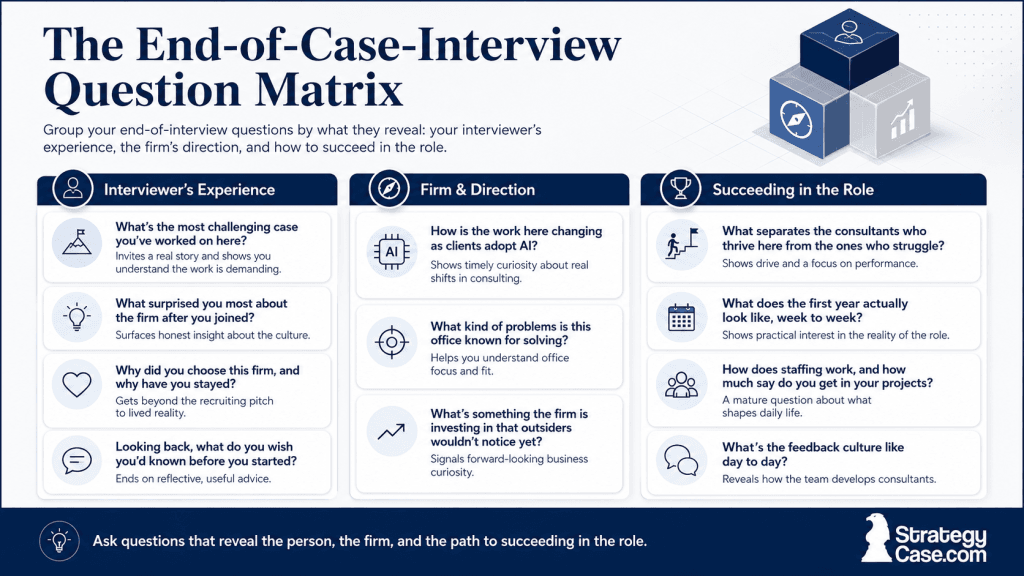
The best questions to ask your interviewer are the ones only that specific person can answer. People enjoy talking about their own experience, and when someone gets you talking about a project you are proud of, you walk away with a warm impression of them. That is the effect you want. Here are 12 questions, grouped by what they do.
Questions About Your Interviewer’s Experience
These are your highest-value questions. They are personal, open-ended, and impossible to prepare a canned answer to, so the conversation feels real.
- “What’s the most challenging case you’ve worked on here?” Invites a real story and signals you know consulting is hard and you are not put off by it.
- “What surprised you most about the firm after you joined?” Works for any interviewer at any level and almost always surfaces something honest about the culture.
- “Why did you choose this firm, and why have you stayed?” Gets at the difference between the recruiting pitch and the lived reality.
- “What do you enjoy most, and least, about the job?” The “and least” shows maturity. You want the honest picture, not the brochure.
- “Looking back, what do you wish you’d known before you started?” Ends the interview on reflective, generous advice, which leaves a good final note.
Questions About the Firm and Its Direction
These show you have thought about the business, not only the job. Use them to demonstrate genuine curiosity about where the firm is heading.
- “How is the work here changing as clients adopt AI?” Timely and specific. It shows you track what is actually happening in consulting.
- “What kind of problems is this office known for solving?” Office-level focus varies a lot, and the answer tells you whether the work fits you.
- “What’s something the firm is investing in that outsiders wouldn’t notice yet?” Open-ended and forward-looking, and it often gets the interviewer genuinely engaged.
Questions About Succeeding as a Consultant
These signal that you are already thinking about how to perform, not just how to get in.
- “What separates the consultants who thrive here from the ones who struggle?” Shows drive and gives you a real benchmark to aim for.
- “What does the first year actually look like, week to week?” Practical, and it helps you picture the role honestly.
- “How does staffing work, and how much say do you get in your projects?” A smart, mature question about the thing that shapes daily life as a consultant.
- “What’s the feedback culture like day to day?” Consulting runs on feedback, and the answer reveals a lot about the team environment.
Firm-Specific Questions: McKinsey, BCG, and Bain
The three MBB firms feel different from the inside, and tailoring one question to the firm in front of you shows real interest. Read the differences in detail in our guide to the Big 3 consulting firms, then pick a question that fits.
- McKinsey leans on structured, hypothesis-driven problem solving and the Personal Experience Interview. A good question: “How has the way the firm solves problems changed since you joined?” You can read more on McKinsey’s careers site.
- BCG prizes intellectual diversity and creative thinking. Try: “When does the team push back on the obvious answer, and how does that play out?” See BCG careers for how they frame it publicly.
- Bain is known for close, long-running client relationships and a strong internal culture. Try: “How do the relationships you build with clients here differ from what you’d expect elsewhere?” Bain describes its culture on its careers page.
One caution: do not turn a firm question into a comparison trap. “Why should I pick you over BCG?” puts your interviewer on the defensive and rarely ends well.
Tailor Your Questions to Who’s Across the Table
A first-round interviewer and a final-round partner are not the same audience. Match the question to the person.
- Junior consultants and associates (often your first round) can speak to the day-to-day with the most honesty. Ask about the real first-year experience, staffing, and feedback.
- Engagement managers and project leaders see how teams are actually run. Ask about what makes a team work well and how they develop the people under them.
- Partners and associate partners (common in the final round) think about the business and the market. Ask about where the practice is heading or what kind of work excites them most right now. Save the strategic questions for this room.
If you have several interviews in one day, prepare a different question for each person so you are never recycling the same line. Interviewers compare notes, and “she asked me a great question about X” is exactly the kind of detail that travels.
Questions You Should Never Ask
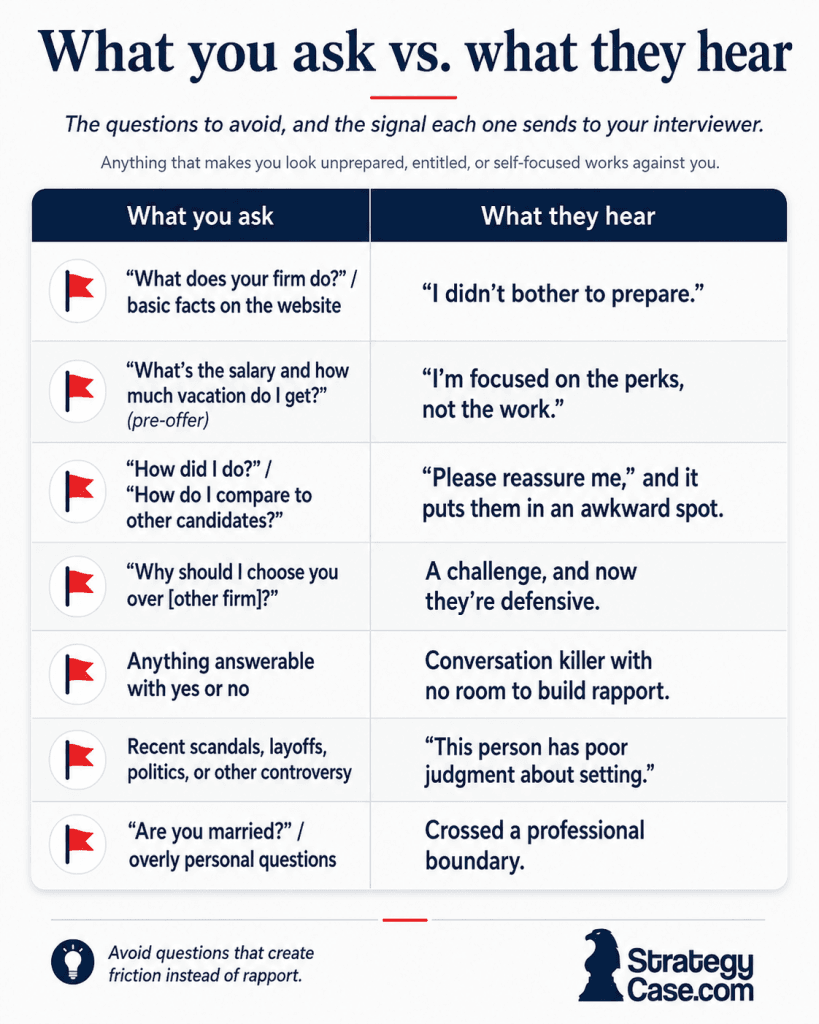
What you choose not to ask says as much as what you do. These land badly, and a few can actively cost you. The pattern is simple: anything that makes you look unprepared, entitled, or self-focused works against you.
| What you ask | What the interviewer hears |
|---|---|
| “What does your firm do?” / basic facts on the website | “I didn’t bother to prepare.” |
| “What’s the salary and how much vacation do I get?” (pre-offer) | “I’m focused on the perks, not the work.” |
| “How did I do?” / “How do I compare to other candidates?” | “Please reassure me,” and it puts them in an awkward spot. |
| “Why should I choose you over [other firm]?” | A challenge, and now they’re defensive. |
| Anything answerable with yes or no | Conversation killer with no room to build rapport. |
| Recent scandals, layoffs, politics, or other controversy | “This person has poor judgment about setting.” |
| “Are you married?” / overly personal questions | Crossed a professional boundary. |
Hold the salary, hours, and benefits questions until you actually have an offer in hand. At that point they are completely fair, and you should ask them. During the interview, they signal the wrong priorities.
How to Ask So It Feels Like a Conversation
The content of your questions matters less than how you deliver them. The goal is a genuine exchange, not a candidate reading from a mental list.
- Prepare four or five, ask two or three. Some of your questions will get answered during the case or the fit discussion. Extras keep you from going blank.
- Listen and follow up. The follow-up question, the one you did not prepare because it builds on their answer, is what proves you were actually listening.
- Make it specific to them. “You mentioned you moved offices, how did that come about?” beats any generic question you could have asked anyone.
- Do not interrogate. Two thoughtful questions with real back-and-forth beat six rapid-fire ones.
- Have a recovery line. If everything you planned got covered, say so and pivot: “You actually answered most of what I was curious about during the case, but I’d love to hear what surprised you most when you joined.” That shows you were engaged the whole time.
This is the same connection skill the fit interview tests, and it is exactly what we drill in StrategyCase 1-on-1 coaching and the Fit Interview Masterclass.
FAQ Questions to Ask at the End of a Case Interviews
How many questions should I ask at the end of a consulting interview?
Aim for two to three good ones. Prepare four or five so you have backups, since some get answered during the conversation. Asking nothing signals low interest; asking six or more turns it into an interrogation.
Is it bad to have no questions for the interviewer?
Yes. “No, I’m good” is one of the weakest ways to close. It gives the interviewer nothing positive to remember and can read as low enthusiasm. Always have at least two questions ready, even if some get covered earlier.
Do the questions I ask affect whether I get the offer?
Indirectly. At MBB they are rarely a formally scored line, but they shape the written comment your interviewer files and the impression they bring to the debrief. In a close decision, a memorable question helps and an absent one hurts.
Should I ask about salary or work hours in the interview?
Not before you have an offer. Compensation, hours, and vacation questions during the interview signal the wrong priorities. Once you have an offer, they are completely appropriate and you should ask them.
What should I ask a partner in a final-round interview?
Go strategic. Ask where the practice is heading, what kind of work excites them most, or how the firm’s approach is changing. Partners think about the business and the market, so meet them there rather than asking day-to-day logistics.
Can I ask the same questions to every interviewer?
Avoid it when you can. Interviewers compare notes, and tailoring a question to each person’s role and seniority shows attention and effort. Prepare a small bank so you can vary them across the day.
Turn the Last Five Minutes Into an Advantage
The questions you ask at the end of a case interview will not win you an offer on their own, but they protect a strong performance, build a real connection, and give the person in the room a reason to speak up for you. Prepare a handful of personal, open-ended questions, keep the salary talk for after the offer, and treat the exchange as a conversation rather than a quiz.
If you want to master the connection side of consulting interviews, from your personal stories to the way you close, the StrategyCase Fit Interview Masterclass walks you through exactly what to prepare and how to deliver it with confidence. The last five minutes are part of your interview. Use them.
About the Author
Florian Smeritschnig is a former McKinsey Senior Consultant and the founder of StrategyCase.com. He spent five years at McKinsey, where he evaluated candidates, and has since delivered 2,200+ mock interviews and coaching sessions, helping secure 700+ offers at McKinsey, BCG, Bain, and other top firms.
