
Last Updated on September 22, 2026
By Florian Smeritschnig, former McKinsey Senior Consultant. Updated September 2026.
Will AI replace junior consultants? No, not the role, but yes, much of the old entry-level task list. AI handles the research, data work, and slide drafting that once filled a junior’s first year and built their judgment. Firms still hire juniors, but they expect more judgment sooner and are rethinking how new hires learn.
“AI will replace junior consultants” is the claim every applicant has read, and it is scary because it is half true. AI now does exactly the work that used to define the entry level: the research, the data pulls, the first-draft slides. But no, it is not replacing the junior consultant, at least not in the near term. What it is doing is quieter and, for your career, more important: it is reshaping the job and hollowing out the way juniors used to learn.
After five years at McKinsey and 2,200+ coaching sessions, here is what actually changed, and what it means if you are trying to break in.
Key Takeaways
- AI is automating the production tasks that defined the junior job (research, data, decks), not the judgment and accountability that the role exists for.
- The real risk is not mass layoffs. It is a broken learning model: the “friction” that used to train juniors is being automated away.
- Firms are not cutting entry-level cohorts to zero. They are shrinking and reshaping them, and raising the bar on judgment and AI fluency.
- Productivity gains are smaller than the hype, because AI output has to be validated, and that is now a big part of the junior job.
- If you want in, build real structure and judgment now, because you will be expected to arrive with what the old apprenticeship used to teach.
Will AI Replace Junior Consultants? The Short Answer
No, not in the near term, and here is the honest version of why. Consulting still sells human judgment, client trust, and someone accountable for a high-stakes call. A junior does not own those yet, but the junior role is the training pipeline that produces the people who will. Firms cannot switch that pipeline off without starving their own future.
The role survives, the tasks are heavily automated, and the medium-term shape of the job is genuinely uncertain. Even McKinsey’s leadership frames the future as human and AI working together rather than humans out. What is not happening is the clean “machines replace analysts” story the headlines sell.
We answer the profession-wide version of this in our guide to whether AI will replace consultants; this page is about the entry level specifically.
What AI Actually Took From the Junior Job
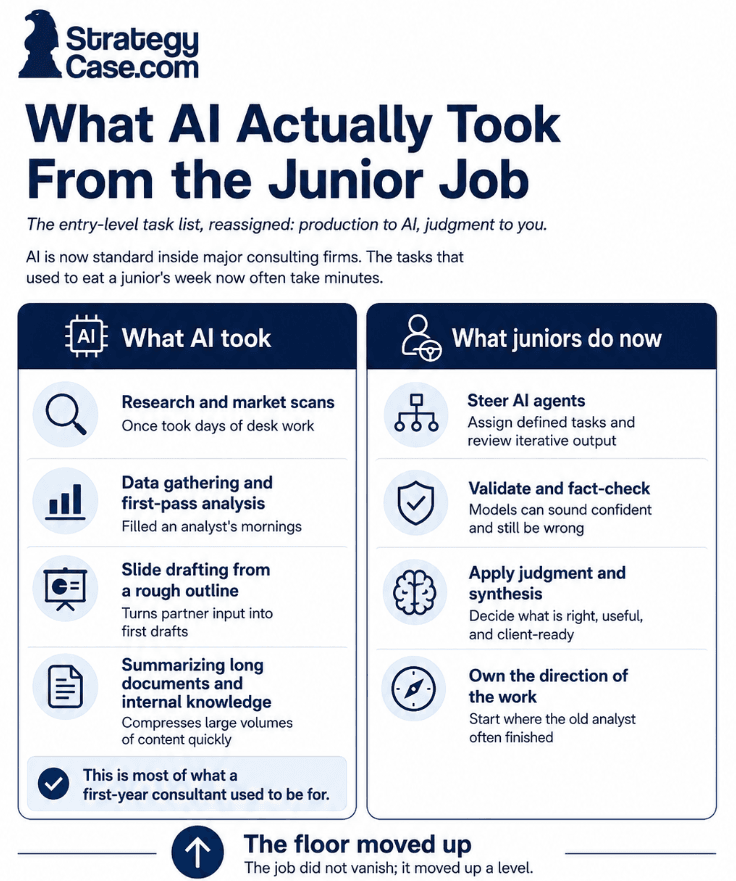
Start with what genuinely changed, because it is real. Large language models are now standard inside McKinsey, BCG, and Bain, usually through internal platforms wired to the firm’s own knowledge and data. The tasks that used to eat a junior’s week now take minutes.
Specifically, AI has absorbed the classic entry-level workload:
- Research and market scans that once took days of desk work.
- Data gathering and first-pass analysis that filled an analyst’s mornings.
- Slide drafting from a partner’s rough outline.
- Summarizing long documents and internal knowledge.
That is not a footnote. It is most of what a first-year consultant used to be for. Which is exactly why the “AI replaces juniors” claim feels plausible, and why the honest answer is more subtle than yes or no.
What Junior Consultants Actually Do Now
The job did not vanish; it moved up a level. Instead of producing the raw material, juniors increasingly direct and check it. McKinsey’s Global Managing Partner Bob Sternfels has publicly described the firm as a workforce of “human and agentic team members,” with each consultant steering multiple AI agents.
For a junior, that means the day-to-day now looks like this:
- Steering AI agents the way you were once steered by a project leader: assigning defined tasks, reviewing iterative output.
- Validating and fact-checking, because models produce confident, plausible, and sometimes wrong answers.
- Judgment and synthesis, deciding whether an AI result is actually right or just well-written, and turning it into something client-ready.
The floor moved up. You are now expected to start where the old analyst finished, which sounds like a promotion and comes with a hidden cost, covered next.
The Real Risk: AI Is Breaking the Learning Model
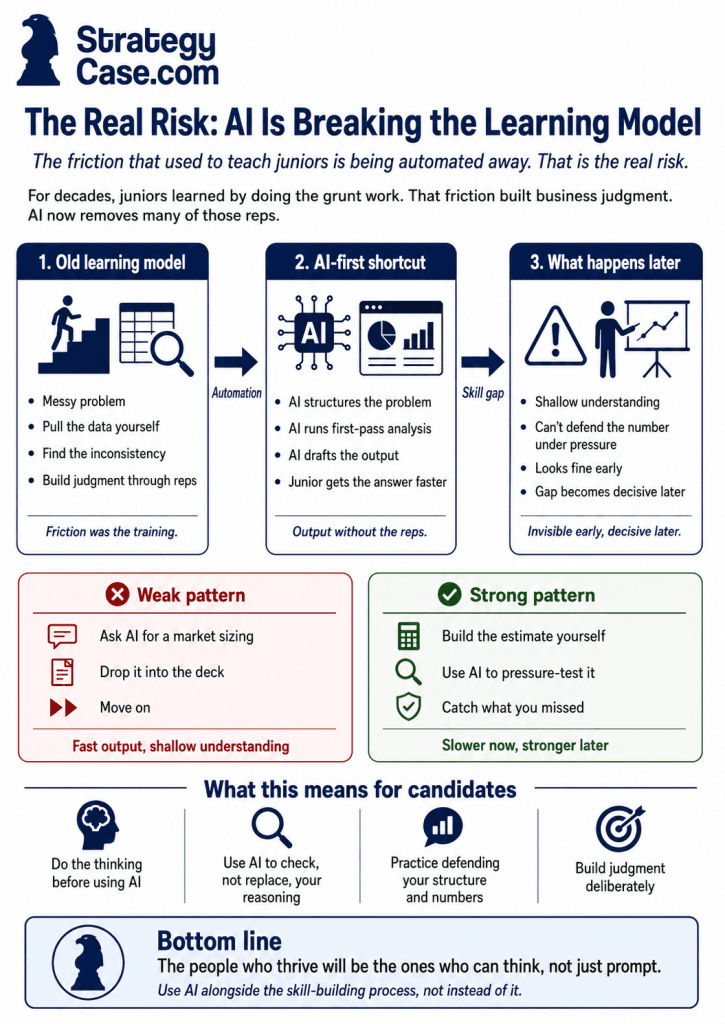
Here is the part almost no one writes about, and it is the one that matters most for your career. For decades, juniors learned by doing the grunt work. Structuring a messy problem, pulling the data yourself, finding the inconsistency in row 400 of a spreadsheet, that friction was the training. It is how business judgment got built.
AI removes the friction. When the machine does the structuring and the first analysis, the step that used to teach you gets skipped. You get the output without the reps that build the underlying skill. Firms now openly worry that juniors are developing core skills more slowly, leaning on copy-and-paste workflows that produce fast output and shallow understanding.
Picture two first-years on the same project. One asks the AI for a market sizing, drops it into the deck, and moves on. The other builds the estimate herself, then uses AI to pressure-test it and catch what she missed. Six months in, they look identical on paper. Two years in, only one can stand in front of a client and defend a number when a partner pushes back, because only one ever learned how. That gap is invisible early and decisive later, and it is the quiet danger of an AI-first entry into consulting.
I see the same pattern every week in coaching. Candidates have quietly outsourced their case interview structuring to ChatGPT, and it shows the moment I push on a structure they cannot defend, because they never actually built it. This is the “prep is broken” problem wearing a new outfit: the tool makes you look ready while skipping the work that makes you good. If you want to build that judgment the right way rather than outsource it, the Case Interview Academy is designed for exactly that.
Firms know this is happening. Several are redesigning early training so juniors build foundational skills deliberately, alongside AI rather than in spite of it, because the old “learn by doing the grunt work” model no longer produces the grunt work. But firm training is not your safety net. The people who arrive already able to think, not just prompt, are the ones who thrive in the reshaped role.
Why the Productivity Gains Are Smaller Than the Hype
You would expect AI to shrink teams overnight. It has not, and the reason tells you where the job is heading. Early on, firms assumed powerful AI meant fewer people delivering the same work. In practice, team sizes on many projects have stayed roughly stable.
Two things absorb the savings. First, expectations rose: instead of fewer people, firms want more output in the same time, more analyses, deeper scenarios, more client iterations. Second, AI created a new tax. Every output has to be validated, every source checked, every number recalculated, because a plausible-sounding wrong answer is worse than no answer.
The evidence backs the caution: in Mercor’s 2026 APEX-Agents benchmark, documented in the research paper, the best AI models completed fewer than 25% of realistic professional tasks correctly on the first try. AI accelerates the work; it does not remove the need to understand and own it.
What This Means If You Want to Break Into Consulting
The shift is real, and your response to it is concrete. The bar did not drop because AI exists; it rose, because firms now have to look harder for genuine judgment under all the polished output.
Three moves matter:
- Build real structure and judgment now. The apprenticeship used to teach this on the job. It teaches less of it now, so arrive with more. This is the exact skill the case interview and the work both reward.
- Show genuine AI fluency. Not buzzwords, but the ability to steer AI, catch its errors, and say clearly where you overrode it.
- Prepare for an AI-shaped process. Firms are adding AI to recruiting itself. See how AI now sits in the consulting interview so the format does not surprise you.
For the bigger picture on hiring numbers and where the career is going, start with our pillar on AI’s impact on consulting careers and the future of consulting. The takeaway for you is simple: the entry-level job is smaller in raw tasks and higher in judgment, so prepare for the 2026 version, not the 2019 one.
Will AI Replace Junior Consultants? FAQs
Will AI replace junior consultants?
Not in the near term. AI is automating the research, data, and slide work that defined the entry-level job, but firms still need juniors as the pipeline that grows into judgment-heavy senior roles. The role is being reshaped and its learning model disrupted, not eliminated.
Are consulting firms hiring fewer junior consultants?
They are shrinking and reshaping entry-level cohorts rather than cutting them to zero. Firms need fewer juniors for pure production work and screen harder for judgment and AI fluency, so entry is more competitive, not closed.
What do junior consultants actually do now that AI exists?
Less raw production, more direction and judgment. Juniors increasingly steer AI agents, validate and fact-check output, and turn it into client-ready recommendations. The job moved from producing the analysis to owning whether it is right.
What skills do junior consultants need in the AI era?
Structured problem-solving and business judgment first, then genuine AI fluency and the discipline to verify output. The ability to catch a confident, wrong AI answer is now a core entry-level skill.
Is it still worth becoming a consultant if AI is taking the junior work?
Yes, if you prepare for the reshaped job. The learning, exits, and compensation that make consulting attractive remain, but the easy first-year tasks that used to build your foundation are automated, so you need to arrive with more skill.
Will AI take entry-level consulting jobs entirely?
No clear sign of that at the leadership level. The talk is of shifting the profile of entry-level roles toward judgment and AI oversight, not removing them. The bigger threat to your odds is a more competitive entry bar, not a vanished job.
Do I need to learn AI tools to become a consultant?
You need practical fluency, not technical depth. Firms expect you to use AI to speed up work and, just as important, to catch its mistakes. Being able to explain where you used AI and where you overrode it signals judgment. Knowing a long list of tools does not.
The Bottom Line
Will AI replace junior consultants? No, but it has already replaced most of the old junior task list, and that is the answer that matters for your plan. The role survives on judgment and accountability AI cannot own. The tasks that used to train you into that judgment are being automated, which means the learning happens less on the job and more on you, before you arrive.
Treat that as a reason to prepare harder, not to give up. Build genuine structure and judgment, learn to steer AI without outsourcing your thinking to it, and walk in ready for the reshaped job.
Related Guides
- How to Get Promoted in Consulting: pay attention to what matters for your first promotion.
- The First 90 Days in Consulting: a practical playbook for new hires.
- AI Consultant Job Guide: an updated guide on AI consultant job opportunities.
- AI Consultant Salary Guide: a current guide on AI consulting salaries.
About the author: Florian Smeritschnig is a former McKinsey Senior Consultant and the founder of StrategyCase. He spent five years at the firm and has since run more than 2,200 mock case interviews and coached hundreds of candidates into McKinsey, BCG, Bain, and other top firms.
