

Last Updated on September 23, 2026
By Florian Smeritschnig, Former McKinsey Senior Consultant · Updated September 2026
To become a management consultant, you need a university degree, relevant work experience, strong analytical skills, and the ability to solve a business problem out loud in a case interview. No license and no certification are required. The degree gets your resume screened. The interview decides whether you get hired.
That gap between credential and gate is why most advice on this question misses.
Search this exact phrase and page one hands you a university degree program, an MBA pitch, a government careers page, and a body selling a certification. Most of the top results have something to sell you, and none of them have sat on the hiring side of the table.
I spent five years at McKinsey as a Senior Consultant, evaluated candidates for the firm, and have since delivered more than 2,200 mock interviews and coaching sessions. Below is what the job actually is, what firms screen for, the four realistic routes in, what each one takes, and what it pays. Here’s how to become a management consultant:
Key Takeaways
- No certification is required. The Certified Management Consultant (CMC) credential ranks near the top of this search result, but it carries no weight in actual top consulting firms like McKinsey, BCG, or Bain hiring.
- “Management consultant” covers two different jobs. The U.S. Bureau of Labor Statistics counts 1,077,100 management analysts earning a median of $101,860. A first-year McKinsey Business Analyst already earns roughly $140,000 total.
- For most countries, a bachelor’s degree is the standard entry requirement. Your major matters far less than your school, your GPA, your work experience and your case performance.
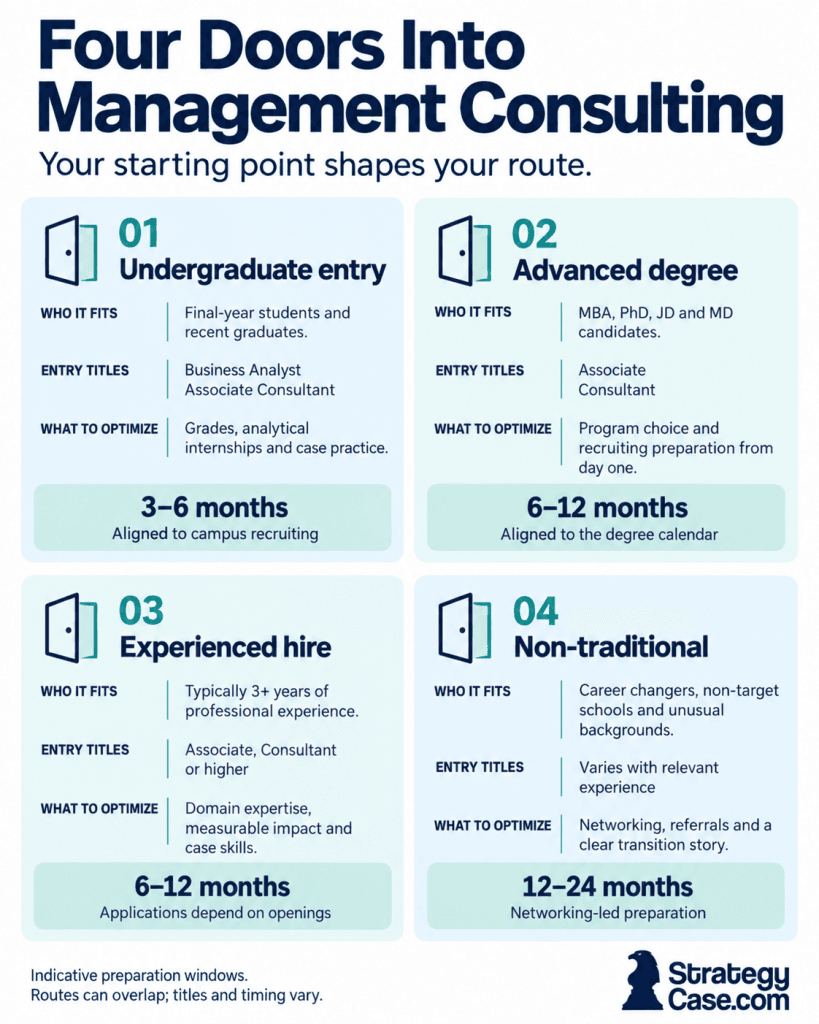
- There are four doors in: undergraduate direct entry, the MBA or advanced degree route, the experienced hire route, and the non-traditional route. Timelines run from three months to two years.
- Roughly 1 in 100 applicants makes it into top consulting, and nearly all the filtering happens in the resume screening and interview stages.
What a Management Consultant Actually Does
A management consultant is hired by a company to solve a problem the company can’t solve on its own. That problem might be something like: profits are falling, growth has stalled, or the organization can’t execute something it has decided to do.
The work runs in projects, typically 6 to 16 weeks. You join a small team, get handed a slice of the problem, and spend your weeks gathering data, building models, interviewing people inside the client company, and turning all of it into a recommendation the client will act on.
The daily reality is less glamorous than the brochure. You’ll spend a lot of time in spreadsheets and slide decks. You’ll travel to client sites. Hours are long and most management consultants in top firms work more than 60 hours per week.
What you’re really selling is structured thinking under time pressure. That’s the skill firms test for, and it is the reason the interview format looks the way it does.
The Two Different Jobs Called “Management Consulting”
This is the distinction that explains why advice on this topic contradicts itself, and almost nobody makes it.
The U.S. Bureau of Labor Statistics tracks “management analysts” as an occupation of 1,077,100 people, with a median wage of $101,860 as of May 2025 and a typical entry requirement of a bachelor’s degree. That category includes independent consultants, internal strategy teams, IT and operations consultants, and boutique specialists.
Strategy consulting at McKinsey, BCG, and Bain is a small, tightly filtered slice of that number. It hires a few thousand people a year worldwide, screens through a standardized case interview, and pays entry-level salaries well above the occupational median.
| Broad management consulting | Strategy consulting (MBB and peers) | |
|---|---|---|
| Size of field | 1,077,100 management analysts in the US (BLS, 2025) | A few thousand hires per year across McKinsey, BCG, and Bain |
| Typical entry education | Bachelor’s degree | Bachelor’s, MBA, or PhD |
| Pay reference point | $101,860 median (BLS, May 2025) | ~$140,000 first-year total comp at McKinsey |
| Main gate | Resume, relevant experience, competency interview | Resume and case interview |
| Does certification help? | Sometimes, in independent or niche practice | No |
| Realistic timeline in | 3 to 6 months | 6 months to 2 years |
Both are real jobs and both are called management consulting. But the entry route for one has almost nothing in common with the entry route for the other. Before you follow any advice on this topic, work out which of these two you’re actually aiming at.
If you’re targeting the second column, the case interview is the thing standing between you and the offer, and it is worth understanding early what that case interview actually tests.
What Qualifications Do You Need to Become a Management Consultant?
A bachelor’s degree, in almost any subject. That’s the formal requirement, and the BLS confirms it as the typical entry-level education for the occupation, with no on-the-job training listed and less than five years of related work experience expected.
The informal requirements are where candidates get surprised. Firms screen on a narrow set of signals, and they ignore several things candidates spend real money acquiring.
| What firms screen on | What firms largely ignore |
|---|---|
| University and program reputation | Your specific major |
| GPA or degree classification | Consulting certifications (CMC and similar) |
| Evidence of analytical rigor | Generic online course certificates |
| Leadership and impact on your resume | Length of your resume |
| A referral, where you have one | Cover letter creativity |
| Case interview performance | Business knowledge trivia |
Major matters less than most applicants assume. Engineering, economics, law, history, and physics graduates all get hired. What the firm wants to see is that you handled something quantitatively hard and did well at it. If you want the full ranking of which degrees actually convert, I broke that down separately in what degree you need for management consulting.
The one qualification that is genuinely non-negotiable is the ability to structure an unfamiliar business problem out loud, in real time, while someone watches. No degree teaches that. It’s trained.
Do You Need a Certification Like the CMC?
No. And this is worth being direct about, because a certification body currently ranks on page one for this exact search and appears in Google’s AI-generated summary of it.
The Certified Management Consultant (CMC) designation is a real credential. It’s administered by national institutes of management consulting and it has genuine standing in one specific context: independent consultants and small firms who need a third-party signal of credibility when they have no brand behind them. If you plan to consult solo, it can help you win clients.
It won’t help you get hired at McKinsey, BCG, Bain, or any of the Big 4 firms. Their application forms don’t ask for it. Their screeners don’t look for it. Their interviewers don’t know your file contains it.
In five years at McKinsey, I evaluated candidates for the firm, and in the 2,200-plus mock interviews and coaching sessions I have delivered since, I have never seen a certification change a hiring outcome. What I have seen repeatedly is the opposite pattern: candidates with excellent paper credentials rejected inside the first 10 minutes of a case, and candidates from schools nobody recruits at getting offers because they could take a messy problem and make it structured.
The Four Doors Into Management Consulting
Every person who becomes a management consultant comes through one of four doors. Which one applies to you is decided by where you’re standing right now, not by preference, and each one has a different timeline and a different thing to optimize.
| Door | Who it is for | Typical entry title | Realistic timeline |
|---|---|---|---|
| 1. Undergraduate direct entry | Final-year students and recent graduates | Business Analyst, Associate Consultant | 3 to 6 months of preparation, aligned to campus recruiting |
| 2. Advanced degree | MBA, PhD, JD, MD candidates | Associate, Consultant | 6 to 12 months, aligned to the degree calendar |
| 3. Experienced hire | 3 or more years of professional work | Associate, Consultant, or higher | 6 to 12 months, applications run year-round |
| 4. Non-traditional | Career changers, non-target schools, unusual backgrounds | Varies, usually Associate level, seldom Project Manager, rarely Partner | 12 to 24 months, networking-led |
Door 1: Undergraduate Direct Entry
The most straightforward route. Firms recruit on a fixed campus calendar, applications for most offices open in the summer, and interviews run in the autumn. You join as a Business Analyst at McKinsey or an Associate Consultant at Bain.
What to optimize: your GPA, one or two internships with analytical substance, and case interview practice starting at least three months before applications open. Miss the calendar and you wait a full year, which is the single most common avoidable mistake in this door.
Door 2: The MBA or Advanced Degree Route
Business school remains the widest on-ramp for career changers, and firms recruit heavily from a defined list of programs. PhD, JD, and MD candidates enter through a parallel track that firms staff deliberately, often with a slightly adapted interview process.
What to optimize: getting into a program the firms actually recruit from, then treating recruiting as a second course load from day one. You don’t need an MBA to become a management consultant. It’s a route, not a requirement.
Door 3: The Experienced Hire Route
If you have threee or more years of professional experience, you apply directly, year-round, and you’re evaluated against a different bar than students. Firms want to see domain expertise they can sell to clients, plus the same structured problem-solving everyone else is tested on.
What to optimize: framing your current work as consulting-relevant, then closing the case gap fast. Experienced candidates often underrate how strange the format feels. The mechanics of level placement and process differ enough that I covered them in the experienced hire guide for McKinsey, BCG, and Bain.
Door 4: The Non-Traditional Route
Career changers, non-target schools, and unusual backgrounds. This door is real, it’s just narrower and slower, and it runs on networking rather than on application portals.
What to optimize: referrals. A referral doesn’t get you the offer, but it gets your file read by a human instead of filtered by a screen, and for this group that is the decisive difference. The specific moves that work are laid out in the guide to getting into consulting from a non-traditional background.
Not sure which door is yours? The fastest way to find out is to look at the entry requirements on the firms’ own sites. McKinsey and BCG both publish their current openings and entry paths by background.
What the Hiring Process Looks Like
Once you know your door, the hiring process is broadly the same across firms, and it runs through five gates:
- Application documents. Resume and cover letter, screened in under a minute.
- Referral or network touch. Optional but weighted, especially for doors 3 and 4.
- Online assessment. McKinsey Solve, the BCG Cognitive Test, Bain’s aptitude tests, and their equivalents elsewhere.
- First-round interviews. Case plus fit, usually two interviews.
- Final round. Two or three more interviews, typically with partners.
Each of those gates has its own preparation requirements, and each one has a free dedicated StrategyCase guide behind it. The full walkthrough, with timings, document standards, and what each gate screens for, sits in the pillar guide on how to get into consulting. Start there once you have picked your door.
One point worth carrying forward: the screening and interview stages are where the overwhelming majority of candidates are eliminated.
How Much Do Management Consultants Make?
Yes, the money is good, and this is the second most common question people ask about this career.
For the occupation as a whole, the BLS puts the median annual wage for management analysts at $101,860 as of May 2025.
At the strategy firms, entry pay sits well above that. Using McKinsey’s US ladder as the reference point:
| Level | Entry path | Total compensation (US, 2026) |
|---|---|---|
| Business Analyst | Undergraduate | ~$140,000 |
| Associate | Post-MBA | ~$275,000 in year one |
| Engagement Manager | Promotion, 2 to 4 years in | ~$290,000 |
| Associate Partner | Promotion | ~$420,000 |
| Partner / Senior Partner | Promotion | $500,000 to $1.2 million+ |
Those numbers come from the full McKinsey salary and hierarchy breakdown, which covers BCG and Bain at every level too, plus how the figures shift by region.
Two caveats. First, pay outside the US is materially lower, often 30 to 50 percent below US levels for the same title. Second, the headline numbers buy a demanding schedule, and the compensation is structured to keep you there.
How Long It Takes, and Whether It’s Worth It
From a standing start, becoming a management consultant takes three to six months if you’re a student hitting a recruiting calendar, and 12 to 24 months if you’re changing careers from an unrelated field and building a network from zero.
Be honest with yourself about the odds. Roughly 1 in 100 applicants makes it into top consulting. That number isn’t meant to discourage you. It’s meant to correct the assumption that getting into a top-tier consulting firm is easy these days.
It’s also worth knowing what you’re walking into. The consulting hiring market has tightened, and AI is reshaping what junior consultants do day to day. The state of hiring is covered in the guide to the consulting job market, and the AI question gets its own answer in the FAQ below.
Ready to work on the part that actually decides it? The StrategyCase Case Interview Academy program covers structuring, math, and charts with drills, which is the gap that eliminates most candidates at the interview stage.
Frequently Asked Questions
What qualifications do you need to become a management consultant?
A bachelor’s degree is the standard requirement, and the BLS lists it as the typical entry-level education for the occupation. Beyond that, firms screen for your university, your GPA, evidence of analytical work, and above all your performance in a case interview. No license or certification is legally or practically required.
Do you need a Certified Management Consultant (CMC) certification?
No, not for firm hiring. The CMC has value in one case: if you plan to consult solo and need outside credibility with clients. McKinsey, BCG, Bain, and the Big 4 don’t screen for it, and in my experience hiring candidates it has never changed an outcome.
Do management consultants make a lot of money?
Relative to most professions, yes. The BLS median for management analysts is $101,860 as of May 2025, and entry-level strategy consulting pays well above that, at roughly $140,000 total for a first-year undergraduate hire at McKinsey in the US. Pay outside the US runs considerably lower.
Can you become a management consultant with no experience?
Yes, through door one. Firms hire undergraduates directly into analyst roles with no prior consulting experience, which is the single largest entry channel. If you’re changing careers with no consulting background, you go through the experienced hire or non-traditional route instead, and you’ll need a referral and a longer runway.
Do you need an MBA to become a management consultant?
No. An MBA is one of four routes, and it is the most reliable one for career changers targeting the top firms, but undergraduates, PhDs, and experienced hires all enter without one. Don’t take on business school debt solely as a consulting entry ticket if another door is open to you.
Will management consulting be replaced by AI?
Not the profession, though the entry-level work is changing fastest. AI has taken over much of the research and slide work that used to fill a first-year analyst’s week. That raises the bar on the judgment work left over. The detailed argument sits in will AI replace consultants.
Related Guides
- How to Get Into Consulting: the full application and recruiting process, gate by gate
- What Degree Do You Need for Management Consulting: degrees ranked by hiring frequency
- Getting Into Consulting From a Non-Traditional Background: the referral-led route
- Experienced Hires at McKinsey, BCG, and Bain: level placement and process for professionals
- The Big 3 Consulting Firms: how McKinsey, BCG, and Bain differ
The Bottom Line on How to Become a Management Consultant
Get a degree, pick the door that matches where you’re standing, and put the bulk of your preparation into the case interview. Skip the certification.
If you’re at the start of this, the 250-plus free StrategyCase guides cover every stage of the process, from your first application through to the final round. Start with the complete case interview guide, because that is the skill your offer depends on the most.
The path in is narrow, but it is well mapped. Candidates who prepare deliberately, on the right thing, get through it every recruiting season.
About the author: Florian Smeritschnig spent five years at McKinsey as a Senior Consultant, where he evaluated real candidates, and has since delivered 2,200+ mock interviews and coaching sessions leading to 700+ offers at McKinsey, BCG, Bain, and other top firms
