

Last Updated on July 20, 2026
By Florian Smeritschnig, former McKinsey Senior Consultant · Updated July 2026
The consulting job market in 2026 is doing two contradictory things at once: firms are cutting thousands of roles while simultaneously expanding entry-level hiring. McKinsey has taken its headcount from a 2022 peak above 45,000 down to roughly 40,000, and in the same breath announced plans to grow its North American workforce by 12% in 2026.
If you read the headlines, consulting looks like it is collapsing. If you read the recruiting calendars, it looks like a hiring race. Both are true, and understanding why is the difference between applying into the part of the pyramid that is shrinking and the part that is growing.
Key Takeaways
- Consulting firms are cutting the middle and back office while expanding the base. McKinsey plans a 12% North American headcount increase in 2026, with junior ranks up as much as 20%.
- The Great Resignation is over. The US quits rate sits at 1.9% as of May 2026, down from a peak near 3.0% in early 2022, and below the 2019 average for two straight years.
- Experienced-hire entry is the hardest it has been in a decade. Entry-level entry is getting earlier and more competitive, not scarcer.
- MBA consulting placement fell at 22 of 24 tracked programs for the Class of 2024, with declines from 1% at Stanford GSB to 17% at Carnegie Mellon.
- Starting salaries have been flat for three consecutive years: $192K base at McKinsey and Bain, $190K at BCG.
The Great Resignation in Consulting Is Over, and It Reversed
For two years, every consulting career article was about people quitting. That era is finished, and the data is not subtle about it.
The US quits rate stood at 1.9% in May 2026, unchanged from April, according to the Bureau of Labor Statistics JOLTS series. At the height of the Great Resignation in early 2022 it was near 3.0%. Quits have now spent two years below the 2019 average, and nearly every industry has moved the same direction: Indeed Hiring Lab notes that the information sector fell from 1.9% to 1.1% since May 2022.
The reason is straightforward. People quit when they believe something better is waiting. Right now most of them do not believe that.
For consulting specifically, this flipped the retention problem into its opposite. In 2022, firms were writing memos about how to keep consultants from leaving. In 2026, they are managing the fact that fewer people leave voluntarily, which means attrition no longer does the work that the up-or-out model relies on. When natural attrition slows, firms have to create the outflow deliberately. That is a large part of what you are reading about as layoffs.
| Great Resignation (2021 to 2022) | Now (2026) | |
|---|---|---|
| US quits rate | ~3.0% peak | 1.9% |
| Consultant bargaining power | High, counteroffers common | Low |
| Firm priority | Retention and rehiring | Headcount discipline |
| Attrition | Above plan | Below plan |
| Candidate bar | Loosened to fill seats | Raised |
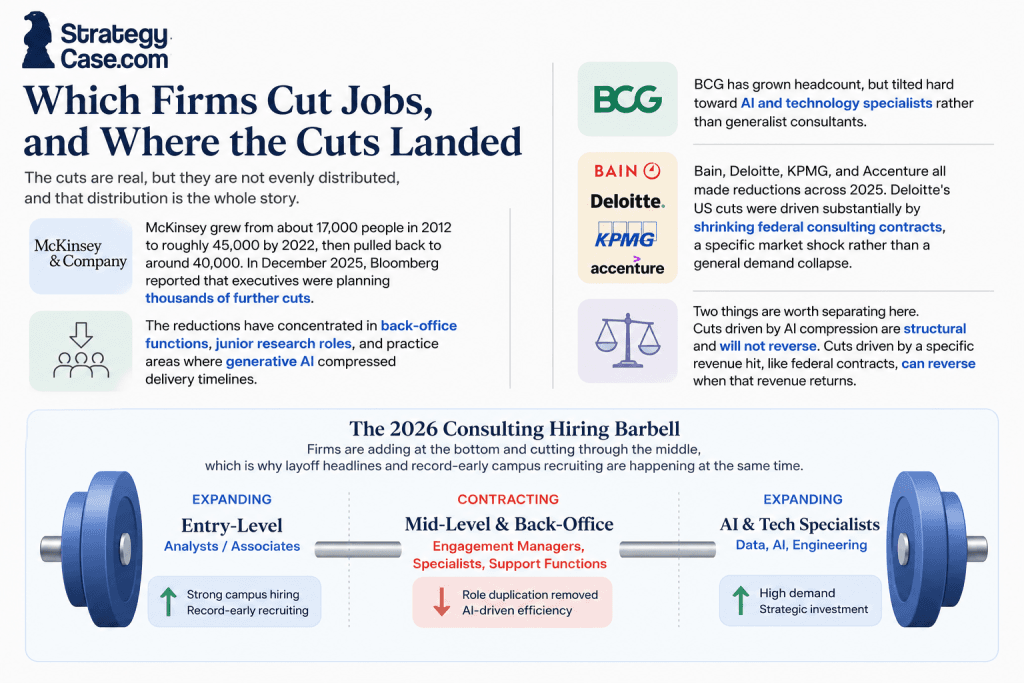
Which Firms Cut Jobs, and Where the Cuts Landed
The cuts are real, but they are not evenly distributed, and that distribution is the whole story.
McKinsey grew from about 17,000 people in 2012 to roughly 45,000 by 2022, then pulled back to around 40,000. In December 2025, Bloomberg reported that executives were planning thousands of further cuts. The reductions have concentrated in back-office functions, junior research roles, and practice areas where generative AI compressed delivery timelines.
BCG has grown headcount, but tilted hard toward AI and technology specialists rather than generalist consultants.
Bain, Deloitte, KPMG, and Accenture all made reductions across 2025. Deloitte’s US cuts were driven substantially by shrinking federal consulting contracts, a specific market shock rather than a general demand collapse.
Two things are worth separating here. Cuts driven by AI compression are structural and will not reverse. Cuts driven by a specific revenue hit, like federal contracts, can reverse when that revenue returns. Reading them as one undifferentiated “consulting crisis” leads candidates to the wrong conclusion about their own odds.
Why Firms Are Cutting and Hiring at the Same Time
This is the part almost every article on this topic gets wrong, and it is where five years inside McKinsey actually helps.
A consulting firm is a pyramid, and the pyramid has an economic logic. Partners sell work. Junior consultants supply the analytical capacity that makes the work deliverable at a margin. The ratio between those two layers is what determines whether the business model functions.
What AI changed is not the need for the pyramid. It changed how many hours of analysis a given engagement consumes. Work that used to take an analyst team a week now takes considerably less. That reduces the number of people needed in the middle, where undifferentiated analytical throughput used to live, and in the back office, where support functions scaled with headcount.
It does not reduce the need for the base. Firms still need people entering the system, learning the craft, and growing into the client-facing roles that the model sells. And they now want that base to arrive already fluent in the tools.
Eric Kutcher, senior partner and chair of McKinsey North America, told reporters that the firm employs between 5,000 and 7,000 non-partner staff in the region and expects that number to rise 15% to 20% over the next five years. McKinsey’s stated plan is to expand junior ranks in North America by as much as 20% in 2026.
So the headline “McKinsey is cutting thousands of jobs” and the headline “McKinsey is expanding hiring by 12%” are describing the same restructuring from opposite ends. The firm is rebuilding the bottom of the pyramid while thinning the middle of it.
For you as a candidate, this means the honest answer to “is consulting still hiring” depends entirely on which door you are trying to walk through.
What This Means for Your Application, by Profile
The market has not gotten uniformly harder. It has gotten harder in some lanes and easier in others.
If you are an undergraduate or master’s student
This is the strongest position in the current market, and it is counterintuitive given the headlines. Firms are expanding entry-level intake and competing for it earlier.
McKinsey moved its US undergraduate recruiting timeline forward, starting the search for its 2027 summer business analyst class in spring rather than June, explicitly to compete with investment banking’s calendar. The practical consequence: if you are planning to apply on last year’s schedule, you are already late. Build your case interview preparation a full recruiting cycle earlier than the advice you will find in older guides.
If you are an MBA candidate
Harder than the 2021 peak, but stabilizing. Consulting placement declined at 22 of 24 tracked programs for the Class of 2024, and the spread by school was wide.
Outside the M7, the drops were steep: Carnegie Mellon fell 17%, Emory and Texas 13%, Yale SOM 12%, and Cornell 11%. The M7 held up considerably better, with Kellogg and Harvard down 7%, Wharton down 4%, and Stanford GSB, MIT Sloan, and Tuck down only 1% to 2%. Where you study matters more in a tight market than it does in a loose one.
MBB volume is still meaningful where it concentrates. For the Class of 2024, Booth placed 101 graduates into MBB, Columbia 91, and Kellogg 82.
Pay has stopped moving. Poets&Quants reported MBA base salaries of $192,000 at McKinsey and Bain and $190,000 at BCG, essentially unchanged for a third consecutive year. Total compensation runs $285,000 at Bain, $270,000 at BCG, and $267,000 at McKinsey. If your decision math assumed automatic annual increases, rebuild it.
If you are an experienced hire
This is the hardest lane, and I want to be direct about it rather than encouraging. The mid-level band is exactly where firms are compressing. When a firm is thinning its middle, it is not simultaneously running a large lateral intake into that same middle.
That does not make it impossible. It makes generic experience insufficient. What still moves is specific, currently scarce expertise, particularly AI implementation, sector depth the firm is actively selling into, and functional skills the firm cannot train fast enough internally. If you are applying as a strong generalist with good but unremarkable industry experience, you are applying into the narrowest part of the market. Our guide on experienced hires at McKinsey, BCG, and Bain covers how to position around that.
If you are applying outside the US
Regional variation is larger than it has been in years. The Middle East ran hot through the recent slowdown (before also reducing hiring significantly) while other regions froze. Asia has seen office-level hiring freezes. European offices have generally moved with the global cycle rather than against it. Check the specific office, not the firm. A candidate rejected in one geography is not a candidate rejected by the firm.
The Recruiting Timeline Moved, and Most Candidates Have Not Adjusted
The single most actionable change in this market is not the headcount numbers. It is the calendar.
Firms competing for entry-level talent against investment banking have pulled their processes forward, in McKinsey’s case by roughly three months. Candidates working from advice written two or three years ago are preparing on a schedule that no longer exists.
Here is what that means concretely. If interviews for a given summer class now conclude before the previous summer ends, your case interview preparation, your networking, and your resume need to be finished a full cycle earlier than the conventional guidance suggests.
Is Consulting Still Worth Pursuing in 2026?
Yes, with a clear caveat about which entry point you are targeting.
Entry-level consulting is arguably a better bet in 2026 than it was in 2023, because firms have publicly committed to expanding that layer and are competing hard to fill it. Experienced-hire entry is genuinely difficult and will stay difficult until firms finish restructuring their middle.
The deeper reason consulting still holds up: the exit opportunities that make consulting valuable as a career accelerator have not deteriorated the way consulting headcount has. The skill set still transfers. What has changed is that you can no longer treat the offer as a volume game. Only about 1 in 100 applicants makes it into top consulting, and the firms have raised the bar rather than lowered it while managing headcount.
What has not changed at all is what gets you through the interview. Firms are not testing whether you memorized more frameworks than the next candidate. They are testing whether you can structure an unfamiliar problem from first principles, reason with incomplete data, and communicate a defensible recommendation. That is the same thing I evaluated candidates on at McKinsey, and it is the thing most preparation still gets wrong.
If you want a structured way in, StrategyCase covers the full path from application to offer, and the complete guide to getting into consulting is the right starting point.
Frequently Asked Questions: Consulting Job Market
Are consulting firms still laying people off in 2026?
Yes, but selectively. The cuts are concentrated in back-office functions, junior research roles, and mid-level generalist positions where AI has compressed the work. McKinsey reduced headcount from a 2022 peak above 45,000 to roughly 40,000. At the same time, several firms are expanding entry-level hiring, so “layoffs” and “hiring” are happening in different parts of the same organizations.
Is it harder to get into McKinsey, BCG, or Bain now than in 2021?
For experienced hires, yes, significantly. For undergraduates and MBAs, it is harder than the 2021 hiring peak but improving, and firms have committed publicly to growing entry-level ranks. The bar for interview performance has risen across the board because firms are being more selective rather than filling seats.
Why is McKinsey cutting jobs and increasing hiring at the same time?
Because the cuts and the hiring target different layers. AI reduced the analytical hours an engagement consumes, which shrinks the need for mid-level throughput and back-office support. The firm still needs a wide base of junior consultants to sustain its delivery model, so it is rebuilding the bottom of the pyramid while thinning the middle.
Did the Great Resignation affect consulting, and is it still happening?
It affected consulting significantly in 2021 and 2022, when attrition ran above plan and firms competed aggressively on retention. It is over. The US quits rate is 1.9% as of May 2026, down from roughly 3.0% at the peak, and has been below the 2019 average for two years. Consultants are staying put.
Should I still apply to consulting if firms are cutting jobs?
If you are applying at entry level, yes. That is the layer firms are actively expanding, and recruiting timelines have moved earlier, which favors candidates who prepare ahead of the crowd. If you are applying as an experienced hire without scarce, specific expertise, expect a much harder process and plan accordingly.
When should I start preparing for consulting recruiting in 2026?
Earlier than most guides tell you. Firms have pulled recruiting forward to compete with investment banking, in McKinsey’s case by about three months for US undergraduate roles. Work backward from the application deadline for your target office and give yourself a full cycle of preparation before it, not after.
Related Guides
- AI’s Impact on Consulting Careers and Hiring
- The Big 3 Consulting Firms Compared
- The Future of Consulting
- AI and the Junior Consultant: How Entry-Level Work Is Changing
- McKinsey Hierarchy and Salary Data
Where This Leaves You
The consulting job market in 2026 rewards precision about where you are applying. Firms are cutting the middle and building the base, which means the same market that looks brutal to a mid-career applicant looks genuinely open to a well-prepared student.
Three things to act on:
- Check the calendar before anything else. Recruiting moved earlier. Being prepared on last year’s schedule is the most common avoidable failure right now.
- Match your entry point to the market. If you are an experienced hire, lead with scarce expertise rather than general capability.
- Prepare for the interview firms actually run. The bar went up. Structured, first-principles problem solving is what gets evaluated, not framework recall.
I spent five years at McKinsey as a Senior Consultant and evaluated real candidates there, and I have delivered 2,200+ mock interviews and coaching sessions since. The candidates who get offers in a tighter market are not the ones who did the most practice cases. They are the ones who understood what was being tested.
If you want that structure, start with the StrategyCase Case Interview Academy, or book 1-on-1 coaching with Florian if you want targeted feedback on where your performance actually breaks.
About the author: Florian Smeritschnig spent five years at McKinsey as a Senior Consultant, where he evaluated candidates, and has delivered 2,200+ mock interviews and coaching sessions since. His clients have secured 700+ offers at MBB, Tier-2 firms, Big 4 consulting divisions, in-house consultancies, and boutiques. He is the author of “The 1%: Conquer Your Consulting Case Interview.”
