Last Updated on July 23, 2026
Updated July 2026. By Florian Smeritschnig, former McKinsey Senior Consultant, 5 years at the firm, 700+ candidates coached to offers.
Searching for the best case interview prep courses usually means one thing: you have interviews coming and the clock is running.
Here is the honest version. The best case interview prep course in 2026 is the one that builds real skill and gives you feedback on your specific gaps, not the one with the biggest case library. For most McKinsey, BCG, and Bain candidates that points to a structured skill program plus expert feedback, though the right pick still depends on your timeline, budget, and target firm.
Below I rank the main case interview prep courses for what each one is actually good at, so you can stop comparing sales pages and choose.
Key Takeaways
- No single course is best for everyone. The right pick depends on your timeline, budget, target firm, and where your skills actually break down.
- Case volume is overrated. Candidates rarely fail from doing too few cases; they fail from practicing the wrong things with no feedback loop.
- CaseCoach leads on polished video courses, RocketBlocks on skill drills, PrepLounge on free peer practice, Management Consulted on lengthy bootcamps.
- For firm-specific screens (McKinsey Solve, BCG Casey, Bain SOVA), specialist prep beats a general case course.
- The single highest-return addition to any plan is expert feedback from someone who has evaluated actual candidates.
Full disclosure before we start: I run StrategyCase, and one of the options below is mine. I will flag exactly where it wins and where a competitor is the smarter buy for your situation. A ranking that puts its own product first for every use case is not worth your time, and you can spot one in about four seconds.
The best case interview prep courses at a glance
Prices are current as of July 2026 and worth double-checking on each provider’s own page, since they change.
| Prep option | Best for | Format | Price band | Honest one-liner |
|---|---|---|---|---|
| StrategyCase Case Interview Academy | Turning case skills into an offer | Self-paced courses + thousands of drills | ~$179 one-time | Skill-and-feedback first, built by an ex-McKinsey consultant and top-global case coach |
| StrategyCase 1-on-1 coaching | Fixing what you cannot see yourself | Live sessions with Florian | $$$ per session or package | The fastest way to find and close your real gaps |
| CaseCoach | A polished video course | Video lessons + AI practice | $$ | Slick and well produced, heavier on AI volume and more traditional case types/frameworks |
| RocketBlocks | Targeted skill drills | Math, structuring, chart drills | $ per month | Great for reps on isolated skills, not a full method |
| PrepLounge | Free peer practice | Case partner matching + library | Free tier + paid coaching | Best free way to find partners, quality of partners varies |
| Management Consulted | An intensive bootcamp | Bootcamps + coaching | $$$ | Thorough and expensive, more traditional approach |
| IGotAnOffer | One-off coaching from a marketplace | Ex-consultant coaching + guides | $$ per session | Solid coach roster, less of a single coherent method |
| Hacking the Case Interview | Free framework content | Articles + course + coaching | Free + paid | Useful free reading, framework-heavy teaching style |
| Victor Cheng / LOMS | The legacy audio course | Audio program + book | $$ one-time | Historically important, dated on modern case interviews |
How to actually choose a case interview prep course
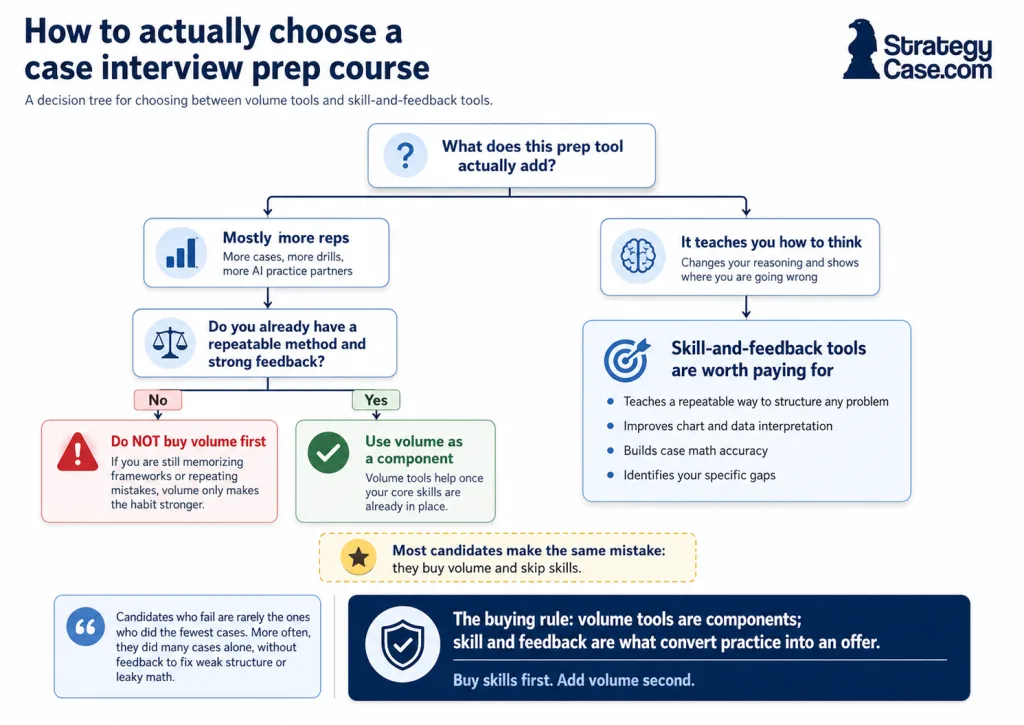
Most rankings compare features. That is the wrong lens, because features are not what gets you the offer.
After coaching 700+ candidates, I sort every prep tool into two buckets.
Volume tools give you more reps: more cases, more drills, more AI practice partners.
Skill-based-teaching-tools change how you think and tell you where you are going wrong.
You need some of both, but the mistake almost everyone makes is buying volume and skipping skills.
Here is why that matters. In five years at McKinsey and across 2,200+ coaching sessions since, the same pattern shows up. The candidates who get dinged are rarely the ones who did the fewest cases. They are the ones who did eighty old-school cases, with nobody to tell them their structure was a memorized template and their math had a leak.
Volume felt like progress. It was not.
So before you buy anything, ask what a given course actually adds.
If it just hands you more cases to grind and the same frameworks that were already outdated 10 years ago, it is a commodity.
If it teaches a repeatable way to structure any problem, approach chart and data interpretation as well as case math plus shows you your specific gaps, it earns its price.
That principle sits behind everything I have written on why so much preparation misses the mark and why candidates who prepare still fail most of the time, and it is the filter I used to rank the options below.
The best case interview prep courses in 2026, reviewed
StrategyCase Case Interview Academy: best for turning skill into an offer
This is the option I built, so keep that bias in mind as you read.
The Case Interview Academy covers the four core areas of the case interview: structuring, brainstorming, chart and data interpretation, and case math. Each area is taught as a full course, combining theory with hundreds of practice drills for structuring, brainstorming, and charts, and thousands of drills for case math.
The design philosophy is deliberately different from that of most platforms. Instead of giving you a large case library and telling you to practise more, the Academy teaches the underlying skills first and then helps you build them through targeted repetition and feedback.
The content is based on my own experience at McKinsey and on more than 2,200 coaching sessions conducted over the past five years. During that time, my clients have secured more than 700 consulting offers worldwide.
For every major component of the case, the Academy focuses on three things:
- The steps to take: a clear, repeatable approach for each part of the interview (as an interviewer and coach, I learned that candidates often don’t know what to do and when; giving them these consistent steps facilitates their progress and demonstrates case leadership/drive to the interviewer)
- How to communicate: practical strategies for presenting your thinking clearly and convincingly
- How to think: techniques rooted in how consultants and experienced problem solvers actually approach unfamiliar problems
What separates the Academy from most other courses is that the methodology is battle-tested and continuously refined. I developed the theory myself, while the cases, drills, and examples reflect the real interviews my clients encounter every day.
Because I remain closely involved in the market, I update the material whenever interview formats, expectations, or recurring candidate weaknesses change. The goal is to keep the Academy current, practical, and effective for modern case interviews.
On the downside, because the course is continuously refined and updated, the videos prioritize practical, current content over highly polished production.
CaseCoach: best for a polished video course
CaseCoach is well branded, professionally produced, and easy to navigate. The video lessons follow a clear sequence, the platform feels polished, and the AI practice partner gives candidates a convenient way to practise independently. For someone who learns best through structured video content and values a clean, guided user experience, it is a reasonable option.
Its strongest advantage may actually be its production quality and global distribution. CaseCoach has built a strong brand and has collaborated with consulting firms and recruiting funnels in several markets, which gives it visibility and credibility that many smaller providers do not have. The platform looks and feels established, and the overall learning experience is more refined than that of most case-prep websites.
My reservation is the underlying methodology. Several of my clients who used CaseCoach before working with me described the cases and teaching as relatively traditional: more focused on standard case types, established frameworks, and conventional approaches than on the messier, more modern problems candidates increasingly encounter in actual interviews. That does not make the content useless, but it can encourage candidates to search for the familiar case category and reproduce a memorized structure instead of developing an approach from first principles.
I am also cautious about the growing reliance on AI practice. AI partners are patient, scalable, and always available, but they tend to reproduce older case conventions and assess what is easy to measure. They are much less reliable at judging the soft signals a real interviewer cares about: whether your structure is genuinely tailored, whether your communication is top-down, whether your judgment is commercially sensible, and whether your interaction feels collaborative rather than rehearsed.
That creates a risk of falling into the volume-without-feedback trap discussed above. You can complete many cases and receive consistent automated responses without anyone identifying the deeper habits holding you back.
Overall, CaseCoach is strong on presentation, accessibility, and distribution. It is a polished way to learn the standard mechanics of case interviews and accumulate practice with light-touch feedback. It is less convincing as a source of modern, individualized, interviewer-level feedback or as a method for moving candidates beyond traditional framework-based preparation.
RocketBlocks: best for targeted skill drills
RocketBlocks does one thing particularly well: it breaks case preparation into bite-sized drills for math, structuring, brainstorming, and chart interpretation. I am strongly in favor of this format because it allows candidates to isolate specific weaknesses instead of hiding them inside full case practice. If your main gap is calculation speed, numerical accuracy, chart reading, or generating ideas under time pressure, a month of focused RocketBlocks practice can be money well spent.
The platform is especially useful once you already understand the broader case process and can identify the individual skills holding you back. Its drills make repetition easy, progress measurable, and practice more targeted than simply running another full case from beginning to end.
It is not a complete case-interview method, however. Practising individual components is different from integrating them into a coherent, hypothesis-driven case discussion. RocketBlocks will not fully teach you how to manage the flow of an entire case, connect one analysis to the next, synthesize findings, or adapt your communication to the signals coming from a real interviewer. It also cannot give you the insider-level judgment of what a McKinsey, BCG, or Bain interviewer is actually reacting to in the moment.
Treat it as a strong component rather than a complete preparation system: identify a specific weakness, use the drills to address it, and combine that practice with a broader methodology, realistic full cases, and high-quality human feedback.
PrepLounge: best for free peer practice and case partners
PrepLounge’s biggest strength is its scale. It is one of the easiest places to find case partners across regions, firms, and experience levels, and live practice with another person is almost always more valuable than doing another case alone. The free tier alone makes it worth creating a profile, especially if you need regular practice partners and want to build confidence communicating under pressure.
The platform is also a useful source of answers to specific recruiting and interview questions. Many coaches contribute actively to the discussion forum, and candidates can often get practical guidance on interview formats, preparation timelines, office differences, and firm-specific processes. The team behind the platform has always been friendly and responsive in my experience.
I have known PrepLounge for a long time. I first used it myself as a candidate, back when it was still a relatively small platform. Today, I use it from the other side as its top-ranked global coach. That gives me a fairly complete view of what the platform does well, and I can recommend it as part of a serious preparation plan.
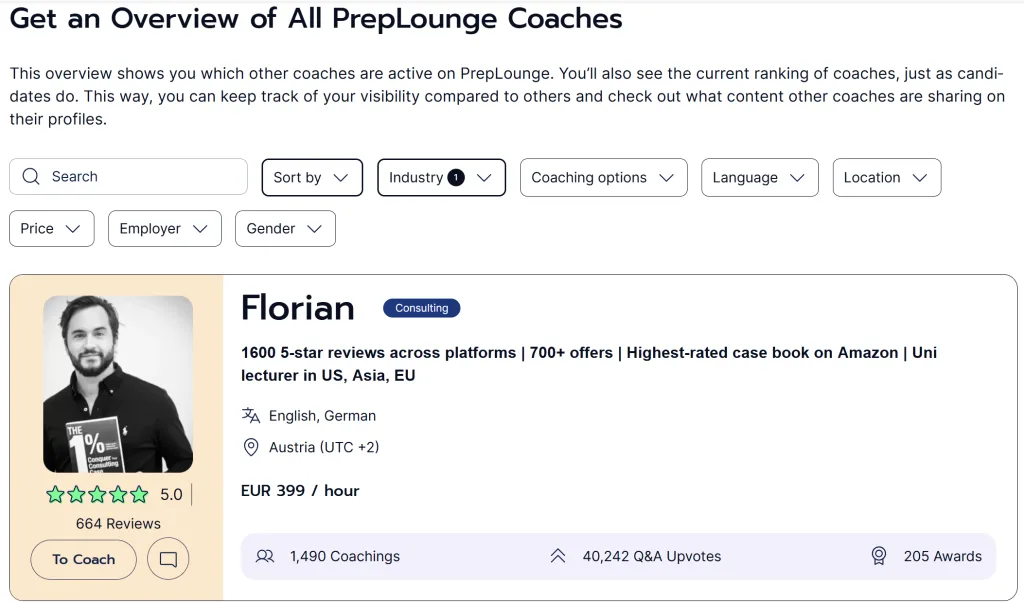
PrepLounge’s global case coach ranking, with my profile ranked first by customer recommendation rate.
The main limitation is quality control. Peer partners are still other candidates, so they may not recognize weak structures, poor communication habits, or incorrect feedback. In the worst case, two candidates can reinforce the same bad habits while both feeling that the session went well. The quality of paid coaching also varies, particularly in terms of genuine MBB experience, interviewer exposure, and the ability to diagnose specific performance gaps.
Use PrepLounge primarily for practice volume, social repetition, and access to a large candidate community. Then add at least one calibration session with someone who has actually interviewed candidates in real life. That combination gives you the best of both worlds: enough live reps to build fluency and sufficiently expert feedback to ensure you are practising the right behaviors.
For a detailed review of PrepLounge, click here.
Management Consulted: best for an intensive bootcamp
Management Consulted has been in the market for a long time and offers a more intensive preparation model than most self-paced platforms. Its programs combine structured coursework, live bootcamps, coaching, and a defined preparation path. If you want someone to tell you what to study, when to study it, and how to move through the process, it provides considerably more hand-holding than a standard online course.
That structure can be valuable for candidates who struggle to prepare independently. Rather than assembling resources from several providers, you get a more complete program with clear milestones and direct support. If budget is not the main constraint and you want an immersive preparation experience, Management Consulted is one of the more established options.
The two main trade-offs are price and methodology. It sits firmly at the premium end of the market, so you are paying not only for the content but also for the bootcamp format, accountability, and access to coaches. Whether that is worth it depends heavily on how much external structure you need.
The teaching approach also tends to be more traditional and framework-forward. That can help beginners understand common case types and build an initial sense of order, but it risks encouraging candidates to classify problems and retrieve memorized structures rather than build a tailored approach from first principles. That is precisely the preparation style I consider less effective for modern MBB interviews, where interviewers increasingly test flexibility, judgment, and the ability to handle unfamiliar problems.
Overall, Management Consulted is strong on structure, intensity, and hand-holding. It is expensive and more old-school in its methodology, but it can still be a good fit for candidates who want a guided bootcamp experience rather than a self-directed course.
For a detailed review of Management Consulted, click here.
IGotAnOffer: best for one-off coaching from a marketplace
IGotAnOffer operates as a coaching marketplace with a broad roster of former consultants, alongside a substantial library of free interview guides. Its main advantage is flexibility. If you want to book a single session with someone from a particular firm, office, or recruiting background, the platform makes it relatively easy to find a relevant coach and schedule a session without committing to a larger package.
That makes it especially useful for targeted needs: a final mock interview before the real thing, feedback on one specific weakness, firm-specific calibration, or a second opinion on your overall readiness. The marketplace model also gives candidates more choice.
The trade-off is consistency. Because each coach brings their own methodology, experience, and coaching style, the quality of the session depends heavily on whom you select. You are buying access to an individual coach rather than following one unified preparation system. One coach may emphasize first-principles thinking and tailored structures, while another may rely more heavily on traditional frameworks or generic feedback.
That is not necessarily a problem for a one-off session, but it matters if you want a coherent preparation journey. Working with several coaches who use different methods can create confusion, particularly for candidates who are still building their fundamentals and do not yet know which advice to trust.
Overall, IGotAnOffer is a good option for targeted, one-off coaching and for candidates who know exactly what type of support they need. It is less suited to someone looking for a single, consistent methodology that takes them from initial preparation through to the final interview.
Hacking the Case Interview: best for free framework content
Founded by a former Bain consultant, Hacking the Case Interview has built a strong presence through its extensive library of free articles and clear explanations of common case types and frameworks. For candidates who are just starting out and want to understand the basic vocabulary, interview flow, and standard problem categories, it is a genuinely useful free resource.
The limitation is that the methodology remains relatively framework-heavy. Templates can help beginners create order, but they can also encourage candidates to identify a familiar case type and reproduce a memorized structure. That approach often breaks down when an interviewer introduces an unusual problem or expects a genuinely tailored analysis.
Use it to learn the fundamentals and get oriented, then move toward a method that teaches first-principles structuring, flexible problem solving, and adaptation to the specific case in front of you.e.
Victor Cheng / LOMS: the legacy option, with caveats
Victor Cheng’s Look Over My Shoulder program and his book shaped a generation of case prep, and the core communication ideas still hold. Credit where it is due.
The problem is that the material reflects an older style of case interview. The cases, frameworks, and interviewer dynamics feel increasingly removed from what candidates face in current MBB processes, where problems are often less standardized and require more flexible, first-principles thinking. Useful for historical context and basic communication habits, but no longer especially useful as a primary preparation method for modern cases.
Free options: YouTube, Reddit, and ChatGPT
You can start for free, and you should. StrategyCase alone publishes 250+ free guides and a free 7-hour case interview fundamentals course, and there is strong free material on YouTube and Reddit as well.
The limits are predictable. Free content is scattered, quality is uneven, and nobody is checking your specific performance. ChatGPT as a case partner is worse than it looks, because it recycles outdated cases and hands out false confidence it cannot back with a real interviewer’s judgment. Free is the right place to begin, not the place to stop if an offer is on the line.
Which case interview prep course should you pick?
Match the option to your situation rather than the loudest brand.
- You have under 2 weeks: Skip the platform hopping. Book focused coaching to find your biggest gaps fast, and drill only those. Volume will not save you now; targeted feedback might.
- You have 4 to 8 weeks (the typical runway): Build skill with a structured program like the Academy, add live reps through a partner on PrepLounge, and get one or two coaching sessions to calibrate before the real thing.
- You are targeting McKinsey specifically: Prioritize a method that covers the Solve assessment and the PEI, not just generic cases. Both are graded, and both sink strong casers who ignore them.
- You are aiming at BCG or Bain: Make sure your prep includes their screens, the BCG cognitive test and Bain’s SOVA, alongside the live case.
- You are on a tight budget: Start with free guides and a free PrepLounge partner, then spend your limited money on one coaching session rather than a subscription.
- You are an experienced hire or career changer: Your gap is usually format, not intellect. You need a method to translate real experience into case structure, which is where a taught system beats grinding cases.
- You are re-applying after a rejection: Do not just do more volume. Get an honest diagnosis of what went wrong first, then rebuild the specific weakness.
The one thing no case interview prep course can skip
Strip away the branding and every option here is really selling one of two things: reps or feedback (ideally both). Reps are cheap and increasingly free. Feedback from someone who has sat on the evaluating side and is currently active coaching MBB candidates across the globe is the scarce input, and it is what consistently moves a candidate from “good enough to get invited” to “clearly above the bar.”
That is the honest reason coaching keeps showing up in these rankings, mine included. If you take one thing from this page, let it be this: buy the skill, then buy the feedback, and treat raw case volume as the cheap commodity it has become.
Frequently asked questions
Are case interview prep courses worth it?
For most serious MBB candidates, yes, but only the right kind. A course that teaches a repeatable structuring method and gives feedback on your gaps pays for itself against a single rejected application. A course that just sells you more cases to grind alone usually is not worth it, because you can find cases for free.
What is the best case interview prep course for McKinsey?
Pick one that covers both the case and McKinsey’s own screens, the Solve assessment and the Personal Experience Interview. A general case course that ignores those leaves two graded stages unprepared. Firm-specific depth matters more for McKinsey than for almost any other firm.
Can I prepare for case interviews for free?
Yes, and you should start there. Free guides, YouTube walkthroughs, and a free PrepLounge partner will get you oriented and give you live reps. The ceiling on free prep is feedback: at some point you need someone who can see the gaps you cannot, and that is worth paying for.
How much do case interview prep courses cost?
They range widely in 2026. Drill subscriptions run in the low tens of dollars per month, self-paced course bundles sit around $100 to $300 one-time, and premium bootcamps and coaching packages reach into the thousands. Cost tracks the level of live human feedback more than the amount of content.
Is CaseCoach or PrepLounge better?
They solve different problems. CaseCoach is a polished, paid video course with AI practice, best if you want structure handed to you. PrepLounge is a free-to-start community for finding live case partners. Many candidates use PrepLounge for reps and a separate course or coach for the actual method.
How long does it take to prepare for a case interview?
Most successful candidates prepare for 4 to 8 weeks of structured practice. Experienced hires often need less time on frameworks and more on adapting their background to the case format. What matters is quality of feedback per week, not raw hours.
Related guides
- The complete case interview guide: the full method, start to finish
- Best case interview books, ranked: if you specifically want books, not courses
- Case interview frameworks that still work: how to structure without memorizing templates
- The McKinsey case interview playbook: the firm-specific method for McKinsey rounds
- Case interview math, the practical guide: the skill that quietly sinks many candidates
The bottom line
There is no single best case interview prep course, only the best fit for your timeline, budget, and target firm. Use free resources to start, use volume tools like drills and peer practice as components, and spend your real money on the skill and the feedback that actually move your offer rate.
If you want that skill layer in one place, start with StrategyCase’s free case interview guides to get oriented. When you are ready to build the skills that convert, the Case Interview Academy was built for exactly that.
When you want a human to find the gap you cannot see, book a coaching session.
About the author: Florian Smeritschnig is a former McKinsey Senior Consultant and the founder of StrategyCase. He spent five years at the firm and has since run more than 2,200 mock case interviews and coached hundreds of candidates into McKinsey, BCG, Bain, and other top firms.