
Last Updated on July 16, 2026
By Florian Smeritschnig, Former McKinsey Senior Consultant · Updated July 2026
You get promoted in consulting by doing next-level work before you have the next-level title, and by earning a sponsor who argues for you when you are not in the room. The formal review only confirms a decision that staffing and hallway conversations already made.
That is the part the official criteria never spell out. Firms publish tidy competency models on how to get promoted in consulting, but the real promotion decision is a mix of demonstrated impact, who advocates for you, and which projects you happened to be staffed on. Miss that, and you can work brutal hours, get “meets expectations” every cycle, and quietly stall while a peer with the same skills moves up.
Having sat on the other side of these discussions at McKinsey when providing feedback on colleagues I have worked with, I will tell you how promotions actually get made and what to do about it.
Key Takeaways
- Promotions are decided in staffing and calibration discussions, not on review day. Review day just ratifies the story.
- The single biggest lever is a sponsor: a senior person who spends their own credibility arguing for you.
- Do the next level’s job before you get the title. Firms promote people who already look the part.
- Getting staffed on visible, well-run projects matters as much as the quality of your work on them.
- Strong executors stall when they never build structure, never find a sponsor, or stay invisible in staffing.
How Consulting Promotions Actually Work
A consulting promotion is a firm’s decision that you already operate at the next level, made through performance ratings, a sponsor’s advocacy, and a calibration discussion where partners compare peers. The formal review documents the decision, but staffing choices and reputation shape it long before.
Here is the mechanic most people miss. At review time, your ratings across projects get pulled together, and a group of senior people sit in a room and compare you against your peer group. Someone has to speak for you in that room. If a partner who knows your work well makes the case, backed by strong project ratings, you move. If nobody does, you wait, no matter how hard you worked.
That is why promotion is never just about output. It is about output plus advocacy plus evidence. Your job across a cycle is to generate all three: do work strong enough to rate well, make sure it is visible to people with influence, and give a sponsor the specific ammunition they need to argue your case.
None of this means the work does not matter. It means the work is necessary but not sufficient. The rest of this guide is about the “not sufficient” part, because that is where strong people quietly lose.
The Consulting Promotion Ladder
Titles vary by firm, but the ladder is consistent, and each firm publishes its own version of it. McKinsey’s career path, for instance, runs from business analyst to associate, then engagement manager, then partner (with some mini-promotions along the way). Each jump tests something genuinely different, and the reason people stall is usually that they keep doing the previous level’s job well instead of the next level’s job.
| Level (typical) | What unlocks the next jump | What gets people stuck |
|---|---|---|
| Analyst / BA | Flawless execution, reliability, clean analysis | Staying a great “task-doer” with no ownership or structure |
| Consultant / Associate | Owning multiple workstreams, structuring ambiguous problems, client presence and influence | Strong analysis but weak communication or no independent structure |
| Manager / EM | Running the team and client day to day, managing up and down | Great individual contributor or analyst who cannot lead a team or a client |
| Principal / Partner | Selling work, owning client relationships, building the practice | Excellent delivery but no client development or network |
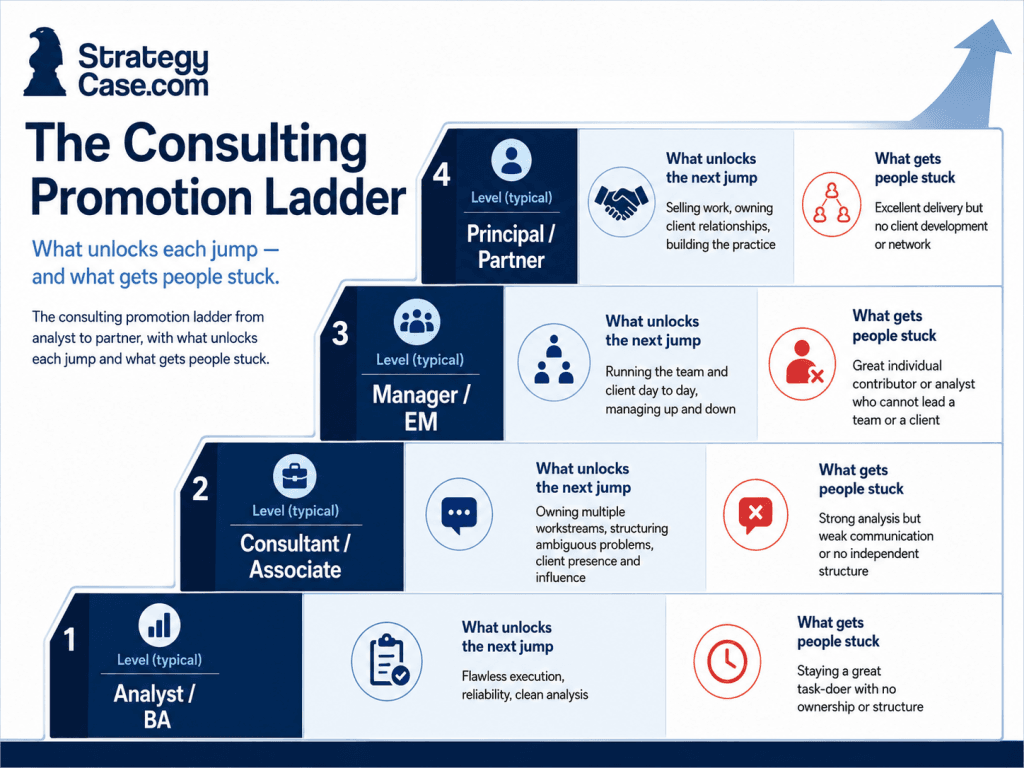
The pattern is clear once you see it. Every jump asks you to let go of what made you successful at the last level and take on a new kind of risk. The people who get promoted early start making that shift before the title arrives. Doing great work on your projects is the foundation, so treat each engagement as evidence, starting from the day you kick off a new consulting project.
What Actually Gets You Promoted: The Unwritten Rules
The official criteria are real, but these are the unwritten rules that decide who moves and who waits.
Do next-level work before you have the title
Firms promote people who already look like they belong at the next level. If you are an analyst who wants to make consultant, start owning a workstream, structuring the ambiguous parts, and taking initiative your manager did not ask for. The promotion becomes a formality that recognizes what you are already doing, which is a far easier case to make than a promise about what you might do.
Win a sponsor, not just a mentor
A mentor gives you advice over coffee. A sponsor puts their name on the line for you in the calibration room. You need a sponsor, and you earn one by consistently making a senior person’s life easier and their work better, so that advocating for you feels like a safe bet. Decades of Harvard Business Review research show sponsorship, not mentorship, is what actually moves people up, and consulting is a textbook case.
Consider Priya, a strong consultant who rated well but kept getting passed over for manager. Her work was excellent and completely invisible above her project lead. She changed one thing: she started giving her partner clean, quotable updates on her workstream and volunteered for a firm initiative the partner cared about. Same quality of work, but now a senior person could see it and speak to it. She made manager the next cycle.
Get staffed on the right projects
Not all projects build your case equally. A well-run engagement with a supportive manager and visible impact does more for your promotion than a chaotic one where you worked twice as hard. Staffing is not fully in your control, but it is not random either. Understanding how consulting projects are staffed and making your interests known helps you steer toward work that builds your profile.
Be easy to staff and easy to manage
Managers advocate for people they want on their teams again. Being reliable, low-drama, and quick to act on feedback is not glamorous, but it is quietly decisive. The consultant everyone wants to staff gets more at-bats, more visibility, and more sponsors. The brilliant one who is hard to work with gets avoided.
Want the full promotion playbook, level by level? It is all in Consulting Career Secrets, written from the other side of the review table.
How to Nail the Review Cycle
The review is where the story gets told, so give the people telling it what they need.
Write a self-assessment that is specific and honest: concrete deliverables, measurable impact, and one or two development areas you are actively working on. Vague self-praise is easy to discount. Specific evidence is easy to repeat in a calibration room. Owning a real weakness reads as maturity, which paradoxically strengthens your case.
Then feed your sponsor. Do not assume they remember every detail of your best work. Give them a short, clear summary they can lift straight into the discussion: what you owned, what changed because of it, and why it shows you are ready for the next level. You are not being pushy. You are making it easy for someone to help you.
Why Strong Analysts Get Stuck
Some of the most capable people stall, and it is rarely because the work was not good enough. It is one of these traps.
- Great executor, no structure. They can run any analysis handed to them but never own the ambiguous, “figure out what the question is” part that the next level requires.
- Invisible in staffing. Excellent work that no senior person can see or speak to does not build a promotion case.
- No sponsor. Plenty of mentors, nobody willing to spend real credibility in the room.
- Fighting the level shift. Clinging to what made them great last year instead of taking on the new kind of risk.
- Poor at managing up. Strong down and sideways, but they never give their partner the confidence and information to advocate for them.
Promotion by Firm and Track
The mechanics are similar everywhere, but the details shift.
- MBB: Formal, fast, and famously up or out. The calibration and sponsor dynamics above are especially strong, and the timelines are tight. More on the “or out” reality in the FAQ below.
- Big 4 and boutiques: Often less rigid and less up-or-out, with more room to sit at a level. That can be a relief, but it also means you have to push harder for visibility, because the machine will not force the conversation for you.
- Experienced hires: You may enter at a higher level, which means less runway to prove you belong before the next jump. Build your sponsor relationship faster.
- IC versus management track: Some firms offer an expert or specialist path that rewards depth over team leadership. If leading teams and selling work is not what you want, that track can be the smarter route up.
How AI Is Raising the Promotion Bar in 2026
AI is quietly changing what “adds value” means at each level, which changes what gets you promoted. When a model can produce a first-cut analysis in minutes, the premium shifts to the things AI cannot do: sharp structuring, judgment under ambiguity, client trust, and knowing which question actually matters. I unpack this in how AI is changing the junior consultant role.
The practical takeaway for your promotion case: lean into the human skills the ladder has always rewarded, and use AI to clear the routine work faster so you have more room to demonstrate them. Consultants who use AI to do more thinking, not less, are the ones who will keep moving up.
Get Promoted Faster
Getting promoted in consulting is not a reward for hours logged. It is a decision that you already operate at the next level, made by people comparing you to your peers, and swung by whoever is willing to advocate for you. Your job is to give them an easy case to make.
To recap the playbook:
- Do the next level’s work before you get the title.
- Earn a sponsor who will argue for you in the room, not just a mentor.
- Get staffed on visible, well-run projects and be easy to manage.
- Feed your sponsor specific evidence and own your development gaps at review time.
At StrategyCase, the questions I get after someone lands the job are often about exactly this: why did a peer move up first, and what do I do about it. The honest answer is that promotion is a skill you can prepare for like any other. The full, level-by-level version lives in Consulting Career Secrets, part of the StrategyCase library, written from someone who sat on the other side of the table.
Frequently Asked Questions: How to Get Promoted in Consulting
How do you get promoted in consulting?
You get promoted by demonstrating next-level impact before you have the title, being staffed on visible projects, and earning a sponsor who advocates for you in calibration discussions. Strong ratings are necessary but not enough on their own. Advocacy and visibility are what turn good work into a promotion.
What actually gets you promoted at McKinsey, BCG, or Bain?
At MBB, promotion comes down to consistently strong project ratings, a senior sponsor who argues your case, and evidence that you already operate a level up. Being reliable and easy to staff keeps you on good teams, which creates the visibility and sponsorship the decision depends on.
How long does it take to get promoted in consulting?
Timelines run roughly two to three years per level early on, though they vary by firm and performance. Because the “or out” side of up-or-out matters just as much, see the detailed timelines in our guide to up-or-out in top-tier consulting firms.
Why do some strong consultants not get promoted?
Usually because their excellent work was invisible to senior people, they never built a sponsor, or they kept doing their current level’s job well instead of taking on the next level’s harder, ambiguous work. Great execution alone does not make the case for a promotion.
What is a sponsor and why does it matter for promotion?
A sponsor is a senior person who spends their own credibility advocating for you when promotion decisions are made, unlike a mentor who simply gives advice. Sponsorship is the biggest lever in consulting promotions, because someone has to argue your case in a room you are not in.
Is getting promoted harder for experienced hires?
It can be, because experienced hires often enter at a higher level with less runway to prove they belong before the next jump. The fix is to build a sponsor relationship quickly and to adapt to the firm’s operating model rather than leading the way your previous company did.
Related Guides
- Consulting Exit Opportunities: the other side of up-or-out, and where consultants go next.
- Work-Life Balance in Consulting: how to push for promotion without burning out.
- 4 Typical Tasks of Entry-Level Consultants: the foundation you build your promotion case on.
- The First 90 Days in Consulting: a practical playbook for new hires.
About the author: Florian Smeritschnig spent five years at McKinsey as a Senior Consultant, where he evaluated candidates, and has since delivered 2,200+ mock interviews and coaching sessions, helping 700+ candidates land offers and careers at McKinsey, BCG, Bain, and other top firms.
