
Last Updated on July 16, 2026
By Florian Smeritschnig, Former McKinsey Senior Consultant · Updated July 2026
Your first 90 days in consulting break into three phases: days 1-30 you learn the firm’s system and earn trust, days 31-60 you deliver real work and get visible, and days 61-90 you prove you belong at the next level. Nail that arc and you set the trajectory for your whole time at the firm.
Here is the uncomfortable part. Nobody hands you this plan on day one. You show up with an offer, a laptop, and a manager who is already busy, and you are left to guess what “good” looks like while the clock quietly starts on your reputation. Reputations set fast in consulting and they are stubborn to change.
This guide is the 30-60-90 day plan I wish someone had given me, drawn from five years at McKinsey and adapted from my book, Consulting Career Secrets.
Key Takeaways
- Your first 90 days are a ramp phase, not a test you pass on day one. Learn first, deliver second, stretch third.
- The strongest early signal is not brilliance. It is being reliable, easy to manage, and quick to turn feedback into change.
- Aim for one visible win by the end of your first month, not a perfect analysis in month three.
- A named sponsor who advocates for you matters more than raw output. Start building that relationship in week two.
- The up-or-out clock starts on day one, so treat feedback as the most valuable thing you receive, not a threat.
What the First 90 Days in Consulting Actually Decide
Your first 90 days in consulting are the onboarding window, usually your first full project or two, when you learn how the firm works, prove you are reliable, and build the relationships that decide how you get staffed next. They set your reputation before any formal review does.
Most new consultants think the review at month six decides their standing. It does not. By then, the story is mostly written. Managers form a view of you in the first few weeks, that view spreads through informal conversations, and it shapes which projects you get pulled onto next. Good early projects lead to more good projects. The reverse is just as true.
This is not about being the smartest person in the room. Firms already screened for raw ability when they hired you. What they are watching now is different: Are you reliable? Do you improve when told something once? Are you easy to staff and easy to manage? Are you eager to deliver and self-standing?
Those are the traits that compound over 90 days into a reputation.
If you want the day-one version of this for your very first project, start with the sibling guide on how to kick off a new consulting project. This article zooms out to the whole first quarter.
Days 1-30: Learn the System and Earn Trust
Your first month has one job: become someone the team can rely on. You are not expected to have answers yet. You are expected to learn fast, ask good questions, and hit every small commitment you make.
Learn the firm’s unwritten rules
Every firm has a written onboarding and a real one. The real one lives in how people actually behave: how fast you are expected to reply, how polished a draft needs to be before you share it, who reviews what, and how disagreement gets voiced. Watch closely in week one and copy the norms of the people who are respected.
Michael Watkins makes the same point in Harvard Business Review: people stepping into a new role should diagnose the situation before acting, not import habits that worked somewhere else. In consulting, that means learning the local operating style before you try to stand out.
Master the tools and the cadence
Get fluent fast in the tools the team lives in: the slide standards, the modeling conventions, the file structure, the daily and weekly rhythm. These sound trivial. They are not. A consultant who fumbles version control or breaks the deck template creates friction the whole team feels.
Consider Maya, a new associate on a cost-transformation project. In her first two weeks she quietly rebuilt her Excel speed and learned the firm’s slide grid cold. Nothing flashy. But when a partner asked for a chart reworked at 9 p.m., she turned it around clean in 20 minutes. That one moment did more for her reputation than any clever comment in a meeting.
She created the right systems for her early on, which enabled her to (over)-deliver on a partner request.
Build your team relationships early
Your manager and the senior people on your team are the ones who will describe you to others. Have a short, direct conversation with your manager in the first days: what does great work look like on this project, how do they like to receive updates, and what would make their life easier. Then deliver against exactly that. Repeat the same process with the partners on your team.
If you want to understand where your hours will actually go before you start, my guide to the typical tasks of an entry-level consultant lays it out honestly.
Deliver your first smal win
Before day 30, put one useful thing in front of your team that they did not have before. A clean data cut. A “killer slide” backed by solid analysis the team has not thought about before. A tight summary of a messy set of interviews. A resolved question that had been nagging the manager. It does not need to be big.
It needs to be real, and it needs to show you can take something from start to finish without hand-holding and because of your own intuition and drive.
Days 31-60: Deliver and Get Visible
Month two is where you shift from learning the system to producing within it. The goal now is consistent, trustworthy output plus visibility with the people who matter.
Own a workstream end to end
By now you should own a piece of the project outright, not just tasks handed to you. Owning means you drive it: you flag risks early, you come to your manager with a recommendation rather than an open question, and you make the analysis tell a clear story. Ownership is the single clearest signal that you are ready for more responsibility.
Use the mid-point feedback
Most projects have a mid-point check-in, and most firms run upward and downward feedback constantly. Treat every piece of feedback as gold. The consultants who ramp fastest are not the ones who never get criticized. They are the ones who get told something once and visibly change it the next week. That responsiveness is what managers remember at review time.
Take Daniel, an experienced hire from industry. His first mid-point feedback was blunt: his slides were dense and buried the answer. Instead of getting defensive, he asked for two examples of “good,” rebuilt his next deck answer-first, and asked his manager to sanity-check it. Within a month the same manager was holding up Daniel’s slides as the standard for the team.
Ready to build these habits before your start date? The full playbook, with templates and checklists for each phase, lives in Consulting Career Secrets, my book for new consultants.
Get staffed by the right people
Consulting careers are built project by project, and staffing is rarely random. Managers ask around for people they have heard good things about. That means visibility matters: do good work, make sure the right people see it, and let your interest in certain topics or industries be known. Understanding how consulting projects are staffed early helps you steer toward the work that builds your profile.
Find a mentor and a sponsor
A mentor gives you advice. A sponsor spends their own credibility advocating for you when you are not in the room. You need both, and the sponsor matters more for your trajectory. By day 60, you should be building a genuine relationship with at least one senior person who will speak up for you at staffing and review discussions.
Days 61-90: Show You’re Ready for More
The final month is about signaling that you are not just competent at your level, you are already operating a notch above it. That is what earns a strong first review and the reputation that pulls you toward better work.
Demonstrate next-level behavior
The people who get promoted early start acting at the next level before they have the title. For an analyst, that means thinking like an associate: connecting your analysis to the bigger question, anticipating what the manager needs next, and taking initiative without being asked. Show the behavior first and the title tends to follow.
Handle your first formal review well
Your first review is a checkpoint, not a verdict. Go in with a clear, honest self-assessment, specific examples of what you delivered, and one or two areas you are actively working on. Owning your development gaps reads as maturity. Pretending you have none reads as a lack of self-awareness, which is worse.
Fix the one thing your feedback flagged
By day 90, you have heard your recurring weakness more than once. Maybe it is over-engineering analysis, maybe it is communication, maybe it is not asking for help soon enough. Pick the single most-mentioned item and visibly close it. Walking into your review able to say “here is the thing you flagged, and here is how I fixed it” is the strongest move you can make.
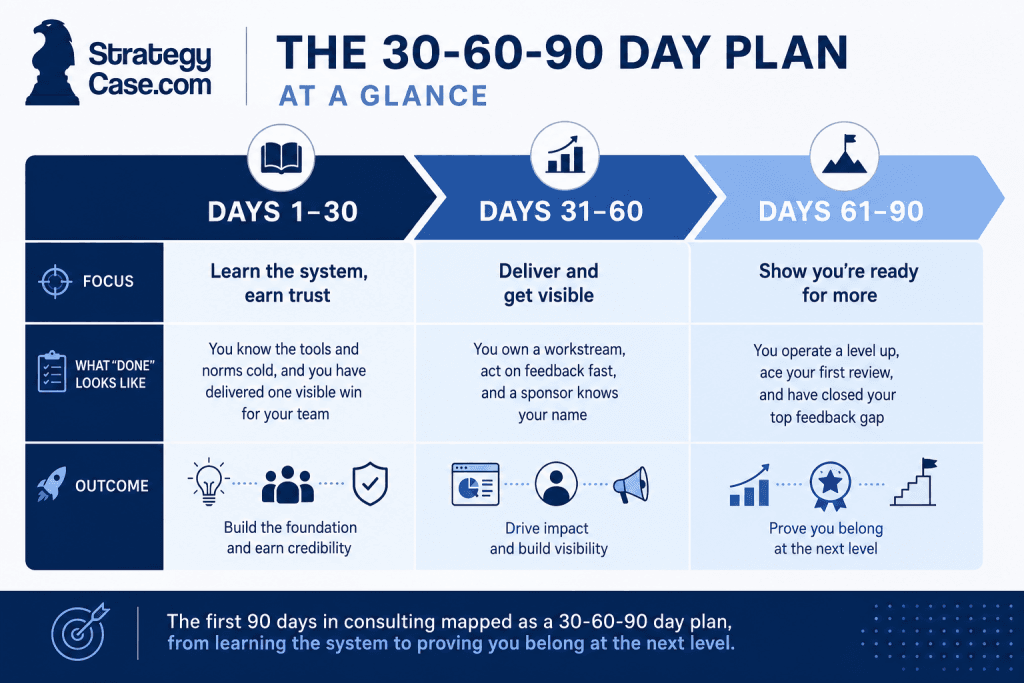
The 30-60-90 Day Plan at a Glance
Here is the full arc in one view. Screenshot it and check yourself against it each month.
| Phase | Focus | What “done” looks like |
|---|---|---|
| Days 1-30 | Learn the system, earn trust | You know the tools and norms cold, and you have delivered one visible win for your team |
| Days 31-60 | Deliver and get visible | You own a workstream, act on feedback fast, and a sponsor knows your name |
| Days 61-90 | Show you’re ready for more | You operate a level up, ace your first review, and have closed your top feedback gap |
Your First 90 Days by Situation
The arc is the same for everyone, but the emphasis shifts with your background and firm.
- Campus analyst (first job ever): Spend more of month one on tools and business fundamentals. Your steepest curve is basic execution speed and professional norms, not strategy.
- MBA associate: You are expected to show structure and client presence faster. Your risk is over-indexing on frameworks and under-indexing on getting your hands dirty in the analysis.
- Experienced hire: Your domain knowledge is an asset, but the case-team operating model is new. Resist running things your old way. Diagnose first, as the HBR point above argues.
- MBB vs boutique vs Big 4: At MBB, firms like McKinsey run a formal, fast feedback and development machine. At smaller firms you often have to supply your own structure and ask for feedback that nobody schedules. The plan still holds, you just drive more of it yourself.
- On-site vs hybrid: If your team is hybrid, relationships and informal learning do not happen by accident. Go in on the days your team is in, and over-communicate on remote days.
Use AI to Ramp Faster in 2026
AI has changed what a strong first 90 days looks like, and knowing how to use it well is now part of the job. It can compress the boring parts of ramping: turning messy notes into a clean summary, building a first-cut industry primer, or pressure-testing your issue tree before you show your manager. I wrote about this shift in detail in how AI is changing the junior consultant role.
One rule holds, though. AI speeds up the prep, it does not replace the judgment. Every number and claim you put in front of a manager or client has to be one you have checked yourself. New consultants who lean on AI for speed but keep ownership of the thinking ramp faster. Those who outsource the thinking get exposed the first time someone asks a follow-up question.
Common First-90-Days Mistakes
Most rocky starts come from the same handful of errors. Watch for these:
- Chasing hours over impact. Being visibly busy is not the same as being useful. Managers notice output and reliability, not who stayed latest.
- Hiding confusion. Silence in week one reads as “lost,” not “independent.” Ask early and specifically.
- Ignoring or arguing with feedback. The fastest way to stall is to get told something twice.
- Skipping relationships. If nobody senior can describe your work, you will get overlooked at staffing.
- Over-promising. Confident claims you cannot back up age badly and are hard to walk back.
Make Your First 90 Days a Launchpad
Your first 90 days in consulting are a compressed version of the whole career: learn a system, deliver under pressure, build the relationships that get you the next opportunity, and turn feedback into visible improvement. Get this quarter right and you earn the reputation that pulls you toward better projects, faster promotions, and more control over your path.
To recap the plan:
- Days 1-30: learn the tools and unwritten rules, and land one visible win.
- Days 31-60: own a workstream, act on feedback fast, and build a sponsor relationship.
- Days 61-90: operate a level up, ace your first review, and close your top feedback gap.
At StrategyCase, most people find us while preparing for interviews, but the questions that come after the offer are just as important, and this is one of the biggest. If you want the complete version, with the templates and war stories behind each phase, it is all in Consulting Career Secrets, part of the StrategyCase library.
Read it before your start date and walk in already knowing how the first quarter goes.
Frequently Asked Questions
What should I do in my first 90 days as a consultant?
Spend the first 30 days learning the firm’s tools and unwritten rules and delivering one small win. Use days 31-60 to own a workstream, act on feedback, and build a sponsor. Use days 61-90 to operate a level up and ace your first review. Learn first, deliver second, stretch third.
What is a 30-60-90 day plan for a new consultant?
It is a simple three-phase ramp: the first 30 days are for learning and earning trust, the next 30 for delivering and getting visible, and the final 30 for showing you are ready for more responsibility. It keeps you focused on the right goal each month instead of trying to do everything at once.
How do you make a good impression in your first months in consulting?
Be reliable, be easy to manage, and turn feedback into change fast. Hit every small commitment, ask specific questions early, and put one useful, finished piece of work in front of your team in the first month. Reliability impresses managers more than cleverness.
How long does it take to feel competent in consulting?
Most new consultants start feeling genuinely competent around the three to six month mark, usually after their first full project. The first 90 days feel uncomfortable by design. Feeling behind early is normal and is not a signal that you cannot do the job.
What gets a new consultant a bad reputation early?
The fastest ways to stall are ignoring feedback, hiding when you are confused, missing small commitments, and being hard to manage. Chasing visible hours instead of real output also hurts, because managers value reliable results over face time.
Is the first 90 days different for an experienced hire versus a campus hire?
The arc is the same, but the emphasis differs. Campus hires spend more time on execution speed and professional norms. Experienced hires already have domain knowledge but must learn the case-team operating model and resist running things the way their old company did.
Related Guides
- Up or Out in Top-Tier Consulting Firms: the promotion clock that starts on day one.
- Must-Have Items for New Management Consultants: the gear worth buying before day one.
- Work-Life Balance in Consulting: protect your energy so the first 90 days do not burn you out.
- How to Get Promoted in Consulting: a practical playbook for new hires.
About the author: Florian Smeritschnig spent five years at McKinsey as a Senior Consultant, where he evaluated candidates, and has since delivered 2,200+ mock interviews and coaching sessions, helping 700+ candidates land offers and careers at McKinsey, BCG, Bain, and other top firms.
