
Updated October 2026. By Dr. Florian Smeritschnig, former McKinsey Senior Consultant
McKinsey doesn’t require a cover letter for most roles. Its recruiting team says so in plain words: “for most positions and programs, we do not require cover letters.” So the real decision isn’t how to write a McKinsey cover letter. It’s whether yours adds something your resume can’t.
Send one if the posting asks for it, if you’re changing careers, if you need to explain a gap or a reapplication, or if you have a genuine tie to an office or practice. Otherwise, spend the time on your resume.
Every application season, the same question comes back on consulting forums. On PrepLounge, a candidate who’d heard that McKinsey doesn’t want cover letters asked whether that also held for the Paris office. Another member replied that a recruiter in London had told them a letter wasn’t required.
The advice in those threads runs from “skip it” to “always attach one, just in case.” Neither works as a rule.
Having screened applications at McKinsey, I’d put it this way. A strong letter helps when it carries evidence the resume can’t, an average one is neutral, and a careless one costs you. Below you’ll find what McKinsey actually asks for (including the postings that do want a letter), a simple rule for deciding, what a screener reads for, and a full annotated example for an experienced hire.
This page covers McKinsey only. If you’re also applying to BCG or Bain, StrategyCase’s consulting cover letter guide has those firms and the base structure.
Key Takeaways
- McKinsey doesn’t require a cover letter for most roles, and its recruiting team says so on the McKinsey careers blog. A few postings do ask for one, such as a 2026 data science role in Houston or Denver.
- Some postings want other documents instead. McKinsey’s Geneva and Zurich postings ask for transcripts from high school onward and reference letters or employment certificates, with no cover letter listed. Read the posting, not the forum.
- Send a letter when it adds evidence your resume can’t show: a career change, a gap, a reapplication, or a real tie to an office or practice. Skip it when it would only restate the resume.
- A strong McKinsey cover letter previews the personal experience interview (PEI). Well-evidenced stories showing Leadership, Connection, Growth, and Drive without ever naming the dimension.
- The “why McKinsey” paragraph has to fail the swap test. Praise for the firm or a recited value survives a find-and-replace with “BCG”, so it does no work.
Does McKinsey Require a Cover Letter?
No, not for most roles. A McKinsey recruiting expert who designs assessments for all client-service roles, and who spent six years as a McKinsey consultant before that, wrote on the McKinsey careers blog that most positions and programs don’t require one. The post dates from 2021, so I checked what the firm asks for today.
In October 2026, I searched McKinsey’s job board, which lists 500+ open roles, for “cover letter.” One posting came back. A search for “motivation letter” returned nothing. Here’s what the postings and the firm’s own pages say:
| Where you’re applying | What McKinsey asks for | Source |
|---|---|---|
| Most positions and programs | No cover letter required | McKinsey careers blog (2021) |
| Senior Data Science Analyst, OptimusAI (Houston or Denver) | A cover letter on why you fit the team | McKinsey job posting, October 2026 |
| Associate, Fellow, and Intern roles in Geneva and Zurich | No cover letter listed. CV, academic transcripts from high school onward, and reference letters or certificates from past employment | McKinsey job posting, October 2026 |
| Every office | The same qualities in a resume/CV and a candidate; some locations require local language proficiency | McKinsey careers FAQ |
So treat the posting as the rule. If it asks for a letter, “optional” doesn’t apply to you. If the portal offers an optional upload, the decision is yours, and the next section shows how to make it.
A word on regional lore. Forum answers often claim certain European offices “expect” a motivation letter. McKinsey’s own FAQ says every office looks for the same qualities, and the Swiss postings I found ask for more paperwork, not a letter. Match the language of the posting, and trust the office’s own instructions over a thread from years ago.
From my own experience, none of my clients had to write one over the last several years, but for some of them it actually made sense.
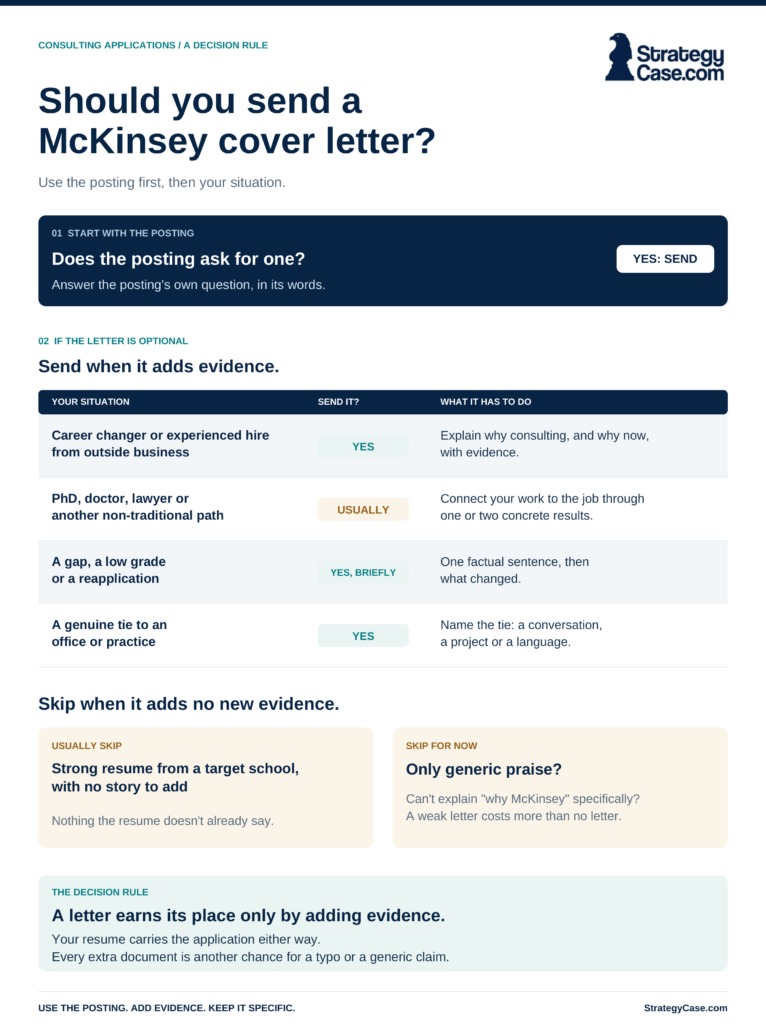
Should You Send a McKinsey Cover Letter? A Decision Rule
Use the posting first, then your situation. This table covers the common cases.
| Your situation | Send a letter? | What the letter has to do |
|---|---|---|
| The posting asks for one | Yes | Answer the posting’s own question, in its words |
| Career changer or experienced hire from outside business | Yes | Explain why consulting, and why now, with evidence |
| PhD, doctor, lawyer, or another non-traditional path | Usually | Connect your work to the job in one or two results |
| A gap, a low grade, or a reapplication | Yes, briefly | One factual sentence, then what changed |
| A genuine tie to an office or practice | Yes | Name the tie: a conversation, a project, a language |
| Strong resume from a target school, no story to add | Usually skip | Nothing the resume doesn’t already say |
| You can’t write “why McKinsey” without generic praise | Skip for now | A weak letter costs more than no letter |
The logic underneath is simple. The resume carries a McKinsey application either way. A letter earns its place only by adding evidence, and every extra document is one more place for a screener to find a typo or a claim that sounds like everyone else’s.
If the table says skip, that hour belongs on your resume. Before you pay anyone to look at it, read whether a consulting resume review is worth it for your situation.
What a McKinsey Screener Reads For in a Cover Letter
Screeners read for evidence, not polish. That’s true of the resume, and it’s true of the letter. The cover letters that helped were the ones that couldn’t have been pasted into another firm’s portal. A screener checks four things.
1. Does It Add Evidence the Resume Can’t?
A resume bullet holds a result. It can’t hold the reason you changed fields, the context behind a gap, or the hard part of a result, like who you had to persuade. That’s what the letter is for. If every sentence in your letter already appears on your resume in some form, the letter is a summary, and the screener has just read the original.
2. Does It Sound Like the Person Who’ll Sit the PEI?
McKinsey’s personal experience interview assesses four dimensions: Leadership, Connection, Growth, and Drive (the names since the 2025 rebrand). The McKinsey PEI guide covers each one.
A good McKinsey cover letter previews that evidence. Pick stories that show the dimensions well: responsibility nobody handed you, a relationship that changed an outcome, a moment you were out of your depth and closed the gap.
Don’t label it. “I demonstrated strong leadership” is a claim. “I piloted it on the night shift first” is evidence.
Keep in mind that the letter and the interview are one application. Whatever you claim in the letter can come back as a question in the PEI.
3. Is “Why McKinsey” Specific and True?
This is the paragraph most letters get wrong, so it has its own section below. The short version: if you can swap “McKinsey” for “BCG” and the paragraph still reads fine, it says nothing. Make it personal, show connections and interactions you had with McKinsey consultants.
4. Can You Write?
Consultants write for clients every day. One page, 250 to 400 words, plain sentences, and no errors. A letter that runs long or wanders reads as a candidate who can’t prioritize, which is the opposite of the job.
McKinsey Cover Letter Example: Experienced Hire, Annotated
The example below is for an experienced hire, because that’s where a McKinsey cover letter does the most work. It’s a constructed illustration, not a real candidate’s letter.
The candidate: An internal medicine physician with three years of residency and two years as an attending physician at a New York teaching hospital, applying for an Associate role in McKinsey’s New York office.
Dear McKinsey Recruiting Team,
I am applying for the Associate position in your New York office. After three years of residency and two as an attending physician here, I want to bring my experience improving hospital operations to consulting and continue building my career in New York.
What this paragraph does. Names the role and office, establishes the candidate’s experience, and gives a genuine geographic connection within the scenario. The opening sets up the career change; the next two paragraphs supply the evidence.
In my work, I have seen many parallels between medicine and consulting. At our 400-bed teaching hospital, I volunteered to lead an eight-person team tackling discharge delays. With a hospital analyst, I reviewed 1,800 discharges and found that medication and transport requests routinely started too late. My first proposal added a checklist; nurses explained that it duplicated existing paperwork. I spent two mornings observing their workflow, then worked with the nurse manager to incorporate discharge planning into the existing ward meeting. To address physicians’ concerns about premature discharge, we retained clinical discharge criteria and tracked readmissions alongside waiting times. I shared both measures in a weekly update. Over eight months, median time from discharge order to departure fell from 5.2 to 3.6 hours across two wards, while the 30-day readmission rate remained stable.
What this paragraph does. The result belongs on the resume. The rejected checklist, time spent observing nurses, and revised proposal earn the story its place in the letter. Volunteering shows initiative; working through objections shows Leadership and Connection; changing the approach shows Growth. The candidate demonstrates analytics and communication through specific actions without naming those skills. Each detail also gives the interviewer something concrete to explore.
When a third ward asked for help, its bottleneck was rehabilitation placement, so I worked with case managers to adapt the approach. That experience changed my career plans. I wanted to spend more of my time diagnosing unfamiliar organizational problems and helping teams solve them. Having taken a project through analysis, implementation, and adaptation, I now want to make that work my primary responsibility across different organizations.
What this paragraph does. Answers the question the medical resume leaves open: why leave clinical practice now? The move follows an experience that changed what the candidate wanted from work. Adapting the approach to a different bottleneck also shows that the candidate can reconsider a solution when the circumstances change.
McKinsey’s “Ensuring the financial sustainability of academic medical centers” helped me frame our proposal around patient access and clinician involvement. I later discussed it with a former physician in your New York office, who described changing a client recommendation after nurses challenged the team’s assumptions. That conversation made McKinsey tangible to me: I could bring clinical judgment to a team while being expected to test my own assumptions and work beyond my original expertise.
What this paragraph does. Connects a specific McKinsey publication to something the candidate actually did within the scenario, then adds a personal interaction and what they learned from it. The publication discusses patient access and clinician involvement in operational improvement. Changing the firm’s name would misattribute the publication and the conversation, so the paragraph fails the swap test. In a real application, both connections must be true.
I would welcome the opportunity to discuss how I could contribute in New York.
Sincerely,
[First Last], MD
What this paragraph does. Closes in one sentence and repeats the office preference. The evidence has already made the case.
The letter’s body runs 319 words across five paragraphs, excluding the salutation, signature, and annotations. It stays within the 250-to-400-word range while explaining the career change, developing one substantive achievement, and giving a specific reason for choosing McKinsey.
What I’d verify before sending. The candidate should be ready to explain how the discharge times were measured, which patients were included, how readmissions were tracked, and what they personally contributed. They should also be able to describe the recruiting conversation accurately. Those details connect the letter to the interview.
Can’t tell whether your own letter clears this bar? That’s normal. You know what every sentence means, so you can’t read it cold the way a screener does. StrategyCase’s cover letter review gives you that cold read from someone who screened applications at McKinsey. The link is at the end of this guide.
How to Write the “Why McKinsey” Paragraph
The swap test decides this paragraph. Replace every “McKinsey” with “BCG” or “Bain.” If the paragraph still reads fine, a screener learns nothing from it, because it could have been sent anywhere.
Here’s the same paragraph twice, for an undergraduate applying for a Business Analyst internship. Both versions are constructed for illustration.
Weak version:
McKinsey is the world’s leading management consulting firm, and its values, such as putting client interests ahead of the firm’s, deeply resonate with me. I would be honored to learn from the best and contribute to a firm with such a strong reputation.
Every sentence survives the swap. The value is recited, not lived, and “learning from the best” is the most common phrase in this paragraph. It isn’t wrong. It’s empty.
Strong version:
As treasurer of my university’s student union, I argued against a budget cut my own committee had proposed, and lost the vote. The compromise we negotiated afterward kept the library’s evening hours open. When I read that McKinsey asks its people to “uphold the obligations to engage and dissent,” it described the part of that year I’m proudest of. A conversation with John Doe, a Business Analyst from your London office, about pushing back on a partner’s hypothesis made me want to work somewhere that expects it.
The value is the same kind of material, but now it’s tied to a moment with a cost (a lost vote) and quoted in McKinsey’s own words from its purpose, mission, and values page. It also shows Connection without naming it.
Real specifics for this paragraph come from four places:
- A practice or office you can tie to your own work. The NYC candidate’s interest is backed by five years of first-hand experience in the medical industry.
- Something McKinsey published that you used or argued with: a McKinsey Global Institute report, a McKinsey Quarterly article, or a program like the Global Lighthouse Network. Name it exactly.
- A conversation that actually happened, with someone who’d recognize your description of it.
- One value, tied to a moment from your life, quoted in McKinsey’s wording.
What doesn’t count: rankings, size, prestige, “world’s leading,” and “learning from the best.” Every applicant can write those, so they tell the screener nothing about you.
McKinsey Cover Letter Advice by Applicant Type
The structure stays the same for every applicant. What changes is the question your letter has to answer.
Undergraduates and Business Analyst Interns
If you’re at a target school and your resume already makes the case, a letter is often skippable. If you send one, keep it under 300 words, with one story and one specific “why McKinsey.” Your resume carries the GPA and the internships. The letter only has to add the person behind them.
Campus windows close early, so check the dates in the McKinsey internship guide before you spend a week polishing a letter.
MBA, PhD, and JD Applicants
Your letter’s job is to answer “why consulting after this degree?” in two or three sentences, with a result as proof. McKinsey’s careers FAQ notes the firm has a long history of hiring people with law degrees, and the same logic applies to PhDs: the degree isn’t the obstacle, the translation is.
Turn research or legal work into a result a generalist can read in seconds. The guide for PhDs moving into consulting covers that translation in depth.
Experienced Hires and Career Changers
This is where the letter does the most work, as in the example above. Answer “why now” with evidence, and translate your industry results into money, time, or scale. If you’re unsure which level you’d enter at, the guide to experienced hires at McKinsey, BCG, and Bain covers levels and tracks.
Reapplicants
I know this situation from my own application. My first McKinsey application was for an internship, and the case interview didn’t go to plan. When I applied for a full-time role 14 months later, my profile had changed: an internship at Kearney, a master’s degree, and a completely different approach to case interviews. (The full story, including a small favor that sped up my reapplication, is in the guide to reapplying after a consulting rejection.)
That’s the shape of a good reapplication paragraph. One factual sentence says you applied before. The rest shows what’s different now, with evidence.
Don’t apologize and don’t relitigate the interview. The screener wants to know what changed, not how the last round felt.
Mistakes That Sink a McKinsey Cover Letter
The general mistakes (length, typos, formatting) are in the consulting cover letter guide. These are the ones specific to McKinsey.
- The wrong firm’s name. On PrepLounge, a coach warned that a McKinsey letter ending “this is why I want to work at BCG” gets rejected. It happens because candidates tailor one base letter for three firms. Search your file for “BCG” and “Bain” or any other firm before you upload it.
- Outdated PEI language. Letters still borrow “personal impact” or “entrepreneurial drive” from older guides. McKinsey’s dimensions are now Leadership, Connection, Growth, and Drive, and the old names suggest your preparation is out of date.
- A number you can’t defend. McKinsey’s careers FAQ says that using generative AI to misrepresent yourself, such as inflating achievements, violates its values. Every figure in the letter can turn into a PEI question.
- The resume in paragraph form. If the letter adds no context, voice, or reason, the screener has read it twice.
Frequently Asked Questions
Does McKinsey require a cover letter?
No, not for most roles. McKinsey’s recruiting team writes on its careers blog that most positions and programs don’t require one. A few postings do ask for a letter, such as a Senior Data Science Analyst role in Houston or Denver in October 2026, so read the specific posting before you decide.
Does McKinsey actually read cover letters?
McKinsey doesn’t publish how much weight a letter gets. What it does say is that most roles don’t require one, which tells you the resume carries the application. If you upload a letter, assume it’s read as part of your application, and that a weak one can cost you.
How long should a McKinsey cover letter be?
One page, 250 to 400 words, in three to five short paragraphs. Address it to “Dear McKinsey Recruiting Team” unless you have a recruiter’s name. If you need more than 400 words, the problem is editing, not space.
Do I need a cover letter for a McKinsey internship?
Usually not. Business Analyst and Associate internships follow the same rule as full-time roles: optional unless the posting asks. Send one if it explains something your resume can’t, like a non-business major, a gap, or a specific office tie. Otherwise, put the time into your resume and your Solve preparation.
Can I use AI to write my McKinsey cover letter?
You can use it to tighten your own draft. McKinsey’s careers FAQ says it understands that candidates use these tools to refine their resumes and CVs, but that using generative AI to misrepresent yourself violates its values. The specifics in your letter have to be yours, because they’re what the PEI will test.
Is a BCG or Bain cover letter different from a McKinsey one?
The structure is the same. The emphasis and the “why this firm” paragraph change. BCG and Bain are covered in the consulting cover letter guide. If you’re looking for BCG’s “video cover letter,” that’s the one-way video interview, a different thing entirely.
Related Guides
- Consulting cover letter guide: the base structure, the fill-in skeleton, and the BCG and Bain versions
- McKinsey application process: every step from CV to offer, and where the letter fits
- McKinsey PEI guide: the four dimensions your letter should preview
- Consulting resume guide: the document that carries your McKinsey application
- How to get a referral for McKinsey, BCG, or Bain: the attachment that can matter more than any letter
The Bottom Line
A McKinsey cover letter is optional for most roles, so treat it as a tool, not a requirement. Read the posting first. Send a letter when it adds evidence your resume can’t: a career change, a gap, a reapplication, or a real tie to an office. Then make one story preview the PEI, and write a “why McKinsey” paragraph that would be false with another firm’s name in it.
Screeners read for evidence, not polish. The hard part is reading your own letter the way a stranger does, and you can’t grade your own cover letter any more than you can grade your own case.
That’s what a second reader is for. Get your McKinsey cover letter reviewed by StrategyCase. I read and edit it myself, with the eye of someone who screened applications at McKinsey, before McKinsey ever sees it.
About the author: Dr. Florian Smeritschnig is the founder of StrategyCase.com and a former McKinsey Senior Consultant who screened candidates for the firm. Since 2020 he has delivered 2,300+ mock interviews and coaching sessions, and his clients have secured 700+ consulting offers, 340 of them at McKinsey, BCG, and Bain. He is the author of three books on consulting interviews and careers, including The 1%: Conquer Your Consulting Case Interview.
