
Last Updated on September 23, 2026
Updated September 2026 · By Florian Smeritschnig, Former McKinsey Senior Consultant
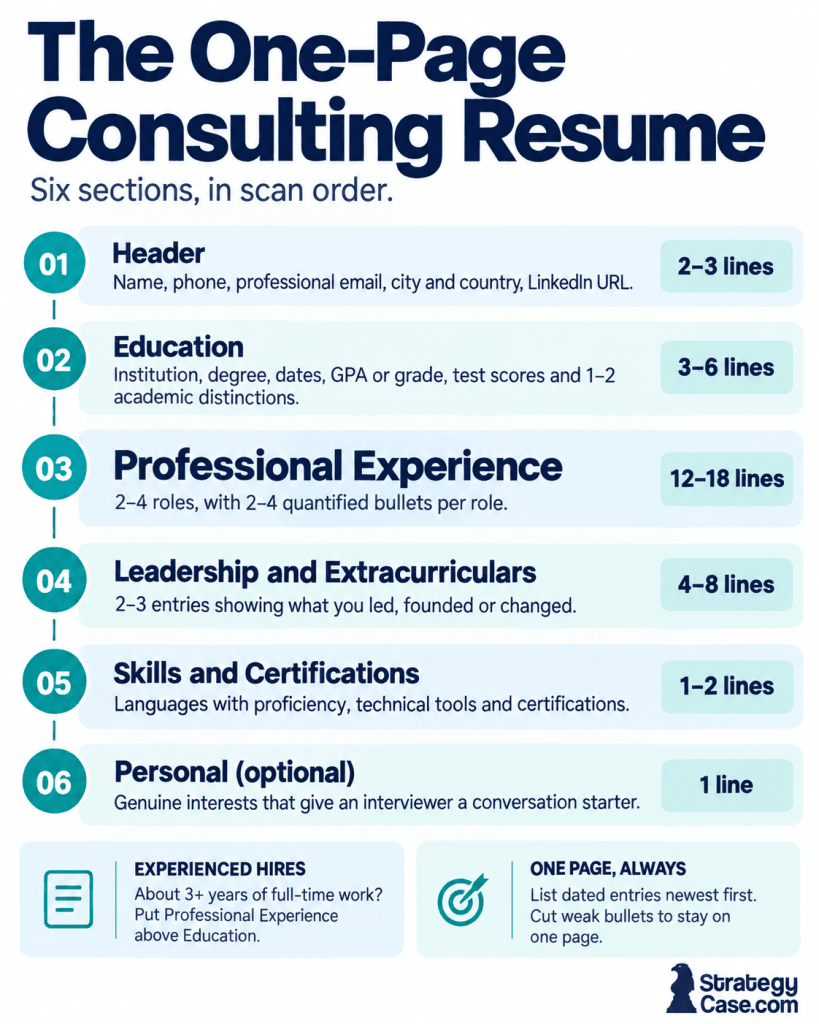
A consulting resume template for McKinsey, BCG, and Bain is a one-page, single-column document with six fixed sections: header, education, professional experience, leadership, skills, and one optional personal line. Every bullet on it follows the same pattern: action verb, what you did, quantified result. That structure is the entire template. Anything decorative, such as columns, photos, skill bars is what gets resumes cut.
Most candidates go looking for a template because they assume the layout is the hard part. It isn’t. The layout takes 20 minutes.
The hard part is that a consulting template has almost no room to hide, so a weak bullet that would pass anywhere else is obvious here. That’s the point of the format, and it’s why firms keep using it.
I spent 5 years at McKinsey, where I evaluated candidates’ resumes, and I have since coached 700+ candidates through MBB recruiting. Below is the exact spec I give them: what each section contains, how many lines it gets, where it sits on the page, and the fill-in pattern for every bullet.
Key Takeaways
- Six sections, one page, one column. Partners with 20 years of experience still use one page. Two-column layouts scramble in applicant tracking systems.
- The top third does most of the work. A screener’s first pass runs 10 to 20 seconds, so your most quantified content has to sit high on the page.
- Every bullet is the same shape: action verb, specific action, quantified result. If a bullet has no number in it, it is a responsibility, not an achievement.
- Three variants, not three resumes. Undergraduates and MBAs lead with education, experienced hires lead with work. The rest of the spec is identical.
- McKinsey now states its AI rules in writing. Using AI to polish wording is explicitly fine. Using it to invent achievements is not.
The Consulting Resume Template in One Table
This is the spec. Six sections, in this order, on one page.
| # | Section | Lines | What goes on it |
|---|---|---|---|
| 1 | Header | 2 to 3 | Name, one phone number, one professional email, city and country, LinkedIn URL |
| 2 | Education | 3 to 6 | Institution, degree, dates, GPA or grade, test scores, 1 to 2 academic distinctions |
| 3 | Professional Experience | 12 to 18 | 2 to 4 roles, reverse chronological, 2 to 4 quantified bullets each |
| 4 | Leadership and Extracurriculars | 4 to 8 | 2 to 3 entries where you led, founded, or changed something |
| 5 | Skills and Certifications | 1 to 2 | Languages with proficiency level, technical tools, certifications |
| 6 | Personal (optional) | 1 | One line of genuine interests that gives an interviewer something to open with |
Two rules govern the whole table. Reverse chronological order inside every section, and no section may push the document onto a second page. If you are over one page, the fix is cutting weak bullets, not shrinking margins to 0.4 inches.
The section order flips for one group only. If you have more than roughly three years of full-time work experience, Professional Experience moves above Education. Everyone else leads with Education.
Get the template. The StrategyCase consulting resume template applies this spec as an editable one-page file, with the line counts, spacing, and section order already set. Download the consulting resume template and fill it in rather than rebuilding the layout from scratch.
What Goes in Each Section
The spec above sets the shape. This is what fills it.
Header
Name at the top, slightly larger than body text. One phone number with country code, one email address that is some version of your name, your city and country, and your LinkedIn URL.
No photo for US and UK applications. No full postal address. No “Curriculum Vitae” as a title, because the screener knows what they’re holding.
Photos are the one genuine regional split. German, Austrian, and Swiss applications still commonly include one. US, UK, and most other international MBB offices do not want one.
Education
Institution, degree, location, and dates on one line. GPA or grade underneath, plus standardized test scores if they are strong. Then one or two distinctions: scholarships, top-of-class ranking, honors.
Report your GPA if it clears the informal bar, and leave it off only if it is genuinely weak, since an absent GPA tends to read as a low GPA. Our guide on GPA thresholds at McKinsey, BCG, and Bain covers where those lines actually sit by office.
Professional Experience
Two to four roles. For each: company, your title, location, dates, then two to four bullets. Give the most recent and most relevant role the most bullets. An internship from five years ago gets one line, not four.
Add a half-line of context after the company name when the employer is not internationally known. “Regional logistics firm, 400 employees” costs you six words and saves the screener from guessing.
Leadership and Extracurriculars
This section is where consulting resumes are won and where most candidates waste space. Firms look for evidence you led something, not evidence you attended something. Two to three entries, each showing initiative: you founded the society, you ran the budget, you grew the membership, you organized the event that raised the money.
Club memberships with no role attached can be cut. They take a line and signal nothing.
Skills and Certifications
One or two lines. Languages with honest proficiency levels (native, fluent, professional working, basic). Technical tools that are genuinely relevant, such as Python, SQL, or advanced Excel. Certifications like CFA or CPA. AI tools, LLMs, and agents.
Leave out soft skills. Nobody has ever won an interview because their resume claimed “strong communication skills.”
Personal
One line, optional, and more useful than candidates expect. Specific interests give an interviewer an easy opening and make you memorable in a stack of near-identical profiles. “Marathon running (Berlin 2025, 3:14)” works. “Reading, travel, music” does not. Some firms and offices try to match interviewers and interviewees based on common interests to break the ice. Adding your personal touch helps them facilitate this.
The Bullet Formula the Template Is Built Around
Every bullet in the template follows one pattern:
Action verb + what you specifically did + quantified result.
That’s it. The template’s line budget assumes this shape, which is why it fits on one page.
| Weak bullet | Same bullet, fixed |
|---|---|
| Responsible for managing a team | Led a 12-person team that cut fulfillment costs by $3M in 6 months |
| Assisted with market research | Analyzed 4 European markets and built the model behind a $12M entry decision |
| Helped improve internal processes | Redesigned the intake process, cutting average handling time 38% across 3 offices |
The pattern in the left column is the single most common reason strong candidates get cut at the resume screen. It’s not that they lack achievements. It’s that they described achievements as duties without clear responsibility and impact, and a screener reading 60 resumes in an hour has no time to decode a duty into an accomplishment.
If you cannot find a number for a bullet, you can usually reach one indirectly: how many people, how much money, what percentage, over what timeframe, compared to what baseline. A bullet with no number left in it after that exercise is usually a bullet worth cutting.
Three Template Variants: Undergraduate, MBA, Experienced Hire
The spec does not change by background. Only the emphasis does.
| Undergraduate | MBA | Experienced Hire | |
|---|---|---|---|
| Leads with | Education | Education | Professional Experience |
| Experience bullets | 6 to 10 total | 10 to 14 total | 14 to 18 total |
| Leadership section | Large, 3 entries | Medium, 2 to 3 entries | Small, 1 to 2 entries |
| Biggest risk | Thin content, padded with memberships | Pre-MBA work crowding out recent roles | Industry jargon a generalist screener cannot read |
| Biggest single fix | Quantify student work properly | Compress pre-MBA roles | Translate domain results into business impact |
Experienced hires have the hardest translation problem. A screener from a generalist background will not know what your industry’s internal metrics mean, so results have to land in money, time, percentage, or headcount. If you are moving across from another sector, the experienced hire guide for McKinsey, BCG, and Bain covers how firms level and read those profiles.
Formatting Specs That Keep the Template Readable
These are the numbers built into the template. They exist to fit one page without looking compressed.
| Element | Spec |
|---|---|
| Length | 1 page, no exceptions below partner level |
| Columns | 1. Two-column layouts scramble in applicant tracking systems |
| Font | Serif or clean sans serif at 10 to 11pt, one family throughout |
| Margins | 0.5 to 0.75 inch on all sides |
| File format | PDF, named YYYYMMDD_Firstname-Lastname-Resume.pdf |
| Dates | One consistent format, right-aligned |
| Colors | Black text. One accent color at most, used only for section rules |
| Graphics | None. No photos outside DACH, no skill bars, no logos, no icons |
Skill bars deserve a specific warning. A bar showing “Analytics: 80%” tells a screener nothing measurable and signals that you chose decoration over content on a document where space is the binding constraint.
Can You Use AI to Fill In the Template?
This is the part of the question that changed in 2026, and most resume template guides have not caught up.
McKinsey now states its position in writing on its careers interviewing page. Using AI to polish your resume is listed as encouraged, in the same category as asking a mentor or a friend for feedback. Using AI to exaggerate or create achievements you do not have is listed as a breach of assessment integrity. The firm’s framing is direct: they want to get to know you, not your AI tool.
That gives you a usable working rule for filling in this template:
- Fine: tightening a bullet you wrote, fixing grammar, finding a stronger verb, checking that a result is stated clearly
- Not fine: generating achievements, inflating numbers, inventing scope you did not have
The practical risk isn’t detection software. It’s the interview. Every bullet on your resume is fair game for questioning, and a fabricated one collapses the moment someone asks for detail. Interviewers are trained for that.
That risk is highest in fit interviews, where the story behind a bullet gets pushed on directly. The way to prepare for that is covered in our guide to walking through your resume in a consulting interview.
Bain describes its process as running on an objective scoring system where candidates are assessed only on what matters for the role, and BCG publishes its own interview preparation resources. All three firms are converging on the same thing: structured, verifiable evidence. A template helps you present that evidence. It cannot manufacture it.
Where Candidates Break the Template
Across the resumes I review in coaching, the same handful of breaks account for most rejections.
Spilling onto a second page. Usually solved by cutting the oldest role to one line, not by shrinking the font to 9pt.
Burying the best bullet. If your strongest quantified result sits in the bottom third, the first pass may never reach it. Move it up.
Inconsistent formatting. Dates in two formats, three font sizes, uneven bullet indentation. It reads as carelessness on a document that is partly a test of precision, and a screener will assume your client deliverables would look the same.
Unexplained gaps. A gap is not disqualifying. An unexplained gap invites the screener to guess, and the guess is rarely generous. One line of context closes it.
For the reasoning behind what a screener grades, and how to write the underlying content rather than how to lay it out, see the full consulting resume guide. This page is the template; that page discusses the overall strategy.
Frequently Asked Questions
Is there a single consulting resume template that works for McKinsey, BCG, and Bain?
Yes. All three firms screen against the same structure, so one well-built one-page template covers all of them. What changes between firms is emphasis in your bullet selection, not layout. McKinsey leans slightly harder on evidence of leading change; Bain rewards collaborative framing. That is a 10-minute tailoring pass per firm, not a different document.
What consulting resume format do MBB firms prefer, Word or PDF?
Submit a PDF unless the application portal specifically asks for Word. PDF preserves your spacing across devices. Build it in Word or Google Docs, then export. Name the file with your own name, not “resume-final-v4.pdf”.
Should I use a resume or a CV for European consulting offices?
For consulting, both terms mean the same one-page document. European offices call it a CV; US offices call it a resume. The exception is academic CVs, which run multiple pages and are not what any consulting firm wants. German, Austrian, and Swiss applications commonly include a photo; most other offices do not.
Can I use a Canva or a two-column resume template for consulting?
No. Multi-column and heavily designed templates scramble in applicant tracking systems, which parse text left to right across the full page width. They also signal the wrong priorities. Consulting screeners read a plain single-column layout faster, and speed is the thing you are optimizing for.
How many bullets should each role have on a consulting resume?
Two to four, weighted toward the most recent and most relevant role. Older or less relevant roles can drop to one line. Total experience bullets should land between 6 and 18 depending on your background, which is what the one-page constraint enforces.
Will using a consulting resume template make my resume look generic?
The layout is meant to be standard, and screeners want it standard because it makes 60 resumes comparable. Differentiation comes from your bullets, not your design choices. A resume that stands out on formatting usually stands out for the wrong reason.
Related Guides
- How to write a consulting cover letter, the other half of the application
- Is a consulting resume review worth it?, when expert feedback on your document pays off and when it does not
- How to get into consulting, the full application and recruiting process
- The McKinsey application process, what happens after you submit
Bottom Line
A consulting resume template isn’t a design decision. It’s a constraint that forces every line on the page to earn its space: one page, one column, six sections, and a bullet pattern that ends in a number. Candidates who fight the constraint by adding columns and graphics lose the thing the format is for. Candidates who accept it spend their time on the only variable that moves the outcome, which is the quality and specificity of the evidence they put inside it.
Three things to do next. Fill the six sections in the order above. Rewrite every bullet until it ends in a quantified result. Then cut whatever pushed you onto a second page.
Download the StrategyCase consulting resume template to start from the finished spec instead of a blank page. If you want a former McKinsey screener to read your actual document and tell you what would get cut and why, 1-on-1 coaching with Florian gives you that before a recruiter ever sees it.
Your resume has one job: survive the first pass. The template exists to make sure nothing else on the page gets in the way of that.
About the author: Florian Smeritschnig spent five years at McKinsey as a Senior Consultant, where he evaluated real candidates, and has since delivered 2,200+ mock interviews and coaching sessions leading to 700+ offers at McKinsey, BCG, Bain, and other top firms
