
Updated July 2026 · By Florian Smeritschnig, Former McKinsey Senior Consultant
A first-year Associate at KPMG Advisory in the US earns roughly $85,000 total compensation in 2026, climbing to $130,000 as a Senior Associate, $180,000 as a Manager, $250,000 as a Senior Manager, $335,000 as a Director, and $500,000 to $1,000,000+ as a Managing Director and Partner. KPMG’s Deal Advisory & Strategy practice (the firm’s M&A and strategy unit) pays a premium of 15 to 25% above core KPMG Advisory at every level. Below is the full KPMG hierarchy, salary by entry path, the Strategy premium breakdown, and how KPMG compensation compares to McKinsey, BCG, Bain, and the other Big 4 firms.
After spending 5 years at McKinsey, I have coached hundreds of candidates through Big 4 recruiting, including dozens who received offers at KPMG Advisory and KPMG Deal Advisory & Strategy. The salary numbers below reflect what actually shows up in offer letters in 2025-2026, including the meaningful gap between core consulting and the strategy practice that most career sites get wrong.
Key Takeaways
- KPMG has 7 main career levels: Associate, Senior Associate, Manager, Senior Manager, Director, Managing Director, Partner
- Associate (US, undergrad entry): ~$75K base + $10K target bonus = $85K total, plus $5-10K signing
- Senior Associate (post-MBA or promoted Associate): ~$115K base + $15K bonus + $20K signing = ~$155K Year 1, $130K base+bonus thereafter
- Manager: ~$155K base + $25K bonus = $180K total
- Senior Manager: ~$215K base + $35K bonus = $250K total
- Director: ~$285K base + $50K bonus = $335K total
- Managing Director / Partner: $400K-$500K+ base, scaling past $1M+ with equity participation
- Deal Advisory & Strategy premium: 15-25% above core KPMG Advisory at each level
- vs MBB and other Big 4: KPMG pays at the lower end of the Big 4 range, 15-25% below MBB and roughly 5-10% below Deloitte and PwC at most levels
KPMG Consulting Salary by Level (US, 2026)
The headline numbers for every KPMG level. KPMG Deal Advisory & Strategy salaries run 15-25% higher than core KPMG Advisory; the strategy-specific section below covers the difference.
| Level | Base Salary | Target Bonus | Total Cash Comp | Typical Tenure |
|---|---|---|---|---|
| Associate | $75,000 | $10,000 | $85,000 | 2 years |
| Senior Associate (post-Master’s / promoted Associate) | $115,000 | $15,000 | $130,000 | 2 to 3 years |
| Manager | $155,000 | $25,000 | $180,000 | 3 to 4 years |
| Senior Manager | $215,000 | $35,000 | $250,000 | 3 to 5 years |
| Director | $285,000 | $50,000 | $335,000 | Several years |
| Managing Director | $400,000+ | Equity share | $600K to $1.2M+ | Several years |
| Partner | $500,000+ | Equity share | $700K to $1.5M+ | Until retirement |
A few notes on this table:
- Base salaries are what KPMG quotes in your offer letter. Bonuses at junior levels are 10-15% of base; at Manager and above they scale to 20-30%.
- Maximum bonus can reach 30-40% higher than target for top-performing Managers and Senior Managers in strong years.
- Managing Director vs Partner: Both are senior firm leadership roles. Managing Director is salaried with equity participation, while Partner is full equity ownership. Some practices use MD as a permanent senior track; others as a 2-4 year waypoint before Partner.
- Partner compensation is structured as equity / profit-sharing rather than base plus bonus. The base figure represents the floor; total earnings depend on firm profitability and the Partner’s book of business.
- Senior Partners at KPMG managing flagship industry accounts can earn $1.5M+ annually, particularly in financial services and technology practices.
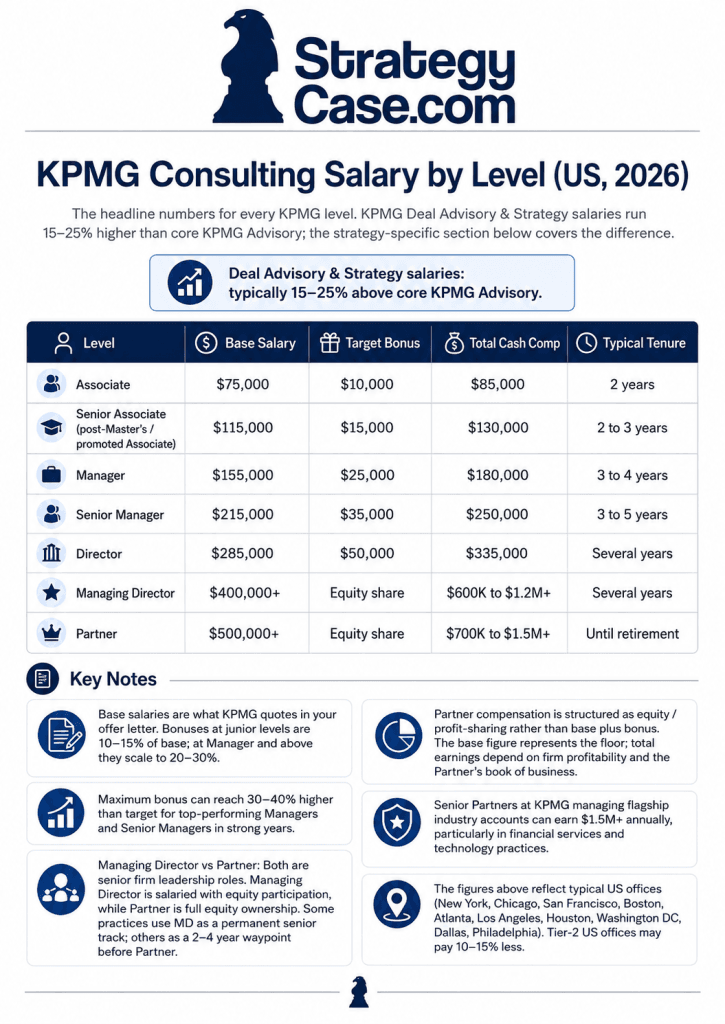
The figures above reflect typical US offices (New York, Chicago, San Francisco, Boston, Atlanta, Los Angeles, Houston, Washington DC, Dallas, Philadelphia). Tier-2 US offices may pay 10-15% less.
KPMG Deal Advisory & Strategy vs Core KPMG Advisory
The most important distinction inside KPMG Consulting: which practice you join determines your salary band.
KPMG Deal Advisory & Strategy is the firm’s combined M&A advisory and strategy practice, handling transaction services, due diligence, integration/separation work, and corporate strategy engagements. It is smaller and more selective than core KPMG Advisory and pays at the top of the Big 4 strategy-practice range. The practice competes with Tier-2 strategy firms and Big 4 strategy peers (Monitor Deloitte, Strategy&, EY-Parthenon) for MBA-graduate talent, though it does not match those practices in scale.
Core KPMG Advisory is the broader consulting practice, organized into three main service areas: Management Consulting (operations, customer/growth, finance transformation), Risk Consulting (governance, regulatory, controls, cybersecurity), and Technology Consulting (cloud, ERP, data, digital). Core KPMG Advisory pays at the lower end of the Big 4 range, similar to or slightly below EY.
The Deal Advisory & Strategy premium at each level (approximate):
| Level | Core KPMG Base | Deal Advisory & Strategy Base | Premium |
|---|---|---|---|
| Associate | $75K | $90K | +20% |
| Senior Associate (post-MBA) | $115K | $145K | +26% |
| Manager | $155K | $195K | +26% |
| Senior Manager | $215K | $260K | +21% |
| Director | $285K | $345K | +21% |
| Managing Director / Partner | $400K+ | $475K+ | +18% |
Where the premium is largest: At the Senior Associate (post-MBA) and Manager levels (3-5 years in), Deal Advisory & Strategy professionals earn 25-26% above their core KPMG Advisory counterparts. This is the strongest argument for targeting Deal Advisory & Strategy specifically rather than core Advisory.
Practical implication for candidates: If you have a profile that could land at MBB or Tier-2 strategy and prefer KPMG for office, culture, or geographic reasons, target Deal Advisory & Strategy. Note that the practice is meaningfully smaller than KPMG Advisory, so opportunities are more limited and competition more intense.
What’s Included Beyond Base and Bonus
The salary table above covers cash compensation. KPMG’s total package adds substantial value on top, especially for new hires.
Signing bonus: $5,000-10,000 for Associate hires, $20,000-30,000 for MBA Senior Associate hires, sometimes higher for PhD or specialized hires. Paid in the first paycheck or split across the first six months.
Relocation allowance: $5,000-15,000 lump sum depending on office and distance. International relocations include temporary housing for 1-3 months.
Health benefits: Comprehensive medical, dental, and vision coverage. KPMG covers a significant portion of premiums, employee contribution is typically $50-150/month for individual coverage.
Retirement contribution: 401(k) with firm match (typically 100% match up to 6-8% of salary) plus a “Personal Time Off Bank” and additional retirement-focused programs.
Training and KPMG Business School: New hires complete formal training through KPMG’s internal learning programs. The firm also offers tuition reimbursement for relevant graduate programs and certifications (CPA, CFA, cloud certifications, cybersecurity credentials).
Parental leave: 12-16 weeks of paid parental leave for primary caregivers, 6-8 weeks for non-primary caregivers, varying slightly by US state regulations.
Sabbatical and time off: KPMG offers a generous PTO structure including the firm-wide week off between Christmas and New Year’s, summer half-day Fridays in some offices, and dedicated personal time programs.
Equity / profit-sharing (Partner-track only): Managing Directors, Partners, and senior practice leaders participate in firm equity. This is where total compensation diverges most dramatically from the base-plus-bonus model.
For a typical post-MBA Senior Associate joining KPMG Advisory in 2026, the all-in first-year compensation including signing bonus is closer to $150,000-160,000 at core Advisory, or $185,000-200,000 at Deal Advisory & Strategy.
KPMG Career Progression: Analyst to Partner Timeline
The standard KPMG promotion track from Associate to Partner is approximately 14-18 years:
- Years 1-2: Associate
- Years 3-4: Senior Associate
- Years 5-7: Manager
- Years 7-9: Senior Manager
- Years 10-13: Director
- Years 13-15: Managing Director
- Year 15+: Partner
Post-MBA hires (Senior Associates) skip the Associate years and reach Partner in approximately 11-14 years. KPMG Deal Advisory & Strategy hires often have a slightly accelerated path (10-12 years post-MBA) given the smaller practice size.
Roughly 3-7% of entering Associates reach Partner at KPMG. The pyramid narrows most sharply between Senior Manager and Director, and again between Managing Director and Partner.
For accelerated paths to Partner, the only reliable variables are:
- Consistent top-quartile performance reviews across your tenure
- Industry or functional specialization in high-demand areas (cybersecurity, cloud, AI, M&A advisory, ESG, financial services regulatory)
- Business development demonstrated early (sponsoring proposals, generating leads, building intellectual capital)
The biggest filter at KPMG, as at all Big 4, is the transition from “great delivery” to “great business development” between Senior Manager and Director.
KPMG Hierarchy: Roles, Tenure, and Promotion Difficulty
KPMG operates a flatter, less aggressive “up-or-out” structure than MBB. Under-performers are managed out over 6-12 months with structured feedback, but KPMG has more room for specialists and consistent solid performers than MBB does.
Associate
Entry-level role for undergraduate hires. Associates conduct research, build models, analyze data, and create slide content under direction from Senior Associates and Managers.
Promotion timeline: 2 years. Promotion difficulty: Low to moderate. The Associate-to-Senior-Associate transition is the most predictable promotion in the KPMG ladder.
Senior Associate
Entry point for Master’s-degree hires (without an MBA), MBA hires (in some practices), and promoted Associates. Senior Associates own workstream pieces, manage Associate-level work, and start building client-meeting presence.
In KPMG Deal Advisory & Strategy, MBA hires sometimes enter at a higher Senior Associate band or directly as Managers depending on prior experience.
Promotion timeline: 2 to 3 years. Promotion difficulty: Moderate.
Manager
Managers own engagements end-to-end. They organize workstreams, manage Senior Associates and Associates, and serve as primary day-to-day client contacts on smaller engagements. At this level, consultants specialize meaningfully in industries (financial services, healthcare, energy, public sector) or functional practices (operations, risk, technology, M&A advisory).
Promotion timeline: 2 to 3 years. Promotion difficulty: Moderate to high. The Manager-to-Senior-Manager step requires demonstrated business development capability.
Senior Manager
Senior Managers lead larger engagements, manage Managers and below, and start owning client relationships independently. Business development becomes the primary evaluation criterion.
Promotion timeline: 2 to 5 years. Promotion difficulty: High. This is where the KPMG pyramid begins narrowing meaningfully.
Director
Directors own significant client portfolios, lead practice-area initiatives, and have meaningful business development responsibility. They are senior pre-Partner leaders with equity-adjacent compensation but not yet full Partner participation in most cases.
Promotion timeline: Variable (3-5 years). Promotion difficulty: Very high.
Managing Director (MD)
A distinct senior level at KPMG that sits between Director and Partner. MDs have broader practice ownership and significant business development responsibility but do not yet have full Partner equity. Like EY’s SMD level, MD at KPMG is sometimes a permanent senior-specialist track and sometimes a 2-4 year waypoint before Partner.
Promotion timeline: Variable. Promotion difficulty: Very high.
Partner
The most senior level at KPMG. Partners are firm equity holders, own major client relationships, lead practices or industries, and shape firm strategy. KPMG’s US Partner pool is approximately 2,500 Partners across all service lines (Audit, Tax, Advisory, Deal Advisory & Strategy).
How “Up-or-Out” Works at KPMG
KPMG’s up-or-out is less aggressive than MBB. Under-performers receive structured feedback, performance improvement plans, and explicit transition support over 6-12 months. KPMG (like other Big 4) helps departing consultants find roles at clients, portfolio companies, or other firms. The KPMG alumni network is strong across finance, audit, and corporate operations careers.
KPMG Salary by Entry Path
KPMG hires through several distinct tracks. Your starting salary depends on which track you enter through.
Undergraduate / Recent Graduate
Enters as an Associate in core KPMG Advisory. Total cash comp: ~$85K. Most hires come from a broad school list, much broader than MBB’s target schools. KPMG has one of the wider Big 4 recruiting footprints, particularly in Risk Consulting and Audit.
Master’s Degree (No MBA)
Enters as a Senior Associate in core KPMG Advisory. Total cash comp: ~$130K. Common backgrounds: MA in Economics, MS in Data Science, MS in Information Systems, MEng. Some practices accept Master’s hires at the Associate level for less specialized backgrounds.
MBA Hire (Direct from Business School)
Enters as a Senior Associate in core KPMG Advisory (~$130K total) or KPMG Deal Advisory & Strategy (~$180K total). Plus $20-30K signing bonus = ~$150-160K all-in Year 1 at core Advisory or ~$200K at Deal Advisory & Strategy. Sourced from a broader MBA list than MBB. Deal Advisory & Strategy specifically recruits from M7, Tuck, Darden, Ross, Stern, INSEAD, LBS.
PhD / Advanced Degree
Enters as a Senior Associate (same salary band as MBA hires). KPMG hires PhDs into specialty roles across data analytics, AI/ML, cybersecurity, and quantitative risk practices.
Experienced Hire (Lateral from Industry)
Variable entry level depending on prior experience. A consultant from MBB, Deloitte, PwC, EY, or in-house corporate strategy with 5-7 years of experience may enter at the Manager, Senior Manager, or Director level.
Lateral from MBB
A common pattern: 2-3 years at McKinsey, BCG, or Bain followed by a lateral to KPMG Deal Advisory & Strategy at the Manager or Senior Manager level. The lateral typically comes with a small salary lift over the equivalent MBB role plus meaningfully better work-life balance.
CPA / Audit-to-Advisory Lateral
A KPMG-specific entry path: experienced auditors with 3-5 years of KPMG Audit experience often lateral internally to Advisory at the Senior Associate or Manager level. This pattern is common given KPMG’s strong audit foundation.
KPMG vs MBB vs Other Big 4
KPMG sits at the lower end of the Big 4 consulting pay range, similar to EY at the core consulting level. KPMG Deal Advisory & Strategy narrows the gap but does not fully close it.
| Level | Core KPMG | KPMG Strategy | McKinsey | BCG | Bain | Monitor Deloitte | Strategy& | EY-Parthenon |
|---|---|---|---|---|---|---|---|---|
| Associate / Analyst | $85K | $100K | $140K | $140K | $140K | n/a | $115K-$161K | $115K+ |
| Senior Associate (post-MBA) | $130K | $180K | $245K | $242K | $230K | $240K | $156K-$249K | $215K |
| Manager | $180K | $245K | $290K | $280K | $290K | $275K | $204K-$320K | $295K |
| Senior Manager | $250K | $325K | $420K | $410K | $360K | $385K | $270K-$400K | $385K |
| Director | $335K | Integrated | (n/a same role) | (n/a) | (n/a) | $450K+ | $240K-$350K+ | $370K |
| Partner | $700K-$1.5M+ | $750K-$1.6M+ | $700K-$1.5M+ | $700K-$1.5M+ | $650K-$1.4M+ | $800K-$1.6M | $390K-$728K+ | $700K-$1.4M+ |
For McKinsey-specific data, see the McKinsey hierarchy and salary breakdown. For BCG, see BCG hierarchy and salary. For Bain, see Bain hierarchy and salary. For Deloitte (including Monitor Deloitte), see Deloitte consulting salary. For PwC and Strategy&, see PwC consulting salary and Strategy& salary. For EY and EY-Parthenon, see EY consulting salary. For a full overview of Big 4 salaries, check our Big 4 salary guide.
For a general introduction to the Big 4, see our guide to the Big 4.
Why KPMG pays below MBB and the larger Big 4 peers: Three structural reasons. First, KPMG’s consulting practice is the smallest of the Big 4 by revenue (Deloitte and PwC are roughly 2x larger than KPMG in consulting). Smaller revenue base supports lower per-consultant economics. Second, KPMG’s consulting heritage is heavily rooted in audit-adjacent advisory (governance, controls, regulatory compliance), which carries lower margins than pure strategy work. Third, the Big 4 partnership economics distribute equity across a meaningful pool, KPMG’s US Partner pool is approximately 2,500 across all service lines, which dilutes per-Partner economics compared to MBB.
Where KPMG outperforms: Lateral moves into KPMG from MBB or other Big 4 often come with meaningful title bumps (MBB Engagement Manager → KPMG Senior Manager or Director). KPMG’s strong Risk Consulting and Tax Advisory practices command premium specialization rates. The audit-to-advisory internal lateral path is also a KPMG-specific advantage for experienced auditors transitioning to consulting.
KPMG Consulting Salary Outside the US
KPMG operates in 140+ countries. International offices pay in local currency, with significant regional variation.
London: KPMG UK is one of the higher-paying non-US offices. Associate base is approximately £32,000-42,000 with bonus bringing total to ~£38,000-50,000. Senior Associate (post-MBA) base is approximately £62,000-78,000 with target bonus pushing total to ~£85,000-105,000. KPMG Deal Advisory & Strategy London pays approximately 20-25% above this range.
Continental Europe (Germany, France, Switzerland, Italy, Spain, Netherlands, Nordics): Roughly 50-65% of US salary in local currency equivalent. Switzerland-based offices pay closest to US levels. German offices include the standard 13th-month payment.
India: KPMG India has a substantial presence (Mumbai, Delhi, Bengaluru, Gurgaon, Chennai, Hyderabad, Pune, Kolkata). Local salaries are paid in INR and typically run at 20-35% of US equivalent in dollar terms.
Middle East (Dubai, Riyadh, Doha, Abu Dhabi): Often higher than European offices on a take-home basis because of tax advantages. Base salaries are typically 70-85% of US levels in USD equivalent.
Asia-Pacific (Singapore, Hong Kong, Tokyo, Sydney, Melbourne, Shanghai, Seoul): Singapore and Hong Kong offices pay closer to US levels. KPMG’s Australia practice has historically been competitive on local-market terms.
Latin America (São Paulo, Mexico City, Bogotá, Buenos Aires): Roughly 35-50% of US salary in local currency equivalent.
International salaries are worth verifying directly with your recruiter, KPMG adjusts non-US compensation frequently.
Frequently Asked Questions
How much does a KPMG Associate make?
A first-year KPMG Advisory Associate in a US office earns approximately $85,000 in total cash compensation: $75,000 base salary plus a target bonus of $10,000. Including signing bonus and benefits, all-in Year 1 compensation is closer to $90,000-95,000.
What is the KPMG Senior Associate salary?
A post-MBA KPMG Senior Associate in 2026 earns approximately $115,000 base salary plus $15,000 target bonus = $130,000 total cash compensation at core KPMG Advisory. KPMG Deal Advisory & Strategy Senior Associates earn approximately $180,000 total. With signing bonus ($20-30K), all-in Year 1 is approximately $150,000-160,000 at core Advisory or $200,000 at Deal Advisory & Strategy.
How much does a KPMG Manager earn?
A KPMG Advisory Manager earns approximately $155,000 base salary plus $25,000 target bonus = $180,000 total cash compensation. KPMG Deal Advisory & Strategy Managers earn approximately 25-26% more (~$245,000 total). Maximum bonus in strong years can push total comp toward $200,000-220,000 at core Advisory.
How much does a KPMG Senior Manager earn?
A KPMG Senior Manager earns approximately $215,000 base salary plus $35,000 target bonus = $250,000 total cash compensation. KPMG Deal Advisory & Strategy Senior Managers earn approximately $325,000 total. The Manager-to-Senior-Manager transition is where business development capability becomes critical for promotion.
How much does a KPMG Partner earn?
KPMG Partners earn $500,000+ as base / floor compensation, with total annual earnings ranging from $700,000 to $1,500,000+ depending on firm performance and equity participation. KPMG Deal Advisory & Strategy Partners earn $750,000-$1.6M+ at the floor. Senior Partners with major client books can earn $2M+ annually.
How long does it take to make Partner at KPMG?
The standard path from Associate to Partner at KPMG is approximately 12-15 years. Post-MBA Senior Associates reach Partner in approximately 11-14 years. KPMG Deal Advisory & Strategy hires often reach Partner in 10-12 years post-MBA. Roughly 3-7% of entering Associates reach Partner.
What is the KPMG career progression from Analyst to Partner?
The standard KPMG career path is: Associate (Years 1-2) → Senior Associate (Years 3-5) → Manager (Years 6-9) → Senior Manager (Years 10-12) → Director (Years 13-15) → Managing Director (Years 16-17) → Partner (Year 18+). Post-MBA hires skip the Associate years and shorten the timeline by approximately 3-4 years.
Is KPMG salary higher than EY?
KPMG and EY salaries are roughly comparable at most levels, with EY typically paying very slightly above KPMG at the core consulting tier. KPMG’s Deal Advisory & Strategy practice pays competitively with EY-Parthenon at the strategy tier, though EY-Parthenon historically pays slightly more given its larger scale and Bain-pedigree origins.
Is KPMG salary higher than Deloitte or PwC?
No. Deloitte and PwC pay 5-10% above KPMG at most core consulting levels in 2026. KPMG Deal Advisory & Strategy narrows the gap to Monitor Deloitte and Strategy& but does not fully close it. The Big 4 consulting salary pecking order in 2026 is roughly Monitor Deloitte ≈ Strategy& ≈ EY-Parthenon at the strategy tier, then Deloitte ≈ PwC > EY ≈ KPMG at the core consulting tier.
What is the difference between KPMG Managing Director and Partner?
Managing Director (MD) is a senior level that sits between Director and Partner at KPMG. MDs have broader practice ownership and business development responsibility than Directors but do not yet have full Partner equity participation. MD is sometimes a permanent senior-specialist track and sometimes a 2-4 year waypoint before Partner promotion. Partner is the full equity-ownership level with profit-sharing.
The Bottom Line
KPMG Consulting offers competitive compensation at the lower end of the Big 4 range, with the Deal Advisory & Strategy practice providing a 15-25% premium for candidates with MBB-quality profiles. KPMG’s combination of broader school recruiting, strong audit-to-advisory internal lateral paths, and meaningful work-life balance flexibility make it a strong choice for candidates who value those dimensions over absolute compensation.
For an undergraduate hire, plan on ~$85K total in Year 1 climbing to ~$180K by Year 7 if you promote on schedule. For a post-MBA hire at core KPMG Advisory, plan on ~$150-160K all-in Year 1 climbing to ~$180K by Manager. For a post-MBA hire at KPMG Deal Advisory & Strategy, plan on ~$200K all-in Year 1 climbing to ~$245K by Manager. Beyond that, compensation depends entirely on whether you reach Managing Director and Partner.
If you are weighing KPMG against MBB or the larger Big 4 peers, the practical differences beyond salary are: KPMG has the most flexibility on hours (45-55 hours/week typical at core Advisory, slightly higher in Deal Advisory & Strategy), strong Risk Consulting and Cybersecurity specializations, the audit-to-advisory internal lateral option, and the smallest-among-Big-4 community feel. MBB and larger Big 4 peers offer higher exit options, more concentrated brand prestige, and faster pyramids for top performers.
KPMG’s interview process runs tighter than the larger Big 4 firms, with more emphasis on risk frameworks and regulatory context in the case rounds — Deal Advisory & Strategy in particular tests structured thinking under M&A-style prompts. The Case Interview Academy covers the structuring, math, charts, and case communication you need to clear the bar across either KPMG track. For a calibrated review of your CV against KPMG’s specific selection criteria plus a customized prep program for your target practice, book a 1-on-1 coaching session.
A KPMG Consulting offer is a strong launching point into both Big 4 consulting and broader corporate operations careers, particularly for candidates who value work-life balance, specialization opportunities (cybersecurity, risk, M&A advisory), and a strong audit-adjacent network. The salary is competitive for the position in the Big 4 hierarchy, and the trajectory is well-defined.
About the author: Florian Smeritschnig spent five years at McKinsey as a Senior Consultant, where he evaluated candidates and since delivered 2,200+ mock interviews and coaching sessions. He founded StrategyCase.com to make top consulting careers more accessible with tailored, up-to-date insights into the recruiting process. As a case and fit interview coach, Florian has helped clients secure 700+ offers at McKinsey, BCG, Bain, Tier-2 firms, Big 4 consulting divisions, in-house consultancies, and boutiques. He is the author of The 1%: Conquer Your Consulting Case Interview, The 1%: Case Interview Workbook, and Consulting Career Secrets, all available on Amazon.
