

Updated September 24, 2026 | By Dr. Florian Smeritschnig, former McKinsey Senior Consultant
A cybersecurity consultant advises organizations on cyber risk, security programs, and attacks, and the firm you join decides which of those you actually do. At the global integrators (Accenture, IBM, and the Big 4), you help run large security programs. At the strategy firms (McKinsey and BCG Platinion), you shape board-level cyber decisions. At the specialists (Mandiant, Unit 42, CrowdStrike, and Booz Allen Hamilton), you investigate and contain attacks.
The verdict for most readers: if you are a student or a career switcher, a Big 4 cyber practice is the most realistic first door. If you already have hands-on security experience, the specialists will pay for it. If you want strategy, you go through the standard MBB or Platinion process.
Most career guides on this topic stop at “get a degree and a certification.” That skips the step where most consulting offers are actually won or lost: the interview. I spent 5 years at McKinsey as a Senior Consultant. Since 2020, I have coached clients to 700+ consulting offers through StrategyCase, and roughly 30% of them came from non-traditional backgrounds. This guide covers the 12 firms worth knowing, what each one hires for, what they pay, and how their interviews work.
Key Takeaways
- “Cybersecurity consultant” is one title for several different jobs: security program delivery at the integrators, cyber strategy at the strategy firms, and incident response or threat intelligence at the specialists.
- The Big 4 cyber practices are the main entry point for graduates. Entry-level technology and cyber consulting pays about $85K to $115K in the US, against a BLS median of $129,180 for information security analysts.
- Specialists rarely hire beginners: a current Mandiant incident response consultant posting asks for 3 years of hands-on incident response experience.
- Consulting firms decide cyber offers on problem solving and communication as much as on technical depth. Expect case or scenario interviews at the Big 4, an IT case plus a business case at BCG Platinion, and a Technical Expertise Interview for expert hires at McKinsey.
- Demand is real but skills-specific: in ISC2’s 2025 workforce study, 95% of respondents reported at least one skills gap on their team, with AI and cloud security the most needed.
What Does a Cybersecurity Consultant Do?
A cybersecurity consultant is an external advisor who helps organizations find, reduce, and respond to cyber risk. Depending on the firm, the work ranges from assessing controls and designing security programs to testing systems like an attacker, advising boards on cyber investment, and leading the response when a breach happens.
In practice, the title covers four job families. Which one you land in depends far more on the firm than on the wording of the job posting:
| Job family | What you do day to day | Where it sits | Typical entry background |
|---|---|---|---|
| Cyber risk and GRC (governance, risk, and compliance) | Assess controls, map regulations to security programs, run maturity assessments | Big 4, Accenture, Optiv | Business, information systems, IT, or audit |
| Technical security consulting | Security architecture, cloud and identity security, penetration testing | Accenture, IBM, Big 4 technical teams, NCC Group | Computer science or IT degree plus hands-on labs |
| Cyber strategy | Cyber risk quantification, security operating models, technology due diligence | McKinsey, BCG Platinion, Big 4 strategy teams | Generalist consultant or senior security expert |
| Incident response and threat intelligence | Investigate breaches, contain attackers, analyze malware | Mandiant, Unit 42, CrowdStrike, Kroll | Several years of SOC, forensics, or incident response work |
The US Bureau of Labor Statistics files most of these roles under information security analysts: 192,900 jobs in 2025, a median wage of $129,180 (May 2025), and 21% projected growth from 2025 to 2035, much faster than the average occupation. Consulting is one slice of that market. It is also the slice where how you think and communicate counts as much as what you know.
The Top Cybersecurity Consulting Firms to Work For
These 12 firms employ a large share of the world’s cybersecurity consultants. The table sorts them by what you would actually do there and who they suit best as an employer:
| Firm | Cyber unit | What you would work on | Best first job for |
|---|---|---|---|
| Accenture | Accenture Security | Large security transformations, cloud security, managed security | Graduates and IT switchers who want scale and technical breadth |
| Deloitte | Deloitte Cyber | Cyber risk, regulation, enterprise security programs | Business or IT graduates drawn to risk and regulation |
| IBM | IBM Cybersecurity Services / X-Force | Threat intelligence, managed detection, AI-driven security operations | Technical profiles who want security operations inside consulting |
| PwC | Cybersecurity, Risk & Regulatory | Privacy, data protection, cross-border compliance | Candidates interested in privacy and compliance-heavy work |
| EY | EY Cybersecurity | Identity and access management, cloud security | Candidates interested in identity, cloud, and digital trust |
| KPMG | KPMG Cyber | Third-party risk, financial services security | Candidates targeting banks and insurers |
| McKinsey | Risk & Resilience practice | Board-level cyber risk and security operating models | Strategy consultants and senior cyber experts |
| BCG | BCG Platinion | Security architecture, technology due diligence | Technologists who want strategy-grade problem solving |
| Booz Allen Hamilton | Booz Allen Cyber | US federal and defense cyber | US candidates who hold or can obtain a security clearance |
| Mandiant | Google Cloud Security | Nation-state breach investigation, threat intelligence | Experienced incident responders |
| Palo Alto Networks | Unit 42 | Incident response, cloud security assessments | Experienced incident response and cloud security specialists |
| CrowdStrike | CrowdStrike Services | Compromise assessments, incident response retainers | Experienced incident response and endpoint specialists |
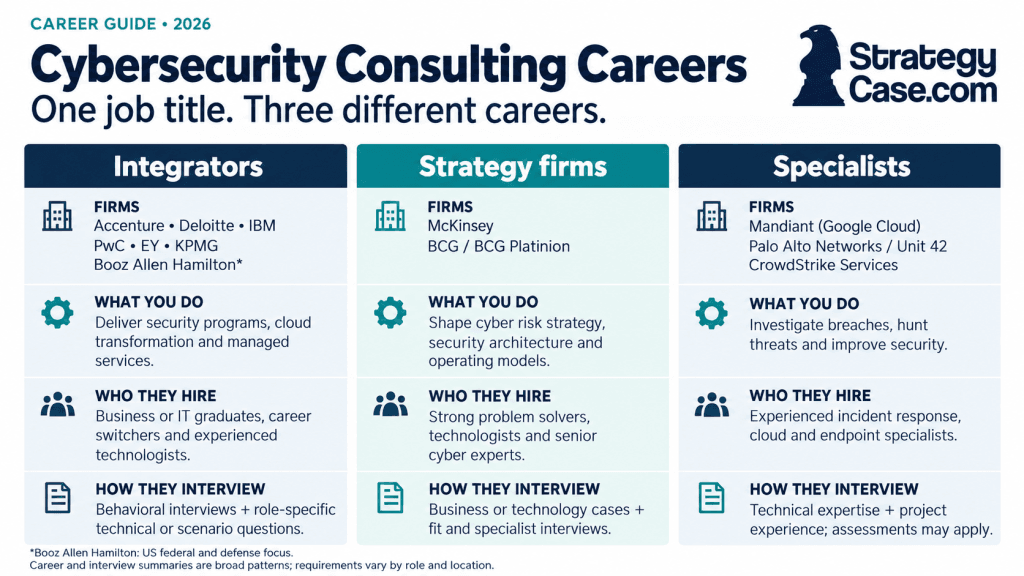
From my experience in strategy consulting at McKinsey, the client-facing strategy work and the deep technical delivery were almost never done by the same people. That divide, not brand prestige, determines what your job looks like and which interview you will face. So it is the divide I use below.
The Global Integrators: Accenture, IBM, and the Big 4
This is where most cybersecurity consultants work, and where most careers start. These six firms run some of the largest cyber practices in the world and hire every year from campus and from industry.
What the job looks like. The work is multi-year programs: cloud migrations, identity programs, security operations center modernization, and regulatory remediation. As a junior, you own a piece of that program, such as a control assessment, a requirements map, a testing workstream, or the materials for a client workshop. Most people specialize within their first two to three years.
Who they hire. The widest range of profiles on this list. Business and information systems graduates go into risk and GRC teams. Computer science graduates go into technical teams. IT, audit, and SOC professionals join as experienced hires.
What sets each firm apart for a candidate:
- Accenture Security runs one of the largest end-to-end security services operations among the integrators, with its own career track inside the firm. It suits people who want technical breadth and very large programs.
- Deloitte Cyber ties cyber to enterprise risk and regulation. It hires everyone from technical testers to pure risk consultants.
- IBM is the most technology-led of the six. Its X-Force research unit feeds threat intelligence into client work, which makes it a good fit if you want security operations more than slideware.
- PwC is anchored in privacy, data protection, and cross-border compliance.
- EY built its cyber reputation on identity and access management and cloud security.
- KPMG stands out in third-party risk and financial services, so it suits candidates who want to work with banks and insurers.
How they interview. Expect a behavioral round plus a case or scenario interview, with technical questions for technical roles. The format depends on the service line. Deloitte, for example, points entry-level consulting candidates to a case interview tool and audit candidates to a scenario tool. Check where the posting sits before you prepare. My guide to Big 4 case interviews breaks down the format at Deloitte, EY, PwC, and KPMG (and also Accenture).
The Strategy Firms: McKinsey, BCG Platinion, and Bain
The strategy firms hire far fewer cyber people, and they hire them differently. Here the work is cyber as a board and investment question: how much to spend, what to protect first, how to organize security across a global business, and whether a deal target’s security is a hidden liability.
McKinsey: Two Ways In
McKinsey runs its cyber work through its Risk & Resilience practice. There are two routes in, and they lead to different interviews:
- Generalist consultant. You apply through the standard process and may be staffed on cyber studies later. You are hired as a consultant, not as a cyber specialist, so the case interview and the PEI decide the offer.
- Expert track. Experienced security professionals hired into expert roles face the McKinsey Technical Expertise Interview alongside the PEI, and often a case interview as well. Technical experts in your field run the TEI.
After coaching specialists and experienced hires into McKinsey, I can tell you the TEI almost never rejects people for lacking technical depth. It rejects them for answering like an engineer talking to another engineer: no stakes, no decision, and no business outcome in the story.
BCG Platinion
BCG runs its hands-on technology work, including cybersecurity architecture and technology due diligence, through Platinion. BCG Platinion’s published application process starts with a CV screen and an introduction call. It is followed by at least two interview rounds: the first includes a case study testing analytical, technical, and presentation skills, and the second pairs an IT case with a business case, run by a Platinion Director and a member of BCG leadership. Some regions add a virtual logic test.
Bain
Bain covers cyber mainly inside its technology and private equity due diligence work rather than through a separate technical unit. If you want Bain, you apply through the standard generalist process and build the cyber angle once you are in.
The Specialists: Mandiant, Unit 42, CrowdStrike, and Booz Allen
Specialists hire for proof, not potential. Their consulting arms are built on threat intelligence and real investigations, and they want people who have already done the work.
- Mandiant (part of Google Cloud) is the best-known name in breach investigation. A current Mandiant incident response consultant posting on Google Careers asks for 3 years of end-to-end incident response work and 3 years of forensics or malware triage experience. It lists capture-the-flag competitions and platforms such as Hack The Box as a plus.
- Unit 42 (Palo Alto Networks) combines threat research with incident response and cloud security assessments. Its consultants work with telemetry from one of the largest installed security platforms.
- CrowdStrike Services runs incident response, compromise assessments, and retainers on top of its Falcon endpoint platform.
- Booz Allen Hamilton is the anchor firm for US federal and defense cyber. Many of its roles require a US security clearance, which shapes who can apply at all.
For most people, a specialist is a second or third job, not a first one. The common path runs through a SOC, an IT security team, or a Big 4 technical team first. You move to a specialist once you have handled real investigations.
Other firms worth knowing. Optiv (a large US security integrator, strong in GRC), NCC Group (a UK leader in penetration testing and assurance), Kroll (forensics-led cyber work, often engaged through law firms), and FTI Consulting (cyber in crisis and litigation contexts) are all serious employers, especially if you want a regional or mid-market career.
Which Firm Type Fits Your Background?
This is the question I would answer first if you came to me for advice. Your starting point narrows the list quickly:
| Your starting point | Best first door | What wins the offer | Where candidates slip |
|---|---|---|---|
| Business, economics, or information systems graduate | Big 4 cyber risk or GRC | Structured case or scenario answers, a credible reason for cyber, familiarity with frameworks such as the NIST Cybersecurity Framework | “I’m passionate about security” with nothing to show for it |
| Computer science or IT graduate | Big 4 or Accenture technical teams, IBM | Technical fundamentals explained in plain language for a client | Answering every question at engineer depth |
| IT, SOC, or audit professional (2 to 5 years) | Big 4 experienced hire | Showing how your work reduced business risk | Listing tasks instead of outcomes |
| Penetration tester or incident responder (3+ years) | Specialists, or senior technical roles at the Big 4 | Real investigations and demonstrable skill | Underestimating the client-communication bar |
| MBA or strategy consultant | McKinsey or BCG generalist track, Big 4 cyber strategy | A strong case interview; cyber knowledge is a bonus | Assuming interest in cyber can replace case skill |
| Senior security leader (director or CISO track) | McKinsey expert track, BCG Platinion, Big 4 director level | Technical judgment tied to business decisions | Telling technical war stories without stakes or outcomes |
| US veteran or cleared professional | Booz Allen, federal practices of Deloitte and Accenture | Clearance plus mission experience | Ignoring the commercial consulting skills the role still needs |
If you are unsure, start where the most doors stay open. A Big 4 or Accenture cyber practice gives you client experience and technical exposure. From there you can move to a specialist, a strategy firm, or an in-house security role. If you come from engineering, my guide on moving from engineering into consulting covers the positioning in more depth.
How Cybersecurity Consulting Interviews Actually Work
Every consulting firm on this list tests two things: can you do the work, and can you work with clients. The weighting changes by firm type:
| Firm type | Typical interview mix | What decides the offer | Where to put your prep time |
|---|---|---|---|
| Big 4 and Accenture | Behavioral round plus case or scenario interview; technical questions for technical roles | Structured thinking, communication, motivation for cyber | Case or scenario practice plus behavioral stories |
| BCG Platinion | At least two rounds: case study, IT case, business case; logic test in some regions | Analytical, technical, and presentation skills | Technology-flavored cases with a business recommendation |
| McKinsey expert track | TEI plus PEI, often a case interview | Technical judgment tied to business impact | One deep TEI story plus PEI stories |
| MBB generalist | Standard assessments, case interviews, fit interview | Problem solving and fit | Full MBB case and fit preparation |
| Specialists | Technical interviews built on real investigations | Hands-on skill and investigative judgment | Labs, capture-the-flag practice, written investigation reports |
The most common mistake I see from technical candidates is the one I describe in my TEI guide: they prepare for a consulting interview as if it were a tech screen. A consulting firm is not hiring you to be the best engineer in the room. It is hiring you to take a messy client problem, structure it, and explain a recommendation to a CFO who has never configured a firewall.
Here is the difference in practice. Say you are asked about a project where you replaced a company’s logging and alerting setup:
- The engineer answer: which platform you chose, how many detection rules you rewrote, and how you tuned them.
- The consultant answer: what risk the old setup left open, what that risk could have cost the business, which options you weighed, what you recommended and why, and what changed for the client afterward.
Same project, same facts. Only the second answer shows the interviewer that you can do the job they are hiring for. For behavioral rounds, my fit interview guide shows how to structure those stories.
Which Certifications Matter for Cybersecurity Consulting?
Certifications get you past the CV screen at a consulting firm. They do not win the offer. They also sort by career stage, which most “best certification” lists ignore:
| Certification | Issuer | Best for | What it takes |
|---|---|---|---|
| Security+ | CompTIA | Graduates and switchers proving fundamentals | Entry-level exam |
| CISSP | ISC2 | Mid-career security generalists and managers | 5 years of experience in 2 or more of 8 domains; a relevant degree can cover 1 year |
| CISM | ISACA | Security managers, GRC and program leads | 5 years of infosec experience, including 3 in security management, within the 10 years before applying |
| CISA | ISACA | Audit, controls, and GRC consultants | Experience-gated, like CISM |
| OSCP | OffSec | Penetration testers | A 24-hour proctored, hands-on exam on live lab machines |
| GIAC certifications | GIAC (SANS) | Incident responders and forensics specialists | Practitioner exams by specialty |
| Cloud security certifications | Cloud providers and ISC2 (CCSP) | Cloud security consultants | Varies; Mandiant lists cloud certifications as a plus |
The contrarian point: the credential most beginners chase first, the CISSP, is not open to beginners anyway. It requires five years of experience. If you pass the exam early, you become an Associate of ISC2 and have six years to earn that experience. So if you are early in your career, pick the one certification that matches your door. Then put the remaining hours into interview preparation, where offers are actually decided.
Cybersecurity Consultant Salary by Firm Type
Pay follows the firm type more than the title. Here is what the data shows for the US:
| Firm type | Entry level | Mid-career | Source |
|---|---|---|---|
| Big 4 technology and cyber consulting | About $85K to $115K total compensation | Manager: about $180K to $240K at KPMG, EY, and Deloitte core consulting | StrategyCase Big 4 salary data (2026) |
| MBB (generalist, including cyber studies) | About $140K total cash for business analysts | About $245K for post-MBA associates at McKinsey | StrategyCase MBB salary data (2026) |
| Specialists | Rarely hire at entry level | Example: a Canadian Mandiant incident response consultant posting lists CAD 134,000 to 137,000 base plus a 15% bonus target | Google Careers posting, September 2026 |
| Market benchmark | n/a | Median information security analyst wage: $129,180 (May 2025) | US Bureau of Labor Statistics |
For level-by-level detail, see my Big 4 salary comparison and my breakdown of McKinsey salaries by level. Two patterns stand out. Cyber is one of the specializations that earns a premium over generalist core consulting at the Big 4. And the strategy firms pay more at entry level but hire far fewer cyber people.
Is Cybersecurity Consulting a Good Career in 2026?
Yes, with one caveat: demand has shifted from headcount to specific skills.
The 2025 ISC2 Cybersecurity Workforce Study surveyed 16,029 security professionals. 95% reported at least one skills gap on their team, and 59% called those gaps critical or significant, up from 44% in 2024. AI (41%) and cloud security (36%) topped the list of needed skills. The same study found 36% of respondents reporting budget cuts and 24% reporting layoffs. So entry-level hiring is more selective than the “millions of open cyber jobs” headlines suggest.
Regulation keeps consulting demand structural. In Europe, the Digital Operational Resilience Act (DORA) has applied to financial firms since January 2025, and the NIS2 directive widened security obligations across sectors. In the US, SEC rules require listed companies to disclose material cyber incidents. Compliance-driven work favors the Big 4, which is one reason their cyber practices keep hiring.
AI cuts both ways. It is the most-needed skill in the ISC2 data, and it is changing what junior consulting work looks like across the industry. I cover that shift in my analysis of AI’s impact on consulting careers and hiring.
The exits are strong. Cyber consultants move into in-house security leadership, the CISO track, security product companies, and private equity portfolio roles. For how consulting exits work in general, see my guide to consulting exit opportunities.
How to Become a Cybersecurity Consultant: 5 Steps
- Choose your firm type before your certification. Integrator, strategy firm, or specialist: each wants different evidence. Use the background table above to pick one door.
- Build the technical base that door expects. For Big 4 risk and GRC roles, learn one framework properly (NIST CSF or ISO 27001) and consider Security+. For technical teams, build labs and cloud fundamentals. For specialists, you need real incident response or testing experience, and capture-the-flag results help.
- Learn to translate risk into business impact. Practice turning every technical point into cost, likelihood, and a decision. This is the skill that separates consultants from engineers, and it is learnable.
- Prepare for the interview you will actually face. Case or scenario interviews at the Big 4, an IT case plus a business case at BCG Platinion, the TEI at McKinsey, technical deep-dives at the specialists. Plan 4 to 8 weeks of focused interview preparation once you have a target. This interview layer is exactly what the StrategyCase courses are built to train.
- Apply through the right channel. Graduates should use campus programs and their recruiting calendars. Professionals should follow the experienced-hire route into McKinsey, BCG, and Bain or the Big 4 lateral process, which work on different rules and timelines.
FAQ: Cybersecurity Consultant Careers
How much does a cybersecurity consultant make?
In the US, entry-level cyber consultants at the Big 4 earn about $85K to $115K in total compensation, and managers about $180K to $240K. MBB business analysts start around $140K in total cash. The BLS median for information security analysts is $129,180 (May 2025). Specialists such as Mandiant pay well but mostly hire people with several years of incident response experience.
What qualifications do you need to become a cybersecurity consultant?
Most firms expect a bachelor’s degree in computer science, information systems, cybersecurity, or business, plus evidence of security interest or skill. Certifications help at the screening stage: Security+ early on, CISSP or CISM later, OSCP for penetration testing. Consulting firms then test problem solving and communication in the interviews, so preparation matters as much as credentials.
Can you become a cybersecurity consultant with no experience?
Yes, through graduate programs at the Big 4, Accenture, and IBM, which hire students every year into cyber risk and technical teams. The specialists are different: Mandiant’s incident response consultant roles ask for years of hands-on experience. With no experience, target an integrator first and move to a specialist later.
Do cybersecurity consulting jobs require case interviews?
At consulting firms, usually yes. The Big 4 use case or scenario interviews depending on the service line, BCG Platinion runs an IT case and a business case, and McKinsey expert hires face a Technical Expertise Interview, often alongside a case. Only the pure specialists (incident response, forensics, red teaming) typically replace the case with technical interviews.
What is the best cybersecurity consulting firm to work for?
It depends on your background. For graduates, Deloitte, Accenture, and the other Big 4 firms offer the most entry-level roles and training. For experienced incident responders, Mandiant, Unit 42, and CrowdStrike offer the deepest technical work. For strategy-minded candidates, McKinsey and BCG Platinion offer board-level cyber work but hire far fewer people.
Is 30 too old to start a career in cybersecurity consulting?
No. Consulting firms hire experienced professionals every year, and a background in IT, audit, the military, or another industry is often an advantage in cyber consulting because clients value domain knowledge. Roughly 30% of my coaching clients come from non-traditional backgrounds. The key is to target the experienced-hire process, not the campus track, and to show how your past work maps to client problems.
Related Guides
- What are the Big 4 vs MBB? explains how Deloitte, PwC, EY, and KPMG differ beyond their cyber practices
- The Big 3 consulting firms compares McKinsey, BCG, and Bain as employers
- Switching from the Big 4 to MBB maps the upgrade path many cyber consultants consider after 2 to 3 years
- How to become a management consultant covers the job, the qualifications, and every way into the industry
- Getting into consulting from a non-traditional background shows how to position an unusual profile
The Bottom Line
A cybersecurity consultant can mean a Big 4 risk advisor, an Accenture security architect, a McKinsey cyber strategist, or a Mandiant incident responder. Those are four different jobs with four different hiring bars. Pick the firm type that fits your background, build the technical base that door expects, and then prepare seriously for the consulting interview, because that is where most technical candidates lose offers they should have won.
If the interview is your gap, start with the free StrategyCase Case Interview Foundations course: 40+ videos, 7+ hours of instruction, and 200+ pages of reading on how consulting firms evaluate problem solving. Start the free StrategyCase course here. If you want someone to diagnose where you stand before a specific interview, 1-on-1 coaching with me starts with a baseline assessment.
Dr. Florian Smeritschnig is the founder of StrategyCase.com and a former McKinsey Senior Consultant who evaluated candidates for the firm. Since 2020 he has delivered 2,200+ mock interviews and coaching sessions, and his clients have secured 700+ consulting offers, 340 of them at McKinsey, BCG, and Bain. He is the author of three books on consulting interviews and careers, including The 1%: Conquer Your Consulting Case Interview.
