

Last Updated on July 14, 2026
Updated July 2026. By Florian Smeritschnig, former McKinsey Senior Consultant.
Companies hire management consultants to rent expertise, senior problem-solving capacity, and an unbiased outside view they can’t build fast enough in-house. Not because their own people aren’t smart.
Why companies hire management consultants is often misunderstood. In five years at McKinsey, I never once saw a client bring us in because they were short on intelligence. They brought us in for speed, objectivity, and the muscle to push a hard decision through.
Below are the seven real reasons companies pay a premium for consultants, what each one looks like from the inside, and the myths worth ignoring.
Key Takeaways
- Companies hire management consultants to rent capability and capacity (expertise, speed, objectivity, and execution) that would be slower or costlier to build in-house.
- The seven core reasons: specialized expertise, senior firepower on demand, an outside-in perspective, driving change, benchmarks and proprietary data, implementation muscle, and upskilling staff.
- It is not cheap. Top-firm projects run from a few hundred thousand to several million dollars, and McKinsey, BCG, and Bain earned an estimated $18.8B, $14.1B, and $7B in 2024.
- The “consultants are just scapegoats” story is mostly a myth. Firms get rehired because they deliver; a single client can run 1,000+ projects with one firm over the years.
- If you are preparing for consulting interviews, understanding this is the backbone of a convincing “why consulting?” answer.
Why Do Companies Hire Management Consultants?
Companies hire management consultants to solve high-stakes problems faster and more objectively than they could alone. Consultants supply specialized expertise, extra senior capacity, an outside perspective, proprietary data, and the drive to push change through, capabilities most organizations cannot justify keeping on the payroll full-time.
That is the short version. The longer version is that a consultant is something a company rents, not something it buys. When a retailer needs to enter a new market next quarter, or a bank has to cut costs by 20% before the next board meeting, building that capability internally is too slow. Hiring one of the four main types of consulting firms for a few months is faster and, at that scale, often cheaper.
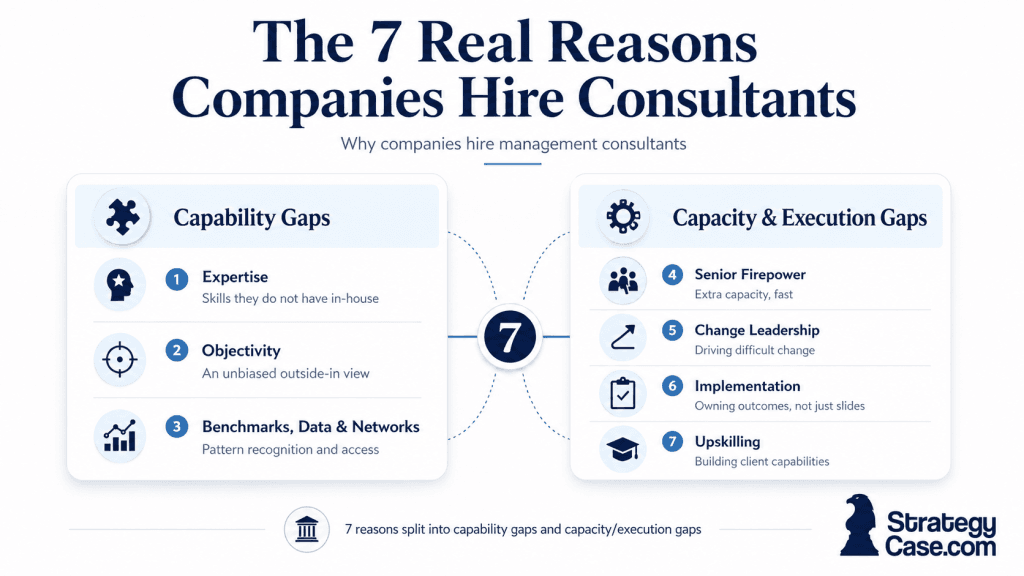
Here are the seven reasons, in one place:
- They need expertise they don’t have in-house.
- They need senior firepower, fast.
- They want an unbiased, outside-in view.
- They need someone to drive change.
- They want benchmarks, data, and networks.
- They need implementation, not just a strategy deck.
- They want to upskill their own people.
The 7 Real Reasons Companies Hire Consultants
1. They Need Expertise They Don’t Have In-House
Most companies are excellent at their core business and average at everything else. When a problem lands outside that core, a first acquisition, a move into a market they have never sold in, a technology shift they have never run, the internal team is learning on the job. Consultants have usually done that exact thing many times, for many clients.
On one market-entry engagement, my team had studied the same industry in four countries in the previous two years. The client had studied it once, badly, five years earlier. We were not smarter than their strategy team. We had simply seen the movie before and knew where the plot turned.
2. They Need Senior Firepower, Fast
This is the reason clients rarely say out loud: capacity. A company’s best people are already fully booked running the business. Pulling them onto a special project means the day job stops.
Consultants arrive as a small, senior team with no other job that week. There is a saying inside the firms that three top-tier consultants can do in a week what a client team struggles to finish in a month. That is not because the consultants are geniuses. It is focus, plus the long hours consultants famously work, aimed at a single problem with nothing else competing for attention.
3. They Want an Unbiased, Outside-In View
Large organizations drift into groupthink. People stop questioning decisions their boss made, avoid politically awkward truths, and defend the way things have always been done. An outsider has none of that baggage.
A consultant can walk into a room and say the thing everyone is thinking but no one is allowed to say. I have delivered findings that a client’s own team had written up privately months earlier, but could never present, because it would have meant telling their CEO he was wrong. Objectivity is a product, and companies pay for it.
4. They Need Someone to Drive Change
Strategy is the easy part. Getting thousands of employees to actually change how they work is where most plans die. Consultants are often hired specifically to be the force that pushes change through internal politics.
Because they sit outside the org chart, consultants can absorb friction that would damage an internal manager’s career. They carry the hard message, take the heat in the workshops, and keep the timeline moving when internal sponsors lose their nerve. When the project ends, they leave, and the client keeps the result.
5. They Want Benchmarks, Data, and Networks
A single client sees its own business. A firm like McKinsey, BCG, or Bain sees hundreds of businesses across every industry. That pattern recognition, plus proprietary benchmarks and research, is genuinely hard to replicate.
Top firms live by the idea of bringing the best of the firm to the client. On my projects, we flew in a specialist from another continent for a single two-hour meeting because that one person had solved this exact problem before. A junior consultant’s real job is often to plug into that global network and pull the right expert, dataset, or benchmark into the room at the right moment.
6. They Need Implementation, Not Just a Strategy Deck
The old cliché is that consultants hand over a slide deck and disappear. That model is fading. Clients increasingly hire firms to stay and implement, and to be paid partly on results.
Traditional consulting fees were fixed, based on team size and time. Today more contracts include fees at risk, where a chunk of the payment depends on hitting agreed targets, cost saved, revenue added, a system actually launched. Companies hire consultants now to own the outcome, not just recommend it.
7. They Want to Upskill Their Own People
A large part of consulting is teaching. Consultants run workshops, coach executives one-on-one, and work side by side with client staff, from the C-suite down to the shop floor. They transfer tools, methods, and ways of thinking that stay behind after the engagement ends.
For many clients, that skills transfer is half the reason they hired the firm. They are not just buying an answer. They are buying an upgrade to their own team, delivered through the project. It is also why the day-to-day work of a junior consultant involves so much structured communication and documentation: the goal is for the client to be able to run it without you next time.
What Companies Actually Hire Consultants to Do
Consultants work across an industry-by-function matrix. The industry is the client’s business (what they sell). The function is the part of the business you are fixing. A single consultant might do a pricing project for a retailer one month and a cost project for a hospital the next.
| Industries that hire consultants | Business functions they hire for |
|---|---|
| Automotive, Aerospace & Defense | Strategy |
| Consumer Goods & Retail | Marketing & Sales |
| Financial Services & Private Equity | Operations |
| Healthcare & Pharmaceuticals | Mergers & Acquisitions |
| Energy, Metals & Mining | Finance |
| Technology, Media & Telecom | Digitization & AI |
| Industrials & Materials | People & Organization |
| Public & Social Sector | Corporate Sustainability |
| Travel, Transport & Logistics | Recovery & Transformation |
Each era has its hot function. Digitization dominated the last decade. Today, most projects carry a sustainability or an artificial-intelligence angle, either as the main topic or as a workstream inside a larger effort. The projects themselves are called engagements, and one client can run several at once.
What It Costs to Hire a Management Consultant
Consulting is expensive, and that price tag is the whole reason the value has to be real. A short project with a small team from a top strategy firm starts in the low hundreds of thousands of dollars. A multi-team strategy-and-implementation program can run into the millions.
The scale of the industry follows from those fees. Estimates of the global management consulting market range from roughly $350 billion and up in 2025, depending on how broadly you define it. The three most prestigious firms alone, McKinsey, BCG, and Bain, earned an estimated $18.8 billion, $14.1 billion, and $7 billion respectively in 2024 (the three firms are privately held, so these are reported estimates).
Fees are structured in two main ways:
- Fixed fee: a set price based on team size, resources, and duration. Still the most common model.
- Fees at risk: part of the payment is tied to measured impact, such as cost saved or revenue added.
No client signs off on that kind of spend, or on the salaries top firms pay their people, unless the expected return is a multiple of the fee.

Who Hires Management Consultants (and Who Signs the Check)
Almost every large organization uses consultants. You would be hard-pressed to find a Fortune 500 company, a major government ministry, or a global bank that has never worked with a top firm.
Clients fall into a few buckets:
- Corporations: multinationals, industry leaders, and mid-sized firms with the budget to pay a premium.
- The public and social sector: governments, ministries, regulators, and NGOs. Even the Vatican has hired top consultants.
- Investors: private equity funds and boards, especially during mergers, acquisitions, and turnarounds.
Inside a company, the buyer is usually a C-level executive, sometimes a division head, and occasionally the board itself during a high-stakes event. These relationships run deep. It is not unusual for one firm to complete more than 1,000 projects with a single large client over the years, and for big organizations to run several competing firms at once. Clients also expect total confidentiality, which is why most successful engagements never become public.
3 Myths About Why Companies Hire Consultants
Myth 1: “Consultants Are Just Expensive Scapegoats”
The story goes that executives hire consultants to rubber-stamp a decision they have already made, so someone external takes the blame if it fails. It happens occasionally, but as a general explanation it falls apart on the numbers. Firms are rehired again and again by the same clients, and companies do not spend millions, repeatedly, on cover they could get from a cheaper report. They spend it because the work moves results.
Myth 2: “Consultants Don’t Actually Create Anything”
Consultants shape more of the modern economy than most people realize, and they rarely get public credit for it. A favorite example: McKinsey did not invent the barcode, contrary to a popular internet claim. But in 1973, two McKinsey consultants helped the grocery industry’s committee define the numerical format behind the Universal Product Code, the standard your groceries still get scanned with today. IBM’s George Laurer designed the actual symbol. That mix of quiet, structural influence, plus heavy investment in research, is exactly what clients are buying.
Myth 3: “Only Struggling Companies Hire Consultants”
The opposite is closer to the truth. The heaviest users of top consulting firms are often the strongest, most profitable companies in their sector. Winning organizations hire consultants to stay ahead, enter new markets, and pressure-test decisions, not because they are in trouble. Consulting is a tool for offense at least as often as defense.
What This Means If You Want to Become a Consultant
If you are reading this to prepare for interviews rather than to hire a firm, pay close attention to the seven reasons above. They are the raw material for the single most common fit question: why consulting?
Weak answers talk about prestige, salary, or “solving interesting problems.” Strong answers connect a genuine motivation to what the job actually is: variety across industries, steep learning, real responsibility early, and the chance to see how top firms operate from the inside. Understanding why companies hire consultants lets you answer “why consulting?” with substance instead of clichés.
At StrategyCase, I have coached 700+ candidates into McKinsey, BCG, Bain, and other top firms, and the ones who succeed understand the business model, not just the interview. If you are serious about breaking in, start with the free StrategyCase guide to how to get into consulting, and get 1-on-1 coaching when you want direct feedback from someone who evaluated real candidates at McKinsey.
Frequently Asked Questions
Why do companies hire consultants instead of doing the work themselves?
Because doing it themselves is usually slower and, at that scale, more expensive. The internal team lacks either the specific expertise or the spare capacity, since the best people are already running the business. A focused external team can deliver a result in weeks that would take the client months.
Are management consultants worth the money?
For the right problem, yes. A strategy project might cost a few hundred thousand to several million dollars, but clients only sign off when the expected return, cost saved, revenue gained, a risk avoided, is a large multiple of the fee. Consultants are rarely worth it for routine work a company can handle in-house.
Do companies hire consultants as scapegoats?
Occasionally, but it is a small part of the picture. If cover were the main product, firms would not be rehired thousands of times by the same clients. Companies keep coming back because the work delivers measurable results, not because it shifts blame.
What kinds of companies hire management consultants?
Large corporations, governments and public bodies, NGOs, and investors such as private equity funds. Buyers are usually C-level executives, and sometimes boards during mergers, acquisitions, or turnarounds. Most large organizations use consultants regularly.
Why do companies hire McKinsey, BCG, and Bain specifically?
For prestige, proprietary benchmarks, and cross-industry pattern recognition. The Big 3 charge the highest fees and are trusted for the most sensitive, high-stakes decisions, where a board wants the most credible outside name in the room.
Is management consulting a dying industry because of AI?
No, but it is changing. AI is automating parts of the analysis that junior consultants used to do, which shifts more of the value toward judgment, relationships, and implementation. Demand for outside expertise and capacity is not going away.
Related Guides
- The Big 4 Consulting Firms: how the Big 4 consulting arms compare to MBB.
- The Complete Case Interview Guide: how firms test who they hire.
- The Future of Consulting: how AI and new business models are reshaping the industry.
The Bottom Line
Companies hire management consultants to rent capability and capacity they cannot build fast enough on their own: expertise, senior firepower, objectivity, benchmarks, execution, and change. It is expensive, and it is worth it precisely because the bar for value is so high. The scapegoat myth and the “they do nothing” myth both miss what is actually happening on these engagements.
If you want to be the person on the other side of that table, the next step is preparation. Understanding why firms hire consultants is where a strong candidacy starts. Get the insider strategy with 1-on-1 coaching from a former McKinsey Senior Consultant, and put yourself in the 1% who break in.
About the author: Florian Smeritschnig spent five years at McKinsey as a Senior Consultant, where he evaluated candidates, and has since delivered 2,200+ mock interviews and coaching sessions, helping 700+ candidates land offers and careers at McKinsey, BCG, Bain, and other top firms.

