
Last Updated on July 16, 2026
By Florian Smeritschnig, former McKinsey Senior Consultant. Updated July 14, 2026.
Consulting projects are staffed like an internal job market: a staffing coordinator or staffing team matches available consultants to incoming client projects based on skills, availability, and development needs, while the partner running the project lobbies for the people they want on their team.
Most consultants learn this the slow way, by getting bounced from one draining project to the next until they burn out. That is the expensive lesson. Understand who actually makes staffing decisions and how the market moves, and you can steer toward the work that builds your career instead of the work that quietly ends it.
I spent 5 years at McKinsey as a Senior Consultant and have coached 700+ candidates into MBB offers since. This guide is a modified excerpt from my book Consulting Career Secrets, and it lays out exactly how consulting projects are staffed at McKinsey, BCG, and Bain, and how to get on the projects you actually want.
Key Takeaways
- Staffing works like an internal job market. A staffing coordinator or team matches you to projects based on availability, fit, and your development goals, while partners recruit the people they want.
- The three MBB firms differ: McKinsey staffs globally, BCG regionally, and Bain locally, which directly shapes your travel, your team, and your work-life balance.
- New consultants get assigned. Your influence over which projects you land grows with tenure, performance, and the internal network you build.
- You can shape or decline a project, but frame it around development goals rather than personal preference, and choose your battles.
- You cannot optimize every factor at once. Pick the two or three that matter most (leadership, team, client, scope, timeline, location) and trade the rest.
How Consulting Project Staffing Actually Works
Consulting project staffing is the internal process of assigning consultants to client engagements. A staffing coordinator or staffing team matches available consultants to incoming projects based on skills, availability, and career development needs. At the same time, the partner leading a project pushes to get the people they want. Junior consultants are mostly assigned; senior consultants increasingly pick.
The mental model that makes everything else click: treat staffing as a job market that lives inside your firm. Supply is the consultants coming off projects and looking for their next one. Demand is the partners with sold work who need teams. Prices, in effect, are set by reputation and relationships.
This market moves with the seasons. Summer is usually slower, with fewer new projects starting, which means more people chasing fewer good roles. The pace picks up again in the fall. Knowing the rhythm helps you time your moves.
The people who decide where you go
Three groups shape where you land, and you should know all three by name.
- The staffing coordinator (or staffing manager). This is the person who runs the matching process, especially early in your tenure. They track your availability, your skills, your preferences, and your development plan. Treat them as an ally, not an administrator. Talk to them regularly, tell them what you want, and they will often go to bat for you.
- The project partner. On any given project, the partner acts like a recruiter. They tap their informal network, ask other partners and project managers who is good, scan staffing lists, and work with coordinators to fill their team with the right fit.
- Your own network. Once you have a few projects behind you, most staffing happens informally. Partners and managers who liked working with you request you by name, or introduce you to colleagues who need someone like you.
The bench: what happens between projects
Between engagements, consultants sit on what firms call the bench (some call it the beach). You are employed and paid, but not billed to a client. You take internal trainings, help with proposals, and hunt for your next role.
A little bench time is normal and even useful. In centralized staffing models, keeping people billed is the staffing manager’s problem, measured through a utilization rate, not something junior consultants are punished for week to week. Extended time on the bench is a different story.
If you have turned down several projects in a row and stayed unstaffed for a while, your bargaining power evaporates and you take what you are given. The goal is to use short bench windows to position for a good next project, not to hide on the bench hoping the perfect one appears.
The Two Staffing Models: Assigned vs. Open Market
Every firm sits somewhere on a spectrum between two models, and where your firm sits changes how much control you have.
The assignment model (centralized). A staffing coordinator or team makes the call, usually in consultation with project leadership. You share preferences, but the decision is top-down. The upside: you do not have to sell yourself to stay busy, and utilization is managed for you. The downside: less say, especially as a junior.
The open-market model (self-staffing). Consultants apply to or express interest in open roles, and it works more like an internal application process. The upside: more control and transparency. The downside: you carry more responsibility for keeping yourself staffed, and quiet networking matters more.
Most large firms, including the MBB firms, run a hybrid. There is a coordinator and a structured process, but a lot of the real matching happens through relationships and informal conversations layered on top. The practical takeaway is the same either way: the formal process gets you started, and your network gets you the projects you actually want.
How McKinsey, BCG, and Bain Staff Differently
The three MBB firms staff on different geographic footprints, and that single difference shapes your travel, your teammates, and your lifestyle more than almost anything else. These are general tendencies, not hard rules, and they vary by office and market.
| Firm | Staffing model | Typical team | Travel | What it means for you |
|---|---|---|---|---|
| McKinsey | Global | Colleagues from offices worldwide | Higher, often international | The widest variety of projects and people, at the cost of more flights and time zones |
| BCG | Regional | Home office plus nearby offices | Moderate | A balance of variety and proximity |
| Bain | Local | Mostly your home office | Lower | Closer to home, a tighter office network, and generally easier work-life balance |
At McKinsey I was regularly staffed across borders, on teams pulled together from several countries. In peak weeks I took 6 flights from Europe via the Middle East to Asia and back. That global model is a genuine advantage if you want range and international exposure early.
It is a real cost if you want to sleep in your own bed on weeknights. Bain’s more local model tends to keep teams close to the home office, which is a large part of why it often scores well on work-life balance and internal culture. BCG sits in between, leaning regional while still sending people further afield to keep teams staffed.
If you are still deciding between firms, the staffing footprint deserves as much weight as pay. It is worth reading up on each firm’s structure and compensation alongside this: start with the Big 3 consulting firms compared, then the pay-and-structure breakdowns for McKinsey and Bain. You can also see how each firm describes life on the job on its own careers site: McKinsey, BCG, and Bain.
Can You Choose Your Own Consulting Projects?
Partly, and it depends on two things: how senior you are and how hot the market is.
Early on, you have limited say. The staffing team assigns you, factoring in your preferences where they can, and your job is to perform and build a reputation. As you gain tenure, credibility, and a network, your influence grows, and most firms expect you to start charting your own path after your first few projects.
The market matters just as much. When projects are plentiful and people are scarce, you get to be choosy. When the market slows and there are more consultants than roles, priority number one becomes staying staffed, and preferences take a back seat.
How to get the projects you want
- Keep your internal profile current. Make sure your specializations and preferences are visible, and subscribe to the relevant staffing newsletters and lists.
- Work the timing. Reach out to partners and project managers you respect about two weeks before you roll off your current project. They may have a role for you, or know someone who does and make the introduction.
- Build the relationship with your staffing coordinator. Tell them your goals early and often. They control the matching and can quietly route good roles your way.
- Aim your projects at your goals. If you want to specialize, chase projects in that area. If you want to lead, take a stretch role, for example acting as a junior project manager while you are still an associate.
- Collect diverse exposure. Working with different partners, teams, and industries is what actually moves you up. Do not get pigeonholed too early.
How to decline a project without hurting your career
You will not always get your ideal project, and no project checks every box. But knowing your priorities lets you set boundaries.
Rather than flatly refusing, make a case built on your development goals: explain what a next project needs to give you and why this one does not fit that plan. That reads as ambition, not avoidance. As a last resort, you can mention genuine unavailability, such as a vacation you have already booked, but use that card sparingly, because it wears thin fast.
Sometimes you simply cannot say no without damage, for instance if you have already declined three projects and sat on the bench for a while. Choose your battles.
The Factors That Make a Project Good or Bad for You
When you evaluate a project, you are really weighing five dimensions: the industry, the business function or focus, the team, the location and travel, and the timeline. You cannot control all five at once, so prioritize and trade off. You usually get the most flexibility on industry, function, and duration, and depending on the setup, you may be able to negotiate partial remote work.
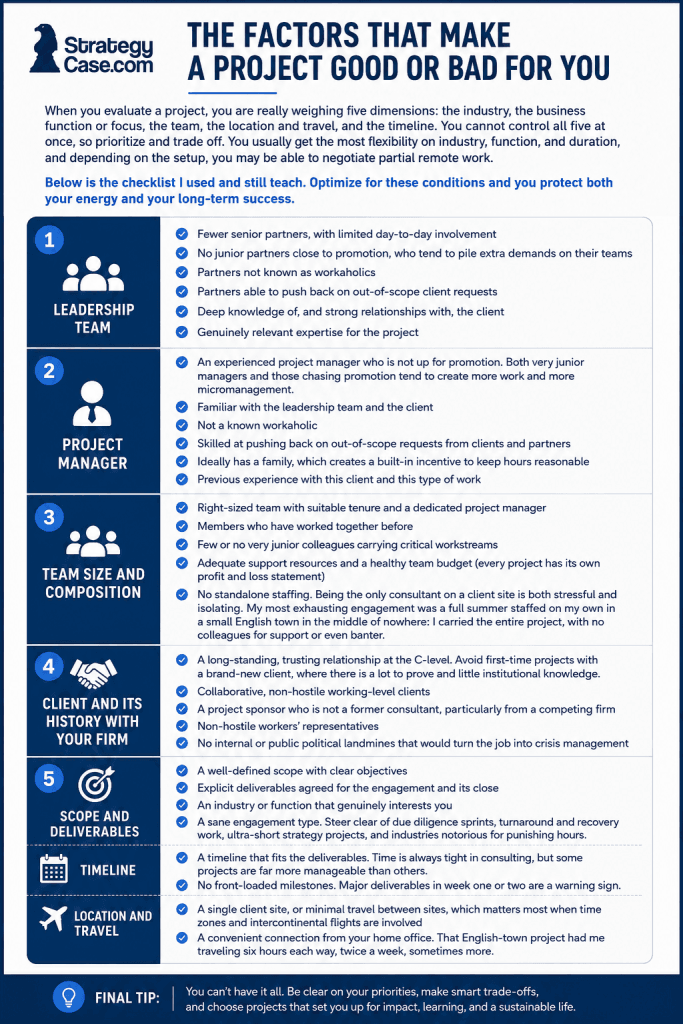
Below is the checklist I used and still teach. Optimize for these conditions and you protect both your energy and your long-term success.
Leadership team
- Fewer senior partners, with limited day-to-day involvement
- No junior partners close to promotion, who tend to pile extra demands on their teams
- Partners not known as workaholics
- Partners able to push back on out-of-scope client requests
- Deep knowledge of, and strong relationships with, the client
- Genuinely relevant expertise for the project
Project manager
- An experienced project manager who is not up for promotion. Both very junior managers and those chasing promotion tend to create more work and more micromanagement.
- Familiar with the leadership team and the client
- Not a known workaholic
- Skilled at pushing back on out-of-scope requests from clients and partners
- Ideally has a family, which creates a built-in incentive to keep hours reasonable
- Previous experience with this client and this type of work
Team size and composition
- Right-sized team with suitable tenure and a dedicated project manager
- Members who have worked together before
- Few or no very junior colleagues carrying critical workstreams
- Adequate support resources and a healthy team budget (every project has its own profit and loss statement)
- No standalone staffing. Being the only consultant on a client site is both stressful and isolating. My most exhausting engagement was a full summer staffed on my own in a small English town in the middle of nowhere: I carried the entire project, with no colleagues for support or even banter.
Client and its history with your firm
- A long-standing, trusting relationship at the C-level. Avoid first-time projects with a brand-new client, where there is a lot to prove and little institutional knowledge.
- Collaborative, non-hostile working-level clients
- A project sponsor who is not a former consultant, particularly from a competing firm
- Non-hostile workers’ representatives
- No internal or public political landmines that would turn the job into crisis management
Scope and deliverables
- A well-defined scope with clear objectives
- Explicit deliverables agreed for the engagement and its close
- An industry or function that genuinely interests you
- A sane engagement type. Steer clear of due diligence sprints, turnaround and recovery work, ultra-short strategy projects, and industries notorious for punishing hours.
Timeline
- A timeline that fits the deliverables. Time is always tight in consulting, but some projects are far more manageable than others.
- No front-loaded milestones. Major deliverables in week one or two are a warning sign.
Location and travel
- A single client site, or minimal travel between sites, which matters most when time zones and intercontinental flights are involved
- A convenient connection from your home office. That English-town project had me traveling six hours each way, twice a week, sometimes more.
Look for the factors that keep your energy up and your long-term trajectory intact. And be cautious when a partner dangles special promises or calls something a “step-up opportunity.”

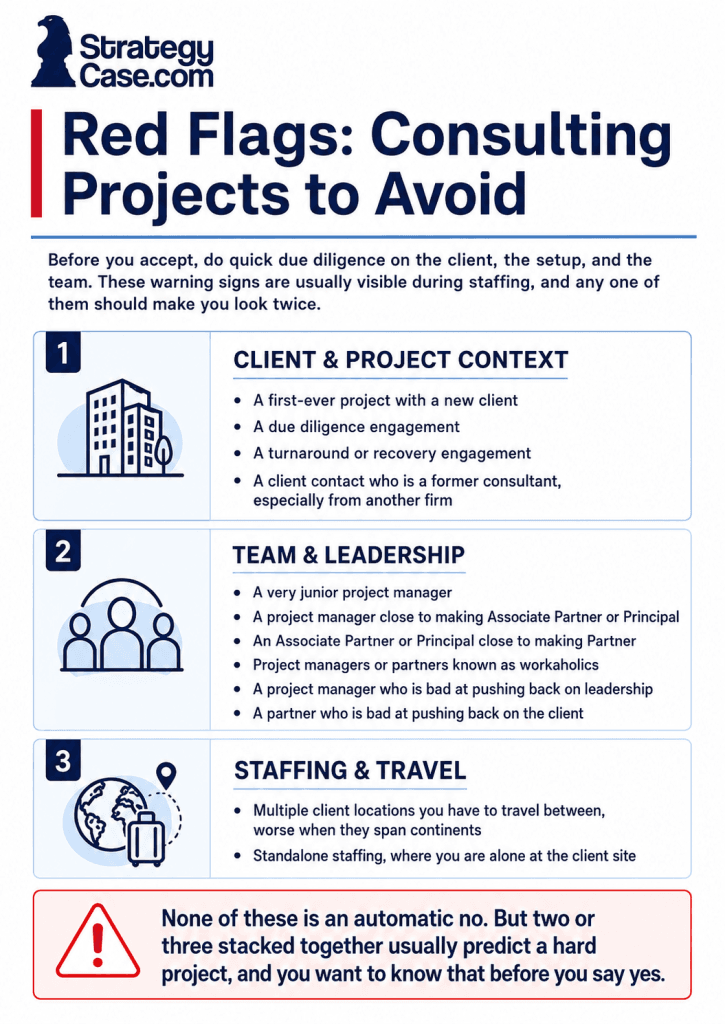
Red Flags: Consulting Projects to Avoid
Before you accept, do quick due diligence on the client, the setup, and the team. These warning signs are usually visible during staffing, and any one of them should make you look twice:
- A first-ever project with a new client
- A very junior project manager
- A project manager close to making Associate Partner or Principal
- An Associate Partner or Principal close to making Partner
- A due diligence engagement
- A turnaround or recovery engagement
- A client contact who is a former consultant, especially from another firm
- Multiple client locations you have to travel between, worse when they span continents
- Standalone staffing, where you are alone at the client site
- Project managers or partners known as workaholics
- A project manager who is bad at pushing back on leadership
- A partner who is bad at pushing back on the client
None of these is an automatic no. But two or three stacked together usually predict a hard project, and you want to know that before you say yes.
How to Vet a Project Before You Say Yes
Once you have some tenure, treat every staffing decision like the mini job change it is. Talk to consultants currently on the project, or people who have worked with that partner and project manager before.
Ask intentional, specific questions instead of vague ones. “How do you like the project?” invites a useless answer. Try these instead:
- “On a scale of 1 to 5, how would you rate the current work-life balance?”
- “What are the best and worst parts of working with this partner or manager?”
- “How well is the scope defined, and how often has it changed?”
- “Is the team fully staffed, or is someone carrying two roles?”
Then run down the factor checklist above. A few honest conversations will tell you more than any staffing memo.
Over time, this compounds. You build a network of people you want to work with and who want to work with you, and most of your projects start arriving through those informal channels anyway. That is the point at which staffing stops happening to you and starts working for you.
Frequently Asked Questions: How Consulting Projects are Staffed
How does staffing work at McKinsey?
McKinsey uses a largely global staffing model run through a structured process, so you can be placed on teams with colleagues from offices around the world. A staffing coordinator matches you to projects based on availability, skills, and development goals, while project partners request the people they want. Expect more international travel and more variety than at firms that staff regionally or locally.
Can you choose your own projects in consulting?
Partly. Junior consultants are mostly assigned and have limited say, though staffing teams factor in your preferences. As you gain tenure, performance, and an internal network, your influence grows and you can steer toward specific projects. How much freedom you have also depends on the market: hot markets give you more choice, slow markets less.
Can you turn down a project in consulting?
At many firms, yes, but how you do it matters. Instead of flatly refusing, frame your case around development goals and explain what a next project needs to offer. Save hard constraints like pre-booked vacation for rare use. Declining too often, especially after extended bench time, damages your standing, so choose your battles.
What is a staffing coordinator in consulting?
A staffing coordinator (sometimes called a staffing manager) is the person who runs the matching of consultants to projects. They track your availability, skills, preferences, and development plan, and they balance those against what incoming projects need. Building a strong relationship with your coordinator is one of the smartest moves a junior consultant can make.
How long do consulting projects last?
Most consulting projects run a few weeks to a few months, and you typically rotate onto a new one every few weeks or months. Each rotation brings a new client, team, and location, and you are expected to get up to speed fast and add value as if you had been there all along.
What happens if you are not staffed on a project?
You sit on the bench (or beach): still employed and paid, but not billed to a client. You take trainings, support proposals, and look for your next role. Short bench spells are normal, and in centralized models utilization is the staffing manager’s metric, not yours. Long stretches, especially after repeated declines, weaken your position.
Related Guides
- How to get into consulting: the complete application guide
- BCG hierarchy and salary data
- The future of consulting: where the career is heading
- Consulting case interviews: the all-in-one guide
- How to get promoted in consulting
- The first 90 days in consulting
The Bottom Line on Consulting Staffing
Staffing is the single biggest lever on your day-to-day life in consulting, and almost no one teaches you to use it. Understand that it runs like an internal job market, learn who makes the calls, and match your firm’s model (global at McKinsey, regional at BCG, local at Bain) to the life you actually want. Early on you will get assigned, so perform and build relationships. As you gain tenure, work the network, aim projects at your goals, and vet every engagement against the factors and red flags above.
Get this right and you compound advantages: better projects, better mentors, better reputation, and a career that builds toward something instead of bouncing around like a ping-pong ball.
If you want the full playbook for thriving once you are in, my book Consulting Career Secrets goes deeper on staffing, promotion, and managing up. And if you are still working to land the offer, book a coaching session with me and let’s build your path in, from application to your first project at StrategyCase.
About the author: Florian Smeritschnig spent five years at McKinsey as a Senior Consultant, where he evaluated candidates, and has since delivered 2,200+ mock interviews and coaching sessions, helping 700+ candidates land offers and careers at McKinsey, BCG, Bain, and other top firms.
