
Last Updated on July 20, 2026
By Florian Smeritschnig, former McKinsey Senior Consultant · Updated July 2026
Most people researching Tata Consultancy Services are trying to place it. Is TCS a Big 4 firm? A consulting firm? The same thing as McKinsey but in India? The answers you find online are either investor-relations copy or a Wikipedia stub, and neither one tells you what the job is worth.
Tata Consultancy Services (TCS) is India’s largest IT services company. It builds and runs enterprise technology for large corporations. It is not a Big 4 firm, and it is not a strategy consultancy. Below is what TCS actually does, which ladder it sits on, and what a TCS role does to your résumé if you eventually want a seat at McKinsey, BCG, or Bain.
Key Takeaways
- TCS is an IT services and technology implementation firm, not a strategy consultancy. It builds, integrates, and operates enterprise systems rather than advising CEOs on corporate strategy.
- TCS is not a Big 4 firm. The Big 4 are Deloitte, PwC, EY, and KPMG. TCS sits at the top of a different ladder: Tier 1 Indian IT services, alongside Infosys, Wipro, HCLTech, and Tech Mahindra.
- It employed 593,798 people as of June 30, 2026, and reported $30.0 billion in revenue for the fiscal year ended March 31, 2026.
- Revenue in dollar terms was roughly flat in FY2026 (down 0.5%) while AI-related revenue crossed a $2.3 billion annualized run rate. The old headcount-equals-growth model is loosening, which changes what an entry-level offer is worth.
- A TCS background is a workable route into consulting, but not a direct one. Strategy firms read it as implementation experience, and that specific discount is what you have to overcome.
What Does Tata Consultancy Services Do?
Tata Consultancy Services designs, builds, integrates, and operates large-scale technology systems for corporations. Typical work includes modernizing a bank’s core systems, running a retailer’s e-commerce platform, or managing an insurer’s IT infrastructure under a multi-year contract. It sells implementation and long-term operation, not strategic advice.
The distinction matters more than it sounds. When a bank decides whether to enter a new market, it may hire a strategy firm. When that same bank needs to replace the core banking platform that decision depends on, and then keep it running for eight years, it hires a firm like TCS.
That is the essential shape of the business: fewer PowerPoint recommendations, far more engineers, and contracts measured in years rather than weeks.
TCS at a Glance
| Founded | 1968, as a division of Tata Sons |
| Headquarters | Mumbai, India |
| Parent company | Tata Group (Tata Sons holds the majority stake) |
| CEO and Managing Director | K Krithivasan |
| Employees | 593,798 (as of June 30, 2026) |
| FY2026 revenue | $30.0 billion (year ended March 31, 2026) |
| FY2026 operating margin | 25.0% |
| Voluntary attrition | 13.6% (last twelve months, Q1 FY2027) |
| Global presence | 46+ countries, 148 nationalities |
| Listed | NSE and BSE; constituent of NIFTY 50 and BSE SENSEX |
| Went public | 2004 |
Figures from the TCS Q4 FY2026 results release (April 9, 2026) and the Q1 FY2026-27 fact sheet (July 9, 2026).
Is TCS a Big 4 Company? No, and Here Is Which Ladder It Is On
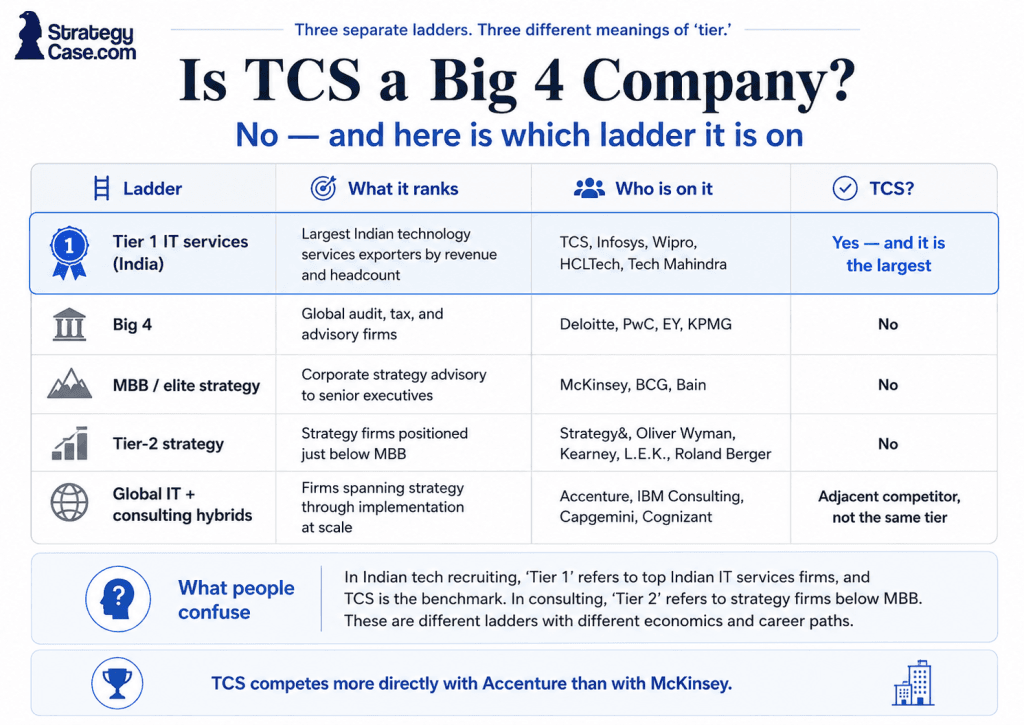
This is the single most common misconception about TCS, and it comes from people mixing up three completely separate rankings that all use similar language.
TCS is not a Big 4 firm. It is not an MBB firm. It sits at the top of the Tier 1 Indian IT services ladder, which is its own category with its own economics and its own exit options.
| Ladder | What it ranks | Who is on it | TCS? |
|---|---|---|---|
| Tier 1 IT services (India) | Largest Indian technology services exporters by revenue and headcount | TCS, Infosys, Wipro, HCLTech, Tech Mahindra | Yes, and it is the largest |
| Big 4 | Global audit, tax, and advisory firms | Deloitte, PwC, EY, KPMG | No |
| MBB / elite strategy | Corporate strategy advisory to senior executives | McKinsey, BCG, Bain | No |
| Tier-2 strategy | Strategy firms positioned just below MBB | Strategy&, Oliver Wyman, Kearney, L.E.K., Roland Berger | No |
| Global IT + consulting hybrids | Firms spanning strategy through implementation at scale | Accenture, IBM Consulting, Capgemini, Cognizant | Adjacent competitor, not the same tier |
The word “tier” is what trips people up. In Indian technology recruiting, “Tier 1” is a compliment and TCS is the benchmark. In consulting recruiting, “Tier 2” means firms like Oliver Wyman and Kearney that sit below MBB. The two vocabularies are unrelated, and TCS belongs to the first one. Most of the firm guides on StrategyCase cover the consulting ladders, which is exactly why this distinction is worth drawing clearly.
The firm TCS actually competes with for the same contracts is Accenture, not McKinsey. If you are weighing offers across that boundary, our Accenture Strategy salary guide covers what the hybrid model pays. For the Big 4 specifically, see our breakdown of what the Big 4 firms are, and for the strategy tier above both, the Big 3 consulting firms.
What TCS Actually Sells
TCS organizes around industry verticals so that delivery teams build sector-specific knowledge. Revenue concentration shifts year to year, but the shape is stable.
| Vertical | Share of revenue | Representative work |
|---|---|---|
| Banking, financial services, insurance (BFSI) | ~30–35% | Core banking modernization, payment infrastructure, regulatory compliance systems |
| Retail and consumer | ~15–18% | Supply chain optimization, omnichannel platforms, demand forecasting |
| Communications, media, technology | ~15–17% | 5G deployment support, telecom billing platforms, cloud-native architecture |
| Manufacturing | ~10–12% | Industrial automation, digital twins, IoT integration, ERP modernization |
| Life sciences and healthcare | ~10–12% | Clinical trial data management, healthcare analytics, patient data security |
Alongside services, TCS licenses its own enterprise software, which is unusual for an IT services firm and a genuine differentiator in deals:
- TCS BaNCS is the flagship. It is core banking, payments, securities trading, and compliance software used by banks and insurers worldwide, usually deployed as part of a modernization program.
- Ignio automates IT operations using machine learning, handling incident detection, predictive monitoring, and routine remediation.
- Cognix is the AI and analytics platform, used to integrate enterprise data sets and build predictive models.
- Quartz is the enterprise blockchain platform, aimed at supply chain tracking, trade finance, and cross-border transaction records.
Selling software alongside implementation is why TCS engagements tend to be sticky. Once BaNCS is running a bank’s core, the relationship lasts a decade.
How TCS Delivers: The Global Network Delivery Model
The Global Network Delivery Model (GNDM) is how TCS staffs work across time zones, and it explains the career geography more than any org chart.
- Onshore teams sit at or near the client, typically 15–20% of a project’s workforce. These are the enterprise architects, business analysts, project leaders, and client relationship managers. This is the client-facing tier.
- Nearshore centers operate in the client’s time zone: Mexico for North American clients, Hungary and Poland for Western Europe. These teams handle agile development that needs real-time collaboration.
- Offshore delivery centers, concentrated in Bangalore, Chennai, and Pune, carry the bulk of development, QA, infrastructure monitoring, and platform operations.
For anyone planning a career here, the important detail is that visibility concentrates onshore. Offshore roles can be technically deeper while remaining structurally further from the client relationships that drive promotion into Client Partner territory.
The TCS Career Ladder
TCS runs one of the largest structured training operations in the industry. Most graduates enter through the Initial Learning Program (ILP), several weeks of instruction at a TCS training campus covering development frameworks, enterprise architecture, system design, and client communication before assignment to a project.
| Level | Typical title | What you actually do |
|---|---|---|
| Entry | Assistant System Engineer (ASE) | Coding, debugging, supporting modules within a larger system; learning internal delivery standards |
| Mid | System Engineer / IT Analyst | Owning components, leading small modules, contributing to technical design, more client contact |
| Senior | Project Manager / Technical Architect | Delivery timelines and resourcing, or designing scalable system architecture across technologies |
| Leadership | Client Partner / Delivery Head | Owning a client account or delivery center: P&L, relationship, and engineering teams that can run into the thousands |
Progression is tied to internal certifications, most commonly in cloud platforms, data engineering, AI and machine learning, cybersecurity, and enterprise application development.
What a TCS Job Does for Your Career
Here is the part the company profiles leave out.
I spent five years at McKinsey as a Senior Consultant and evaluated real candidates there, and in the years since I have coached candidates out of large IT services firms into strategy consulting through StrategyCase. The pattern is consistent enough to state plainly: a TCS background gets you read, but it gets you read as an implementer.
Screeners at strategy firms scan a résumé for evidence that you have owned a business problem, not a workstream. A TCS résumé usually reports scale, and scale is the wrong currency. “Managed a team of 25 on a core banking migration” reads as delivery management. What a strategy firm wants to see is what changed for the client: the decision you shaped, the number that moved, the recommendation you owned. Candidates who make the jump are almost always the ones who worked onshore, sat in front of the client, and can talk about the business case rather than the build.
The second thing that catches people is the case interview. Candidates from large delivery organizations tend to be strong on structure and weak on the “so what.” They will lay out a clean issue tree and then narrate the analysis instead of committing to an answer, because in delivery work the requirements come from the client. In a case, nobody hands you the requirements. That habit is trainable, but it takes deliberate reps, and it is the single most common reason otherwise sharp engineers stall in first-round interviews.
None of this makes TCS a bad start. Sector knowledge in BFSI or life sciences is genuinely portable, and technology fluency is worth more in consulting now than it was a decade ago. It is simply a route with a known discount attached, and knowing the discount in advance is how you plan around it. Our guide on moving from engineering into consulting covers the translation problem in detail, and how experienced hires get into McKinsey, BCG, and Bain explains where laterals actually enter the hierarchy.
TCS vs Strategy Consulting: The Honest Comparison
| TCS (IT services) | MBB (strategy consulting) | |
|---|---|---|
| Core product | Building and operating systems | Advice on business decisions |
| Typical client contact | CIO, CTO, IT leadership | CEO, board, business unit heads |
| Team size | Hundreds to thousands of engineers | Usually fewer than ten consultants |
| Engagement length | Multi-year contracts, often renewed | Weeks to a few months |
| What you are measured on | Delivery, uptime, contract economics | Insight, client influence, problem-solving |
| Entry point | Campus hiring at large volume | Highly selective, case-interview gated |
| Exit options | Technology leadership, product, IT strategy | Industry strategy, PE, founding roles, senior operating jobs |
Both are legitimate careers. They are simply not the same career, and the interview processes test almost entirely different things. If you are preparing for the strategy side, start with our complete guide to case interviews.
Getting Into TCS: Application and Interview Process
The TCS process varies by role and region, but most candidates see four stages.
- Application and résumé screening. Recruiters assess academics, technical skills, and relevant experience. For technology roles, expect to show familiarity with specific languages, frameworks, and enterprise environments. Our consulting résumé guide applies to client-facing roles here as well.
- Online assessment. Quantitative reasoning, logical problem-solving, coding, and foundational technical knowledge. Volume hiring makes this a genuine filter.
- Technical interview. Data structures, system architecture, databases, algorithms, and cloud infrastructure, often with a live problem to work through or a system to troubleshoot.
- Managerial and HR interview. Behavioral questions on teamwork, conflict, leadership, and motivation, plus, for consulting and client-facing roles, case-style discussion of a business problem with a technology dimension.
That case-style round is where preparation gaps show. It is a lighter version of what MBB runs, but it tests the same instinct: structure the problem, work the numbers, commit to a recommendation.
What Is Changing at TCS in 2026
Three developments matter if you are deciding whether to join.
AI is decoupling revenue from headcount. TCS reported AI-related revenue crossing a $2.3 billion annualized run rate in Q4 FY2026, while total revenue in dollar terms fell 0.5% for the year. Operating margin, meanwhile, reached a four-year high of 25.3% in that quarter. Growth is coming from higher-value work rather than more people, and the historic promise of an IT services career, that steady headcount growth creates steady promotion, is weaker than it was.
Hiring has resumed, but selectively. TCS added roughly 9,300 people in Q1 FY2027 after a flat stretch, bringing headcount to 593,798. Attrition of 13.6% is moderate by industry standards. The additions are concentrated in cloud, data, and AI skills rather than general application development.
Routine coding is the exposed layer. Generative AI tools compress exactly the work that entry-level ASE roles have traditionally absorbed. That pushes value toward client-facing, architectural, and domain-specialist roles. If you join, optimize aggressively for onshore exposure and a specific industry domain rather than general delivery experience.
Frequently Asked Questions
What does Tata Consultancy Services actually do?
TCS builds, integrates, and operates enterprise technology for large organizations: core banking systems, e-commerce platforms, cloud migrations, ERP modernization, and long-term IT infrastructure management. It also licenses its own software, including the TCS BaNCS banking platform. It sells implementation and operations rather than strategic advice.
Is TCS a Big 4 company?
No. The Big 4 are Deloitte, PwC, EY, and KPMG, which are audit, tax, and advisory firms. TCS is an IT services company and the largest of India’s Tier 1 technology firms. Its closest direct competitor is Accenture, not any Big 4 firm.
Which tier company is TCS?
In Indian IT recruiting, TCS is a Tier 1 company, the top category, alongside Infosys, Wipro, HCLTech, and Tech Mahindra. That “Tier 1” label is unrelated to consulting’s “Tier-2” designation for firms like Oliver Wyman and Kearney, which describes a different industry entirely.
When was TCS founded, and who owns it?
TCS was founded in 1968 as a division of Tata Sons and went public in 2004. It remains part of the Tata Group, with Tata Sons holding the majority stake. It is listed on India’s NSE and BSE and is a constituent of the NIFTY 50 and BSE SENSEX.
Is TCS an MNC?
Yes. TCS is a multinational corporation headquartered in Mumbai with operations in more than 46 countries, employees of 148 nationalities, and the majority of its revenue earned outside India, primarily in North America and Europe.
Can you move from TCS to McKinsey, BCG, or Bain?
Yes, but it is a lateral move with a known obstacle. Strategy firms read IT services experience as implementation rather than advisory work, so you have to reframe your record around business outcomes instead of delivery scale, and clear a case interview that rewards committing to an answer. Onshore, client-facing experience and deep sector knowledge make the strongest cases.
Related Guides
- How to Get Into Consulting: the full application and recruiting process, start to finish
- The Case Interview for Experienced Hires: why senior delivery habits read as junior in a case, and how to fix it
- The McKinsey Technical Expertise Interview: the specialist route in, if you want to stay technical
- Switching From Big 4 to MBB: the closest sibling transition, carrying the same implementation discount
- Moving From a Tier-2 Firm to MBB: what the jump looks like when strategy work is already on your résumé
The Bottom Line
Tata Consultancy Services is the largest IT services company in India and one of the largest in the world: 593,798 employees, $30.0 billion in FY2026 revenue, and a business built on constructing and running the systems that large corporations depend on. It is not a Big 4 firm and not a strategy consultancy, and treating it as either will lead you to the wrong expectations about the work and the wrong preparation for the interviews.
As a career, it offers scale, structured training, and genuine sector depth. What it does not offer is the executive-advisory positioning that strategy firms recruit for, which is why the move from TCS into consulting takes deliberate repositioning rather than a straight application.
If that is the move you are planning, prepare for the interview that actually gates it. The StrategyCase Case Interview Academy is built around the skill that trips up candidates from delivery backgrounds most often: structuring a problem you were not handed, and committing to an answer under pressure.
About the author: Florian Smeritschnig spent five years at McKinsey as a Senior Consultant, where he evaluated candidates, and has delivered 2,200+ mock interviews and coaching sessions since. His clients have secured 700+ offers at MBB, Tier-2 firms, Big 4 consulting divisions, in-house consultancies, and boutiques. He is the author of “The 1%: Conquer Your Consulting Case Interview.”

