

Last Updated on September 23, 2026
By Florian Smeritschnig, Former McKinsey Senior Consultant · Updated September 2026
Management consulting is the business of solving a company’s hardest problems from the outside, usually as a time-boxed project with a defined question, a small dedicated team, and a recommendation delivered to senior management at the end.
That’s the definition. Here’s the part the textbooks leave out.
Search this exact phrase today and the top result on Google is not Wikipedia, and it is not a business school. It is a Reddit thread where someone asks what management consulting is and how the people who do it make so much money. That thread currently outranks Bain, Wikipedia, and four education providers. When a forum post beats every formal definition on the page, it means the clean definitions are not answering the question people are actually asking.
The real question instead of “what is management consulting” is usually one of three: what do these people do all day, why does anyone pay them for it, and should I try to get in?
I spent five years at McKinsey as a Senior Consultant, evaluated candidates for the firm, and have since delivered more than 2,200 mock interviews and coaching sessions. Below is what the work actually consists of, what a project looks like from the inside, what management consulting is not, and who it genuinely suits.
Key Takeaways
- Management consulting is project work, not advice in the abstract. A typical engagement runs six to twelve weeks, answers one defined question, and ends in a recommendation to senior management.
- The term covers two very different jobs. The U.S. Bureau of Labor Statistics counts 1,077,100 management analysts earning a median of $101,860. Strategy consulting at McKinsey, BCG, and Bain is a few thousand hires a year out of that total.
- Nobody agrees how big the industry is, because nobody agrees what counts. IBISWorld puts the global market at $1.1 trillion on a broad definition; narrower definitions land in the hundreds of billions.
- The day-to-day is less glamorous than the brochure: long hours and constant stress for structuring problems, pulling data, building models, and turning all of it into slides that a client executive can act on.
- The case interview exists because it compresses the first eight weeks of a real project into 30 minutes. Understanding the project explains the interview.
What Is Management Consulting? The Short Definition
Management consulting is a professional service in which an external firm is hired to analyze a specific business problem and recommend a course of action. Consultants are brought in for a defined period, work alongside the client’s own staff, and deliver a recommendation that the client is free to accept, reject, or modify.
Three features separate it from other kinds of business help.
It is external. The value comes partly from not being an employee. Consultants have no stake in internal politics, no history with the people involved, and no career to protect inside the building.
It is project-shaped. Consulting is not an ongoing service like accounting or payroll. It has a start date, an end date, a scope, and a deliverable. When the project ends, the team leaves.
It is advisory by default. The core product is a recommendation. Many firms now also do implementation work, but the traditional model stops at telling the client what to do and why.
Want the client’s side of this? I covered the buying decision separately in why companies hire management consultants.
What Management Consultants Actually Do All Day
The honest answer is that a consultant’s week is mostly spreadsheets, slides, and meetings. The glamour is in the decisions the work informs, not in the work itself.
A typical week breaks down into five activities.
Structuring the problem. Before anyone touches data, the team breaks a vague question into parts that can actually be answered. “Why are profits falling?” becomes a set of testable branches. This is the skill firms screen for hardest, and it is the one most candidates underestimate.
Gathering information. That means interviewing the client’s own staff, requesting data extracts, reading industry reports, and benchmarking against competitors. A surprising share of consulting is finding out what the client already knows but has never assembled in one place.
Analysis. Building models in Excel, sizing markets, testing what actually drives a number. Most of it is arithmetic done carefully under time pressure, not advanced mathematics.
Synthesis. Turning the analysis into a short, defensible argument. This is where consultants earn their keep. The finding is worthless if the executive can’t follow it in ten minutes.
Communication. Presenting to the client, running working sessions, and defending the logic when a senior executive pushes back.
The job also involves travel. Management consultants travel frequently and regularly work 60+ hour weeks. I treat how much consultants actually work as its own topic.
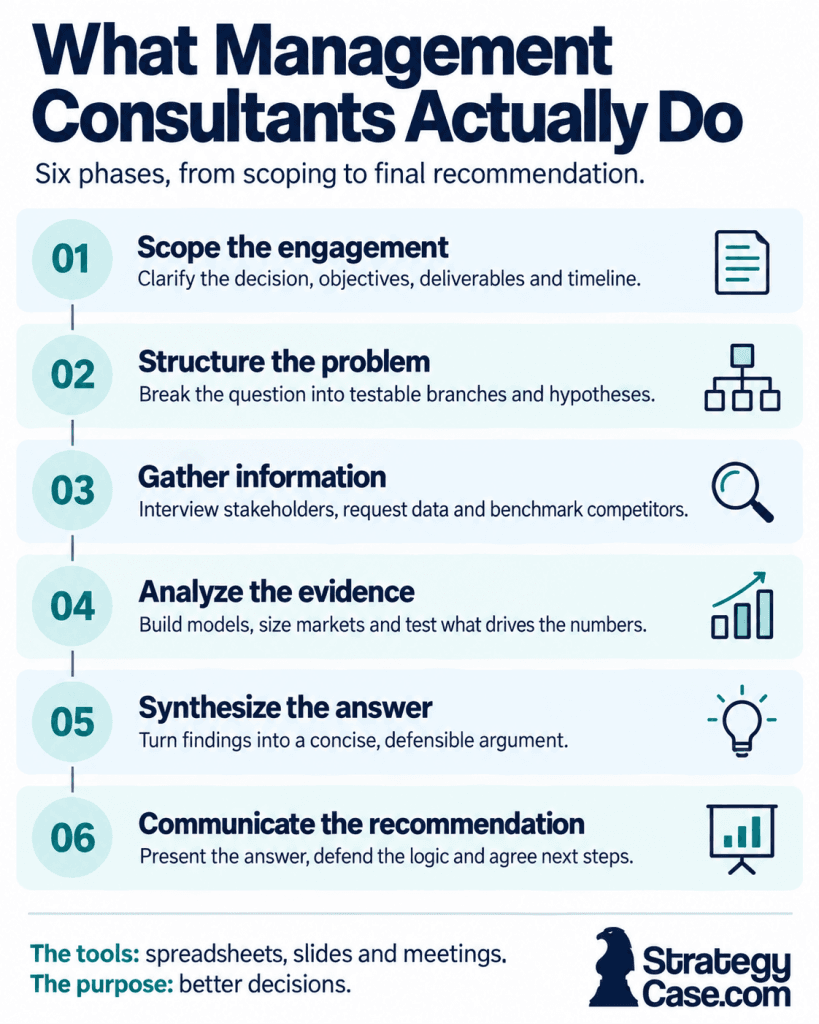
The anatomy of a typical management consulting engagement.
The Anatomy of a Consulting Project
Management consulting is not a continuous flow of advice. It is a sequence of discrete projects, and every project follows roughly the same shape.
| Phase | Typical timing | What happens | What the client sees |
|---|---|---|---|
| Scoping | Before the team arrives | A partner and the client agree the question, the scope, and the fee | A proposal |
| Structure and workplan | Week 1 | The problem is broken into branches; analyses are assigned owners and deadlines | A workplan and a starting hypothesis |
| Analysis | Weeks 2 to 4 | Interviews, data requests, models, benchmarks | Progress updates |
| Mid-point review | Around week 4 | The team synthesizes what it has and checks direction with the steering committee | The first real read-out |
| Pressure test | Weeks 5 to 7 | Findings get challenged internally before the client ever sees them | Working sessions |
| Recommendation | Final week | An answer-first presentation, then handover or a follow-on implementation phase | The final document |
Two things follow from this shape.
First, scoping decides more than analysis does. A brilliantly executed study of the wrong question is worth nothing. That conversation happens before the junior team is even staffed, which is why partners are paid what they are paid.
Second, and this matters if you are considering the career: the case interview is a compressed simulation of phases two through six. You are handed a vague business question, asked to structure it, given data to interpret, pushed to do the arithmetic under time pressure, and then asked to deliver a recommendation. Thirty minutes instead of eight weeks, same sequence.
That’s not a coincidence, and it’s the single most useful thing to understand before you start preparing. If the interview format has always looked arbitrary to you, this is why it isn’t. The complete guide to case interviews walks through each of those stages in detail.
The Two Very Different Jobs That Share the Name
Here’s the main source of confusion, and the reason two people can answer this question completely differently and both be right.
“Management consulting” describes both a vast general occupation and a small elite slice of it.
The U.S. Bureau of Labor Statistics tracks management analysts as an occupation of 1,077,100 people, with a median annual wage of $101,860 as of May 2025, a bachelor’s degree as the typical entry requirement, and projected growth of 10 percent from 2025 to 2035. That number includes independent consultants, internal improvement teams, IT and operations specialists, and regional boutiques.
Strategy consulting at McKinsey, BCG, and Bain, which is our focus here at StrategyCase.com, is a narrow slice of that population. Those firms hire a few thousand people a year worldwide, screen almost everyone out through a standardized case interview, and pay entry-level packages well above the occupational median.
You can see the same disagreement in the industry’s own numbers. IBISWorld puts the global management consultants market at $1.1 trillion in 2025, growing at a 3.6 percent compound rate since 2020. Other published estimates for “management consulting services” land in the hundreds of billions.
Neither is wrong. They’re counting different things, because there is no agreed boundary around what qualifies.
For a candidate, the practical consequence is simple: when someone quotes a salary, a growth rate, or a success rate for “management consulting,” ask which of the two jobs they mean. The answer usually changes the number by a factor of two or more. I broke the compensation side of this down in why management consultants are paid so much.
What Management Consulting Is Not
Definitions get sharper by exclusion. These are the five fields most often confused with management consulting, and what actually separates them.
| Often confused with | How it differs |
|---|---|
| Investment banking | Banks execute transactions and are paid on deals closing. Consultants advise on decisions and are paid for the study, whatever the client then decides. |
| Accounting and audit | Audit verifies what already happened against a standard. Consulting recommends what should happen next, with no standard to check against. |
| IT and technology implementation | Implementation builds and installs the system. Management consulting decides whether the company should change the system at all, and why. |
| In-house strategy teams | Same work, no external position. In-house teams carry internal history and politics, which is precisely what clients pay outsiders to avoid. |
| Independent or freelance consulting | Usually one experienced person selling specialist expertise directly. Firm-based consulting sells a team, a method, and a brand the client’s board will accept. |
The Big 4 firms sit across several of these rows at once, which is why they are hard to classify and why their consulting arms behave differently from their audit businesses. The full breakdown by business model is in the guide to the four types of management consulting firms.
Is Management Consulting a Good Career?
It depends on what you want out of the first few years of your working life, and I’d rather be straight with you than sell it.
What the job genuinely gives you. Exposure to senior decision-makers far earlier than almost any other career. A structured way of thinking that transfers to everything afterwards. A credential that opens doors for a decade. Pay that starts high and rises quickly.
What it costs. Long hours, and the travel is real. Limited control over which projects you get staffed on (depends on the firm; McKinsey gives you more flexibility compared to BCG and Bain). Work that is often intellectually interesting but emotionally thin, since you leave before you see whether the recommendation worked. Firms also run up-or-out progression, so the job has a built-in clock.
What is changing. AI has absorbed a meaningful share of the research and slide production that used to fill a first-year analyst’s week, and the hiring market has tightened alongside it. That raises the bar on the judgment work left over. Current conditions are covered in the guide to the consulting job market.
Most people do not stay. That’s a feature of the model, not a failure, and the destinations are well-trodden enough that I mapped them in consulting exit opportunities. If you want the balanced version of this argument at length, it is in the pros and cons of a consulting career.
If you want to test the reality against the firms’ own descriptions rather than anyone’s summary, Bain and BCG both publish detailed role descriptions and entry paths.
Frequently Asked Questions
What does a management consultant actually do all day?
Mostly structuring problems, gathering and analyzing data, and turning the results into presentations for client executives. A normal day involves interviews with client staff, work in Excel, building slides, and internal team discussions. The strategic decisions people associate with the job are the output of that work, not the daily activity.
What is the difference between management consulting and strategy consulting?
Strategy consulting is a subset of management consulting. Management consulting covers any external advice on improving how a company is run, including operations, technology, and organization. Strategy consulting deals specifically with the highest-level questions: which markets to enter, what to sell, what to buy, and where to compete.
Why do companies pay consultants so much when they already have employees?
Because they are buying three things their employees cannot supply: an outside view with no internal politics attached, a team that can be assembled and dismissed in weeks rather than hired permanently, and pattern recognition from having seen the same problem at other companies.
What is the difference between MBB and Big 4 consulting?
MBB refers to McKinsey, BCG, and Bain, which focus on strategy work for senior management and hire a small number of people through a standardized case interview. The Big 4 are much larger accounting-rooted firms whose consulting arms cover a wider range of work, hire far more people, and screen somewhat less narrowly.
Do management consultants actually implement their recommendations?
Increasingly, yes, though it varies. The classic model ends at the recommendation and hands execution back to the client. Most large firms now also sell implementation phases that run months or years, partly because clients grew tired of paying for advice nobody carried out.
Is management consulting a good career for someone who does not have a business degree?
Yes, and this is one of the more persistent myths. Firms hire engineers, physicists, lawyers, historians, and PhDs, because they screen for structured reasoning rather than business knowledge. What matters is evidence that you handled something quantitatively demanding, plus your performance in the case interview.
Related Guides
- Why Companies Hire Management Consultants: the client’s side of the decision
- Why Management Consultants Are Paid So Much: the economics behind the salaries
- Pros and Cons of a Consulting Career: the honest trade-offs before you commit
- Getting Into Management Consulting as an Experienced Hire: the guide for lateral hires
The Bottom Line on Management Consulting
Management consulting is outside problem-solving sold as projects. A company has a question it can’t answer internally, hires a team for six to twelve weeks, and receives a recommendation it’s free to ignore. Everything else about the industry, the salaries, the prestige, the hours, the interview process, follows from that basic shape.
Three things are worth taking away.
The term covers two different jobs, and you should always ask which one is being discussed. The daily work is more analytical and less glamorous than the reputation suggests. And the case interview, which looks arbitrary from the outside, is a compressed version of the actual work.
If you’ve read this far because you’re considering the career rather than just curious about the word, the next step is the entry route, not more definitions. Start with how to become a management consultant, which covers qualifications, the four realistic doors in, and what each one takes.
And when you’re ready to work on the part that actually decides the outcome, the StrategyCase Case Interview Academy drills the structuring, math, and chart work that eliminates most candidates at the interview stage. The 250-plus free StrategyCase guides cover everything around it, from the application through the final round.
This industry is harder to get into than almost any other, and roughly 1 in 100 applicants makes it. That’s a reason to prepare deliberately, not a reason to skip it.
About the author: Florian Smeritschnig is a former McKinsey Senior Consultant who evaluated candidates at the firm and has delivered 2,200+ mock interviews and coaching sessions. Through StrategyCase, he has helped 700+ coachign candidates win offers at McKinsey, BCG, Bain, and other top firms.
