
Updated October 2026. By Dr. Florian Smeritschnig, former McKinsey Senior Consultant
Good case interview practice means drilling the one skill that keeps breaking (structuring, exhibits, case math, or the recommendation) in short targeted reps, then testing it in a full case with someone who gives you honest feedback. Most candidates who land MBB offers do 20 to 30 live cases plus a much larger number of short drills. What each case teaches you matters far more than the count.
That isn’t how most people practice. The default advice, on forums and on most of the pages, is to do more: more cases, more partners, more casebooks. So candidates reach case 40 and still hear the feedback they heard in week one, because repetition without a diagnosis rehearses the mistake.
After having failed my first McKinsey interviews, I re-applied, changed my approach and got in. I worked there for 5 years and learned how cases are scored and constructed. I left the firm and since 2020 I’ve delivered 2,300+ mock case interviews and coaching sessions for my clients. Below: the four formats of case interview practice and what each one can’t do, how many cases you need, how to match feedback to the right drill, how to run one practice case so it counts, and where to find practice material.
Key Takeaways
- Case interview practice comes in four formats, and each has a blind spot. Drills build speed and precision, solo cases build stamina, partner cases build the conversation, and only an experienced evaluator can tell you how far you are from the bar.
- Aim for 20 to 30 live cases plus many more short drills. Twenty cases you score and debrief beat 60 you never analyzed.
- Diagnose before you drill. Feedback like “not MECE” names a symptom. The cause often sits upstream, such as building categories before you’ve pinned down the decision the client has to make.
- Re-run the part that broke before you start a new case. Redo the broken structure or exhibit in the same case until it holds.
- Build friction into practice on purpose. Ask your partner to push back on correct answers and to cut cases short, so the real interview isn’t the first time it happens.
What Counts as Case Interview Practice?
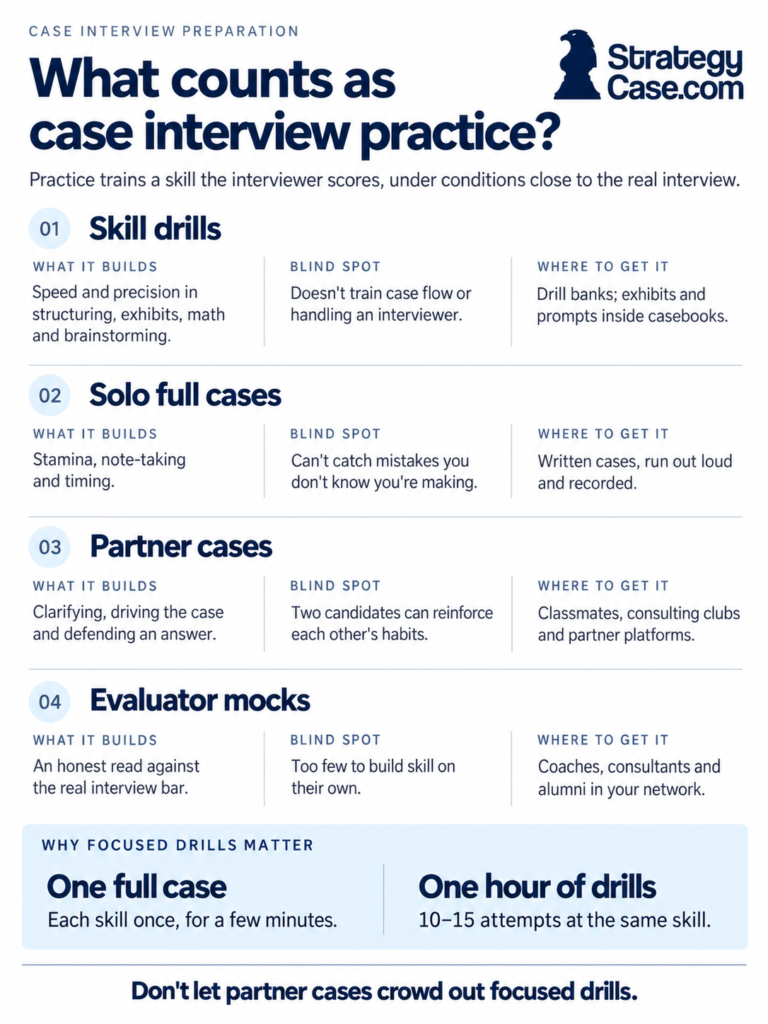
Case interview practice is any rep that trains a skill the interviewer scores, under conditions close to the real interview. It comes in four formats, and most candidates spend too many hours in the third one, partner cases. They feel like the real thing, but a full case touches each skill once, for a few minutes, inside an hour. A drill gives you 10 or 15 attempts at the same skill in that hour.
| Format | What it builds | Its blind spot | Where to get it |
|---|---|---|---|
| Skill drills | Speed and precision in structuring, exhibits, math, brainstorming (as well as communication and meta-skills if done right) | Doesn’t train flow or handling an interviewer | Drill banks; the exhibits and prompts inside casebooks |
| Solo full cases | Stamina, note-taking, timing | Can’t catch mistakes you don’t know you’re making | Written cases, run out loud and recorded |
| Partner cases | The conversation: clarifying, driving the case, defending an answer | Two candidates tend to reinforce each other’s habits | Classmates, consulting clubs, partner platforms |
| Evaluator mocks | An honest read against the real bar | Too few to build skill on their own | Coaches, consultants and alumni in your network |
How Many Practice Cases Do You Need?
Most candidates who land MBB offers do 20 to 30 live cases, plus a much larger number of solo drills. Twenty well-reviewed cases with real feedback beat 60 cases you never analyzed. Our case interview prep plan turns that into 2-, 4-, and 8-week schedules.
The research on skill-building points the same way. In Anders Ericsson’s 1993 study of violinists at a Berlin music academy, the best students didn’t stand out for total time spent on music. They stood out for accumulated hours of deliberate practice: effortful, solitary work aimed at specific weaknesses.
While working with my clients, I discovered that case practice works the same way. Hours count when they target a weakness and come with feedback. Hence, focus on individual case element drills first. Run the as if an interviewer is present, e.g., play back the question out loud, ask for time to structure your framework, then communicate your framework, and, eventually, prioritize the next steps and analysis.
If you practice these things, you are not just building the mental models and thinking techniques but also the right steps and communication for each part of the case (and that is what I found to be most effective with my clients).
Here’s what volume without diagnosis looks like in public. In a 2013 Wall Street Oasis thread, a candidate wrote that they’d done about 60 cases with partners and felt roughly 70% ready. Their analysis and recommendations had improved.
What still bothered them was delivery: whether to pause for ten seconds before answering, how to keep notes organized once exhibits arrived, and whether asking for guidance cost points. Sixty cases had trained the content. Nobody had isolated the delivery skills, so they never got drilled.
So stop counting cases and track these readiness signals instead:
- You can build a structure tailored to an unfamiliar business without reaching for a memorized framework.
- You lead with the insight when you get an exhibit, not with a description of the axes.
- You can do case math out loud, at a steady pace, and sanity-check the result.
- You can give a clear recommendation from any point in a case, including when time runs out.
Diagnose First: Match the Feedback to the Drill
Most practice feedback names a symptom. The drill has to target the cause, and the two are often in different places.
A pattern I see in first sessions: a candidate has done dozens of practice cases with peers, and the feedback keeps coming back as “not MECE.” The structure isn’t the root problem. They generate categories before clarifying the decision the client has to make, so every structure looks reasonable and none of them answers the question. Peers name the symptom. A diagnosis names the cause.
Use this map to translate what you hear into what you practice:
| Feedback you keep hearing | The underlying weak skill | The drill that fixes it |
|---|---|---|
| “Not MECE” or “your structure felt generic” | Anchoring on the client’s decision before you build buckets | Restate the decision in one sentence, then build a first-principles structure, 10 to 15 prompts in a row |
| “You described the chart but didn’t tell me what it means” | Exhibit interpretation: insight, then the so-what | Read an exhibit in 60 seconds, then state the core insights, the implications and next steps for the client |
| “Your math was slow” or “check that number” | Setup and sanity checks under time pressure | Timed calculations, plus an estimate before every exact answer |
| “Your ideas were a list” | Structured brainstorming | Brainstorm into two or three named groups before listing any ideas |
| “I had to lead you” | Driving a candidate-led case | Full cases where your partner answers questions but never suggests the next step |
| “Where’s your answer?” | Synthesis | End any case on cue: recommendation, two reasons, the next steps |
Notice that most rows end in a drill, not a full case. Structuring, math, and exhibits are the skills where isolated reps pay back fastest, and all of them are available as single StrategyCase courses.
The case interview charts course has 17 video lessons and 50 exhibit drills with sample answers. The case interview frameworks course has 36 lessons and 100 structuring and brainstorming drills. Pick the one your feedback points to. For math, see our case math course.
How to Run One Practice Case So It Counts
A practice case has three parts: what you decide before it, what you capture during it, and what you do in the ten minutes after it. Most candidates skip the first and the third.
Before: Pick One Skill to Test
Name one skill you’re testing in this case, and tell your partner. “Watch whether I lead with the insight on each exhibit” gets you specific feedback. “How did I do?” gets you “pretty good, maybe a bit more structure.”
During: Record It and Add Friction
Record the case, with your partner’s consent, and ask them to note the minute when things went wrong. Then add friction. In case interview practice, you want to experience struggle and friction, because a smooth mock mostly rehearses what you can already do.
Three ways to add it:
- Pushback on a correct answer. Ask your partner to challenge at least one answer per case, including correct ones, without telling you which. You learn to check your logic before you defend it or concede.
- A surprise time cut. Have them stop the case without warning: “We have two minutes. What do you tell the CEO?”
- A planted error. Agree that there will be curveballs in advance, such as an exhibit that doesn’t fit your hypothesis, and let your partner choose one per case.
This matters because of how interviews are lost. After seeing it first-hand at McKinsey and coaching since, I’ve found that candidates rarely lose an offer over the mistake itself. They lose it in the reaction: the freeze, the triple apology, the spiral that colors the rest of the case.
My guide to handling mistakes in case interviews covers the three-step recovery. Practice it here, while it costs nothing.
After: Score It, Then Re-Run the Broken Part
Score the case on the five dimensions in our case interview feedback sheet and write down one fix, not five. Then re-run the part that broke, in the same case, before you start a new one. Starting a fresh case feels productive, but it gives you one more attempt at everything except the thing that failed.
Here’s a worked demonstration on a practice prompt I’ve made up for this guide: “An island ferry operator has lost summer bookings since a budget airline started flying to the island. What should it do?”
First pass. “I’d look at revenue and costs, then the market, the competition, and the customer.” It isn’t wrong. It would also fit any company with falling sales, which is why an interviewer would call it generic.
Re-run, after naming the decision:
“The question is which travelers to fight for, and how. A flight competes for foot passengers. It doesn’t compete for anyone bringing a car, a camper van, or freight. So I’d first split the lost bookings into foot and vehicle passengers. For foot passengers, I’d compare what the flight offers on time, price, and frequency with what we can change: fares, timetable, hotel bundles. Then I’d check whether we should shift capacity toward vehicles and freight, where the airline can’t follow.”
Same case, ten minutes later, and the second structure contains an insight the first one couldn’t reach. That’s the rep that counts.
Case Interview Practice Partners: How to Get Real Value From Peers
You need partners. The case is a conversation, and you can’t practice clarifying questions, interruptions, or defending a number on your own. These habits get far more out of each session:
- Swap roles every session. Giving cases teaches you what an interviewer sees, and you’ll spot your own habits in other people’s cases.
- Agree on the skill and curveballs up front. A partner who knows what to watch for gives feedback you can act on.
- Ask about your reaction, not only your answer. “How did I look when the exhibit contradicted me?” is a better question than “was my answer right?”
- Practice with people who will challenge you. A friend who nods along to everything gives you the smooth case you don’t need.
- Find partners where candidates gather. Try your university’s consulting club, classmates in the same recruiting cycle, and PrepLounge (where I also coach), which many candidates use to find partners online.
Peer cases have a ceiling. Two candidates at the same level can’t reliably tell a good answer from a distinctive one, because neither has seen the real bar. A professional interviewer’s read pays most early, before a habit has been rehearsed for 30 cases, because it decides what the rest of your practice should drill.
Where to Find Case Interview Practice Material
Start with the firms themselves. McKinsey’s own interviewing page tells candidates to “share tailored solutions vs standard frameworks,” which is as clear an argument against template practice as you’ll find. Here’s what each source is good for:
| Source | What you get | Best for | Watch out for |
|---|---|---|---|
| McKinsey practice cases | Five written cases on its interviewing page (Beautify, Diconsa, Electro-Light, a national education system, Talbot Trucks) with suggested answers | McKinsey’s interviewer-led question style | Only five; have a partner read them to you rather than reading them yourself |
| BCG’s case interview prep page | Do’s and don’ts from BCG, plus a link to OneDay@BCG, a free job simulation | Seeing what BCG says it looks for | No case library on the page as of October 2026 |
| Bain’s case interview prep hub | Bain-designed practice cases and tips, and a filmed consultant mock interview | Watching a full case end to end | Watch it as a model of the format, not a script |
| University casebooks | Hundreds of free cases with interviewer notes | Partner cases at volume | Quality is uneven, and many teach rigid templates. Our ranking of free MBA casebooks sorts them |
| Real case collections | Cases firms and candidates have published | Breadth across firms and industries | Run them, don’t read them; our collection of 42 real case interview examples links each one |
| The 1%: Case Interview Workbook | 25 original cases plus 3 bonus cases, 120+ practice opportunities, interviewer notes | Partner cases a non-expert can run well | A book, so pair it with drills for speed. See the Workbook |
| Drill banks | Short reps on one skill with sample answers | Fixing the weakness your feedback names | Drills alone won’t train the full conversation |
Case Interview Practice by Situation
The four formats stay the same. The mix changes with your timeline, your background, and the firm.
If your interview is under three weeks away. Skip breadth. Get one honest read on your skills, drill it every day, and do one full case a day with feedback. The 2-week schedule in the prep plan linked above is built for this.
If you’re an experienced hire or career changer. Your business judgment is usually the strength. The gaps tend to be format: structuring out loud, case math under a clock, and synthesizing on the spot. Spend proportionally more time on drills and less on business content.
If you have no business background. Learn the components before you run full cases, or you’ll spend weeks rehearsing a broken structure. Drills first, cases second.
If you’re interviewing at McKinsey. Its cases are interviewer-led: the interviewer asks a sequence of questions, and each one is a mini drill. Practice answering cold questions crisply, then check your style against the official practice cases.
If you’re interviewing at BCG or Bain. Cases are mostly candidate-led, so you need to drive. Use partner cases where your partner never suggests the next step.
If you’re interviewing in a second language. Practice in the language of the interview from the first week, including the math. Thinking well and speaking fluently are separate skills under pressure.
Frequently Asked Questions
What are case interview practice questions?
Case interview practice questions are the parts of a case drilled one at a time: an opening prompt to structure, an exhibit to interpret, a calculation, a brainstorming question, or a request for a recommendation. Practicing them separately is faster than full cases for building each skill. Full cases then test whether the skills hold together.
Where can I practice case interviews for free?
Start with the firms: McKinsey publishes five practice cases on its interviewing page, Bain has a case interview prep hub with practice cases and a filmed mock interview, and BCG offers a free job simulation called OneDay@BCG. University casebooks add hundreds of free cases. For partners, try your university’s consulting club or a partner platform.
Can I practice case interviews alone?
Yes, for a large share of your practice. Drills on structuring, charts and math as well as recorded solo cases all work alone. What you can’t build alone is the full conversation and pressure, or an honest read of mistakes you don’t know you’re making. Our guide to practicing case interviews alone covers the methods and a weekly solo plan.
Is it better to practice with a peer or a coach?
You need both, for different jobs. Peers give you volume and the feel of a live conversation. An experienced professional interviewer tells you which skill is costing you points, which peers can’t reliably judge. Most candidates benefit from getting that read early, so their peer cases drill the right thing.
Are AI case interview simulators good practice?
Not yet. All the tools I have tested so far recycle generic cases and frameworks, and are built by engineers who have never seen a consulting office from the inside.
Should I practice cases out loud?
Always. The interview is spoken, and silent practice hides the gaps in your logic. Say your structure, math steps, and assumptions out loud, even in solo drills.
Related Guides
- Consulting case interviews: the complete guide: what the interview tests and how it’s scored
- Case interview success: the four habits that separate offer holders from everyone else
- The most common case interview mistakes: the errors to drill out before your first round
- Is case interview coaching worth it?: when an expert read pays off, and when it doesn’t
The Bottom Line
Case interview practice works when every rep has a target. Diagnose the skill that keeps breaking, drill it in short reps, then test it in full cases with someone who’ll push back. Aim for 20 to 30 live cases, re-run the part that broke before you move on, and build friction in so the interview holds no first-time surprises.
The drill stage is where most candidates are thin, and it’s what the StrategyCase Case Interview Academy is built for. Its three parts match the skills interviewers score (case structuring, exhibit interpretation and data analysis, and case math) and come with 82 video lessons and thousands of practice drills with sample answers, for $179. Start drilling with the StrategyCase Case Interview Academy, and spend your partner cases testing skills instead of discovering what’s missing.
About the author: Dr. Florian Smeritschnig is the founder of StrategyCase.com and a former McKinsey Senior Consultant who evaluated candidates for the firm. Since 2020 he has delivered 2,300+ mock interviews and coaching sessions, and his clients have secured 700+ consulting offers, 340 of them at McKinsey, BCG, and Bain. He is the author of three books on consulting interviews and careers, including The 1%: Conquer Your Consulting Case Interview.
