
Updated September 2026 · By Florian Smeritschnig, former McKinsey Senior Consultant
One mistake in a case interview will not cost you the offer at McKinsey, BCG, or Bain. Interviewers expect slips under pressure. What they actually score is how calmly and quickly you recover, because resilience and coachability matter more than a flawless answer. Perfectionism in case interviews is the real threat here, not the occasional wrong number.
I spent five years at McKinsey as a Senior Consultant, where I evaluated real candidates, and I have since delivered more than 2,200 mock interviews and coaching sessions. The candidates who lose the offer over a mistake almost never lose it because of the mistake. They lose it because they panic, freeze, or spiral, turning one small slip into a visible collapse over the rest of the case interview.
This guide shows you what interviewers actually reward, a three-step method to recover from any slip in real time, the overreactions that do real damage, and how to train calm recovery before your interview.
Key Takeaways
- One mistake rarely decides a case interview. Candidates get offers after miscalculations, missed branches, and shaky structures all the time, because they recovered well.
- Perfectionism backfires. The belief that every answer must be flawless creates the pressure that makes real mistakes more likely.
- Interviewers score resilience, coachability, and recovery far more than flawless execution. These map directly to traits McKinsey, BCG, and Bain look for in future consultants.
- Use the 3 R’s to recover in real time: Recognize the slip briefly, Recalibrate out loud, and Resume your pace without dwelling.
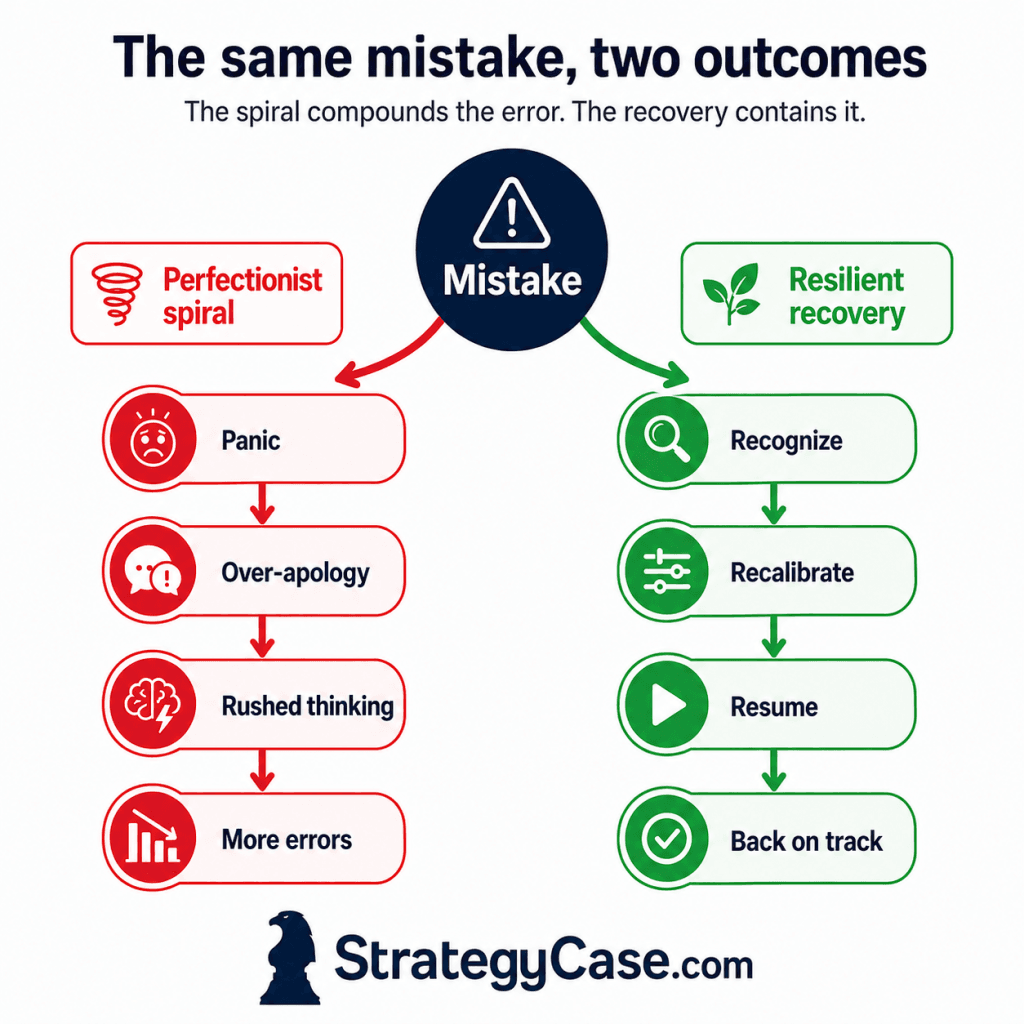
- The damage usually comes from the overreaction, not the error: freezing, over-apologizing, speeding up, or second-guessing every step afterward.
Will One Mistake Cost You the Offer?
No. One mistake will almost never cost you a case interview offer. Interviewers at McKinsey, BCG, and Bain assume you will slip somewhere, miscalculate a figure, miss a branch in your structure, or stumble on a chart, because the format is built to push you past your comfort zone.
Here is the verdict from the other side of the table: a candidate who makes a mistake and recovers cleanly often scores higher than one who never slips but thinks rigidly. The error is a data point. Your reaction is the test.
That single reframe takes most of the fear out of the room.
What Perfectionism Looks Like in a Case Interview
What is perfectionism in a case interview? Perfectionism in a case interview is the belief that every number, framework, and sentence has to be flawless, and that a single mistake means rejection. It shows up as freezing after an error, over-apologizing, second-guessing, or rushing, and it tends to cause more mistakes than it prevents.
The trap is a spiral. You miscalculate one figure, your inner critic flares, and instead of staying on the problem you start auditing every word and number you say next. That divided attention is exactly what produces the next mistake, and the one after that. The slip did not sink you. The spiral did.
This pattern is more common than ever, and not because candidates got worse. Perfectionism has been rising for decades: a landmark meta-analysis of more than 41,000 students found that self-oriented, socially prescribed, and other-oriented perfectionism all increased measurably between 1989 and 2016 (Curran and Hill, 2019, Psychological Bulletin). The high achievers who target consulting tend to sit at the sharp end of that trend.
I see it most in two groups.
First-timers treat the case like an exam with a single correct answer. Experienced hires and career changers, used to being the most polished person in the room, panic the moment they look anything less than expert. Both are solving the wrong problem.
The case is not an exam, and nobody expects you to look expert at someone else’s job on the spot.
What Interviewers Actually Reward (Not Perfection)
After evaluating candidates at McKinsey and coaching hundreds more across MBB, I can tell you interviewers are not sitting with a red pen waiting to cross you out after the first error. They are watching how you handle it. Three behaviors carry far more weight than a clean run.
- Resilience. Say you miscalculate a number. Instead of freezing, you calmly note, “Let me double-check that math,” correct it, and continue. That small recovery shows the composure clients expect on real projects. The opposite is just as visible: one slip rattles the candidate, errors pile up, confidence drains, and the body language closes off for the rest of the case.
- Coachability. Mid-case, an interviewer often drops a hint: “Do you want to consider another revenue stream?” A strong candidate does not ignore the cue or cling to their first idea. They take it (“Good point, let me fold that in”) and integrate it smoothly. That flexibility is gold, and it is hard to fake.
- Recovery. Sometimes you present a structure and realize halfway through it is missing a critical piece. The weak move is to panic or apologize on a loop. The strong move is to adjust on the spot: “I want to add one more lens here, competitive response, to give us a fuller picture.” Self-correcting without losing momentum reads as maturity.
None of this is soft framing. These traits line up with what the firms publicly say they assess. McKinsey’s own interviewing guidance tells candidates the case is about their problem-solving approach and thinking out loud, not a perfect answer, and its Personal Experience Interview explicitly scores drive and the ability to learn and adapt.
A candidate who recovers well is showing those exact qualities live, under pressure.
The 3 R’s: How to Recover From a Mistake in Real Time
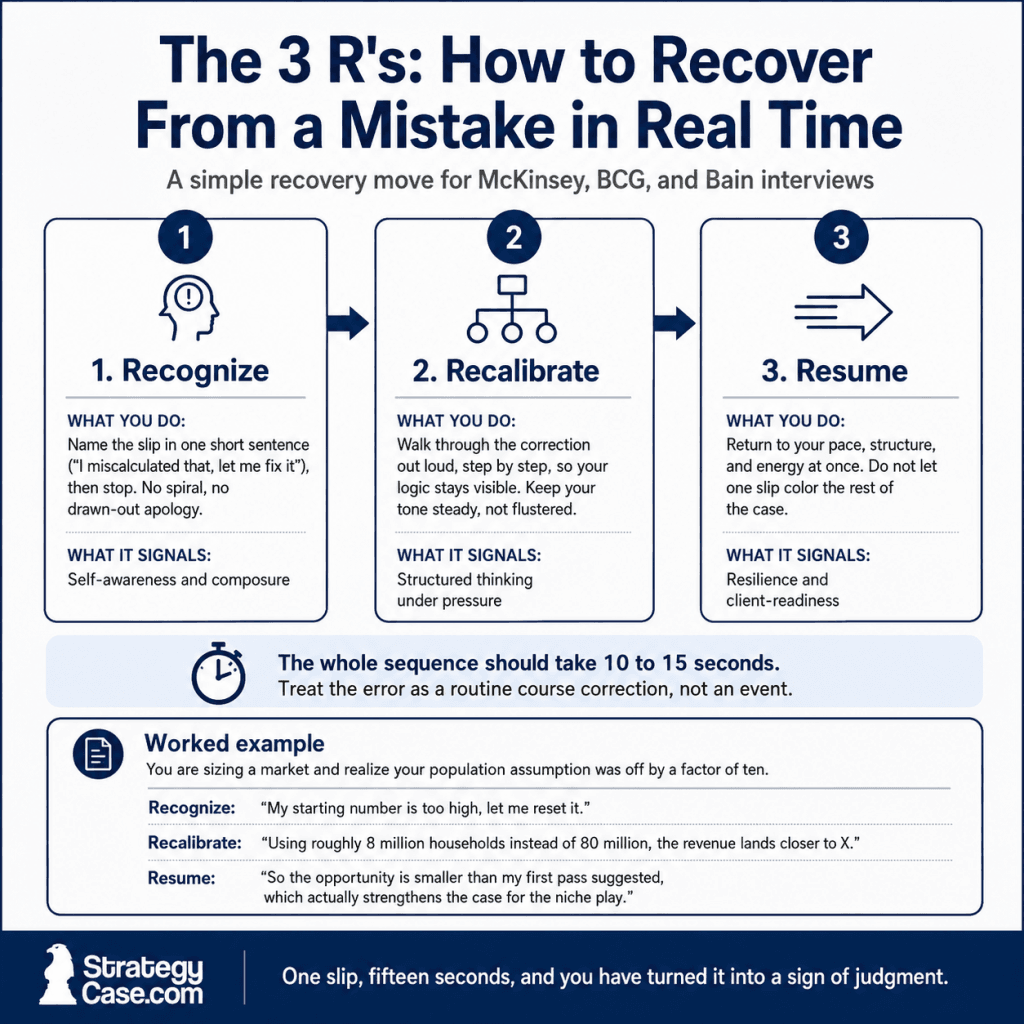
When a slip happens in your McKinsey, BCG, or Bain interview, you need a move you can run on autopilot, because your working memory is already full. I teach a simple one: the 3 R’s. Recognize, Recalibrate, Resume.
| Step | What you do | What it signals |
|---|---|---|
| 1. Recognize | Name the slip in one short sentence (“I miscalculated that, let me fix it”), then stop. No spiral, no drawn-out apology. | Self-awareness and composure |
| 2. Recalibrate | Walk through the correction out loud, step by step, so your logic stays visible. Keep your tone steady, not flustered. | Structured thinking under pressure |
| 3. Resume | Return to your pace, structure, and energy at once. Do not let one slip color the rest of the case. | Resilience and client-readiness |
The whole sequence should take ten to fifteen seconds. The goal is to treat the error as a routine course correction, not an event. Notice that step two is really a communication skill: the cleaner you talk through your reasoning, the smaller any mistake looks, because the interviewer can see you are still in control of the logic.
A worked example. You are sizing a market and realize your population assumption was off by a factor of ten.
- Recognize: “My starting number is too high, let me reset it.”
- Recalibrate: “Using roughly 8 million households instead of 80 million, the revenue lands closer to X.”
- Resume: “So the opportunity is smaller than my first pass suggested, which actually strengthens the case for the niche play.”
One slip, fifteen seconds, and you have turned it into a sign of judgment.
What NOT to Do After a Mistake
The damage almost always comes from the overreaction, not the error. These are the moves that turn a recoverable slip into a real problem, and the ones I flag most often in coaching.
- Over-apologizing. Saying sorry three times signals you think the mistake is a big deal. Acknowledge once, then move on. A simple “thanks for the patience” is plenty.
- Freezing. Long silence makes an error feel bigger than it is and reads as fragility. Keep talking through your logic.
- Speeding up. Racing to “make up” for a slip produces more slips, unstructured thinking, and an anxious tone. Hold your pace.
- Second-guessing everything. Re-checking every later answer fractures your attention. Do not ask the interviewer whether your answer is “right,” that is your job to reason toward, and asking signals you have lost confidence.
- Hiding it. If you spot a clear error, name it. Pretending it is not there while the interviewer watches is worse than the mistake.
If you want the fuller list of what sinks candidates, the most common case interview mistakes guide covers the structural ones too, beyond the mindset traps above.
Reframe It: A Case Is a Process, Not a Performance
Think of a case interview like driving with GPS. A wrong turn does not end the trip. When you miss an exit, the GPS does not shout or shut down. It recalculates, gives you a new route, and you keep moving toward the destination. The only real mistake would be slamming the brakes in frustration.
A case works the same way. A slip is just a wrong turn. Recognize it, recalibrate, and drive on. As long as you reach a sound recommendation with clear logic, interviewers will not care that the path was not perfect.
This is why obsessing over a flawless run is the wrong target. The candidates who succeed in case interviews are not the ones who never err. They are the ones who stay in the process, keep their structure visible, and treat each correction as part of the work, which is exactly what consulting actually looks like.
How to Train Calm Recovery Before Your Interview
Calm recovery is a skill, not a personality trait, and you can build it in the weeks before your interview. A few things that work, especially if you have under four weeks to prep:
- Make mistakes on purpose in practice. During mock cases, deliberately mis-state a number, then run the 3 R’s. Rehearsing the recovery move is what makes it automatic when the real slip comes.
- Get feedback on your reaction, not just your answer. Most candidates review whether they got the case “right.” Ask your partner how you looked when you stumbled. That is the gap targeted coaching closes fastest, because you cannot see your own tells.
- Practice thinking out loud. Silence is where the spiral grows. The more comfortable you are narrating your logic, the less any single error can rattle you.
- Lower the stakes in your head. Remind yourself before you walk in that one mistake is expected and survivable. That belief alone removes much of the pressure that causes slips.
At StrategyCase, this is built into how we train candidates. Our Case Interview Academy drills structured thinking, communication, and composure together, with realistic practice and feedback, so recovery becomes second nature instead of something you hope holds up on the day.
Frequently Asked Questions Perfectionism in Case Interviews
Can you make a mistake in a case interview and still get the offer?
Yes. Candidates get offers at McKinsey, BCG, and Bain after miscalculations, missed branches, and shaky structures all the time. Interviewers weigh your structure, reasoning, communication, and composure across the whole case, so one recovered slip rarely moves the decision.
Do consulting interviewers expect a perfect case interview?
No. The format is designed to push you past your comfort zone, so interviewers expect slips. They are testing how you think and how you handle pressure, not whether you can run every step without an error.
How do you recover from a mistake in a case interview?
Use the 3 R’s. Recognize the slip in one short sentence, Recalibrate by correcting it out loud step by step, and Resume your normal pace immediately. The whole move should take ten to fifteen seconds and stay matter-of-fact.
Should you point out your own mistakes in a case interview?
Yes, if the error is clear and affects your answer. Name it once, briefly, and fix it. Do not apologize repeatedly or hide it. Self-correcting without drama signals exactly the composure interviewers want.
How do I stop overthinking and being a perfectionist in case interviews?
Shift your target from “flawless answer” to “clear process.” Practice making and recovering from mistakes so they feel routine, get feedback on your reaction rather than just your result, and manage the stress and nerves that feed the perfectionist spiral.
How many mistakes can you make and still pass a case interview?
There is no fixed number. A few small, well-recovered slips are normal and rarely cost you. What ends a case is the pattern, not the count: repeated errors driven by panic, or one mistake that triggers a visible collapse for the rest of the interview.
Related Guides
- Case Interview Frameworks: How to Structure Any Case
- How to Be MECE in a Case Interview
- Brainstorming in a Case Interview
- Case Interview Math: The Ultimate Guide
- Case Interview Examples From McKinsey and Others
The Bottom Line
Perfectionism in case interviews sets you up to fail. The moment you decide every answer must be flawless, you create the pressure that makes real mistakes more likely and harder to recover from. What separates candidates who get offers at McKinsey, BCG, and Bain is not a perfect run. It is calm recovery: acknowledge the slip, adjust with confidence, and keep moving.
Remember the simple version: resilience beats flawless execution in every case interview. That mindset can be trained, and it is one of the highest-impact things you can practice before the day. To build it with realistic practice and feedback on how you actually recover, start with the StrategyCase Case Interview Academy.
