
By Florian Smeritschnig, former McKinsey Senior Consultant · Updated July 2026
The case interview mindset that actually earns offers is calm, structured composure under pressure. Not raw brainpower, and not bluffing.
You have drilled dozens of cases, memorized the math shortcuts, and can recite every framework in your sleep. Then the interview starts and your voice drops: “Uh, maybe we could… possibly… look at market share?” Even a solid answer sounds like a guess when you deliver it that way, and the interviewer quietly notes “low confidence” before you touch a single number.
After five years evaluating candidates at McKinsey and 2,200+ coaching sessions, I can tell you what that mindset looks like from the other side of the table, and exactly how to train it before your next round.
Key Takeaways
- Interviewers score how you carry yourself under pressure, not only whether your logic is flawless. Composure is a real, evaluated dimension.
- The winning mindset is “calm and structured,” not “confident and bluffing.” Confidence with no structure behind it reads as noise and gets punished on the second follow-up.
- A confident candidate who takes a wrong turn and recovers calmly usually outscores a nervous candidate who whispers the right answer.
- You can train the case interview mindset: narrate your thinking, turn uncertainty into structure, recover from mistakes out loud, and run a breathing reset before you walk in.
- This is not an interview trick. Staying composed while you solve an unfamiliar problem is the core survival skill of the actual consulting job.
What is the case interview mindset?
The case interview mindset is the mental approach that keeps you calm, structured, and in control while you solve an unfamiliar business problem out loud. Instead of chasing a perfect answer, you focus on thinking clearly under pressure, steering the conversation, and recovering smoothly when you are wrong.
Smart but Shaky: Why Composure Decides Close Calls
Most candidates walk into their case interview armed to the teeth. Cases drilled, math practiced, every prep book highlighted. And then the pressure hits, and all that preparation collapses into polite hesitation. The eyes search for approval. The tone asks a question instead of making a point.
Here is the thing: a shaky delivery makes smart logic sound like guesswork. The content might be fine, but the signal the interviewer receives is doubt.
When I interviewed candidates, the hardest rejections to write were for people whose math was clean and whose structure held up, but who spent the whole hour looking to me for permission. On paper, they could do the job. In the room, I could not picture sending them to a client the following week.
That gap, between capable-on-paper and trusted-in-person, is where a lot of technically strong candidates lose the offer.
So when you feel stress take over in a case interview, understand what is actually at stake. Confidence is not a bonus skill layered on top of the analysis. It is part of the analysis the interviewer is scoring.
What Interviewers Actually Score: The “Client-Ready” Test
Interviewers are not teachers marking your homework. Behind every follow-up question, they are asking themselves one thing: “Would I trust this person in front of a client?”
This is not a StrategyCase invention. On its own careers site, McKinsey states plainly that the case exists to see how you “structure tough, ambiguous business challenges,” “deal with all the implications of facts and data,” and “articulate your thoughts in a fast-moving discussion.” Nowhere does it say “recite the correct framework.” The evaluation is about how you operate under uncertainty, out loud, in real time.
That reframes the whole exercise. A candidate with a messy structure delivered calmly will usually get more follow-ups, more hints, and more room to recover. The nervous genius who second-guesses every step and constantly seeks reassurance gets quietly cut off, even when the underlying logic is correct.
Here is what that difference looks like in practice:
| In the moment | Nervous candidate | Composed candidate |
|---|---|---|
| Voice and pacing | Fast, trailing off, every point rising like a question | Even tone, slightly slower, lands each point |
| Hitting a wrong turn | Apologizes, freezes | Names it and pivots: “Let me adjust that assumption” |
| A pause to think | Fills the silence with filler words | Takes the pause openly: “Give me a moment to structure this” |
| Running out of data | Guesses quietly and hopes | States the assumption and the logic behind it out loud |
| Interviewer pushes back | Caves immediately | Holds the point, then updates if the challenge is fair |
None of the composed responses require you to be right. They require you to stay in control. That is the trait a complete case interview approach has to build alongside the hard skills, because firms weight it heavily.
Confidence Without Structure Is Just Noise
You may have heard the line that “in a case interview, confidence beats correctness.” It is half true, and dangerously easy to misread.
The half that is true has real research behind it. In a well-known set of studies, Anderson and colleagues found that overconfident people are consistently seen as more competent by others and gain higher social status, even when their actual ability does not justify it. Delivery genuinely moves how people judge you. Presence is not fluff.
The half that gets people rejected is the leap from “delivery matters” to “so I can bluff my way through.” Interviewers at top firms solve ambiguous problems for a living. They are trained to separate presence from substance, and a confident candidate with no real structure gets exposed the moment the second follow-up lands. Bluffing can carry a room for sixty seconds. It does not survive forty minutes with someone who does this every day.
So the formula is not confidence instead of structure. It is structure first, then delivered with conviction. Think of confidence as an amplifier sitting on top of a signal. Turn it up on a clear structure and you sound like a consultant. Turn it up on nothing and you just broadcast louder noise.
The StrategyCase view fits in one line: you cannot fake your way through a case, but you can absolutely under-sell a good one. Most candidates lose points to the second problem, not the first.
How MBB Partners Sell Clarity in Chaos
There is a skill they do not teach in any case book: senior consultants can walk into a room with a half-formed hypothesis and still sound completely in control.
It is tempting to call that bluffing. It is not. It is a trained reflex to stay structured when the ground shifts. A partner does not hide the uncertainty. They organize it out loud: here is what we know, here are the two things that would change the answer, here is where I would start. The room leans in, not because every word is brilliant, but because the person clearly has a way through.
I watched partners rebuild a client deck in the taxi ten minutes before a meeting and then present it as if it were the plan all along. What made it work was not deception. It was the calm certainty that they could reason their way to something useful in real time, and the structure to actually do it.
That is what clients pay for: not perfection, but the sense that this person will figure it out with them. Your case interview is a thirty-minute audition for exactly that reflex. Even when your case framework is not perfect, deliver it like you mean it, communicate your structure top-down, and keep your pacing steady.
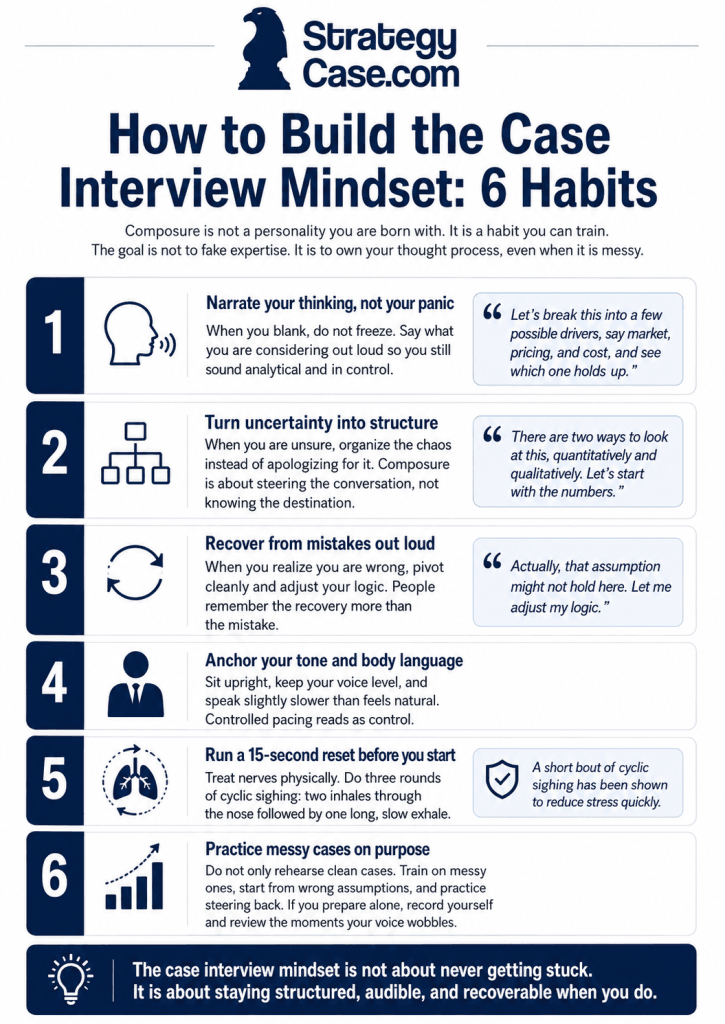
How to Build the Case Interview Mindset: 6 Habits
Composure is not a personality you are born with. It is a habit you can train. The goal is never to fake expertise. It is to own your thought process, even when it is messy.
1. Narrate your thinking, not your panic. When you blank, do not freeze or mutter “I don’t know.” Say what you are considering out loud:
“Let’s break this into a few possible drivers, say market, pricing, and cost, and see which one holds up.”
Even if it is imperfect, you sound analytical and in charge.
2. Turn uncertainty into structure. When you are unsure, organize the chaos instead of apologizing for it:
“There are two ways to look at this, quantitatively and qualitatively. Let’s start with the numbers.”
Composure is about steering the conversation, not knowing the destination.
3. Recover from mistakes out loud. When you realize you are wrong, do not flinch. Pivot:
“Actually, that assumption might not hold here. Let me adjust my logic.”
Consultants do this in client meetings constantly. Nobody remembers that you were wrong. They remember that you recovered cleanly.
4. Anchor your tone and body language. Sit upright, keep your voice level, and speak slightly slower than feels natural. Fast, clipped talking reads as self-doubt. Controlled pacing reads as control, even while you improvise.
5. Run a 15-second reset before you start. Nerves are physical, so treat them physically. Stanford researchers found that a short bout of “cyclic sighing”, two inhales through the nose followed by a long, slow exhale, lowered stress and calmed people faster than meditation. Do three rounds in the hallway before you walk in.
6. Practice messy cases on purpose. Do not only rehearse the clean ones. Run timed drills where you deliberately start from a wrong assumption and practice steering back. If you are preparing on your own, record yourself and watch for the moment your voice wobbles. That moment is the skill you are training.
Structure is the signal. Composure is the amplifier. Confidence without structure just makes the noise louder.
When Your Mind Goes Blank: A 3-Step Recovery
Every candidate freezes at some point. The blank is not the problem. Freezing and apologizing is. Here is a recovery you can run in real time.
- Buy time honestly. Say, “Let me take a moment to structure my thinking.” Silence is allowed. Narrated silence reads as control, not weakness.
- Zoom out to the objective. Restate the question and the goal in one sentence. Reconnecting to what you are actually solving usually shakes something loose.
- Rebuild one branch. Pick a single driver, any reasonable one, and reason forward from it out loud. Momentum returns the instant you are moving again.
The candidate who survives a tough case is not the one who never blanks. It is the one who has a calm, rehearsed way back.
The Mindset That Outlasts the Interview
Here is the part no one tells you: this mindset is not just for interviews. It is how the job actually works.
As a junior consultant, you will be dropped into meetings you barely understand, asked to “add a few thoughts” in front of a client you met ten minutes ago, or sent to cover for a manager who got pulled onto another call. You will nod, take notes, and contribute something coherent while part of your brain quietly asks, what are we even talking about?
That is normal, and firms expect you to handle it well. They want you to project calm, ask sharp questions, and add something useful even when you do not yet have the full picture. Consultants do not always know the answer. They stay structured and composed while they find it. Composure fills the gap between what you know and what you can work out, and it buys your thinking time to catch up.
That is exactly why the case interview mindset is worth training deliberately, and it is the layer we drill inside the Case Interview Academy right next to the hard skills. Master structure and composure together, and you stop sounding like a candidate hoping to pass. You start sounding like someone who already does the job.
Frequently Asked Questions About the Case Interview Mindset
Does confidence really matter more than getting the case right?
Not more, but alongside. Interviewers score both structure and delivery, and a confident candidate who recovers from a wrong turn usually beats a nervous one who whispers the right answer. The catch is that confidence with no structure behind it gets exposed fast. Build the logic first, then deliver it with conviction.
How do I stay calm if I get nervous in a case interview?
Treat nerves as physical. Run three rounds of slow, exhale-focused breathing before you walk in to lower your arousal, then slow your speaking pace on purpose during the case. Narrate your reasoning out loud so your attention stays on the problem instead of on the fear.
What should I do if my mind goes blank during a case?
Say “let me take a moment to structure my thinking,” restate the objective in one sentence, then pick a single driver and reason forward from it. Narrated silence reads as control. Freezing and apologizing is what actually costs you points.
How do I recover after making a mistake in the middle of a case?
Name it and pivot without flinching: “Actually, that assumption might not hold. Let me adjust.” Do not over-apologize or spiral. Interviewers expect wrong turns; they are watching whether you catch and correct them the way you would in a real client meeting.
Can you fake confidence in a case interview?
You can fake the surface for about a minute, but not the substance. Trained interviewers separate presence from real problem-solving on the follow-up questions. The durable move is not faking confidence, it is building genuine composure through practice so the calm is real.
How long does it take to build the case interview mindset?
Most candidates see a clear shift within three to four weeks of deliberate practice, provided they drill composure and not just frameworks. Recording your mock cases and practicing recovery from deliberate mistakes accelerates it more than simply doing a higher volume of cases.
Related Guides
- Perfectionism in case interviews: why chasing the perfect answer backfires, and how to trade it for progress.
- What makes candidates succeed in case interviews: the factors that actually separate offers from rejections.
- Mastering note-taking in case interviews: stay organized on paper so your structure holds when the pressure spikes.
The Bottom Line
Case mastery is equal parts structure and composure. You can deliver the best framework ever built, but if you sound unsure while using it, you will rarely get past “thank you, we’ll be in touch.” And you can carry a shaky structure a surprisingly long way if you stay calm, steer the conversation, and recover cleanly when you slip.
So train both. Build the structure until it is second nature, then practice delivering it under pressure until the calm is real, not performed. The case interview mindset is not about looking like you know everything. It is about proving you can stay clear-headed while you figure it out, which is the entire job.
If you want to build the hard skills and the composure that carries them in one place, start with the StrategyCase Case Interview Academy.
About the author: Florian Smeritschnig is a former McKinsey Senior Consultant and the founder of StrategyCase.com. He spent five years at McKinsey evaluating real candidates, has delivered 2,200+ mock interviews and coaching sessions, and has helped 700+ candidates land offers at McKinsey, BCG, Bain, and other top firms.
