

By Florian Smeritschnig, Former McKinsey Senior Consultant. Updated July 8, 2026.
How to practice case interviews alone? Does it even make sense?
The short answer is yes. But, it depends on the how.
Most candidates who practice case interviews alone get worse, not better. They grind 40 cases in their bedroom, repeat the same broken structure every time, and walk in having rehearsed their mistakes until they are automatic.
Solo prep is not the problem. Unstructured solo prep is. And isolated solo prep is. You can practice case interviews alone and build real skill, as long as you create a feedback loop that catches errors before they harden. At the same time, you need to combine it with peer practice to be effective.
After evaluating candidates at McKinsey and running 2,200+ coaching sessions through StrategyCase and PrepLounge, here is exactly what you can build by yourself, how to grade your own work, and the live reps you still cannot skip.
Key Takeaways
- You can build most technical case skills alone: structuring, case math, chart reading, and market sizing all improve with focused solo drills.
- Solo practice only works with a feedback loop. Record every case, play it back, and score it against a fixed rubric, or you will groove your mistakes.
- You cannot replace live cases entirely. Most candidates who land MBB offers do 20 to 30 live cases for real-time pressure and unscripted feedback.
- Do drills on your own and save partner and coach time for full cases. That split is faster and cheaper than trading two-hour sessions.
- AI case tools help with reps and talking out loud, but they cannot judge business insight, so treat them as a drill partner, not a coach.
Can You Prepare for Case Interviews Alone?
Yes. You can prepare for case interviews alone for every skill that has a clear right answer or a repeatable technique. Structuring, case math, chart interpretation, market sizing, and out-loud communication all improve through solo repetition, because you can check your work against a model answer or a recording.
What you cannot fully replicate alone is the live, unscripted case: an interviewer who interrupts, pushes back, changes the data, and reads your composure under real pressure. In my experience across 2,200+ sessions, most candidates who receive offers from McKinsey, BCG, or Bain complete 20 to 30 live cases before interview day.
Solo work is what makes each of those live cases count.
So the honest answer is a split. Use solo practice to build and sharpen skills. Use a small number of live cases to test them under fire. Candidates who do only one or the other tend to stall.
The Hidden Risk of Practicing Cases Alone
Here is what nobody tells you: practice does not make perfect. Practice makes permanent. Every time you solve a case the wrong way with no one to correct you, you teach your brain that the wrong way is normal.
This is the core of why so much case prep fails. Candidates confuse volume with progress. They track how many cases they have done instead of whether each case was better than the last. I have watched candidates arrive at coaching having done 60 cases on their own, every one of them reinforcing the same habit of jumping into analysis before structuring the problem.
I wrote more about this gap in why so much case preparation misses the mark.
The fix is not fewer solo cases. The fix is a feedback loop.
When you practice alone, you play three roles at once: candidate, interviewer, and coach. Most people only play the first. The methods below show you how to play all three, so your solo reps build skill instead of cementing errors.
What You Can and Cannot Build Alone
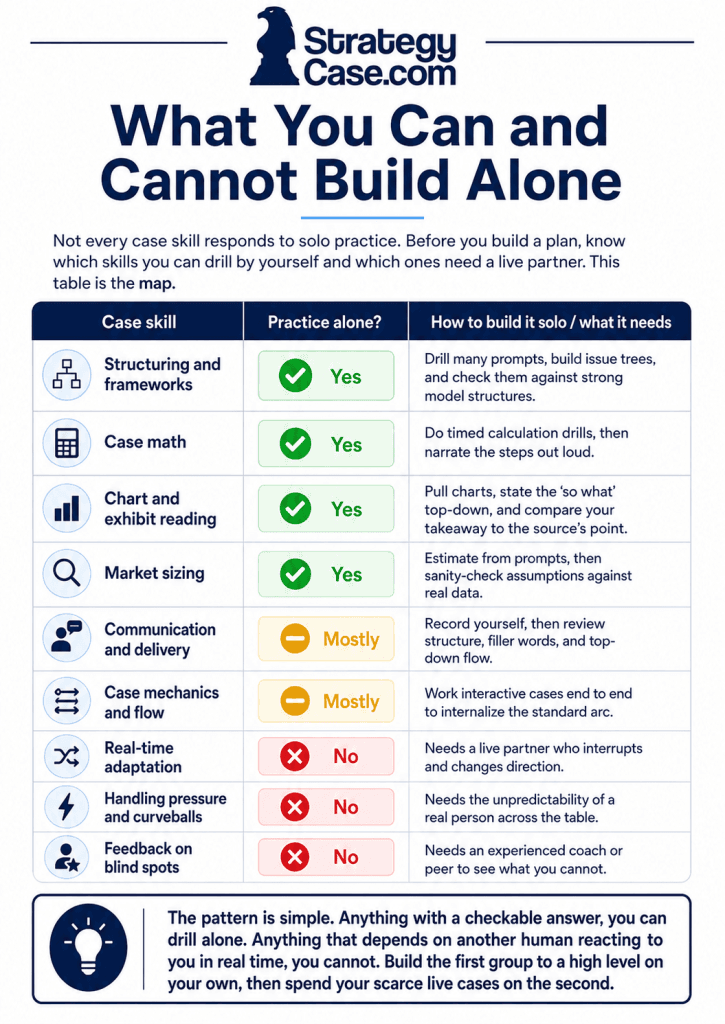
Not every case skill responds to solo practice. Before you build a plan, know which skills you can drill by yourself and which ones need a live partner. This table is the map.
| Case skill | Practice alone? | How to build it solo |
|---|---|---|
| Structuring and frameworks | Yes | Drill many prompts, build issue trees, check against model structures |
| Case math | Yes | Timed calculation drills, then narrate the steps out loud |
| Chart and exhibit reading | Yes | Pull charts, state the “so what” top-down, compare to the source’s point |
| Market sizing | Yes | Estimate from prompts, then sanity-check assumptions against real data |
| Communication and delivery | Mostly | Record yourself, review for structure, filler words, and top-down flow |
| Case mechanics and flow | Mostly | Work interactive cases end to end to internalize the standard arc |
| Real-time adaptation | No | Needs a live partner who interrupts and changes direction |
| Handling pressure and curveballs | No | Needs the unpredictability of a real person across the table |
| Feedback on blind spots | No | Needs an experienced coach or peer to see what you cannot |
The pattern is simple. Anything with a checkable answer, you can drill alone. Anything that depends on another human reacting to you in real time, you cannot. Learn the theory and build the first group to a high level on your own, then spend your scarce live cases on the second.
How to Practice Case Interviews Alone: 6 Methods That Work
These are the solo methods I give coaching candidates who cannot find quality partners, or who want to get more out of the partners they have. Do them in order. The first one is non-negotiable.
1. Learn the Fundamentals Before You Drill
You cannot practice your way out of not knowing the material. If you drill structuring before you understand what a strong structure looks like and how to thing about it the right way, you will only get faster at being wrong.
Start by learning the mechanics of each case type and skill. Our complete guide to case interviews covers the full picture, and the case interview frameworks guide shows you how to build structures from first principles instead of memorizing templates. Get the theory right first. Then every solo rep reinforces something correct.
2. Drill One Skill at a Time
The biggest advantage of solo practice is focus. A full mock case with a partner touches structuring, math, and charts once each and eats an hour. On your own, you can do 15 structuring prompts back to back and actually get good at structuring.
Break the case into its parts and attack them separately:
- Structuring: build issue trees for 10 to 15 prompts in a row. Our StrategyCase structuring and brainstorming drills are built for exactly this.
- Math: run timed case interview math problems, then say the steps out loud as if walking an interviewer through them.
- Charts: practice reading exhibits and leading with the insight, using our guide on how to interpret charts and data.
- Market sizing: estimate, then pressure-test your assumptions against real numbers with our market sizing guide.
This is quality over quantity in practice. 10 focused structuring reps beat three scattered full cases.
3. Work Full Cases in Interactive and Q&A Formats
Drills build the parts. You still need to assemble them. Two formats let you run a complete case with no partner.
Interactive cases give you multiple-choice branches and model answers, so a form of feedback is built in. Firms publish these on their recruiting sites: BCG and Oliver Wyman both offer guided online cases that mimic the real flow. Casebooks from university consulting clubs work the same way, with a written prompt, exhibits, and a full solution to check against.
Treat every one as a live interview. Read the prompt once, take notes, structure, work the math, and deliver a recommendation out loud. Then compare your path to the model answer and mark where you diverged. You can also break these cases into pieces and drill each element on its own.
For a starting library, see our collection of real case examples from McKinsey and others.
4. Turn the News Into Case Prompts
Open the Economist or the Wall Street Journal, pick a headline, and turn it into a case. “Airline X is cutting 15% of routes” becomes a profitability or turnaround case. “Retailer Y is entering India” becomes a market entry case.
From the headline, generate the clarifying questions you would ask, build a structure using both breadth and depth, and talk through your analysis out loud. This trains the exact skill firms test: taking an ambiguous business situation and imposing structure on it.
It also has no answer key, which forces you to defend your own logic.
5. Flip to the Interviewer’s Seat
Take the same headline and switch roles. What would you ask if you were the interviewer? Write down the questions, the data you would hand over, and the traps you would set.
Seeing the case from the other side of the table is the fastest way to build intuition for where interviewers steer a case. When I evaluated candidates, the strongest ones understood exactly what I was testing at each step.
You can build that instinct alone by designing cases, not only solving them.
6. Practice Out Loud and Record Yourself
This is the single highest-return solo habit, and most candidates skip it. Talking through a case in your head is not practice. It hides every gap in your communication and lets you believe you were clearer than you were.
Record every solo case and drill on your phone, then play it back with a critical ear. Listen for filler words, structure that is not top-down, and moments where you lost the thread.
In 2,200+ coaching sessions, the clearest jump I see comes when candidates stop thinking silently and start speaking and reviewing the tape. The recording is your stand-in interviewer.
Can You Practice Case Interviews With AI?
Yes, and in 2026 it is worth doing, but only if you understand what AI can and cannot judge. AI case tools are a genuinely useful drill partner. They generate endless prompts, run you through a case at any hour, and give instant feedback on whether your math is right or your structure is roughly MECE. For reps, and for forcing yourself to talk out loud, they beat practicing in silence.
The limit is judgment. Current AI case simulators are trained on the same recycled, outdated case archetypes that already dominate the prep market, and they cannot reliably tell whether your insight was sharp or your synthesis actually answered the client’s question. They reward volume and surface structure, which is the trap that produces polished candidates who still get rejected.
Use AI the way you would use flashcards: strong for reps and mechanics, weak as a judge of quality. Do not let it replace live cases with real people, and do not let it convince you that 40 AI cases equal genuine readiness. Treat it as one more solo tool inside a real feedback loop, not the loop itself.
For on that, see our guide on how to use AI for case interview prep.
Grade Yourself Like an Interviewer: The Solo Case Scorecard
The reason solo practice usually fails is that people do not score it. They finish a case, think “that went fine,” and move on. Interviewers do the opposite: they rate you on specific dimensions. Copy them.
After every solo case, score yourself from 1 to 5 on each dimension below. Write the numbers down and track them over time. The goal is not a high score today. It is a rising trend.
| Dimension | What a 5 looks like | Common solo failure |
|---|---|---|
| Structure | MECE, tailored to the prompt, insight-led | Generic framework forced onto the case |
| Math | Fast, accurate, narrated clearly | Right answer, no explanation of the steps |
| Charts | Leads with the “so what,” ties back to the question | Describes the chart instead of interpreting it |
| Hypothesis | Forms an early view and tests it | Waits passively for the data to speak |
| Communication | Top-down, concise, signposted | Rambling, no headline, buries the answer |
| Synthesis | Crisp recommendation with reasons and risks | Summary of what happened, not a recommendation |
If you cannot honestly give yourself a 4 or 5 on a dimension, that is your next drill. This scorecard turns vague self-review into a targeted plan, and it is the closest thing to a coach you can build on your own.

You can download this case interview evaluation sheet here.
A Simple Weekly Plan to Practice Cases Alone
Structure beats motivation. Here is a one-week template that balances solo drills, full solo cases, and the live reps you still need. It is the same split we use with StrategyCase coaching candidates. Scale it up or down based on your timeline.
| Day | Focus | Time |
|---|---|---|
| Monday | Structuring drills (10 to 15 prompts) | 45 min |
| Tuesday | Case math drills, narrated out loud | 45 min |
| Wednesday | Full solo case, recorded and scored | 60 min |
| Thursday | Chart and market sizing drills | 45 min |
| Friday | Live case with a partner or coach | 60 min |
| Saturday | Full solo case, then review Friday’s recording | 75 min |
| Sunday | Rest, or review your scorecards for the week | 30 min |
Notice the split. Four of the seven sessions are solo, which is where you build raw skill efficiently. One is live, which is where you test it. If you can only get one live case a week, protect it and bring your sharpest solo-built skills to it. If you have a big weakness, replace a drill day with more of that weakness until the scorecard moves.
Do Not Forget the Fit Interview
Case skills get all the attention, but the fit interview decides just as many offers. The good news: fit is one of the most straightforward parts to practice alone.
Write out your core stories, then practice delivering them out loud using a structured format, and record yourself exactly as you would for cases. Our complete fit interview guide walks through how to build and tell stories that land, and the Fit Interview Masterclass gives you a full system if you want structured practice.
Solo fit prep is high-payoff, because the questions barely change and story (you prepare beforehand) and delivery are most of the score.
How to Practice Case Interviews Alone: FAQ
Can you prepare for case interviews by yourself?
Yes, for most technical skills. Structuring, math, chart reading, market sizing, and communication all improve through solo drills, especially when you record and score yourself. You still need a handful of live cases to practice real-time adaptation and pressure, so treat solo work as the foundation, not the whole plan.
How many practice cases do you need before a consulting interview?
It varies, but most candidates who land MBB offers do 20 to 30 live cases plus a much larger number of solo drills. Quality matters more than the count. 20 well-reviewed cases with real feedback beat 60 cases you never analyzed.
Can I practice case interviews with ChatGPT or other AI tools?
Yes, for reps and instant feedback on math and basic structure. AI is a solid drill partner and far better than practicing in silence. It cannot reliably judge business insight or synthesis, so do not let AI cases replace live practice with experienced people.
How do I get feedback on cases when I have no partner?
Build your own feedback loop. Record every case, play it back, and score it against a fixed rubric like the scorecard above. Compare your answers to model solutions in casebooks and interactive cases. For blind spots you cannot see yourself, book a small number of expert coaching sessions.
How long should a solo case practice session be?
Around 45 to 75 minutes. A full solo case runs 45 to 60 minutes including structuring, math, and a spoken recommendation, plus 10 to 15 minutes to review the recording. Skill drills can be shorter and more frequent, which is the main efficiency win of practicing alone.
Is practicing cases alone enough to get an offer?
On its own, usually not. Solo practice builds the skills, but firms test them in a live, adaptive setting, so you need real cases with people too. The winning combination is heavy solo skill-building plus 20 to 30 live cases where you get honest feedback.
Related Guides
- How long should you prepare for consulting interviews?
- How to be MECE in a case interview
- The McKinsey case interview guide
- Brainstorming in a case interview
Practice Smart, Then Break Into Consulting
The candidates who practice case interviews alone the right way are not doing a watered-down version of real prep. They build skills efficiently, then spend their scarce live cases where those cases matter most. Record every rep, score it against the rubric, and follow a weekly plan instead of chasing a case count.
If you would rather follow a proven system than build one from scratch, the StrategyCase Case Interview Academy gives you 14+ hours of video lessons and hundreds of modern, interview-level drills, all built by a former McKinsey consultant and top global case coach. Learn the right habits first. Then every solo rep works for you instead of against you.
About the author: Florian Smeritschnig is a former McKinsey Senior Consultant and the founder of StrategyCase.com. He spent 5 years at McKinsey, where he evaluated candidates, and has since delivered 2,200+ mock interviews and coaching sessions, helping 700+ candidates land offers at McKinsey, BCG, Bain, and other top firms.
