

By Florian Smeritschnig, former McKinsey Senior Consultant · Updated October 2026
The McKinsey application process runs through five stages: an online application with a CV screen, the McKinsey Solve assessment, first-round interviews (cases plus the Personal Experience Interviews), second-round partner interviews, and the offer. End to end it usually takes one to three months, and McKinsey accepts roughly 1% of applicants.
What sets McKinsey’s recruitment process apart is not an exotic set of steps. Like any consulting hiring process, it screens a CV, runs an assessment, and interviews. McKinsey just sets the bar higher at every stage and weighs personal fit (its PEI) as heavily as the case. Miss on any single step and a strong showing elsewhere will not save you.
I spent years at McKinsey, sat on the other side of the recruiting table, and at StrategyCase and other platforms like PrepLounge have coached 2,200+ sessions and hundreds of candidates through this exact funnel. This guide walks each stage in order: what happens, what McKinsey is actually testing, how long it takes, and where to go deep to prepare.
Key Takeaways
- Five stages: online application and CV screen, the Solve assessment, first-round interviews, second-round partner interviews, and the offer.
- Timeline: roughly 1 to 3 months end to end, though it varies by office and recruiting cycle.
- McKinsey weighs the Personal Experience Interview (PEI) as heavily as the case. Excelling at one does not offset a weak showing in the other.
- Acceptance is around 1%, so every stage is a hard filter, not a formality.
- The process is the same for Digital, Operations, and most roles; the case content shifts, and some technical and data roles add an extra assessment.
- Experienced hires often get a short “initial assessment call” before the first round.
The McKinsey Application Process at a Glance
Here is the whole generalist funnel in one place. Each stage links to the dedicated guide for going deep.
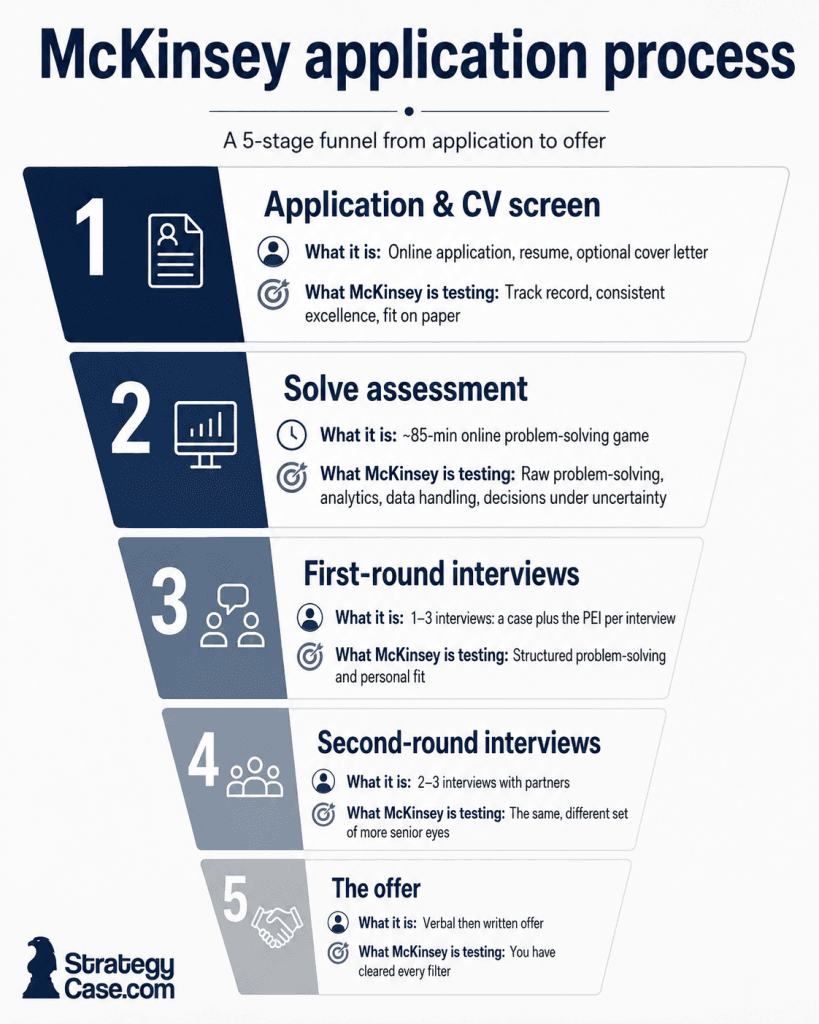
The rest of this guide takes each stage in turn.
Step 1: The Online Application, CV, and Cover Letter
Everything starts with the online application and a resume screen. The cover letter is optional in most McKinsey offices, but a strong one can help, especially if your CV needs context.
A McKinsey screener spends about 30 seconds on your resume and is scanning for one thing: a pattern of consistent excellence. Not a single highlight, but a track record of rising to the top across whatever you have done. They read four areas:
- Academics. Strong grades from a respected program, ideally with demanding coursework or research.
- Work experience. Impact, leadership, and results you can quantify, in any industry.
- Extracurriculars. Leadership and commitment outside work or study, which signal drive and balance.
- International exposure. Study, work, or volunteering abroad, which signals adaptability for a global firm.
A referral from a current consultant is the single highest-return thing you can attach here; it gets your CV read properly rather than filtered on volume. For the detail on each document, see the consulting resume guide, the cover letter guide, and the consulting networking guide. If you want a screener’s eyes on your materials, the StrategyCase team offers a McKinsey-tailored resume and cover letter review.
In some offices, a short HR phone screen follows the CV stage. It is usually logistical (confirming eligibility and motivation), occasionally touching on basic fit or even a quick case. Treat it as evaluative to be safe; the McKinsey phone interview guide covers it.
Step 2: The McKinsey Solve Assessment
If your application clears the screen, you are invited to Solve, McKinsey’s gamified online assessment (formerly the Problem Solving Game / Imbellus). It runs about 95 minutes and tests how you think rather than what you know, so no business knowledge is required. All candidates now take it.
Solve is built from interactive modules. The ones candidates report in 2026:
- Red Rock Study (~35 min): structured research in an ecology scenario, pulling insights from text, charts, and tables and doing the quantitative work to answer targeted questions.
- Sea Wolf (~30 min): an ocean-cleanup simulation testing decision-making under uncertainty, resource allocation, and iterative strategy.
- Sustainable Future Lab (~30 min): a newer behavioral, decision-focused module that drops you into team scenarios and scores how you act, not just how you calculate.
McKinsey tweaks Solve continually to keep it resistant to rote prep, so practice the underlying skills (fast data interpretation, structured decisions, clean math) rather than memorizing one version. Full breakdown and playable simulations are in the McKinsey Solve guide. We have been tracking this assessment since it’s launch in London in 2019 and consistenly update our guidance and simulations.
Step 3: First-Round Interviews (Case + PEI)
Clearing Solve gets you to the first interview round: typically 1 to 3 interviews, each conducted by a consultant from Associate to Associate Partner level. Each interview has three parts:
- Personal Experience Interview (PEI), ~20 min: structured stories about your past, mapped to McKinsey’s fit dimensions.
- Case interview, ~25–30 min: a live business problem testing your structured problem-solving.
- Your questions, ~5 min: your chance to engage the interviewer.
McKinsey weighs the case and the PEI equally. This is the most common thing candidates get wrong: they pour 90% of their prep into cases and treat the PEI as a warm-up. As a former McKinsey, I saw strong problem-solvers rejected on fit again and again.
The PEI explores four dimensions (renamed by McKinsey in 2025). Prepare two stories for each:
- Drive (entrepreneurial drive): initiative, building something, pushing through.
- Connection (personal impact): persuading and influencing others.
- Leadership (inclusive leadership): leading teams through challenges.
- Growth (courageous change): resilience and adapting through change.
The McKinsey PEI guide covers how to build these stories, and the SCORE framework is the structure to use.
The case is interviewer-led: McKinsey drives the questions while you structure the problem, interpret exhibits, do the math, and form a hypothesis-driven recommendation. The full method is in the McKinsey case interview guide, and the Case Interview Academy trains you to the firm’s bar.
One newer wrinkle: in 2026 McKinsey is piloting a non-evaluative AI interview in some US offices, where you work live with its internal tool, Lilli, on a realistic task. It does not replace the case or PEI; it observes how you frame, critique, and synthesize with AI as a junior teammate. More in the McKinsey AI interview guide.
Step 4: Second-Round (Partner) Interviews
The second round is 2 to 3 interviews led by Partners and Senior Partners. The format mirrors the first round (case plus PEI). Partners probe your judgment, presence, and the weaker spots from round one, while confirming your strengths.
Two practical notes. First, partners occasionally fold a quick estimation question into the case (the classic “how many ambulances are in this country” type). They are rare, but practice market sizing so one does not catch you off guard. Second, whether you can reuse PEI stories from round one varies by office, so check with your local HR. The final-round and partner interview guide covers the differences.
If you are applying for an internship, the process usually ends after the first round; only full-time candidates go to the second round.
Step 5: The Offer, and How Long It All Takes
Clear the second round and the offer follows, usually a verbal yes within days, then a written offer. McKinsey rarely negotiates base pay (if ever), but it is worth understanding the full package against the McKinsey salary bands.
The question almost every candidate asks is how long the whole thing takes and how long McKinsey takes to respond at each step. It varies by office and recruiting cycle, but here is the realistic shape.
| Stage | Typical wait or duration |
|---|---|
| Response to your application | 1–4 weeks (longer in peak cycles and recent years) |
| Solve invitation and results | Invited within days to weeks of passing the screen; results in about 1–2 weeks (3-7 days to take it from date of invite) |
| First round scheduled | Within 1–3 weeks of clearing Solve |
| First-round decision | A few days to a week (sometimes same day) |
| Second round | Within 1–3 weeks of the first round |
| Final decision and offer | Often within days of the final round (sometimes same day) |
| End to end | Typically 1 to 3 months |
If you go quiet for a few weeks, that is normal, not a rejection; volumes and partner schedules drive the pace. If you are dinged, it is not the end: McKinsey openly welcomes re-applicants, and strong candidates are sometimes invited into the Keep in Touch program. Just mind any re-application waiting period and come back with something new to show.
When to apply. McKinsey recruits experienced hires year-round, but campus and MBA hiring runs on cycles. Most full-time applications open in the late summer and autumn (roughly August to October in many regions) for roles starting the following year, with internship deadlines a little earlier. Apply as early in your target cycle as you can: some offices review on a rolling basis and fill spots before the stated deadline, so being early is a real edge.
How the Process Differs by Role
The five-stage funnel above is the generalist path. Most other McKinsey roles use the same structure with small additions:
- Digital and Implementation consulting: identical format; the cases just lean toward digital, operations, or public-sector themes. Prepare the fundamentals, not theme-specific cases.
- Data Science (McKinsey Digital): adds a QuantHub assessment (statistics, R, and Python) before the interviews, then a data-heavy case in the rounds.
- Operations, Implementation, and Orphoz: the same McKinsey process; Orphoz, McKinsey’s implementation arm, runs Solve, case, and PEI just like the core firm.
- Experienced hires: often a short initial assessment call (~20 min, a streamlined case testing structuring and math) before the first round. The experienced-hire guide covers entry levels and the lateral process.
- Technical roles (engineers, designers, analytics): add a Technical Expertise Interview (TEI) tailored to the domain. Generalist consulting candidates do not face the TEI; details in the TEI guide.
McKinsey vs BCG and Bain: How the Process Differs
The three firms run similar funnels, but BCG and Bain differ from McKinsey in a few ways that change how you prepare. For the broader firm comparison, see the Big 3 consulting firms guide.
| Aspect | McKinsey | BCG & Bain |
|---|---|---|
| Cover letter | Optional in most offices | Often expected, with motivation emphasized |
| Assessment | Solve (problem-solving game) | BCG and Bain use their own online tests and case-based assessments |
| Case format | Interviewer-led (McKinsey drives) | More candidate-led (you drive the case). Bain has moved more towards interviewer-led cases in recent years |
| Fit interview | Structured PEI stories | A more traditional fit conversation, not PEI-format |
The headline: McKinsey is interviewer-led with a heavily structured PEI, while BCG and Bain expect you to drive the case more and run a looser fit interview.
How Hard Is It to Get Into McKinsey?
Hard. McKinsey accepts roughly 1% of applicants, and the bar is high at every stage, which is why each step is a genuine filter rather than a checkbox. But “hard” is not “random.” The candidates who get offers are not the ones with the most impressive CV; they are the ones who prepared deliberately for every stage, especially the PEI, which most people underrate.
The process rewards structured preparation, and that is something you control. For where you stand and what would move the needle, the how to get into consulting guide is the place to start.
FAQ: The McKinsey Application Process
How long does the McKinsey application process take?
Roughly 1 to 3 months from application to offer, though it varies by office and recruiting cycle. Expect 1 to 4 weeks for a response to your application, then Solve, two interview rounds spaced 1 to 3 weeks apart, and an offer within days of the final round.
How long does McKinsey take to respond after I apply or after Solve?
Usually 1 to 4 weeks after the application, and about 1 to 2 weeks after Solve, with longer gaps during peak recruiting cycles. Silence for a few weeks is normal and is not a rejection; application volumes and interviewer schedules drive the timing.
Do all McKinsey applicants take the Solve assessment?
Nearly all do. Solve is now a standard step in most offices and roles after the CV screen. Some experienced-hire or specialized processes vary, but the typical generalist candidate should expect to take it.
How hard is it to get a job at McKinsey?
Very. McKinsey accepts about 1% of applicants and sets a high bar at the CV screen, Solve, and both interview rounds. The differentiator is preparation: structured, deliberate practice for the case and the PEI is what separates offers from rejections.
Does McKinsey weigh the case or the personal fit interview more?
Equally. A strong case does not offset a weak PEI, or vice versa. McKinsey screens for both structured problem-solving and personal fit, and underpreparing the PEI is the single most common reason otherwise-strong candidates miss.
When do McKinsey applications open?
McKinsey recruits experienced hires year-round, while campus and MBA full-time applications typically open in late summer and autumn (around August to October in many regions) for the next year’s intake, with internships a little earlier. Exact dates vary by office and program, and some offices review on a rolling basis, so apply early.
Can you reapply to McKinsey after a rejection?
Yes. McKinsey welcomes re-applicants and views growth positively. Reflect on any feedback, add something new since your last attempt, mind any re-application waiting period, and note that strong candidates are sometimes invited into the Keep in Touch program.
Related Guides
- How to get into consulting: the application and recruiting pillar that sits above this guide.
- McKinsey case interview: the deep guide to the interview that decides half your score.
- McKinsey PEI: how to build the personal-fit stories McKinsey scores.
- McKinsey Solve guide: the assessment, broken down, with playable simulations.
The Bottom Line
The McKinsey application process is not mysterious; it is a five-stage filter, each step harder than most candidates expect. The people who get offers treat every stage as a real hurdle, especially the PEI, and prepare for the case to McKinsey’s actual standard rather than a generic one.
That is what StrategyCase is built to do. The Case Interview Academy and Fit Interview Masterclass were created by former McKinsey interviewers to take you to the firm’s bar, and 1-on-1 coaching with Florian gives you feedback calibrated to exactly where you are in the funnel.
Map the process, prepare each stage deliberately, and the 1% is within reach. Book a free StrategyCase consultation and we will assess your profile and build your McKinsey preparation plan.

2 Responses
Dear Florian,
Thank you so much for providing the insightful blog! I have a question about the application timeline, however. I completed the problem-solving game over 2 weeks ago, and think I did pretty well (all animal survive and the plant survived longer than 15 moves). However, I haven’t heard from McKinsey since. I wonder usually how long does it take to hear from the recruiters after the game? At this point, in your experience, should I move on and assume I wasn’t selected for the interview? I’d really appreciate any insight!
Tina
Dear Tina,
It depends on the office. Most candidates hear back within 2 weeks, however, sometimes it can take up to one month. I would not worry too much at this stage and focus on the case interview and PEI preparation. Fingers crossed! Cheers, Florian