

By Dr. Florian Smeritschnig, former McKinsey Senior Consultant · Updated October 16, 2026
Apply to the BCG office where you speak the local language, have a real connection, and bring experience its clients need, not the one with the most famous skyline. BCG offices sit in 100+ cities in more than 50 countries, and BCG’s careers pages spell out how office choice works. You set a first and second office preference, students can hold up to four open applications, and only one office can move your application forward.
Most candidates choose by where they want to live. They put New York or London first, add a second city that has nothing to do with the first, and hope. If the resume screen says no, they rarely learn whether the office choice played a part.
I spent 5 years at McKinsey, and left as a Senior Consultant. I never worked at BCG, so every BCG rule in this guide comes from BCG’s own careers pages and office directory, checked on October 16, 2026. What I add is the consulting career advisor’s read on how an office choice looks from the other side of the table. I also draw on what I’ve seen since founding StrategyCase in 2020, coaching candidates into BCG offices across the globe.
This guide puts the decision first. The full 2026 list of BCG office locations by region follows after that.
Key Takeaways
- BCG has offices in 100+ cities in more than 50 countries, grouped into six regions, plus specialist units such as BCG X and BCG Platinion.
- You set a first and second office preference in your BCG profile. Students can hold up to four open applications, experienced hires should apply to one role at a time, and only one office can move your application forward.
- Language is the hardest filter. Outside English-speaking offices, BCG expects the local language in almost all cases: German for Germany and Austria, French for Paris, Spanish for Spain. The US, UK, Middle East, Singapore, Nordic, and Australian offices list English only.
- The “easiest” BCG office is the one where you clear the filters most applicants fail: the language, the work rights, a real tie to the country, or experience in the industries the office serves.
- Moving an accepted offer to another office is rare and usually means restarting the process. Apply where you want to start.
How BCG Office Selection Works: 2 Preferences, Up to 4 Applications, 1 Office
BCG office selection: the part of BCG’s application where you choose the office or country posting you apply to and rank a first and second office preference in your candidate profile. Students can hold up to four open applications. Every office you applied to can see your application, but only one can take it forward, in the order you ranked them.
BCG publishes these rules across its careers FAQ, its guide for international applicants, and its US Associate recruiting page. Few candidates read all three. Here is what each rule means for you:
| Rule | What BCG says | What it means for you |
|---|---|---|
| Applications | Each office or country posting has its own application. Students and recent graduates can hold up to four at once, and BCG’s UK team recommends three. Experienced hires should apply to one role at a time | More applications help only if they share one story |
| Preferences | Your profile holds a first and second office preference. Every application must match it, and BCG asks you not to change it between applications | You set your ranking once per cycle |
| Review order | Every office you applied to can see your application, but only one can move it forward, in the order of your ranking | Your first preference gets the first look |
| Interviews | You can interview for only one consulting role at a time. BCG London withdraws your application if you accept an interview elsewhere before it decides | No parallel processes in two cities |
| Regions | If you apply across regions, BCG advises at most two location preferences | Two continents rarely add up to one plan |
| Language | Outside English-speaking offices, fluency in the local language in almost all cases. The posting states it | Language decides eligibility before fit |
| Reapplying | Wait about a year after a rejection. A rejection by London doesn’t stop another office from considering you | A no from one office isn’t a no from BCG |
| Offer transfers | Moving an accepted offer to another office is rare and usually means restarting the process | Pick the office you want to start in |
In several countries, one posting covers a whole group of offices. BCG’s US postings for MBA and advanced-degree candidates list 22 locations, and its Germany and Austria posting covers all eight offices in those two countries. Your preferences decide which office inside that group reviews you, and once you join, that office becomes your home office. In the US, BCG’s postings also require you to live within a reasonable commuting distance of it.
Same Criteria, Different Odds: Why Your BCG Office Choice Matters
BCG publishes one set of interview criteria for consulting roles worldwide: integrity, intellectual curiosity, creative thinking, a collaborative mindset, and drive, according to its interview process page. The case and the fit questions test the same skills in Chicago and in Munich.
What changes between offices is supply and demand. A candidate strong enough for one office can miss in another, because three things differ:
- Applicants per seat. BCG itself calls London and New York large regional hubs. Famous offices draw the biggest applicant pools, so more strong profiles chase each offer.
- Hard filters. BCG requires the local language across most of continental Europe, Latin America, and North Asia. Its Nordic, Dutch, and Swiss offices also want a clear connection to the country. Every filter shrinks the pool for the people who clear it.
- What the office sells. Each BCG office page lists its own industry mix. Houston names energy and oil and gas, and Detroit names automotive. Bring that background to the matching office and you look like an obvious hire.
From the advisor’s side, an office choice reads as a signal before you solve a single case. Two cities with nothing in common read as “any offer will do.” Two offices that match your background, language, or industry read as a plan. BCG’s advice to international applicants points the same way: decide where you genuinely want to live and work, and which geographies fit your industry interests.
How to Choose a BCG Office: 4 Questions to Answer in Order
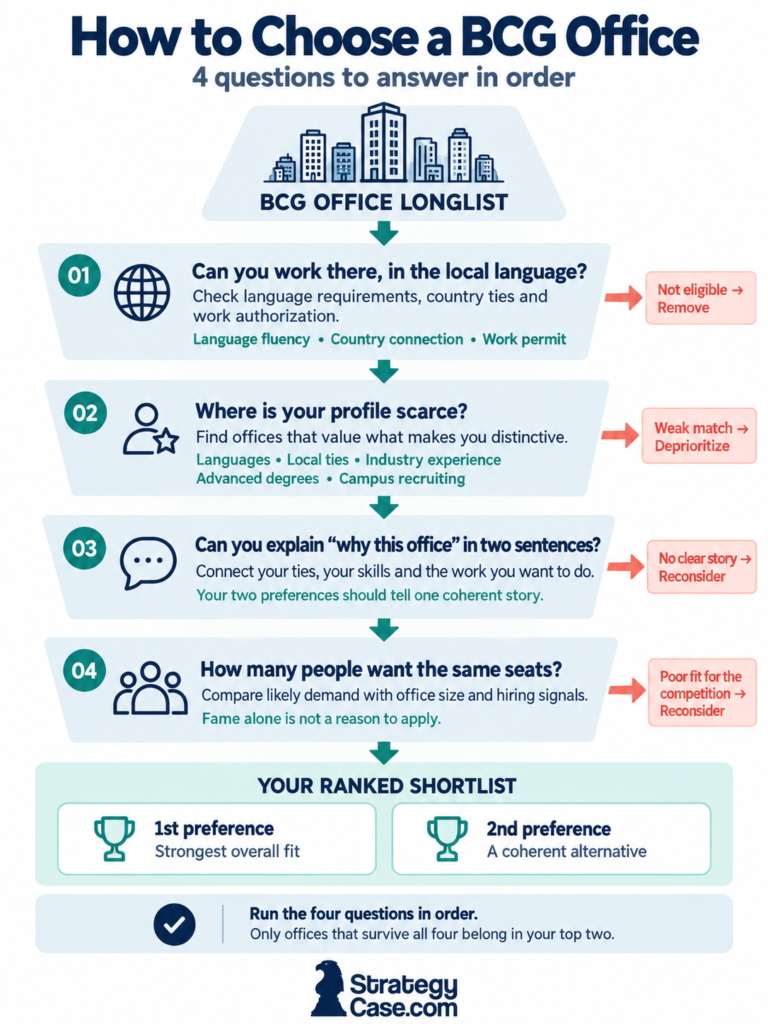
1. Can you work there, in the local language?
Start with eligibility, because no story beats a hard filter. BCG tells international applicants that a successful application starts with an office where you can discuss business fluently, and it publishes the language each office needs:
| BCG’s language rule | Offices |
|---|---|
| English only | All US offices, London, Toronto, Calgary, the Middle East offices, Singapore, Jakarta, Kuala Lumpur, Manila, Ho Chi Minh City, Australia, New Zealand, Copenhagen, Helsinki, Oslo, Stockholm, Tel Aviv, Johannesburg, Lagos, Nairobi |
| Local language recommended | Amsterdam (Dutch), Athens (Greek), Bangkok (Thai), Cairo (Arabic), Geneva (French), Zurich (German), India (Indian languages), Japan (Japanese) |
| Local language required | Germany and Austria (German), Paris, Casablanca, and Montreal (French), Spain, Mexico, Bogotá, Buenos Aires, Lima, and Santiago (Spanish), Brazil and Lisbon (Portuguese), Italy (Italian), Brussels (Dutch or French), Prague (Czech or Slovak), Warsaw (Polish), Budapest (Hungarian or another regional language), Istanbul (Turkish), Seoul (Korean), mainland China and Taipei (Mandarin), Hong Kong (Mandarin, Cantonese preferred), Almaty, Baku, and Tashkent (Russian, local language preferred) |
Where BCG names a level, the bar is high: German at C1 for Germany and Austria, and C2, the top level of the European language scale, for French in Paris, Spanish in Spain, Italian in Italy, and Mandarin in Greater China. Paris also asks for at least one professional experience in French.
Two more filters sit next to language:
- A clear connection to the country. BCG’s Nordic, Dutch, and Swiss offices treat English as enough, but each asks for a clear connection to the country. Without one, the English-only label won’t carry you.
- Work authorization. BCG helps employees get work permits, but the government decides, and BCG can’t promise approval. The UK’s Skilled Worker visa needs a certificate of sponsorship from a Home Office-approved employer. Singapore’s Employment Pass applies a qualifying salary and then the points-based COMPASS framework. Some US federal work requires a security clearance, and under Executive Order 12968, eligibility for access goes only to US citizens, with narrow exceptions.
2. Where is your profile scarce?
List what makes you unusual in BCG’s applicant pool, then find the office that needs it:
- A language beyond English. BCG’s list turns this into a map. Fluent German opens eight offices, Spanish opens eight more, and Mandarin opens all of Greater China.
- A real tie to a place. Family, roots, or years lived there count most where BCG asks for a clear connection: the Nordics, the Netherlands, and Switzerland.
- Industry experience that matches the office. BCG’s Houston page names energy and oil and gas, Detroit names automotive, and Seattle names industrial goods and technology. Stuttgart’s page calls the city a stronghold of the automotive industry.
- An advanced degree. BCG runs a separate US track for PhDs, MDs, JDs, postdocs, and physicians. In London, a PhD or medical degree puts you in line for Senior Associate.
- A campus pipeline. BCG recruits actively at some schools and not at others. Our MBB target schools list shows where BCG recruits, and an office that already hires from your program knows how to read your resume.
3. Can you explain “why this office” in two sentences?
Expect the question from a recruiter, in a coffee chat, or in the BCG fit interview. “I’d love to live in Munich” is a preference. A real answer links your ties to the place, the skills you bring to its clients, and the work you want to do there.
Your two preferences should tell the same story. BCG makes that easier than it sounds, because some offices already work as one team. The Bay Area offices run staffing and career development jointly, often with BCG’s other West Coast offices, and BCG describes Houston as part of a Southwest System. A second preference inside the same group reads as one plan. A second preference on another continent reads as two.
4. How many people want the same seats?
The famous offices attract the biggest pools. That doesn’t make them wrong for you, but it raises the price of a weak “why this office” answer.
BCG describes the trade-off itself. Large regional hubs like London and New York offer a breadth of practice areas, and smaller offices can offer a tight-knit environment and faster visibility. BCG doesn’t publish headcount for most offices, though several office pages give a number or a rank (see the FAQ below). For the rest, filter LinkedIn for current BCG associates and consultants in each city and compare. It’s rough, but it beats a number copied from a forum.
How to Rank Your Two BCG Office Preferences
BCG publishes the rules, not how recruiters weigh your ranking beyond the review order. Treat this as my rule of thumb, not a formula:
| Your situation | A sensible ranking | Why |
|---|---|---|
| One office fits on all four questions | That office first, its closest sister office second | Your first choice reviews you first, and the second keeps one story |
| Two offices in your home region fit equally | The office with your stronger “why” first | Only one office moves you forward, so lead with your best case |
| One US office plus one office abroad | Your real first choice first, and file both the US and the international application | BCG requires both applications when a preference sits outside the US |
| Fluent German speaker targeting Germany or Austria | Your DACH office first | One application covers all eight offices, and the C1 German rule shrinks the pool |
| An office where you lack the language or a realistic visa route | Leave it off | BCG expects the local language in almost all cases |
Three rankings I would talk any candidate out of:
- Two unrelated hubs. New York first and Singapore second tells BCG you have no plan. BCG already advises at most two location preferences across regions, and those two should connect.
- A famous office first “to try your luck.” Your first preference gets the first look, and you can interview for only one consulting role at a time. If your real fit is Atlanta, ranking New York first spends your first review where your story is weakest.
- A ranking built on a planned transfer. BCG says moving an accepted offer to another office is rare and usually means starting over. Rank the office you want to start in.
Which BCG Office Is Easiest to Get Into?
No BCG office advertises a lower bar. The interview criteria are the same everywhere, so the case is as demanding in Nashville as in New York. The easiest BCG office for you is the one where few applicants clear the same filters you do.
In practice, that means four patterns:
- Local-language offices, if you speak the language natively. BCG requires German at C1 for its eight offices in Germany and Austria, so a native speaker competes only with other fluent German speakers. In London, the same candidate competes with applicants from across Europe and beyond.
- Regional offices in your own country. New York and London draw the largest applicant pools in their regions. In October 2026, BCG’s US posting for experienced-hire consultants listed seven offices, none of them New York or the Bay Area: Atlanta, Chicago, Detroit, Miami, Minneapolis, Nashville, and Raleigh-Durham.
- Offices whose core industry is your industry. An energy background makes you immediately useful in Houston, and an automotive background does the same in Detroit or Stuttgart.
- Offices that want a country connection, if you have one. A Danish or Dutch candidate who grew up there clears a filter that most international applicants to Copenhagen or Amsterdam don’t.
Lower competition helps only if your story for that office is real. A forced “why Houston” falls apart at the first follow-up question, and a candidate whose heart is in New York reads as a flight risk anywhere else.
Which BCG Office Is the Best or Most Prestigious?
Every BCG office carries the same name on your resume, and the interview criteria don’t change between them. Office prestige isn’t a tier that changes how your experience reads later.
What does differ is the work. Your exit options follow the industries you build expertise in, and those depend on your office’s client base. So the best BCG office is the one whose clients you want to know in five years. BCG’s own office pages show where each industry concentrates:
| If you want to build expertise in… | BCG offices whose own pages list it |
|---|---|
| Health care and life sciences | Boston, Bay Area, New Jersey, Philadelphia, Houston, Detroit |
| Financial services and private equity | New York, Boston, London, Los Angeles, Bay Area |
| Technology | Bay Area (San Francisco and Silicon Valley), Seattle, Brooklyn |
| Energy and utilities | Houston, Dallas, Atlanta |
| Automotive and industrial goods | Detroit, Stuttgart, Seattle, Atlanta |
| Public sector | Washington, DC, the Middle East offices, London, Seattle |
The Main BCG Offices at a Glance
These are the BCG offices StrategyCase coaching clients target most, plus the German and Austrian offices, since German is my native language. Addresses and office descriptions come from each office’s page in BCG’s office directory, checked October 9, 2026. The “best fit” lines are my read.
BCG Boston (headquarters)
- Address: 200 Pier 4 Boulevard. Bruce Henderson opened the office in 1963 when he founded BCG, and BCG’s website lists this address as the firm’s own.
- What the office serves: health care, financial services, industrial goods, consumer goods, high tech, retail, and private equity, plus a central role in BCG’s global public health work
- Best fit: health care, life sciences, and private equity backgrounds, advanced-degree candidates, and candidates with ties to Boston’s universities
BCG New York
- Address: 10 Hudson Yards. BCG opened in New York in 1984 as its 10th office. BCG Brooklyn, opened in March 2023 at 55 Water Street, combines BCG X builders with business consultants.
- What the office serves: health care, insurance, industrial goods, financial services, consumer goods, and retail. BCG calls New York one of its largest offices worldwide.
- Best fit: candidates who want financial services, insurance, or a broad client mix and have strong ties to New York schools or Wall Street. Expect the largest applicant pool in the Americas.
BCG Chicago
- Address: 360 N. Green Street. The office opened in 1979.
- What the office serves: a mix that spans nearly all of BCG’s practice areas. A broad client base in and around Chicago means many consultants work locally. BCG calls it one of the largest, most diverse, and most influential offices in the firm.
- Best fit: candidates with Midwest roots or Kellogg, Booth, or Big Ten ties. A credible plan to build a career in the Midwest beats treating Chicago as a backup to New York.
BCG Bay Area (San Francisco and Silicon Valley)
- Addresses: Two Embarcadero Center, San Francisco (opened 1974), and 444 Castro Street, Mountain View (opened 2018, home to BCG’s Digital Immersion Center)
- What the office serves: health care, technology, media and telecom, energy, private equity, and the public sector. The two offices work as one Bay Area team, and BCG’s US postings list them as a single location.
- Best fit: engineers, product managers, and data scientists from the tech industry, and candidates with Stanford or Berkeley ties. Our engineer-to-consulting guide shows how to frame that background.
BCG Washington, DC
- Address: 655 15th Street NW. The office opened in 1996.
- What the office serves: industrial goods, consumer goods, retail, technology, health care, and financial services, plus public sector projects in education, global health, and conservation. BCG notes that its DC staff ranges from physicists and chemists to MBAs and JDs.
- Best fit: US citizens with public sector or policy backgrounds, and advanced-degree candidates
- Watch out for: work that requires a security clearance is generally limited to US citizens (see question 1)
BCG Houston
- Address: 1550 Lamar Street. The office opened in 2003, has grown to more than 300 staff, and belongs to BCG’s Southwest System.
- What the office serves: energy and utilities, oil and gas and refining, health care, consumer goods, and retail
- Best fit: candidates from energy, oil and gas, or utilities, and candidates with Texas roots
BCG London
- Addresses: 80 Charlotte Street, near Soho, plus a second site at 25 North Colonnade, Canary Wharf
- What the office serves: financial services, consumer products, retail, travel and tourism, health care, energy and utilities, metals and mining, private equity, media, telecom, and the public sector
- How applying works: CV, then a short numerical assessment, a final CV review, and case-based first-round interviews with senior London consultants. BCG asks for at least a 2:1 degree. The 2026 graduate window runs September 9 to October 18, and BCG makes all decisions after the deadline, so applying late in the window doesn’t hurt you.
- Best fit: candidates with UK work rights and ties to UK universities who want financial services, consumer, or public sector work. BCG lists London as English only.
- Watch out for: Skilled Worker sponsorship if you don’t already have UK work rights (see question 1)
BCG Germany and Austria (Munich, Berlin, Düsseldorf, Frankfurt, Hamburg, Cologne, Stuttgart, Vienna)
- How applying works: one application, “BCG Deutschland & Österreich,” covers all eight offices. BCG requires German at C1 plus English, first practical experience, and time spent abroad. Recruiting runs year-round.
- The offices: Munich was BCG’s first German office and is the largest in Germany and one of the firm’s largest worldwide. Düsseldorf, with more than 500 employees, is the second largest in Germany.
- A common way in: the 8- or 10-week Visiting Associate internship. Interns who convince their case team can receive a full-time offer on their last day through BCG’s FAST FORWARD program. BCG plans a high three-digit number of hires in Central Europe in 2026, most of them in Germany, according to its Germany and Austria careers FAQ.
- Best fit: candidates with fluent German who want to build a career in the region. For native speakers, these offices are often the strongest first preference. Our guide to life as a BCG consultant in Germany covers hours, travel, and the DACH model.
- Switzerland is separate: Zurich and Geneva recruit on their own, recommend German (Zurich) or French (Geneva), and ask for a clear Swiss connection.
BCG Singapore and Southeast Asia
- Address: 79 Robinson Road, Level 27, CapitaSky. The Singapore office opened in 1995.
- What the office serves: leading Singaporean and Southeast Asian companies, government agencies, and multinationals
- How applying works: BCG posts Associate roles country by country across Southeast Asia. Associate applications run year-round, and summer internship applications close in October or November. English is enough, with Thai preferred for Bangkok.
- Best fit: candidates with Singapore work rights, regional roots, or a regional language, who are comfortable with frequent travel across Southeast Asia
- Watch out for: non-residents need an Employment Pass, assessed under COMPASS (see question 1)
BCG Dubai and the Middle East (Dubai, Abu Dhabi, Doha, Riyadh)
- Addresses: Dubai: The Offices 3 at One Central, Level 7 (opened 2007). Riyadh: Tadawul Tower, Floor 20 (opened 2015). Abu Dhabi: Al Niyadi Building. Doha: Tower 121, Abraj Quartier 2, The Pearl.
- What the offices serve: financial services, health care, telecommunications, and the public sector, including national policy and economic diversification work. BCG says its Dubai team spans more than 76 nationalities.
- How applying works: BCG’s guide for international applicants lists January 2027 as the next window for Associates and Visiting Associates across all four offices, and lists them as English only.
- Best fit: candidates with Gulf ties who want large-scale public sector and transformation work and accept heavy travel to client sites across the region
- Good to know: the UAE does not levy income tax on individuals, which changes the net-pay comparison with the US or UK
What Changes Between BCG Offices, and What Doesn’t
Office choice changes the setting of your recruiting process. The test of your skills stays the same.
| The same in every office | Can differ by office |
|---|---|
| BCG’s interview criteria: integrity, curiosity, creative thinking, collaboration, drive | Whether you need the local language, and at what level |
| A case interview for client-facing roles | The first screen: the Consulting Career Assessment for the US application, a short numerical assessment in London |
| What BCG looks for: strong academics from students, a record of impact from experienced hires | The calendar: fixed campaigns in the US, the UK, and Greater China, year-round recruiting in Germany and Austria, Benelux, and the Nordics |
| What a strong resume looks like | The entry route and title: Associate or Consultant by degree, Senior Associate for PhDs in London, internships as the main way in for Italy |
Our BCG online assessment guide shows which test your office sends first. The Consulting Career Assessment guide covers the US screen, which arrives 30 to 90 minutes after you apply. For dates, see the consulting recruiting timeline: BCG’s US Associate deadlines for 2027 starts have closed, and the US advanced-degree deadline is October 14, 2026. Experienced hires apply to a specific opening, so their office choice runs through the role, as our experienced hire guide explains.
One more thing changes: case topics can lean toward the office’s client base, since interviewers bring business problems they know. Don’t respond by memorizing “Houston energy cases” or “Detroit auto cases.” That is exactly the template thinking that fails at BCG, where the interviewer still scores how you structure, analyze, and judge. Train those skills with our BCG case interview guide, and treat industry reading for your target office as a bonus on top.
All BCG Office Locations by Region (2026 List)
The list below shows every BCG location with a consulting office, as published in BCG’s office directory on October 9, 2026. BCG groups its offices into six regions: North America, Central and South America, Europe, the Middle East, Africa, and Asia Pacific.
BCG offices in the United States
Atlanta, Austin, Boston (headquarters), Brooklyn, Chicago, Dallas, Denver, Detroit, Houston, Los Angeles, Miami, Minneapolis, Nashville, New Jersey (Summit), New York, Philadelphia, Pittsburgh, Raleigh-Durham, San Diego, San Francisco, Seattle, Silicon Valley (Mountain View), and Washington, DC.
BCG offices in Canada and Mexico
- Canada: Calgary, Montreal, Toronto
- Mexico: Mexico City, Monterrey
BCG offices in Europe
- United Kingdom: London (Charlotte Street, plus Canary Wharf)
- Germany: Berlin, Cologne, Düsseldorf, Frankfurt, Hamburg, Munich, Stuttgart
- Austria and Switzerland: Vienna, Zurich, Geneva
- France, Italy, and Spain: Paris, Milan, Rome, Madrid, Barcelona
- Nordics: Copenhagen, Helsinki, Oslo, Stockholm
- One office each: Amsterdam, Athens, Brussels, Budapest, Istanbul, Lisbon, Prague, Tel Aviv, Warsaw
- Caspian region: Almaty, Baku, Tashkent
BCG offices in the Middle East and Africa
- Middle East: Abu Dhabi, Doha, Dubai, Riyadh
- Africa: Cairo, Casablanca, Johannesburg, Lagos, Nairobi
BCG offices in Asia Pacific
- Greater China: Beijing, Hong Kong, Shanghai, Shenzhen, Taipei
- India: Bengaluru, Chennai, Hyderabad, Mumbai, New Delhi (Gurugram)
- Japan: Fukuoka, Kyoto, Nagoya, Osaka, Tokyo
- Southeast Asia: Bangkok, Hanoi, Ho Chi Minh City, Jakarta, Kuala Lumpur, Manila, Singapore
- Australia and New Zealand: Brisbane, Canberra, Melbourne, Perth, Sydney, Auckland
- Korea: Seoul
BCG offices in Central and South America
- Brazil: Rio de Janeiro, São Paulo
- One office each: Bogotá, Buenos Aires, Lima, Santiago
What is not on this list
BCG’s directory also lists specialist units, often at the same address as a consulting office. They include BCG Platinion (technology consulting), BCG X (tech build and design, with dedicated sites in Berlin, Manhattan Beach, Singapore, and Tokyo), BCG Expand (research), INVERTO (procurement), Advanced Capabilities Centers (Boston, Bengaluru, Gurugram, Madrid), ValueScience Centers (Munich, South San Francisco), BCG Global Services (Boston), and a capability center in Lisbon. These units hire into their own roles. If you are applying as a generalist consultant, you choose from the offices above.
Frequently Asked Questions About BCG Offices
How many offices does BCG have?
BCG has offices in 100+ cities in more than 50 countries, according to its About page, which also reports 33,500 employees and $14.4 billion in annual revenue. Its office directory listed more than 100 consulting offices on October 9, 2026, before counting specialist units. For comparison, McKinsey lists offices in 130+ cities, so its network is larger by city count.
Where is BCG’s headquarters, and is BCG only in Boston?
BCG is headquartered in Boston, where Bruce Henderson founded the firm and opened its first office in 1963. BCG’s website lists the firm’s address as 200 Pier 4 Boulevard, Boston. BCG isn’t only in Boston, though: it has offices in 100+ cities, and your home office shapes your career far more than where headquarters sits.
Can I apply to more than one BCG office?
Yes. Students and recent graduates can hold up to four open applications at once, and BCG’s UK team recommends three. Your profile carries a first and second office preference. Every office you applied to can see your application, but only one can take it forward, in the order you ranked them. Experienced hires should apply to one role at a time.
Which BCG office is the biggest?
BCG doesn’t publish headcount for every office, so treat precise figures you read online as estimates. BCG’s own pages call New York and Munich among its largest offices worldwide, and Chicago one of the largest in the firm. Düsseldorf lists more than 500 employees, Houston and Los Angeles more than 300 staff each, and New Jersey upwards of 300. For any other office, count current consultants on LinkedIn and ask recruiters how many associates it hires each year.
Do BCG offices pay differently?
Within the US, BCG’s current postings list one first-year base per role across all the US offices they cover: $200,000 for a Consultant and $120,000 for an Associate, both effective January 1, 2027. Outside the US, BCG says pay varies by role, experience, and location, so it follows each local market. Taxes matter too, since the UAE doesn’t tax individual income. Our BCG salary guide has the figures by level.
Can I transfer between BCG offices later?
Yes, but plan to start where you apply. BCG offers temporary transfers of a few months to a year, client projects abroad, secondments, and permanent transfers that depend on mutual fit with the host office’s needs. Moving an accepted offer to another office before you start is different: BCG calls it rare, and it usually means restarting the recruitment process.
Related Guides
- McKinsey office locations: how McKinsey’s three-choice, 60-point office selection compares
- Bain office locations: Bain’s offices and what each one recruits for
- McKinsey vs BCG vs Bain: choosing the firm before you choose the office
- Consulting resume guide: build the resume your target office screens for
- How to get into consulting: the full application playbook across firms
Choose Your BCG Office, Then Prepare for the Interview That Never Changes
The office decision takes an afternoon, and it shapes everything that follows:
- BCG offices share one set of interview criteria. Your odds differ because applicants per seat, language, and work rights differ.
- Answer the four questions in order: eligibility, scarcity, story, competition.
- Put your strongest-fit office first. It gets the first look, and only one office can move you forward.
- Use the full list above to find offices you hadn’t considered, especially outside the headline cities.
Once your office is set, the work is the same everywhere: a case and a fit interview judged on skills, not on the city you picked. Start with StrategyCase’s free Case Interview Foundations course to build the structuring and analysis every BCG office tests. When you want structured practice, the Case Interview Academy adds case structuring, exhibit interpretation, and case math drills. And if you want an expert read on which office fits your profile and where your preparation stands, a coaching session with me starts with a baseline and a plan.
About the author: Dr. Florian Smeritschnig is the founder of StrategyCase.com and a former McKinsey Senior Consultant. Since 2020 he has delivered 2,200+ mock interviews and coaching sessions, and his clients have secured 700+ consulting offers, 340 of them at McKinsey, BCG, and Bain. He is the author of three books on consulting interviews and careers, including The 1%: Conquer Your Consulting Case Interview.
